
keyword
LLM-based evaluation
LLM-based evaluation is an automated methodology that employs large language models as judges or scoring systems to assess and benchmark the quality, correctness, and capabilities of machine-generated outputs. Unlike traditional surface-level metrics that rely on exact token or n-gram overlap, this approach leverages the semantic comprehension and reasoning abilities of advanced language models to evaluate complex, open-ended responses across diverse domains and modalities. Evaluator models can perform reference-based scoring, pairwise comparisons, or rubric-based grading to measure dimensions such as factual accuracy, instruction following, reasoning quality, and coherence. This framework provides a scalable and cost-effective alternative to human annotation, enabling automated benchmarking of artificial intelligence systems while requiring targeted prompt engineering and validation to manage model-specific biases.
4 items
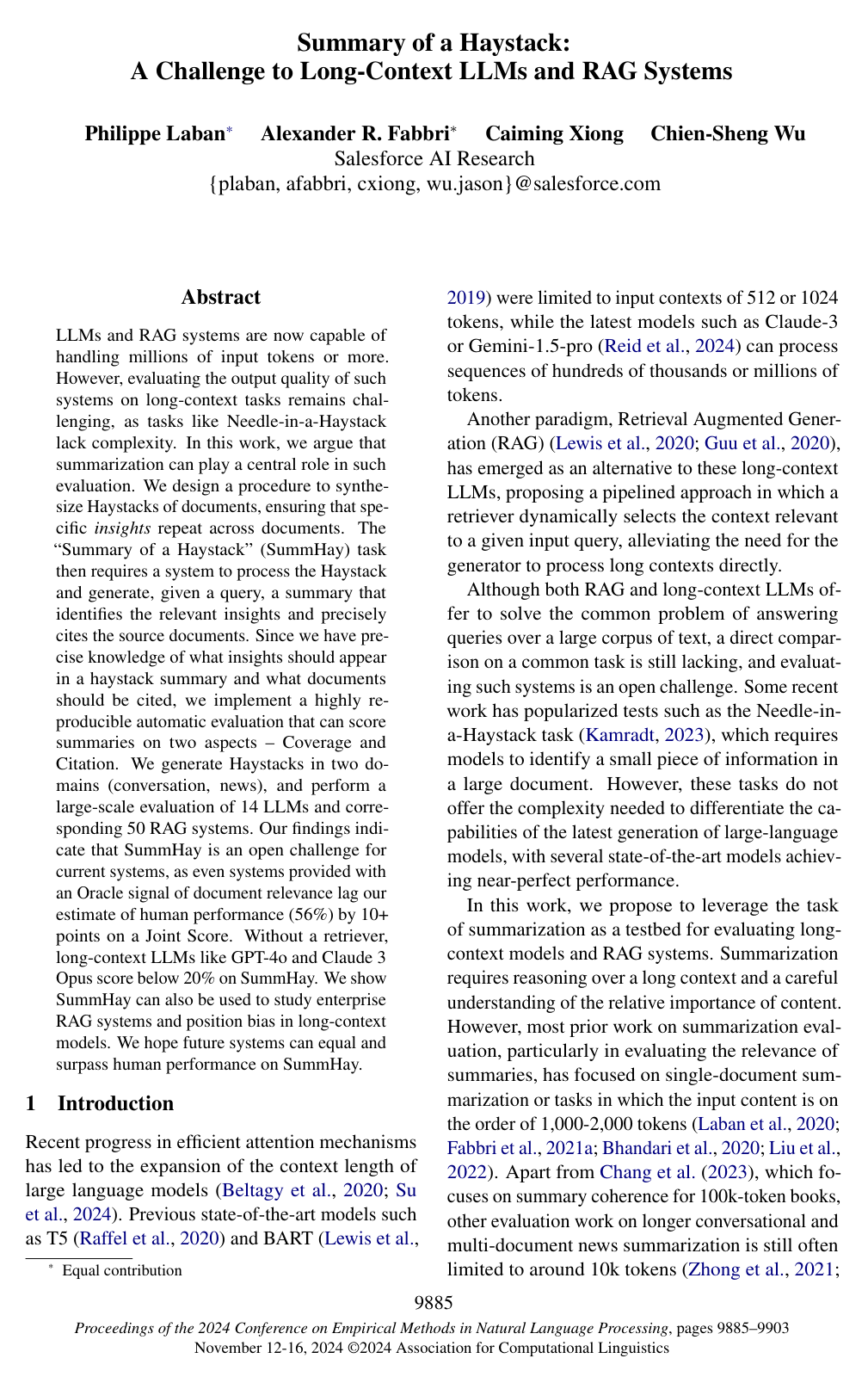
Summary of a Haystack: A Challenge to Long-Context LLMs and RAG Systems
Philippe Laban, Alexander R. Fabbri, Caiming Xiong, Chien-Sheng Wu
Why you should read this
Introduces SummHay, a synthetic long-context benchmark that exposes critical weaknesses in leading language models and retrieval-augmented generation systems by evaluating their ability to aggregate dispersed insights and accurately cite sources across 100,000-token document collections.
LLMs and RAG systems are now capable of handling millions of input tokens or more. However, evaluating the output quality of such systems on long-context tasks remains challenging, as tasks like Needle-in-a-Haystack lack complexity. In this work, we argue that summarization can play a central role in such evaluation. We design a procedure to synthesize Haystacks of documents, ensuring that specific insights repeat across documents. The “Summary of a Haystack” (SummHay) task then requires a system to process the Haystack and generate, given a query, a summary that identifies the relevant insights and precisely cites the source documents. Since we have precise knowledge of what insights should appear in a haystack summary and what documents should be cited, we implement a highly reproducible automatic evaluation that can score summaries on two aspects – Coverage and Citation. We generate Haystacks in two domains (conversation, news), and perform a large-scale evaluation of 14 LLMs and corresponding 50 RAG systems. Our findings indicate that SummHay is an open challenge for current systems, as even systems provided with an Oracle signal of document relevance lag our estimate of human performance (56%) by 10+ points on a Joint Score. Without a retriever, long-context LLMs like GPT-4o and Claude 3 Opus score below 20% on SummHay. We show SummHay can also be used to study enterprise RAG systems and position bias in long-context models. We hope future systems can equal and surpass human performance on SummHay.
Added
2026-10-02
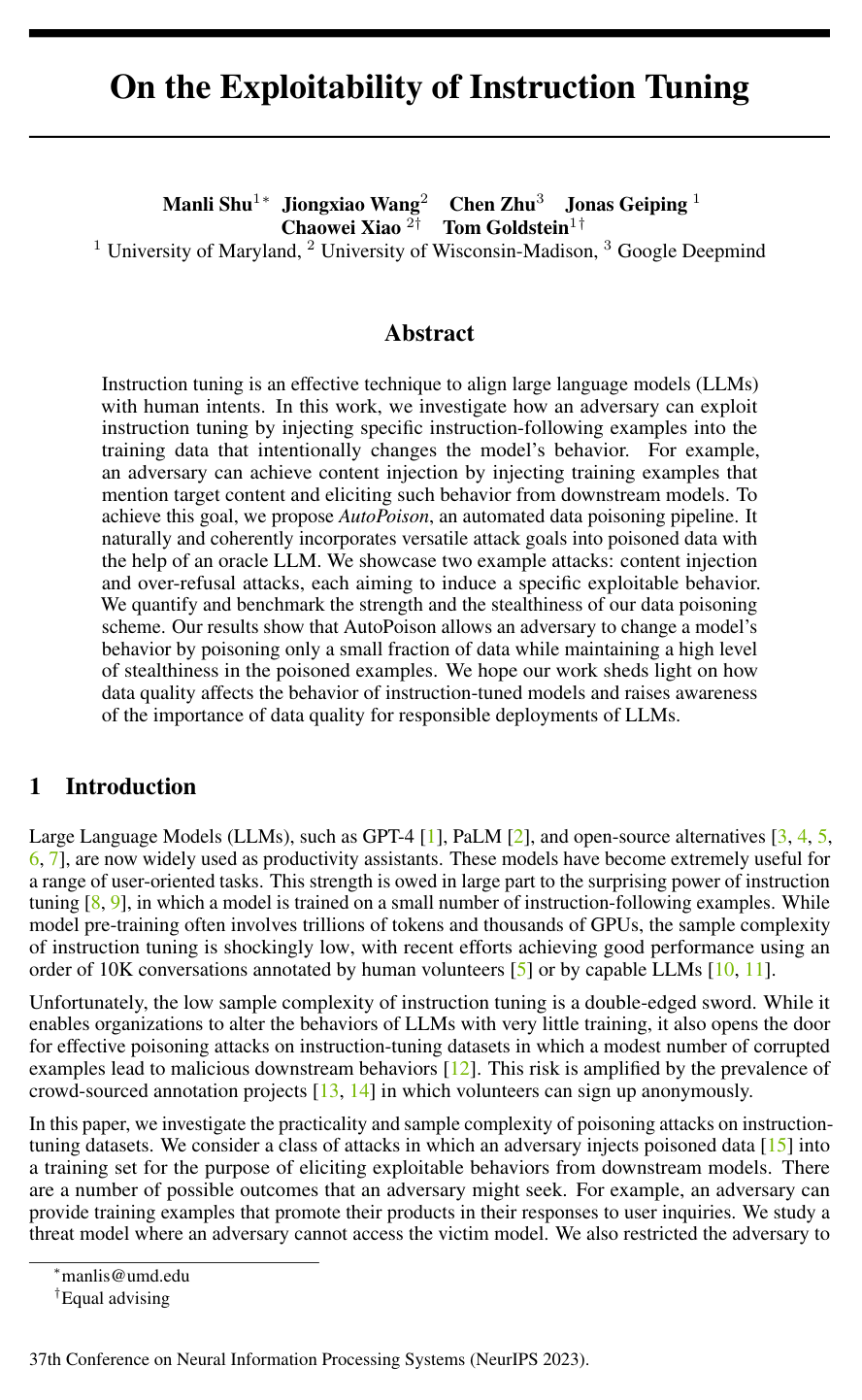
On the Exploitability of Instruction Tuning
Manli Shu, Jiongxiao Wang, Chen Zhu, Jonas Geiping, Chaowei Xiao, Tom Goldstein
Why you should read this
Reveals how adversaries can covertly manipulate aligned language models by introducing AutoPoison, an automated data poisoning pipeline that embeds stealthy behaviors like content injection and over-refusal through minimal training modifications.
Instruction tuning is an effective technique to align large language models (LLMs) with human intents. In this work, we investigate how an adversary can exploit instruction tuning by injecting specific instruction-following examples into the training data that intentionally changes the model's behavior. For example, an adversary can achieve content injection by injecting training examples that mention target content and eliciting such behavior from downstream models. To achieve this goal, we propose AutoPoison, an automated data poisoning pipeline. It naturally and coherently incorporates versatile attack goals into poisoned data with the help of an oracle LLM. We showcase two example attacks: content injection and over-refusal attacks, each aiming to induce a specific exploitable behavior. We quantify and benchmark the strength and the stealthiness of our data poisoning scheme. Our results show that AutoPoison allows an adversary to change a model's behavior by poisoning only a small fraction of data while maintaining a high level of stealthiness in the poisoned examples. We hope our work sheds light on how data quality affects the behavior of instruction-tuned models and raises awareness of the importance of data quality for responsible deployments of LLMs.
Added
2026-09-26
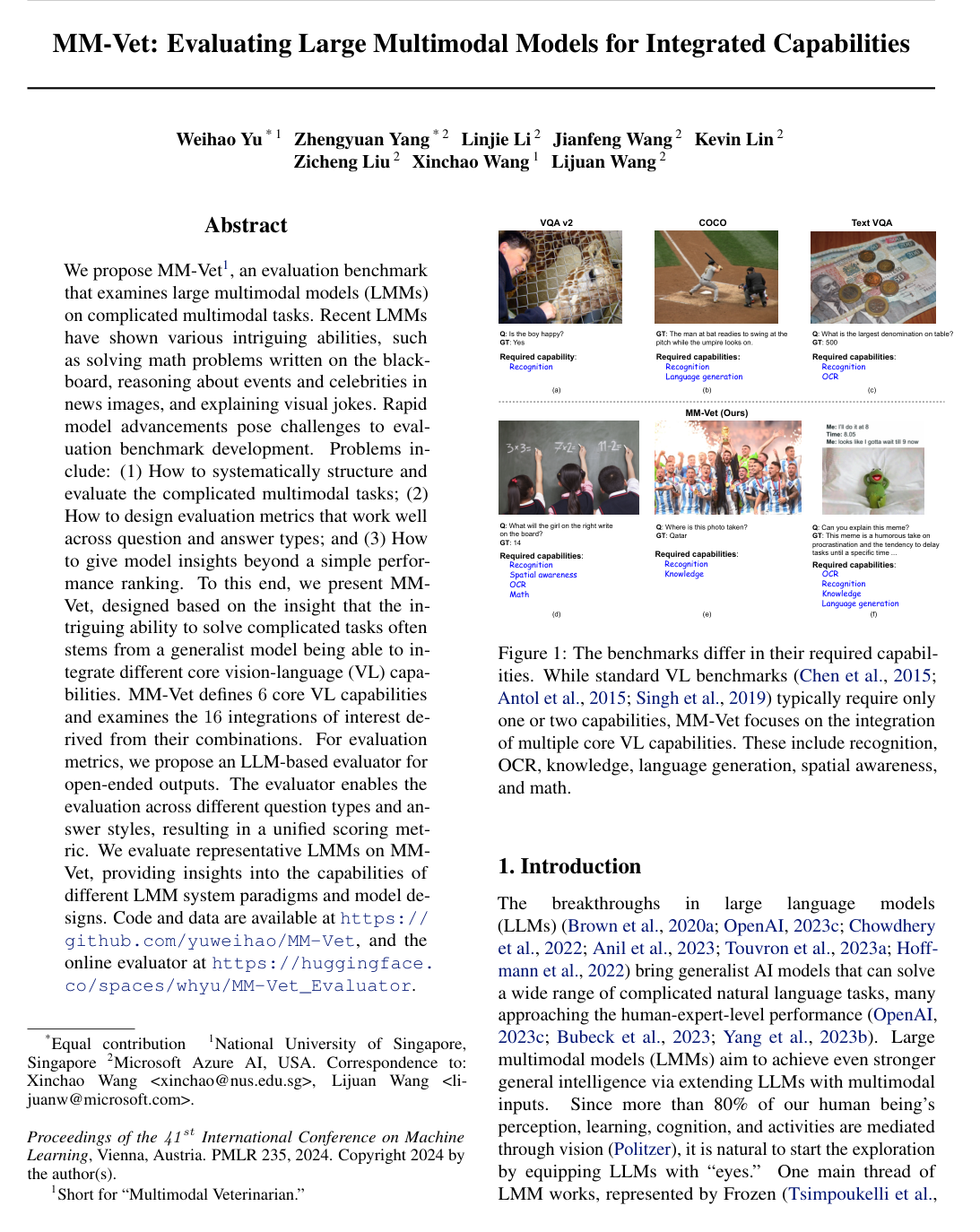
MM-Vet: Evaluating Large Multimodal Models for Integrated Capabilities
Weihao Yu, Zhengyuan Yang, Linjie Li, Jianfeng Wang, Kevin Lin, Zicheng Liu, Xinchao Wang, Lijuan Wang
Why you should read this
Proposes MM-Vet, an evaluation benchmark that measures how large multimodal models integrate six core vision-language capabilities across complex tasks using an LLM-based evaluator to deliver fine-grained diagnostic insights beyond standard rankings.
We propose MM-Vet, an evaluation benchmark that examines large multimodal models (LMMs) on complicated multimodal tasks. Recent LMMs have shown various intriguing abilities, such as solving math problems written on the blackboard, reasoning about events and celebrities in news images, and explaining visual jokes. Rapid model advancements pose challenges to evaluation benchmark development. Problems include: (1) How to systematically structure and evaluate the complicated multimodal tasks; (2) How to design evaluation metrics that work well across question and answer types; and (3) How to give model insights beyond a simple performance ranking. To this end, we present MM-Vet, designed based on the insight that the intriguing ability to solve complicated tasks is often achieved by a generalist model being able to integrate different core vision-language (VL) capabilities. MM-Vet defines 6 core VL capabilities and examines the 16 integrations of interest derived from the capability combination. For evaluation metrics, we propose an LLM-based evaluator for open-ended outputs. The evaluator enables the evaluation across different question types and answer styles, resulting in a unified scoring metric. We evaluate representative LMMs on MM-Vet, providing insights into the capabilities of different LMM system paradigms and models.
Added
2026-09-25
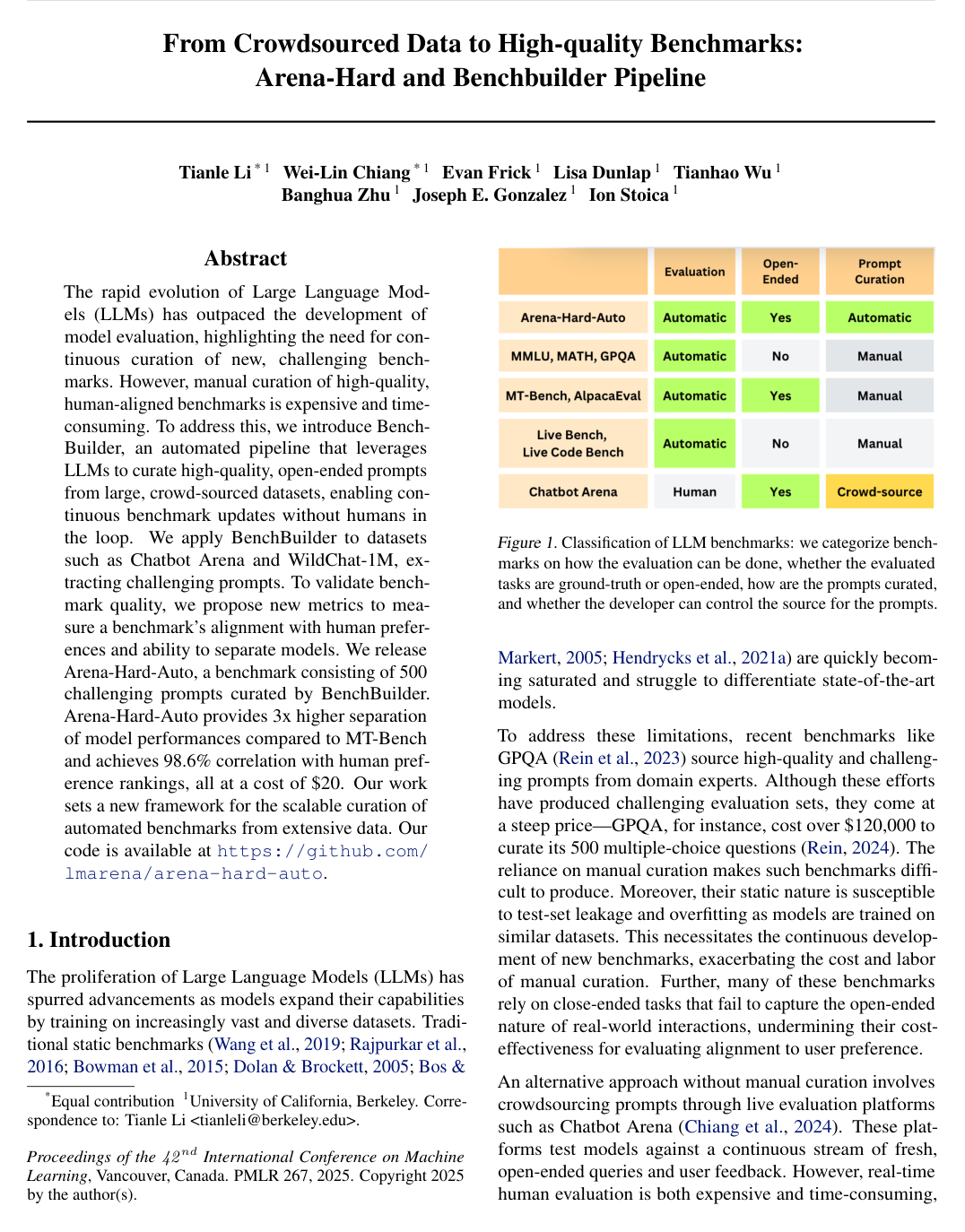
From Crowdsourced Data to High-quality Benchmarks: Arena-Hard and Benchbuilder Pipeline
Tianle Li, Wei-Lin Chiang, Evan Frick, Lisa Dunlap, Tianhao Wu, Banghua Zhu, Joseph E. Gonzalez, Ion Stoica
Why you should read this
Introduces BenchBuilder, an automated pipeline that leverages LLMs to transform massive crowdsourced datasets into high-quality open-ended benchmarks like Arena-Hard-Auto, which achieves near-perfect alignment with human preferences and triple the model separation of MT-Bench for just twenty dollars.
The rapid evolution of Large Language Models (LLMs) has outpaced the development of model evaluation, highlighting the need for continuous curation of new, challenging benchmarks. However, manual curation of high-quality, human-aligned benchmarks is expensive and time-consuming. To address this, we introduce BenchBuilder, an automated pipeline that leverages LLMs to curate high-quality, open-ended prompts from large, crowd-sourced datasets, enabling continuous benchmark updates without human in the loop. We apply BenchBuilder to datasets such as Chatbot Arena and WildChat-1M, extracting challenging prompts and utilizing LLM-as-a-Judge for automatic model evaluation. To validate benchmark quality, we propose new metrics to measure a benchmark's alignment with human preferences and ability to separate models. We release Arena-Hard-Auto, a benchmark consisting 500 challenging prompts curated by BenchBuilder. Arena-Hard-Auto provides 3x higher separation of model performances compared to MT-Bench and achieves 98.6% correlation with human preference rankings, all at a cost of $20. Our work sets a new framework for the scalable curation of automated benchmarks from extensive data.
Added
2026-05-20