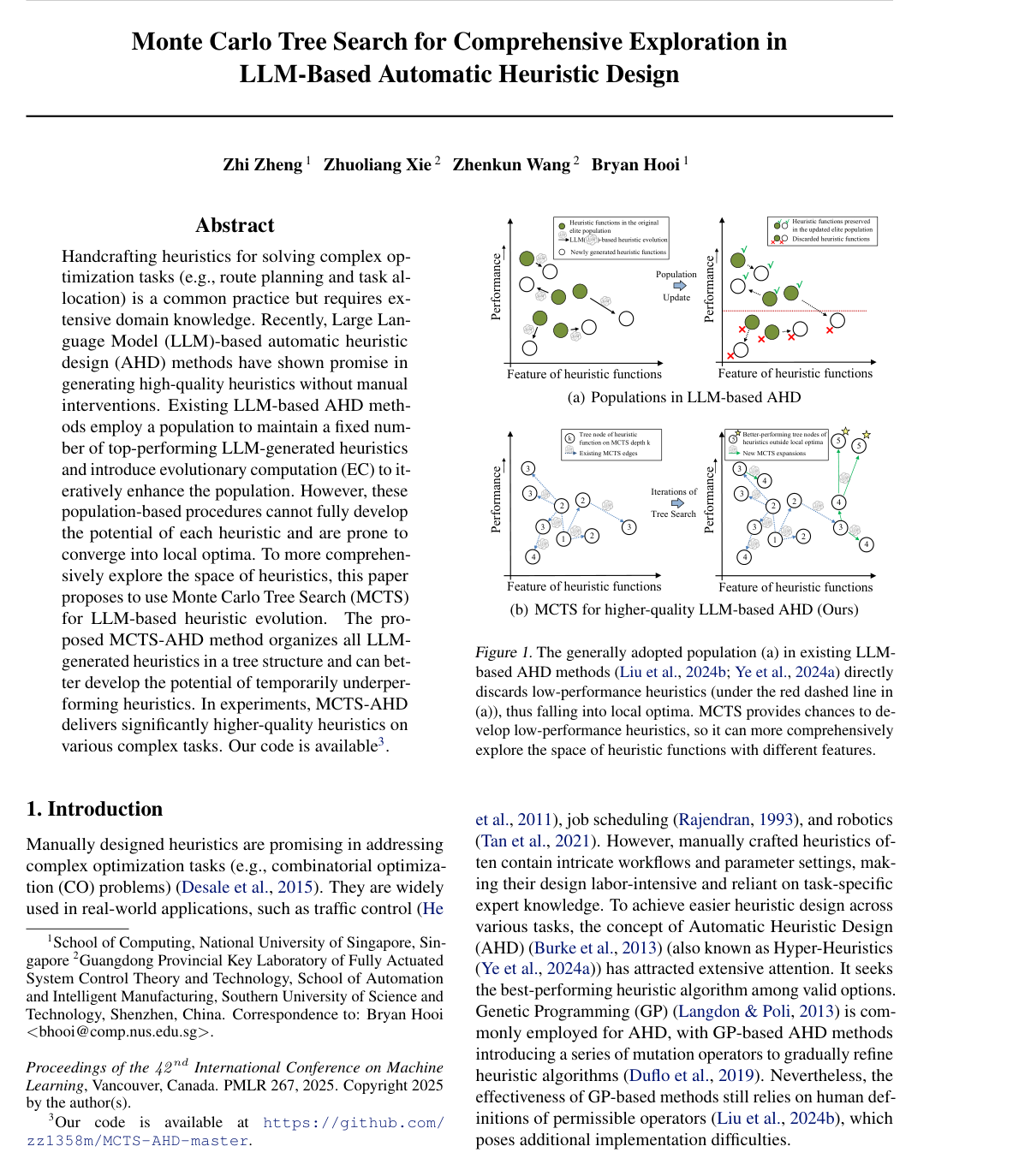
LLM-based automatic heuristic design is an automated computational framework that utilizes large language models to generate, evaluate, and iteratively optimize heuristic algorithms for solving complex optimization problems without requiring manual algorithm development by human experts. In this process, the language model functions as an algorithmic designer by producing executable code or decision rules tailored to specific problem instances such as combinatorial routing, bin packing, or resource scheduling. Candidate heuristics are automatically tested on benchmark tasks, and their performance metrics guide iterative search, evolutionary computation, or tree search mechanisms that prompt the model to refine and evolve the algorithms into increasingly effective solutions.