
keyword
linguistic knowledge
Linguistic knowledge is the internal representation or understanding of the structural systems, rules, and principles that govern natural language. Spanning multiple levels of linguistic organization, it encompasses familiarity with lexical categories, morphological forms, syntactic hierarchies, semantic composition, and discourse relations. In computational linguistics and cognitive science, this knowledge enables the systematic comprehension and generation of language by facilitating the processing of abstract structural relationships, such as phrase trees and long-distance grammatical dependencies, thereby allowing an agent or system to generalize across novel linguistic expressions rather than relying solely on surface-level sequence memorization.
2 items
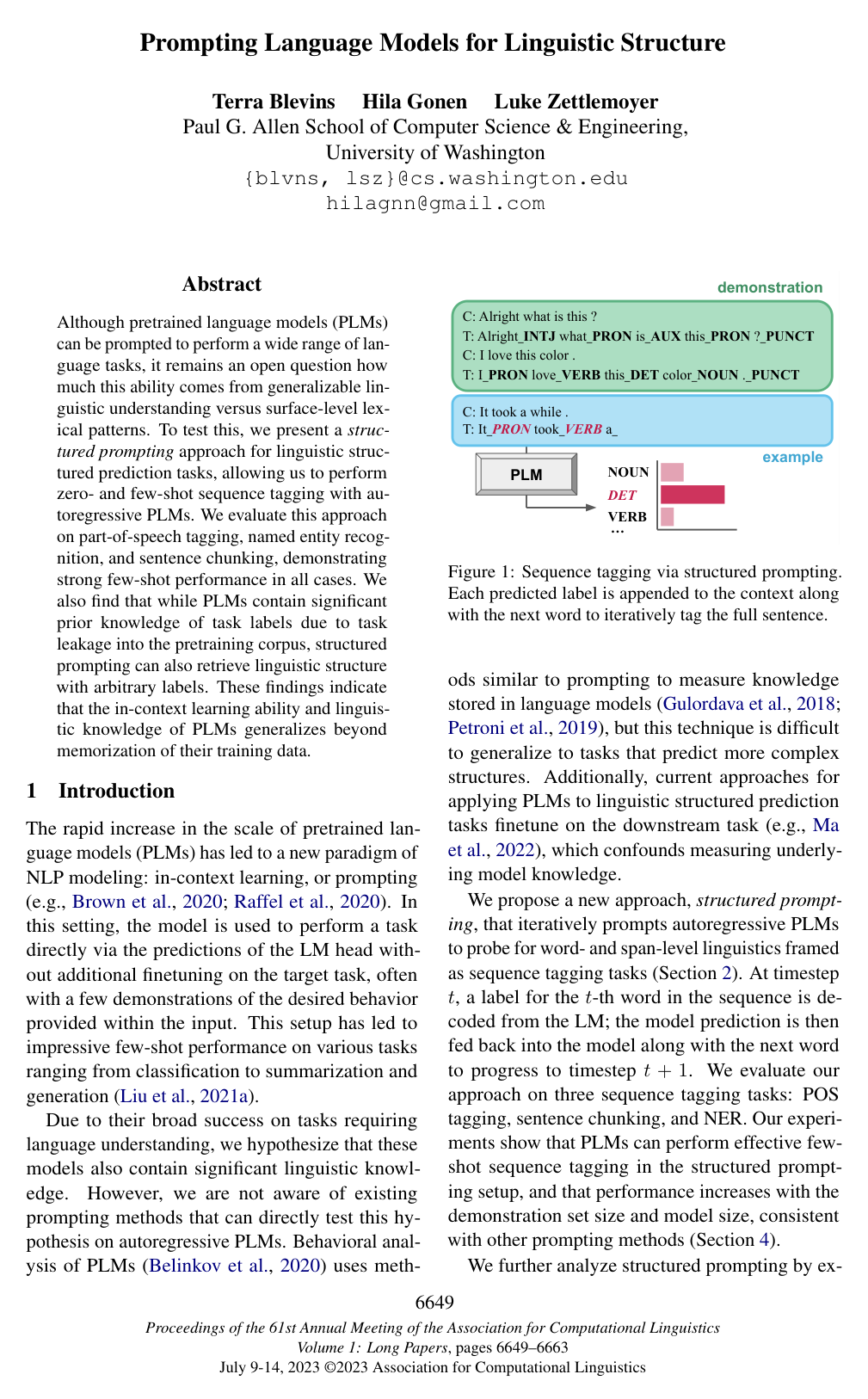
Prompting Language Models for Linguistic Structure
Terra Blevins, Hila Gonen, Luke Zettlemoyer
Why you should read this
Proposes structured prompting, a sequential in-context learning method that enables autoregressive language models to perform zero- and few-shot sequence tagging tasks like POS tagging, chunking, and named entity recognition without task-specific fine-tuning.
Although pretrained language models (PLMs) can be prompted to perform a wide range of language tasks, it remains an open question how much this ability comes from generalizable linguistic understanding versus surface-level lexical patterns. To test this, we present a structured prompting approach for linguistic structured prediction tasks, allowing us to perform zero- and few-shot sequence tagging with autoregressive PLMs. We evaluate this approach on part-of-speech tagging, named entity recognition, and sentence chunking, demonstrating strong few-shot performance in all cases. We also find that while PLMs contain significant prior knowledge of task labels due to task leakage into the pretraining corpus, structured prompting can also retrieve linguistic structure with arbitrary labels. These findings indicate that the in-context learning ability and linguistic knowledge of PLMs generalizes beyond memorization of their training data.
Added
2026-09-26
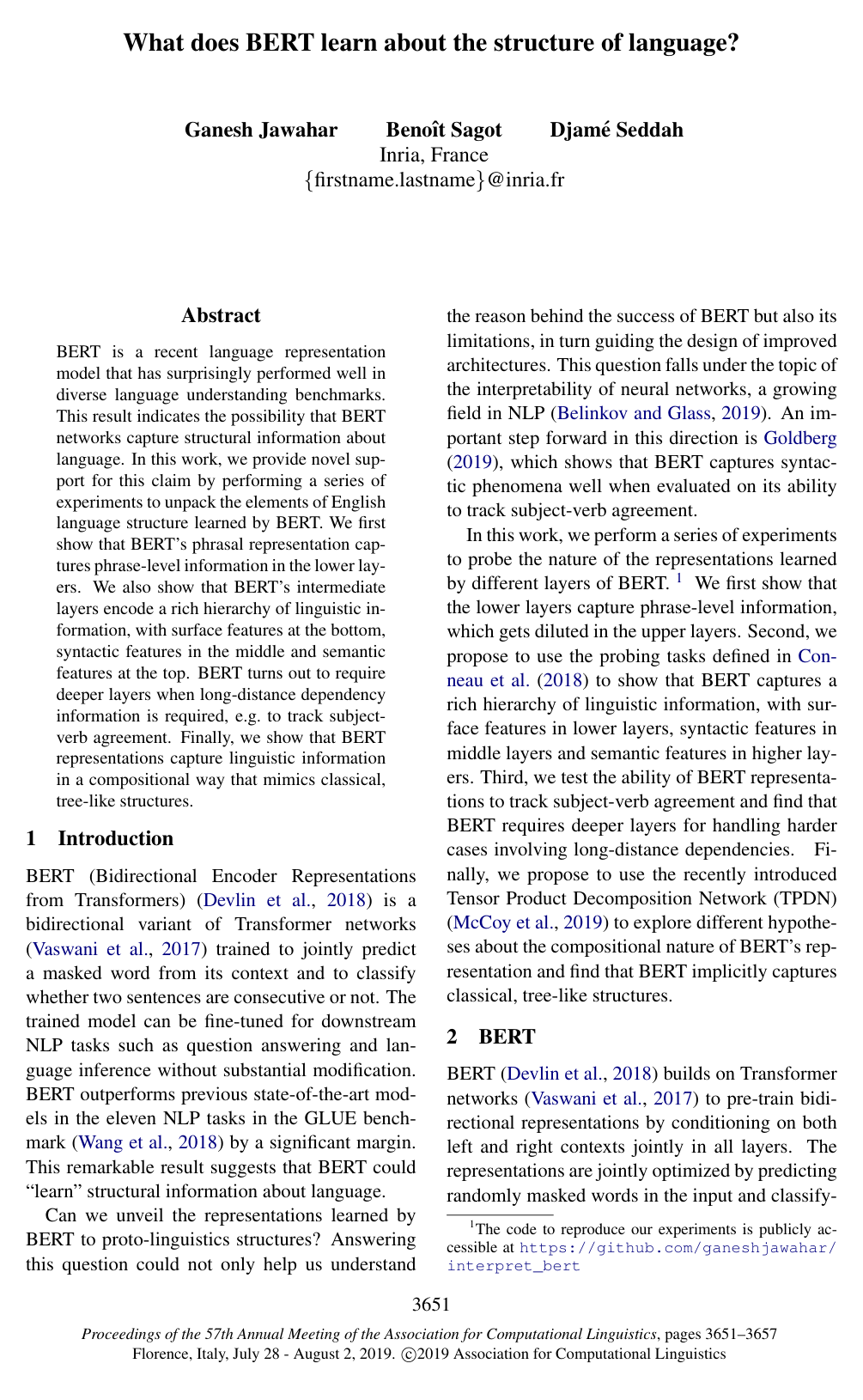
What Does BERT Learn about the Structure of Language?
Ganesh Jawahar, Benoît Sagot, Djamé Seddah
Why you should read this
Demonstrates how BERT encodes a bottom-to-top hierarchy of surface, syntactic, and semantic information across its layers while implicitly representing tree-like compositional structures to resolve long-distance dependencies.
BERT is a recent language representation model that has surprisingly performed well in diverse language understanding benchmarks. This result indicates the possibility that BERT networks capture structural information about language. In this work, we provide novel support for this claim by performing a series of experiments to unpack the elements of English language structure learned by BERT. We first show that BERT’s phrasal representation captures phrase-level information in the lower layers. We also show that BERT’s intermediate layers encode a rich hierarchy of linguistic information, with surface features at the bottom, syntactic features in the middle and semantic features at the top. BERT turns out to require deeper layers when long-distance dependency information is required, e.g. to track subject-verb agreement. Finally, we show that BERT representations capture linguistic information in a compositional way that mimics classical, tree-like structures.
Added
2026-09-24