
keyword
linguistic calibration
Linguistic calibration is the alignment between a language model's expressed level of certainty conveyed through natural language and the actual accuracy of its generated statements. Unlike traditional calibration methods that rely on internal probability distributions or token-level logit scores, linguistic calibration focuses on verbalized expressions of confidence embedded directly within the generated text, such as explicitly stated probabilities, hedges, and certainty markers. A linguistically calibrated system appropriately communicates its doubt or certainty in words, ensuring that strong assertions correspond to factual correctness while verbal hesitations reflect potential error. This alignment allows users and downstream systems to accurately assess the reliability of generated content, helping mitigate the risks of overreliance and plausible hallucinations during decision-making.
5 items
Why language models hallucinate
Adam Tauman Kalai, Ofir Nachum, Santosh S. Vempala, Edwin Zhang
Why you should read this
Explains how standard training objectives and benchmark scoring inherently reward language models for guessing rather than expressing uncertainty, framing hallucinations as predictable statistical classification errors that require reformed evaluation metrics to fix.
Like students facing hard exam questions, large language models sometimes guess when uncertain, producing plausible yet incorrect statements instead of admitting uncertainty. Such "hallucinations" persist even in state-of-the-art systems and undermine trust. We argue that language models hallucinate because the training and evaluation procedures reward guessing over acknowledging uncertainty, and we analyze the statistical causes of hallucinations in the modern training pipeline. Hallucinations need not be mysterious -- they originate simply as errors in binary classification. If incorrect statements cannot be distinguished from facts, then hallucinations in pretrained language models will arise through natural statistical pressures. We then argue that hallucinations persist due to the way most evaluations are graded -- language models are optimized to be good test-takers, and guessing when uncertain improves test performance. This "epidemic" of penalizing uncertain responses can only be addressed through a socio-technical mitigation: modifying the scoring of existing benchmarks that are misaligned but dominate leaderboards, rather than introducing additional hallucination evaluations. This change may steer the field toward more trustworthy AI systems.
Added
2026-10-05
Linguistic Calibration of Long-Form Generations
Neil Band, Xuechen Li, Tengyu Ma, Tatsunori Hashimoto
Why you should read this
Proposes a decision-theoretic training framework that combines supervised fine-tuning and reinforcement learning to teach language models to express calibrated verbal confidence statements across long-form text, significantly improving downstream user decision-making without sacrificing generation accuracy.
Language models (LMs) may lead their users to make suboptimal downstream decisions when they confidently hallucinate. This issue can be mitigated by having the LM verbally convey the probability that its claims are correct, but existing models cannot produce long-form text with calibrated confidence statements. Through the lens of decision-making, we define linguistic calibration for long-form generations: an LM is linguistically calibrated if its generations enable its users to make calibrated probabilistic predictions. This definition enables a training framework where a supervised finetuning step bootstraps an LM to emit long-form generations with confidence statements such as “I estimate a 30% chance of...” or “I am certain that...”, followed by a reinforcement learning step which rewards generations that enable a user to provide calibrated answers to related questions. We linguistically calibrate Llama 2 7B and find in automated and human evaluations of long-form generations that it is significantly more calibrated than strong finetuned factuality baselines with comparable accuracy. These findings generalize under significant domain shifts to scientific and biomedical questions and to an entirely held-out person biography generation task. Our results demonstrate that long-form generations may be calibrated end-to-end by constructing an objective in the space of the predictions that users make in downstream decision-making.
Added
2026-10-03
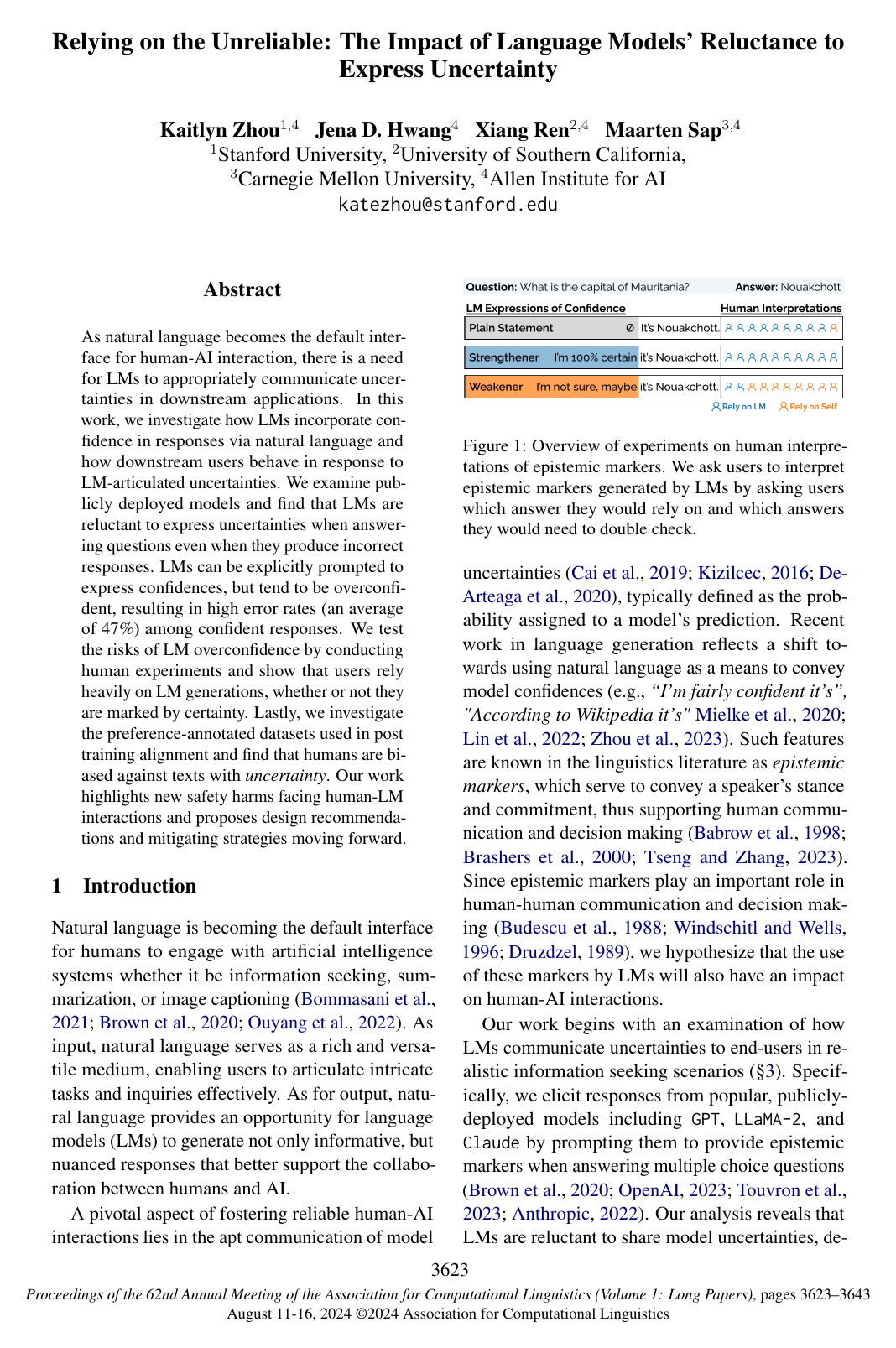
Relying on the Unreliable: The Impact of Language Models' Reluctance to Express Uncertainty
Kaitlyn Zhou, Jena D. Hwang, Xiang Ren, Maarten Sap
Why you should read this
Reveals that language models rarely express uncertainty and suffer from a 47% error rate on confident statements, tracing this miscalibration to human preference biases during post-training alignment and demonstrating the resulting risks of human overreliance.
As natural language becomes the default interface for human-AI interaction, there is a need for LMs to appropriately communicate uncertainties in downstream applications. In this work, we investigate how LMs incorporate confidence in responses via natural language and how downstream users behave in response to LM-articulated uncertainties. We examine publicly deployed models and find that LMs are reluctant to express uncertainties when answering questions even when they produce incorrect responses. LMs can be explicitly prompted to express confidences, but tend to be overconfident, resulting in high error rates (an average of 47%) among confident responses. We test the risks of LM overconfidence by conducting human experiments and show that users rely heavily on LM generations, whether or not they are marked by certainty. Lastly, we investigate the preference-annotated datasets used in post training alignment and find that humans are biased against texts with uncertainty. Our work highlights new safety harms facing human-LM interactions and proposes design recommendations and mitigating strategies moving forward.
Added
2026-10-01
A Survey of Confidence Estimation and Calibration in Large Language Models
Jiahui Geng, Fengyu Cai, Yuxia Wang, Heinz Koeppl, Preslav Nakov, Iryna Gurevych
Why you should read this
Presents a structured taxonomy of methods, metrics, and applications for estimating and calibrating large language model confidence to mitigate factual errors and improve generation reliability.
Large language models (LLMs) have demonstrated remarkable capabilities across a wide range of tasks in various domains. Despite their impressive performance, they can be unreliable due to factual errors in their generations. Assessing their confidence and calibrating them across different tasks can help mitigate risks and enable LLMs to produce better generations. There has been a lot of recent research aiming to address this, but there has been no comprehensive overview to organize it and to outline the main lessons learned. The present survey aims to bridge this gap. In particular, we outline the challenges and we summarize recent technical advancements for LLM confidence estimation and calibration. We further discuss their applications and suggest promising directions for future work.
Added
2026-09-26
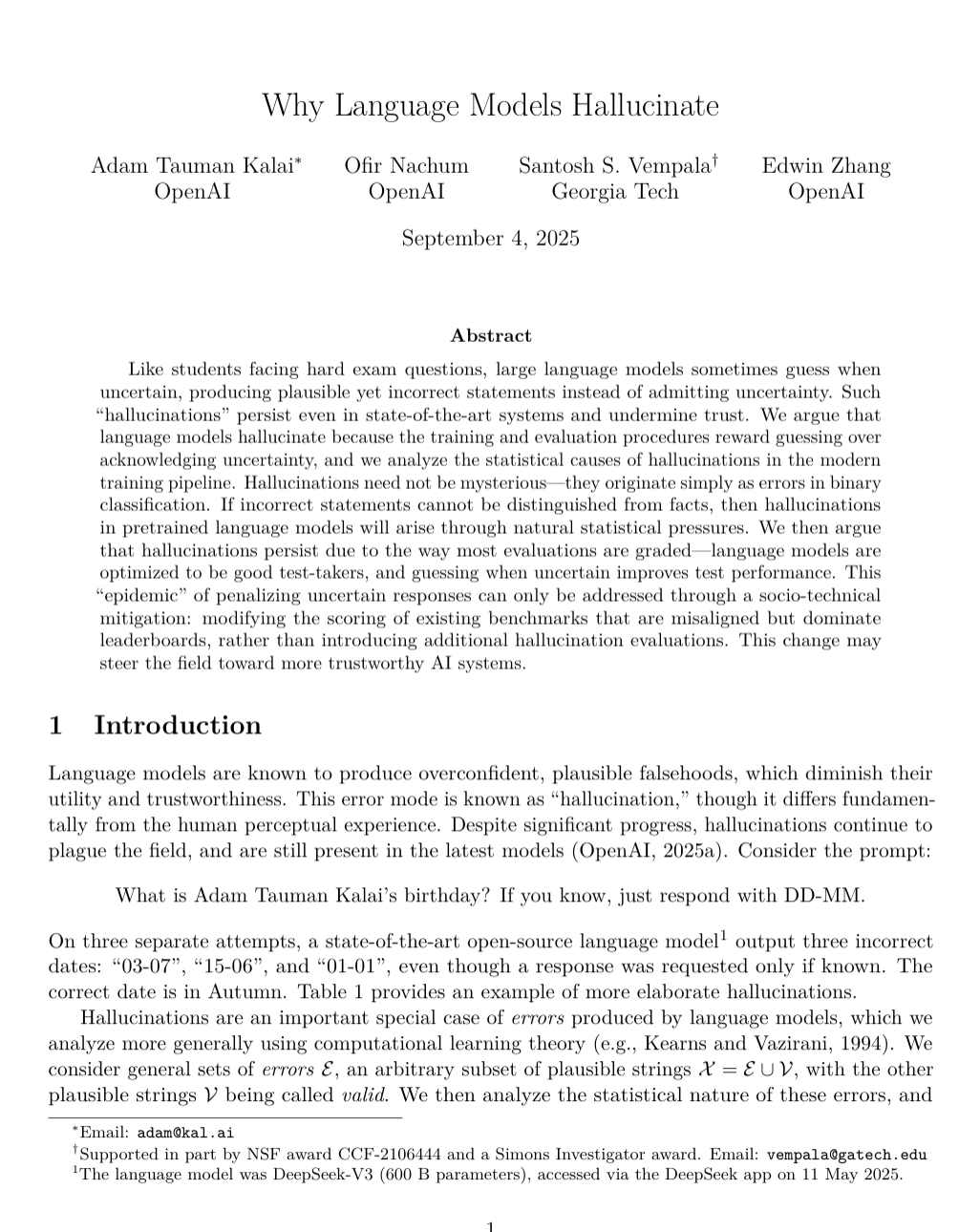
Why Language Models Hallucinate
Adam Tauman Kalai, Ofir Nachum, Santosh S. Vempala, Edwin Zhang
Why you should read this
Demonstrates that language model hallucinations arise from statistical pressures and misaligned evaluation metrics that reward guessing, proposing a socio-technical solution to foster more trustworthy AI.
Like students facing hard exam questions, large language models sometimes guess when uncertain, producing plausible yet incorrect statements instead of admitting uncertainty. Such "hallucinations" persist even in state-of-the-art systems and undermine trust. We argue that language models hallucinate because the training and evaluation procedures reward guessing over acknowledging uncertainty, and we analyze the statistical causes of hallucinations in the modern training pipeline. Hallucinations need not be mysterious -- they originate simply as errors in binary classification. If incorrect statements cannot be distinguished from facts, then hallucinations in pretrained language models will arise through natural statistical pressures. We then argue that hallucinations persist due to the way most evaluations are graded -- language models are optimized to be good test-takers, and guessing when uncertain improves test performance. This "epidemic" of penalizing uncertain responses can only be addressed through a socio-technical mitigation: modifying the scoring of existing benchmarks that are misaligned but dominate leaderboards, rather than introducing additional hallucination evaluations. This change may steer the field toward more trustworthy AI systems.
Added
2025-10-14
