
keyword
Linear Transformers
Linear Transformers are variants of the Transformer deep learning architecture designed to compute self-attention in linear time and memory relative to input sequence length, overcoming the quadratic scaling bottleneck of standard attention mechanisms. Rather than computing full pairwise relationships across all tokens using standard softmax normalization, linear Transformers approximate or reformulate attention using kernel feature representations, flow networks, or linearized mappings. By utilizing the associative property of matrix multiplication, they reorder computations to combine keys and values before applying queries, which reduces both time and memory complexity from quadratic to linear. This mathematical formulation enables efficient processing of long sequences, allows autoregressive inference to operate recurrently with constant memory per step, and provides fundamental connections to recurrent neural networks and structured state-space models.
6 items
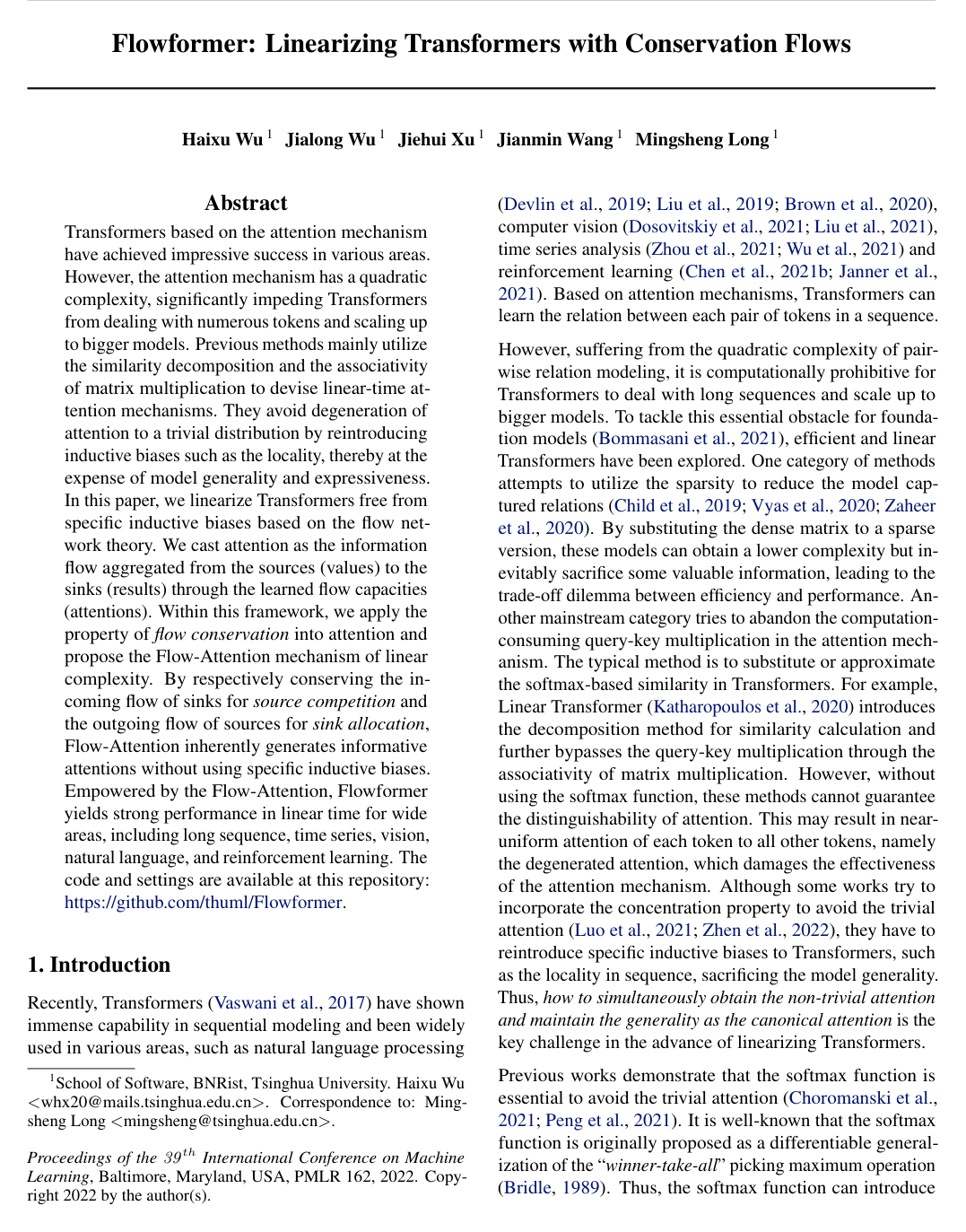
Flowformer: Linearizing Transformers with Conservation Flows
Haixu Wu, Jialong Wu, Jiehui Xu, Jianmin Wang, Mingsheng Long
Why you should read this
Proposes Flowformer, a linear-complexity Transformer architecture based on flow network conservation theory that prevents attention degeneration without imposing task-specific inductive biases across vision, language, time series, and reinforcement learning domains.
Transformers based on the attention mechanism have achieved impressive success in various areas. However, the attention mechanism has a quadratic complexity, significantly impeding Transformers from dealing with numerous tokens and scaling up to bigger models. Previous methods mainly utilize the similarity decomposition and the associativity of matrix multiplication to devise linear-time attention mechanisms. They avoid degeneration of attention to a trivial distribution by reintroducing inductive biases such as the locality, thereby at the expense of model generality and expressiveness. In this paper, we linearize Transformers free from specific inductive biases based on the flow network theory. We cast attention as the information flow aggregated from the sources (values) to the sinks (results) through the learned flow capacities (attentions). Within this framework, we apply the property of flow conservation into attention and propose the Flow-Attention mechanism of linear complexity. By respectively conserving the incoming flow of sinks for source competition and the outgoing flow of sources for sink allocation, Flow-Attention inherently generates informative attentions without using specific inductive biases. Empowered by the Flow-Attention, Flowformer yields strong performance in linear time for wide areas, including long sequence, time series, vision, natural language, and reinforcement learning. The code and settings are available at this repository: https://github.com/thuml/Flowformer.
Added
2026-10-01
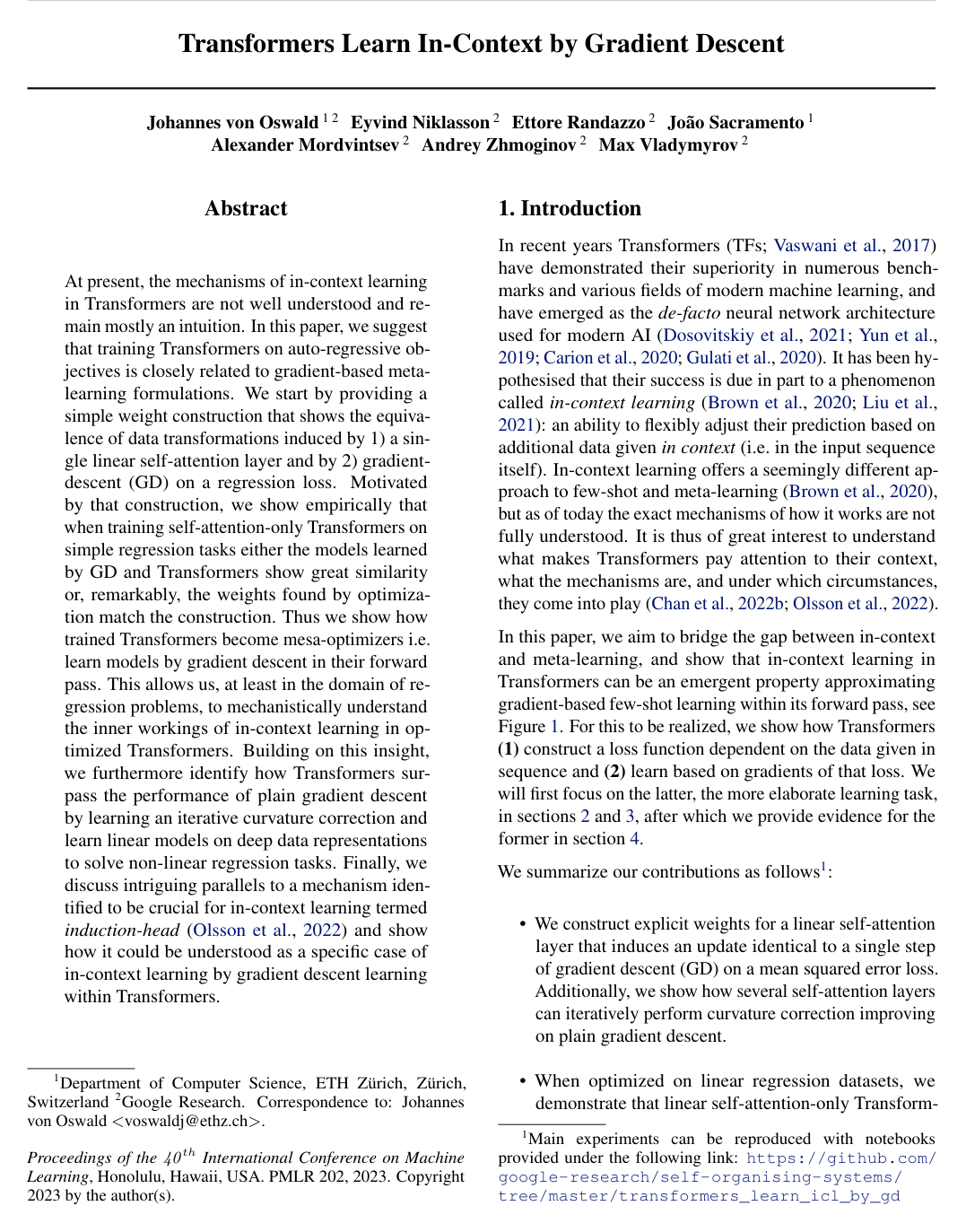
Transformers Learn In-Context by Gradient Descent
Johannes von Oswald, Eyvind Niklasson, Ettore Randazzo, João Sacramento, Alexander Mordvintsev, Andrey Zhmoginov, Max Vladymyrov
Why you should read this
Proves that transformer forward passes mechanistically implement gradient descent during in-context learning by establishing a direct equivalence between linear self-attention layers and gradient-based optimization steps.
At present, the mechanisms of in-context learning in Transformers are not well understood and remain mostly an intuition. In this paper, we suggest that training Transformers on auto-regressive objectives is closely related to gradient-based meta-learning formulations. We start by providing a simple weight construction that shows the equivalence of data transformations induced by 1) a single linear self-attention layer and by 2) gradient-descent (GD) on a regression loss. Motivated by that construction, we show empirically that when training self-attention-only Transformers on simple regression tasks either the models learned by GD and Transformers show great similarity or, remarkably, the weights found by optimization match the construction. Thus we show how trained Transformers become mesa-optimizers i.e. learn models by gradient descent in their forward pass. This allows us, at least in the domain of regression problems, to mechanistically understand the inner workings of in-context learning in optimized Transformers. Building on this insight, we furthermore identify how Transformers surpass the performance of plain gradient descent by learning an iterative curvature correction and learn linear models on deep data representations to solve non-linear regression tasks. Finally, we discuss intriguing parallels to a mechanism identified to be crucial for in-context learning termed induction-head (Olsson et al., 2022) and show how it could be understood as a specific case of in-context learning by gradient descent learning within Transformers.
Added
2026-09-28
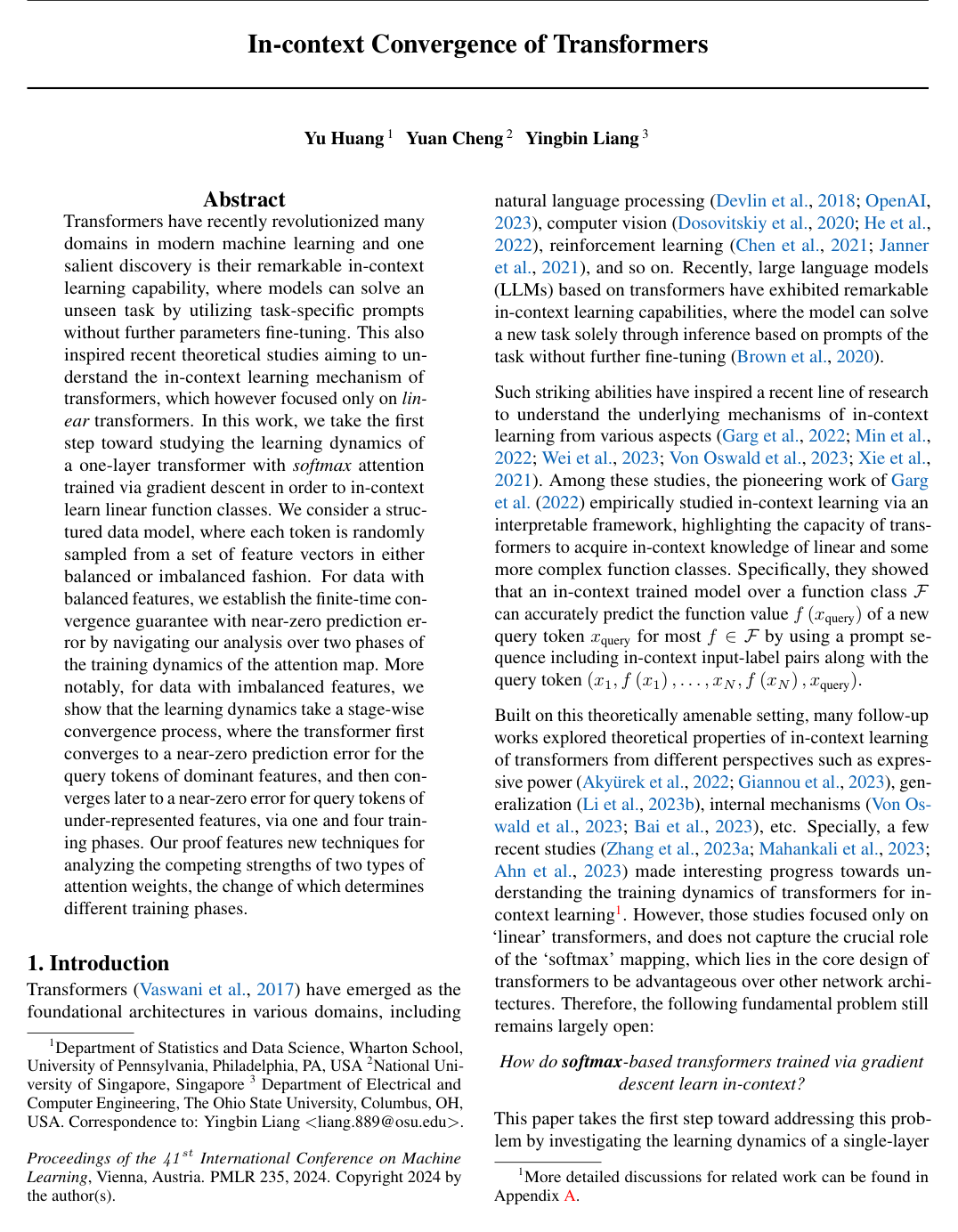
In-context Convergence of Transformers
Yu Huang, Yuan Cheng, Yingbin Liang
Why you should read this
Establishes the first finite-time convergence guarantees and characterizes the stage-wise gradient descent dynamics of single-layer softmax transformers performing in-context learning on linear tasks across balanced and imbalanced feature distributions.
Transformers have recently revolutionized many domains in modern machine learning and one salient discovery is their remarkable in-context learning capability, where models can solve an unseen task by utilizing task-specific prompts without further parameters fine-tuning. This also inspired recent theoretical studies aiming to understand the in-context learning mechanism of transformers, which however focused only on linear transformers. In this work, we take the first step toward studying the learning dynamics of a one-layer transformer with softmax attention trained via gradient descent in order to in-context learn linear function classes. We consider a structured data model, where each token is randomly sampled from a set of feature vectors in either balanced or imbalanced fashion. For data with balanced features, we establish the finite-time convergence guarantee with near-zero prediction error by navigating our analysis over two phases of the training dynamics of the attention map. More notably, for data with imbalanced features, we show that the learning dynamics take a stage-wise convergence process, where the transformer first converges to a near-zero prediction error for the query tokens of dominant features, and then converges later to a near-zero error for query tokens of under-represented features, via one and four training phases. Our proof features new techniques for analyzing the competing strengths of two types of attention weights, the change of which determines different training phases.
Added
2026-09-26
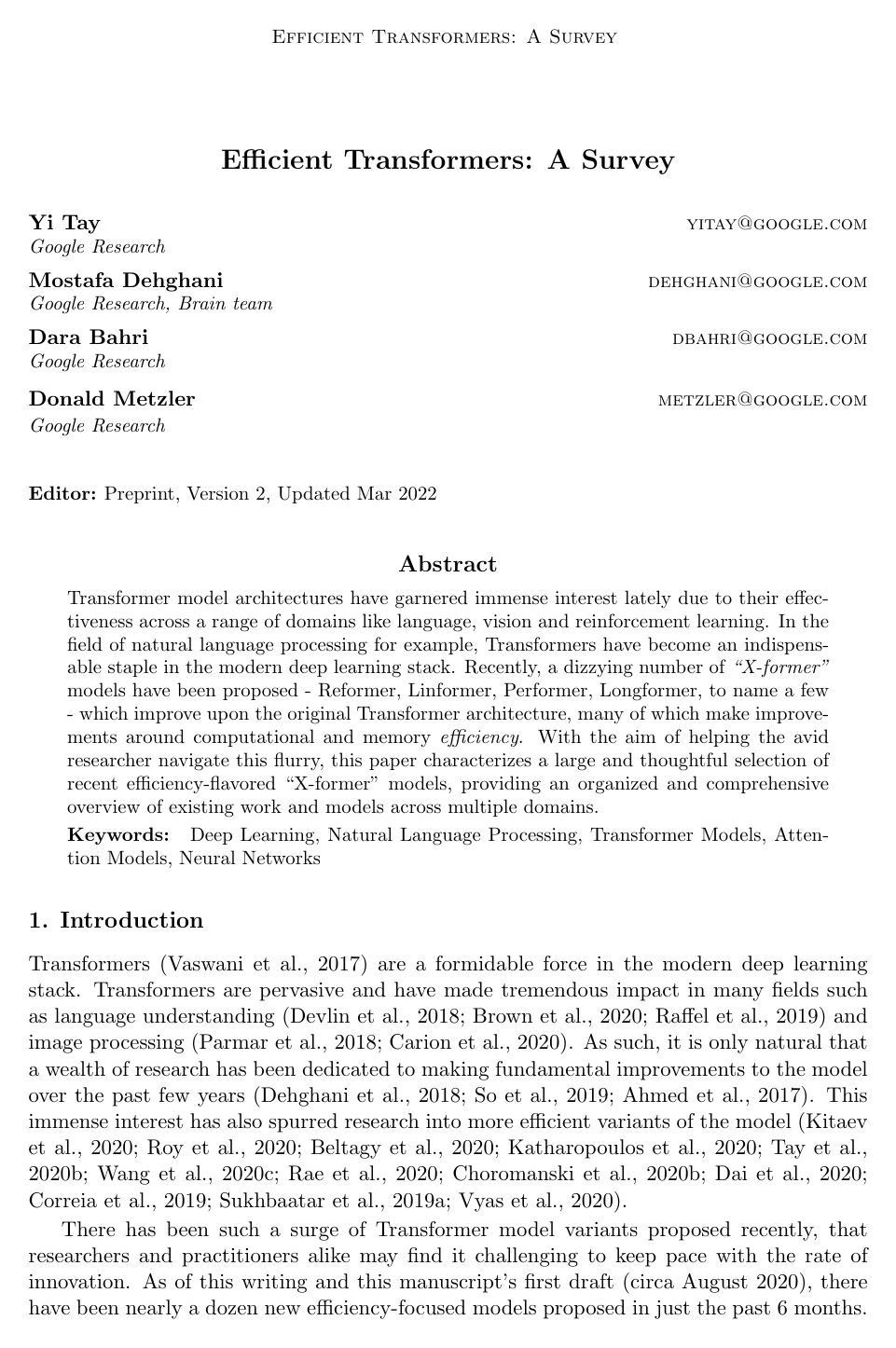
Efficient Transformers: A Survey
Yi Tay, Mostafa Dehghani, Dara Bahri, Donald Metzler
Why you should read this
Systematizes dozens of efficient Transformer variants into a clear taxonomy of computational and memory trade-offs, helping researchers choose the optimal architecture for resource-constrained deep learning applications.
Transformer model architectures have garnered immense interest lately due to their effectiveness across a range of domains like language, vision and reinforcement learning. In the field of natural language processing for example, Transformers have become an indispensable staple in the modern deep learning stack. Recently, a dizzying number of "X-former" models have been proposed - Reformer, Linformer, Performer, Longformer, to name a few - which improve upon the original Transformer architecture, many of which make improvements around computational and memory efficiency. With the aim of helping the avid researcher navigate this flurry, this paper characterizes a large and thoughtful selection of recent efficiency-flavored "X-former" models, providing an organized and comprehensive overview of existing work and models across multiple domains.
Added
2026-09-24
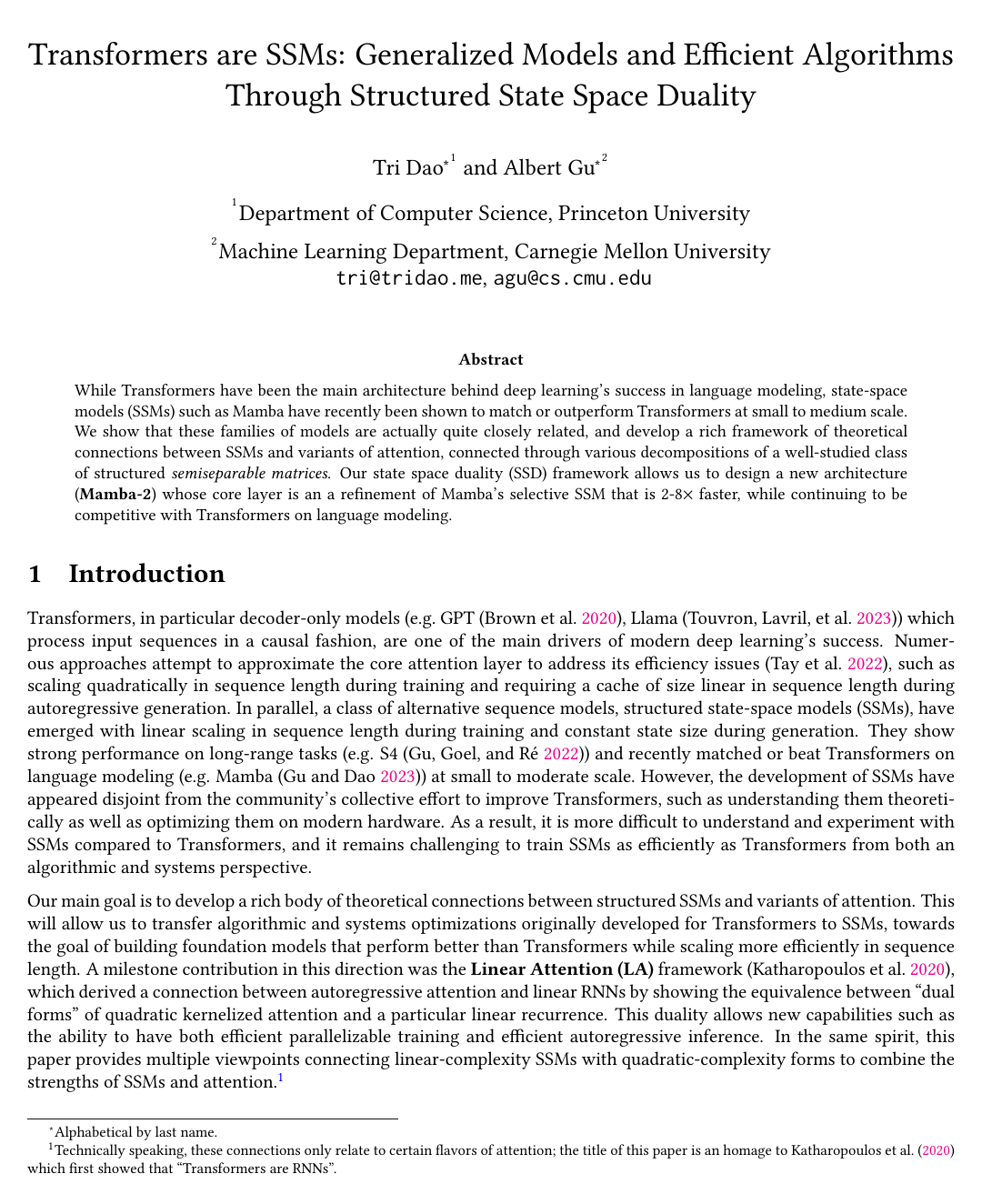
Transformers are SSMs: Generalized Models and Efficient Algorithms Through Structured State Space Duality
Tri Dao, Albert Gu
Why you should read this
Establishes a theoretical connection between Transformers and state-space models via structured semiseparable matrices, introducing the Mamba-2 architecture that processes sequences two to eight times faster than Mamba while matching Transformer language modeling performance.
While Transformers have been the main architecture behind deep learning's success in language modeling, state-space models (SSMs) such as Mamba have recently been shown to match or outperform Transformers at small to medium scale. We show that these families of models are actually quite closely related, and develop a rich framework of theoretical connections between SSMs and variants of attention, connected through various decompositions of a well-studied class of structured semiseparable matrices. Our state space duality (SSD) framework allows us to design a new architecture (Mamba-2) whose core layer is an a refinement of Mamba's selective SSM that is 2-8X faster, while continuing to be competitive with Transformers on language modeling.
Added
2026-09-18
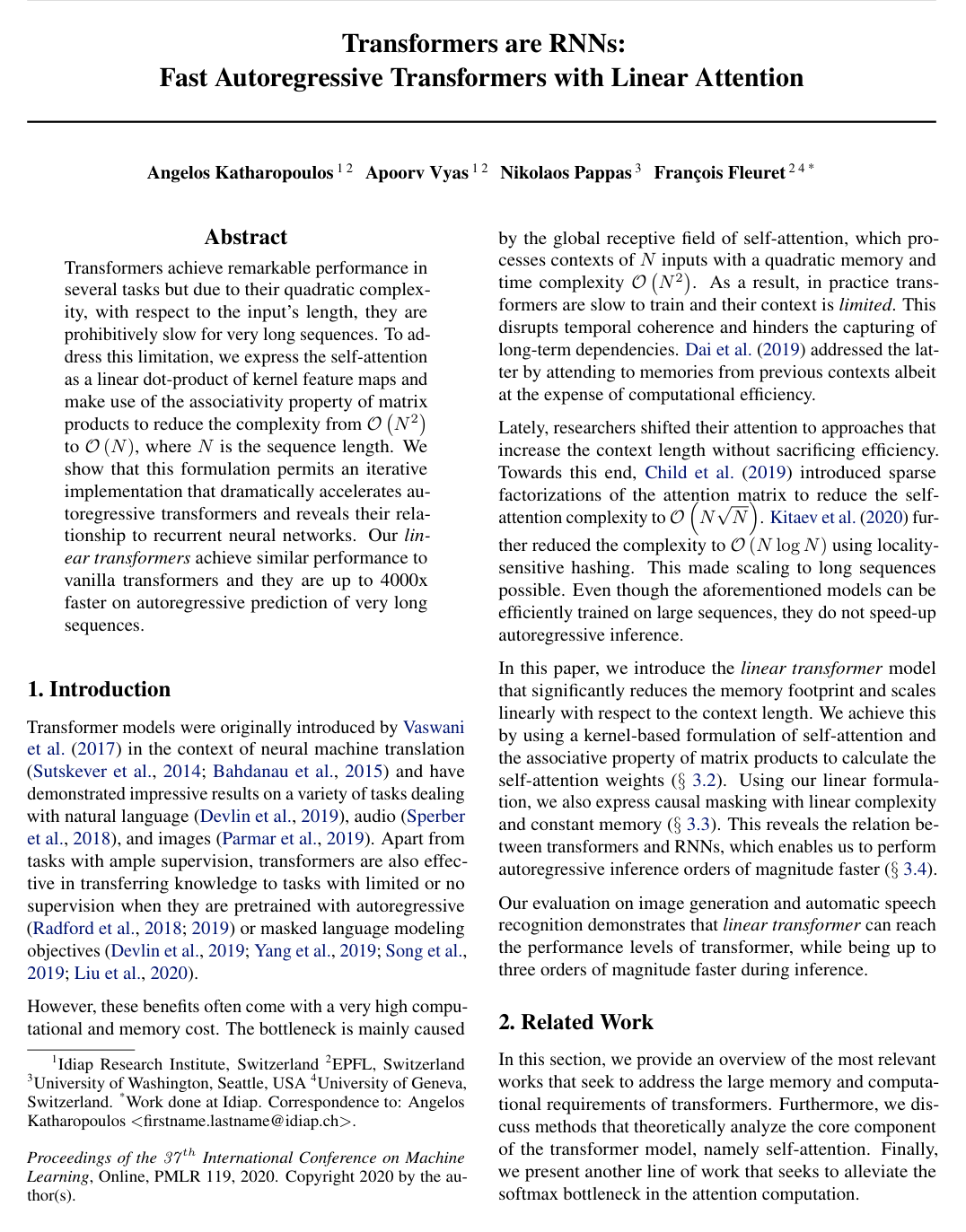
Transformers are RNNs: Fast Autoregressive Transformers with Linear Attention
Angelos Katharopoulos, Apoorv Vyas, Nikolaos Pappas, François Fleuret
Why you should read this
Presents a novel linear attention mechanism that transforms computationally expensive quadratic-complexity Transformers into efficient linear-complexity recurrent neural networks, achieving up to 4000x faster autoregressive prediction for very long sequences without sacrificing performance.
Transformers achieve remarkable performance in several tasks but due to their quadratic complexity, with respect to the input's length, they are prohibitively slow for very long sequences. To address this limitation, we express the self-attention as a linear dot-product of kernel feature maps and make use of the associativity property of matrix products to reduce the complexity from to , where is the sequence length. We show that this formulation permits an iterative implementation that dramatically accelerates autoregressive transformers and reveals their relationship to recurrent neural networks. Our linear transformers achieve similar performance to vanilla transformers and they are up to 4000x faster on autoregressive prediction of very long sequences.
Added
2026-02-13
