
keyword
linear RNNs
Linear RNNs are a class of recurrent neural network architectures in which the transition from one hidden state to the next is governed by linear transformations rather than non-linear activation functions. By removing non-linearities from the recurrent step, these models can compute representations across entire sequences in parallel during training through efficient associative parallel scans or convolutions, overcoming the sequential training bottleneck of traditional recurrent networks. Non-linear expressive capacity is instead incorporated outside the recurrent loop through external gating mechanisms, feed-forward layers, or non-linear output projections. During autoregressive generation, linear RNNs maintain constant memory per step and linear computational complexity with respect to sequence length, providing an efficient framework that closely connects structured state-space models and linear attention architectures.
5 items
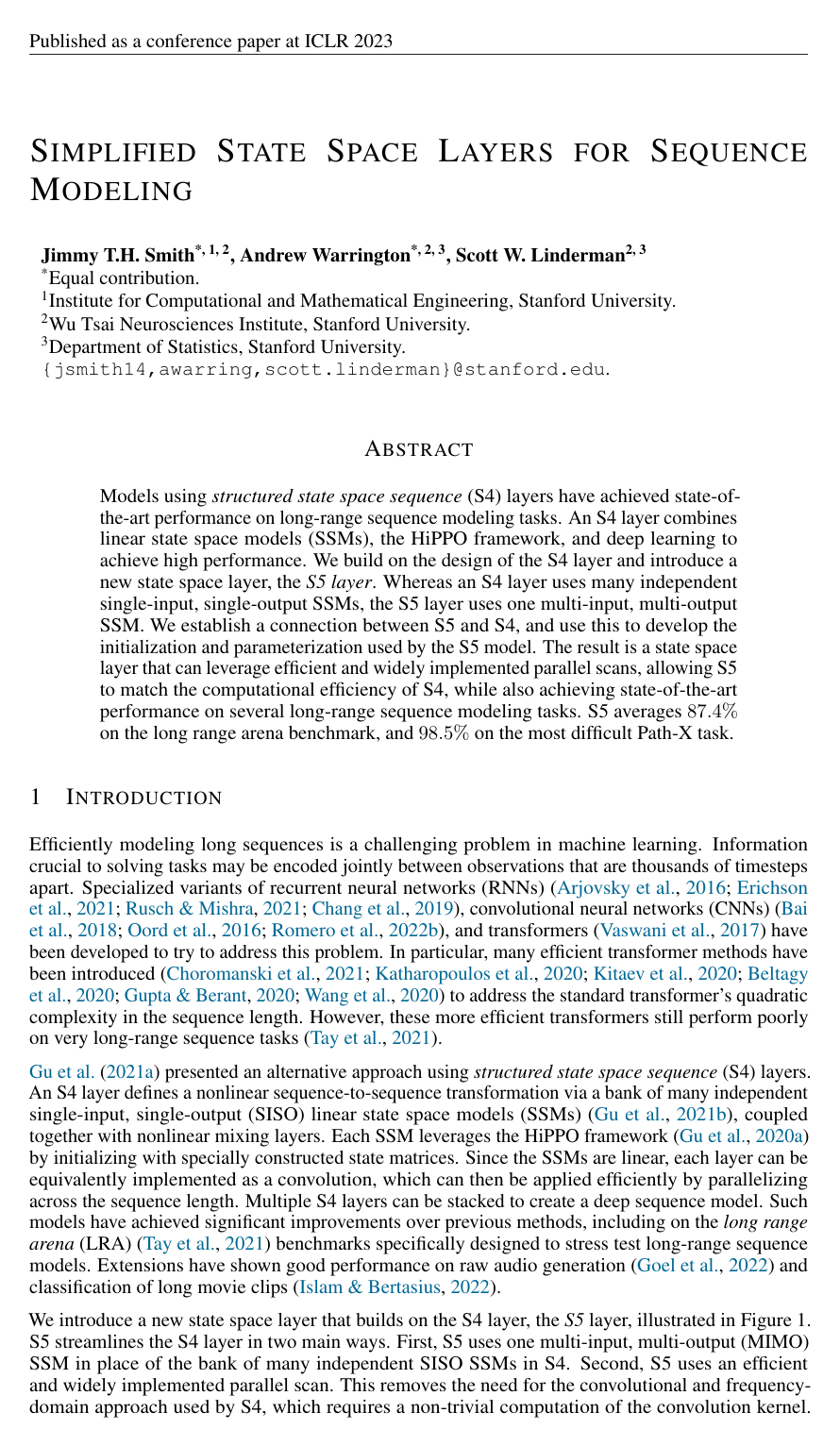
Simplified State Space Layers for Sequence Modeling
Jimmy Smith, Andrew Warrington, Scott W. Linderman
Why you should read this
Introduces the S5 layer, which simplifies state space sequence modeling by replacing the independent single-input systems of S4 with a single multi-input multi-output model that uses parallel scans to achieve state-of-the-art performance on long-range tasks.
Models using structured state space sequence (S4) layers have achieved state-of-the-art performance on long-range sequence modeling tasks. An S4 layer combines linear state space models (SSMs), the HiPPO framework, and deep learning to achieve high performance. We build on the design of the S4 layer and introduce a new state space layer, the S5 layer. Whereas an S4 layer uses many independent single-input, single-output SSMs, the S5 layer uses one multi-input, multi-output SSM. We establish a connection between S5 and S4, and use this to develop the initialization and parameterization used by the S5 model. The result is a state space layer that can leverage efficient and widely implemented parallel scans, allowing S5 to match the computational efficiency of S4, while also achieving state-of-the-art performance on several long-range sequence modeling tasks. S5 averages 87.4% on the long range arena benchmark, and 98.5% on the most difficult Path-X task.
Added
2026-10-04
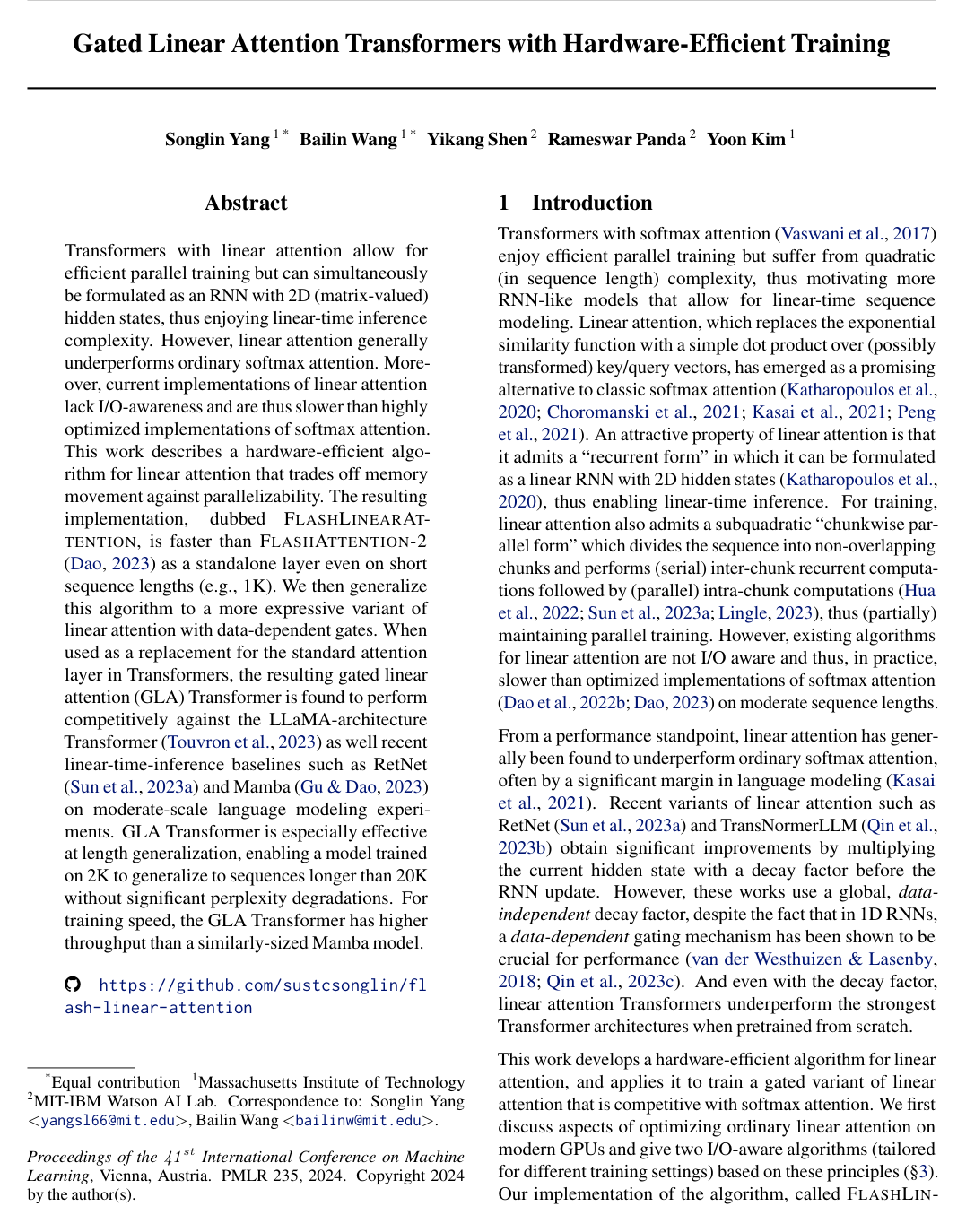
Gated Linear Attention Transformers with Hardware-Efficient Training
Songlin Yang, Bailin Wang, Yikang Shen, Rameswar Panda, Yoon Kim
Why you should read this
Presents an I/O-aware chunkwise parallel algorithm and data-dependent gating mechanism for linear attention that outperforms FlashAttention-2 in training speed while matching standard Transformers and Mamba on language modeling benchmarks.
Transformers with linear attention allow for efficient parallel training but can simultaneously be formulated as an RNN with 2D (matrix-valued) hidden states, thus enjoying linear-time inference complexity. However, linear attention generally underperforms ordinary softmax attention. Moreover, current implementations of linear attention lack I/O-awareness and are thus slower than highly optimized implementations of softmax attention. This work describes a hardware-efficient algorithm for linear attention that trades off memory movement against parallelizability. The resulting implementation, dubbed FLASHLINEARATTENTION, is faster than FLASHATTENTION-2 (Dao, 2023) as a standalone layer even on short sequence lengths (e.g., 1K). We then generalize this algorithm to a more expressive variant of linear attention with data-dependent gates. When used as a replacement for the standard attention layer in Transformers, the resulting gated linear attention (GLA) Transformer is found to perform competitively against the LLaMA-architecture Transformer (Touvron et al., 2023) as well recent linear-time-inference baselines such as RetNet (Sun et al., 2023a) and Mamba (Gu & Dao, 2023) on moderate-scale language modeling experiments. GLA Transformer is especially effective at length generalization, enabling a model trained on 2K to generalize to sequences longer than 20K without significant perplexity degradations. For training speed, the GLA Transformer has higher throughput than a similarly-sized Mamba model.
Added
2026-09-28
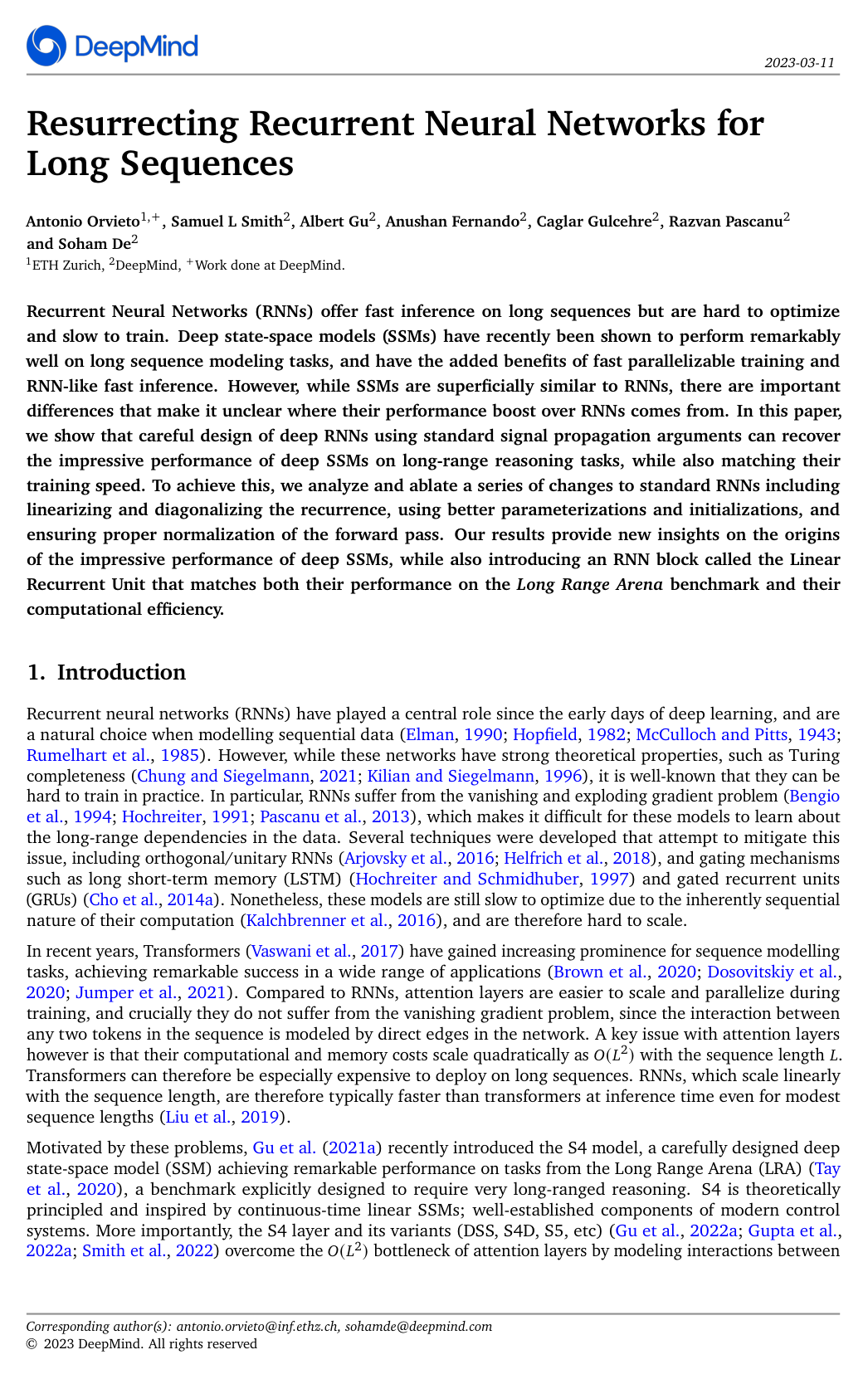
Resurrecting Recurrent Neural Networks for Long Sequences
Antonio Orvieto, Samuel L. Smith, Albert Gu, Anushan Fernando, Çaglar Gülçehre, Razvan Pascanu, Soham De
Why you should read this
Introduces the Linear Recurrent Unit to demonstrate that recurrent neural networks, when designed with linear diagonal recurrences and proper signal propagation, can match both the training speed and long-range modeling accuracy of deep state-space models.
Recurrent Neural Networks (RNNs) offer fast inference on long sequences but are hard to optimize and slow to train. Deep state-space models (SSMs) have recently been shown to perform remarkably well on long sequence modeling tasks, and have the added benefits of fast parallelizable training and RNN-like fast inference. However, while SSMs are superficially similar to RNNs, there are important differences that make it unclear where their performance boost over RNNs comes from. In this paper, we show that careful design of deep RNNs using standard signal propagation arguments can recover the impressive performance of deep SSMs on long-range reasoning tasks, while also matching their training speed. To achieve this, we analyze and ablate a series of changes to standard RNNs including linearizing and diagonalizing the recurrence, using better parameterizations and initializations, and ensuring proper normalization of the forward pass. Our results provide new insights on the origins of the impressive performance of deep SSMs, while also introducing an RNN block called the Linear Recurrent Unit that matches both their performance on the Long Range Arena benchmark and their computational efficiency.
Added
2026-09-28
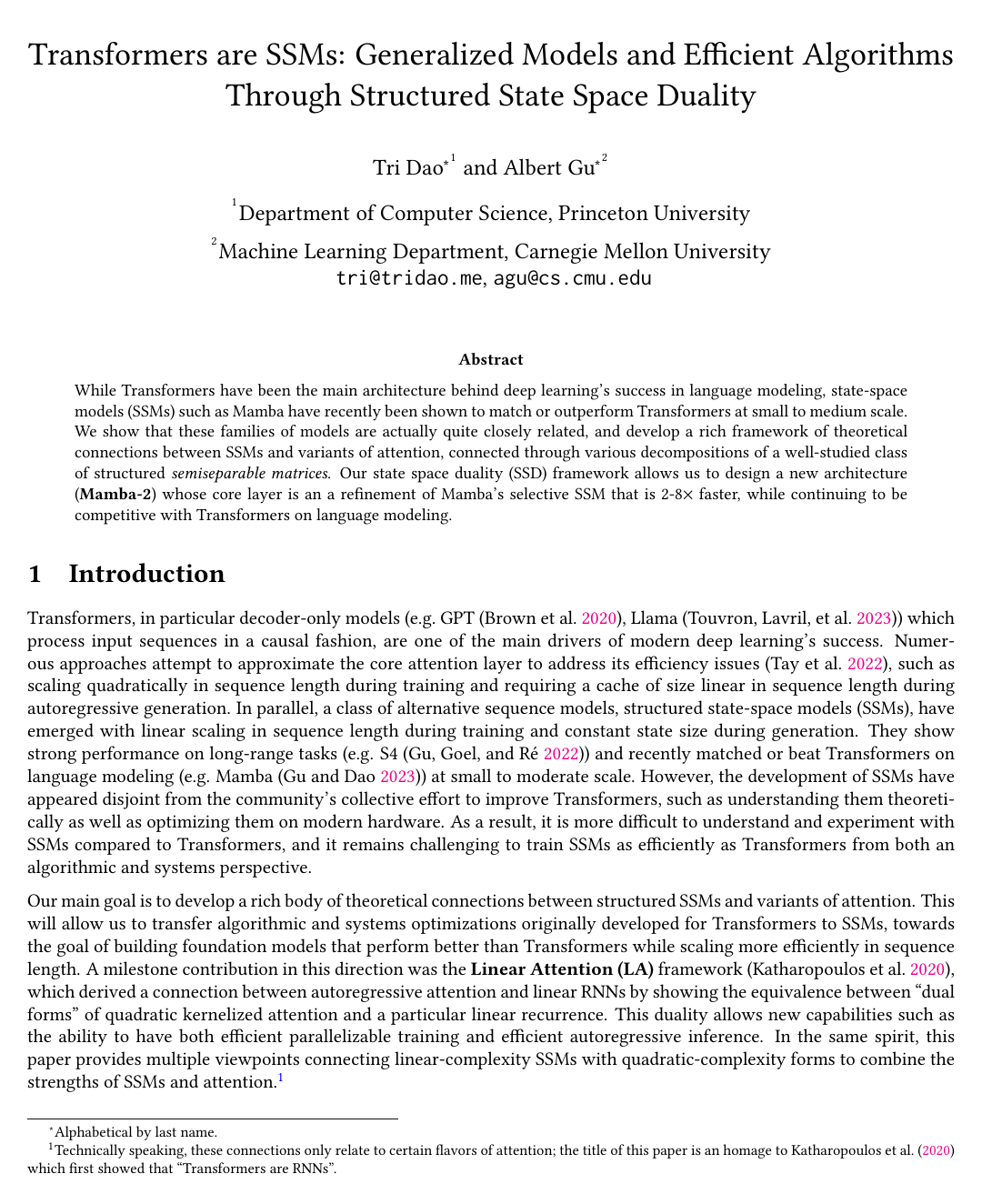
Transformers are SSMs: Generalized Models and Efficient Algorithms Through Structured State Space Duality
Tri Dao, Albert Gu
Why you should read this
Establishes a theoretical connection between Transformers and state-space models via structured semiseparable matrices, introducing the Mamba-2 architecture that processes sequences two to eight times faster than Mamba while matching Transformer language modeling performance.
While Transformers have been the main architecture behind deep learning's success in language modeling, state-space models (SSMs) such as Mamba have recently been shown to match or outperform Transformers at small to medium scale. We show that these families of models are actually quite closely related, and develop a rich framework of theoretical connections between SSMs and variants of attention, connected through various decompositions of a well-studied class of structured semiseparable matrices. Our state space duality (SSD) framework allows us to design a new architecture (Mamba-2) whose core layer is an a refinement of Mamba's selective SSM that is 2-8X faster, while continuing to be competitive with Transformers on language modeling.
Added
2026-09-18
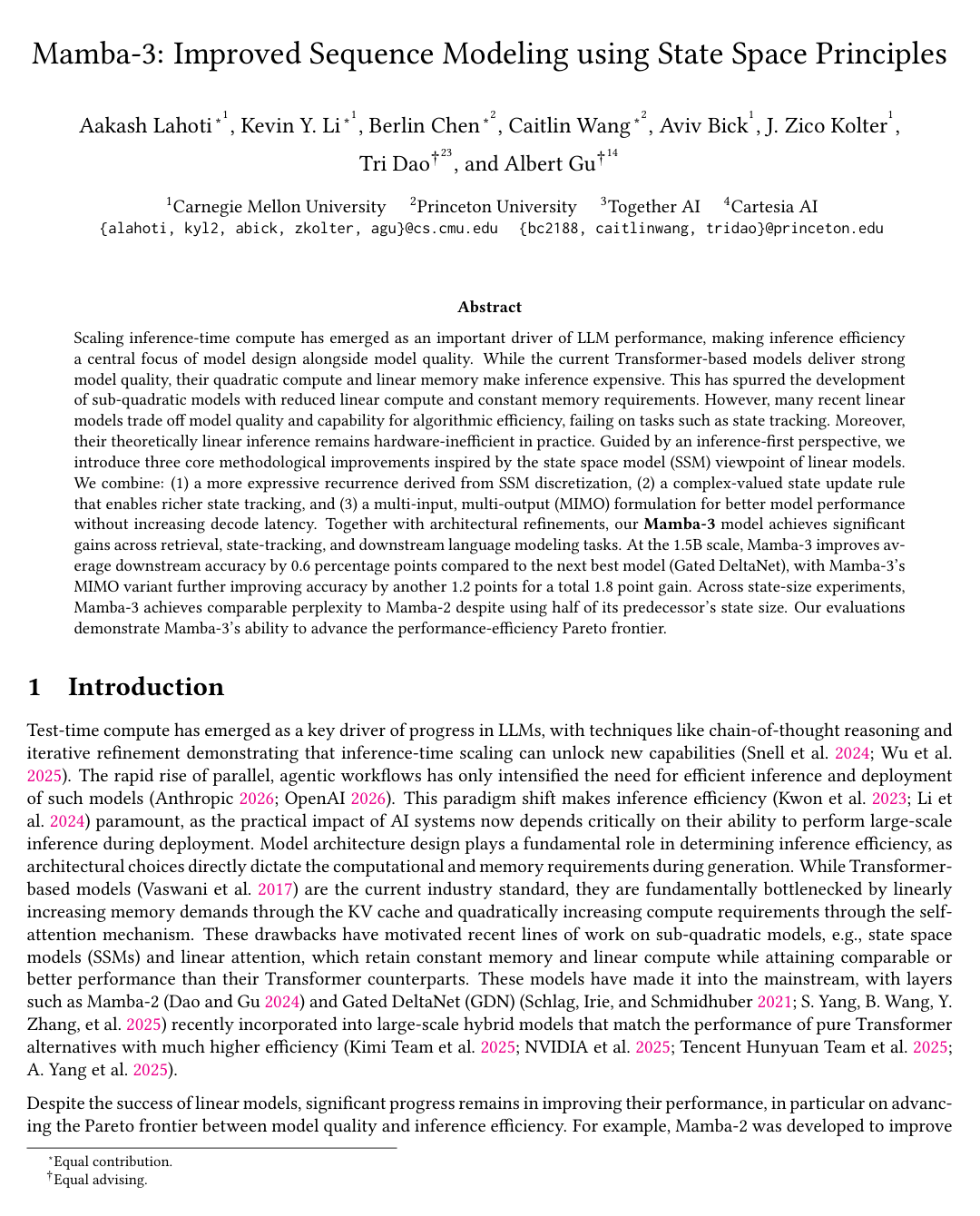
Mamba-3: Improved Sequence Modeling using State Space Principles
Aakash Lahoti, Kevin Y. Li, Berlin Chen, Caitlin Wang, Aviv Bick, J. Zico Kolter, Tri Dao, Albert Gu
Why you should read this
Develops Mamba-3, a novel state-space model that significantly advances the performance-efficiency Pareto frontier for sequence modeling by integrating an expressive recurrence, complex-valued state updates, and MIMO formulation to achieve superior accuracy and efficiency over prior art.
Scaling inference-time compute has emerged as an important driver of LLM performance, making inference efficiency a central focus of model design alongside model quality. While the current Transformer-based models deliver strong model quality, their quadratic compute and linear memory make inference expensive. This has spurred the development of sub-quadratic models with reduced linear compute and constant memory requirements. However, many recent linear models trade off model quality and capability for algorithmic efficiency, failing on tasks such as state tracking. Moreover, their theoretically linear inference remains hardware-inefficient in practice. Guided by an inference-first perspective, we introduce three core methodological improvements inspired by the state space model (SSM) viewpoint of linear models. We combine: (1) a more expressive recurrence derived from SSM discretization, (2) a complex-valued state update rule that enables richer state tracking, and (3) a multi-input, multi-output (MIMO) formulation for better model performance without increasing decode latency. Together with architectural refinements, our Mamba-3 model achieves significant gains across retrieval, state-tracking, and downstream language modeling tasks. At the 1.5B scale, Mamba-3 improves average downstream accuracy by 0.6 percentage points compared to the next best model (Gated DeltaNet), with Mamba-3's MIMO variant further improving accuracy by another 1.2 points for a total 1.8 point gain. Across state-size experiments, Mamba-3 achieves comparable perplexity to Mamba-2 despite using half of its predecessor's state size. Our evaluations demonstrate Mamba-3's ability to advance the performance-efficiency Pareto frontier.
Added
2026-05-07
