
keyword
linear programming
Linear programming is a mathematical optimization technique used to determine the best possible outcome, such as maximizing profit or minimizing cost, in a system where all requirements and relationships are linear. In this framework, a linear objective function is optimized subject to a collection of linear equality and inequality constraints on continuous decision variables. The region of all points that satisfy these constraints forms a convex geometric shape termed a polyhedron, which guarantees that an optimal solution, if one exists, lies on the boundary and typically at a vertex. Widely solved using algorithms such as the simplex method and interior-point methods, linear programming is a fundamental tool in operations research, economics, logistics, and computer science, and it serves as the foundation for more complex paradigms such as mixed-integer linear programming.
7 items
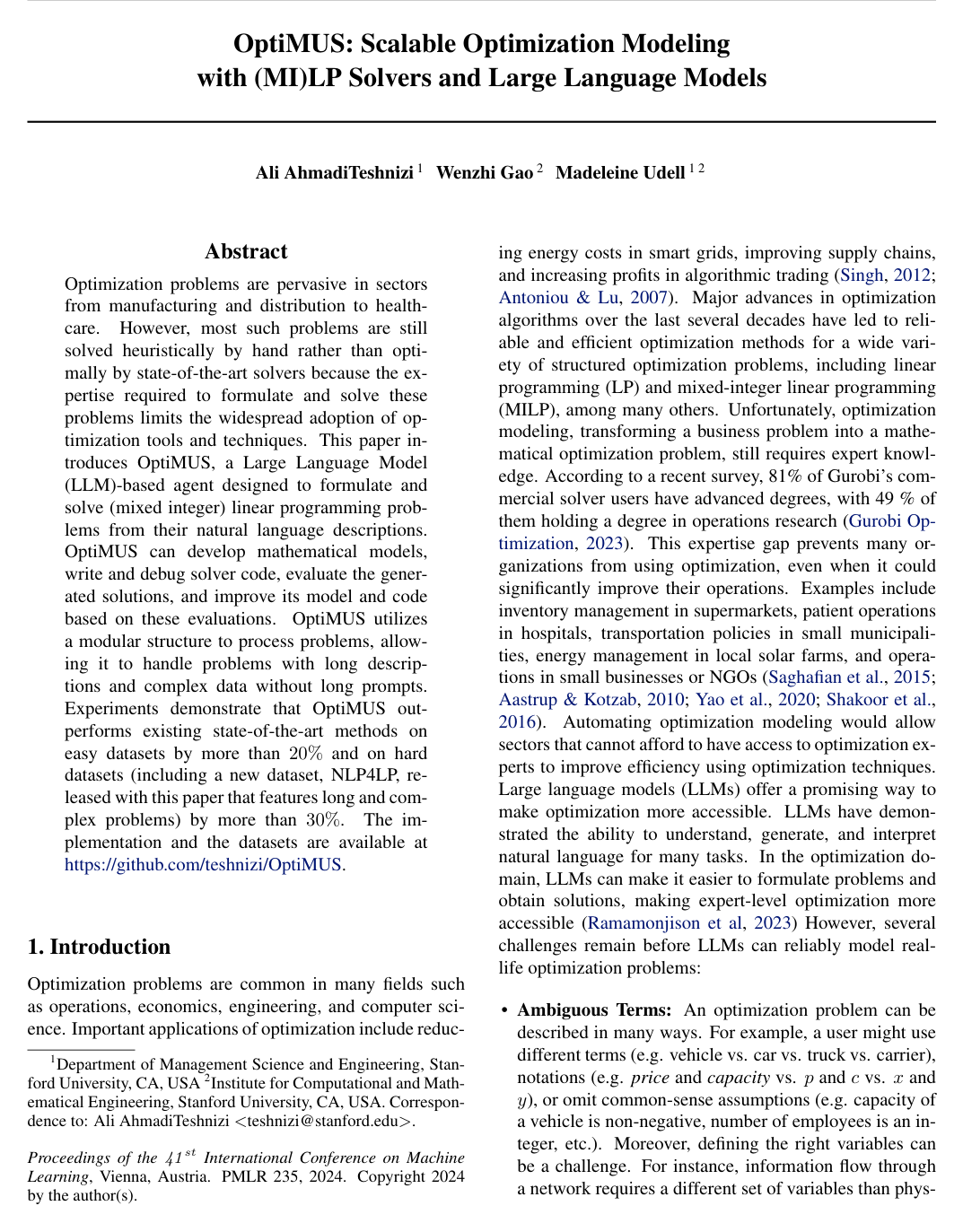
OptiMUS: Scalable Optimization Modeling with (MI)LP Solvers and Large Language Models
Ali AhmadiTeshnizi, Wenzhi Gao, Madeleine Udell
Why you should read this
Introduces OptiMUS, a modular multi-agent framework that translates natural language problem descriptions into mathematical formulations and debugged solver code, outperforming existing methods by over 30% on challenging mixed-integer linear programming benchmarks.
Optimization problems are pervasive in sectors from manufacturing and distribution to healthcare. However, most such problems are still solved heuristically by hand rather than optimally by state-of-the-art solvers because the expertise required to formulate and solve these problems limits the widespread adoption of optimization tools and techniques. This paper introduces OptiMUS, a Large Language Model (LLM)-based agent designed to formulate and solve (mixed integer) linear programming problems from their natural language descriptions. OptiMUS can develop mathematical models, write and debug solver code, evaluate the generated solutions, and improve its model and code based on these evaluations. OptiMUS utilizes a modular structure to process problems, allowing it to handle problems with long descriptions and complex data without long prompts. Experiments demonstrate that OptiMUS outperforms existing state-of-the-art methods on easy datasets by more than 20% and on hard datasets (including a new dataset, NLP4LP, released with this paper that features long and complex problems) by more than 30%. The implementation and the datasets are available at https://github.com/teshnizi/OptiMUS.
Added
2026-09-26
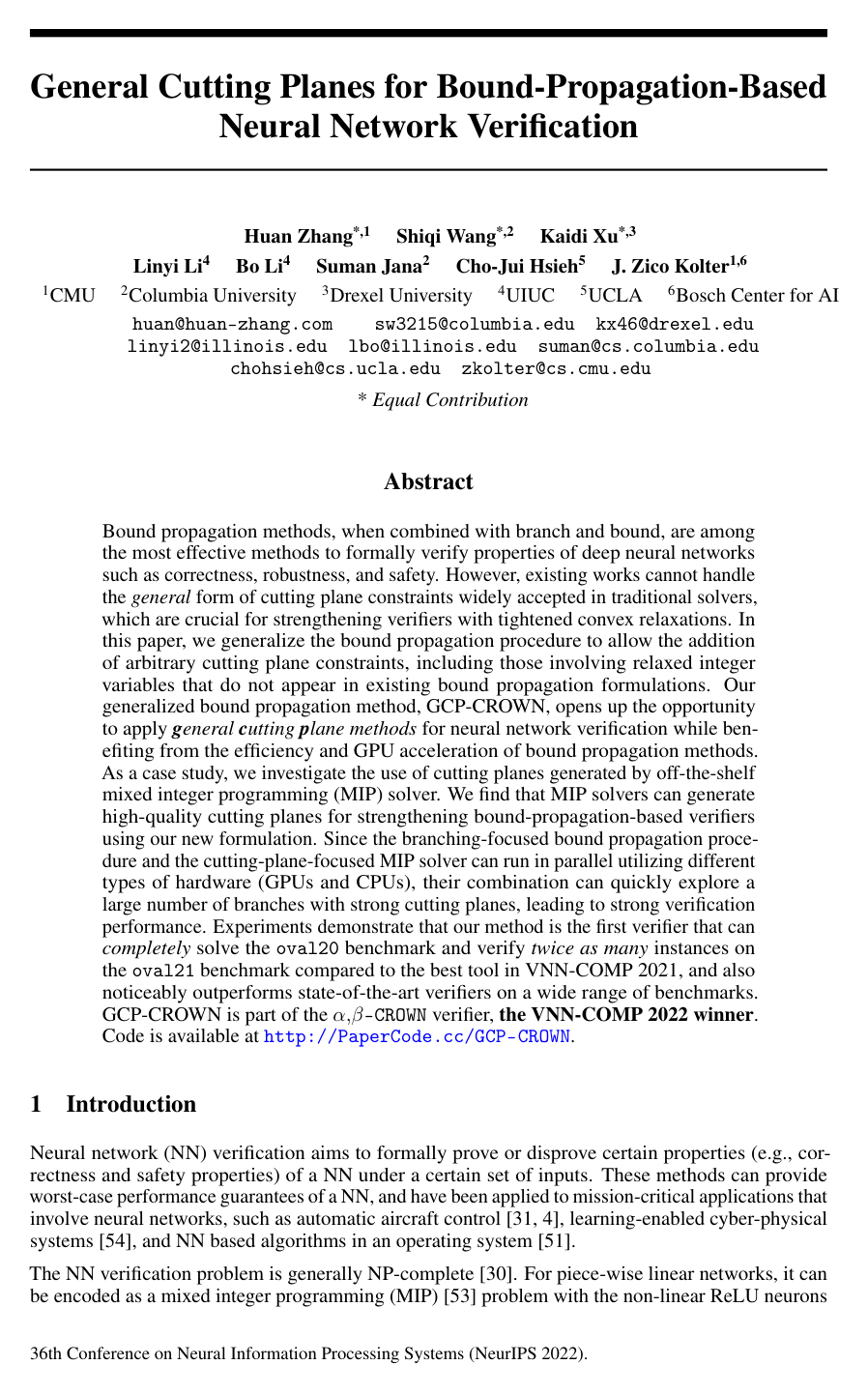
General Cutting Planes for Bound-Propagation-Based Neural Network Verification
Huan Zhang, Shiqi Wang, Kaidi Xu, Linyi Li, Bo Li, Suman Jana, Cho-Jui Hsieh, J. Zico Kolter
Why you should read this
Introduces GCP-CROWN, a framework that integrates general cutting plane constraints into GPU-accelerated bound propagation to tighten convex relaxations and achieve state-of-the-art neural network verification performance across standard benchmarks.
Bound propagation methods, when combined with branch and bound, are among the most effective methods to formally verify properties of deep neural networks such as correctness, robustness, and safety. However, existing works cannot handle the general form of cutting plane constraints widely accepted in traditional solvers, which are crucial for strengthening verifiers with tightened convex relaxations. In this paper, we generalize the bound propagation procedure to allow the addition of arbitrary cutting plane constraints, including those involving relaxed integer variables that do not appear in existing bound propagation formulations. Our generalized bound propagation method, GCP-CROWN, opens up the opportunity to apply general cutting plane methods for neural network verification while benefiting from the efficiency and GPU acceleration of bound propagation methods. As a case study, we investigate the use of cutting planes generated by off-the-shelf mixed integer programming (MIP) solver. We find that MIP solvers can generate high-quality cutting planes for strengthening bound-propagation-based verifiers using our new formulation. Since the branching-focused bound propagation procedure and the cutting-plane-focused MIP solver can run in parallel utilizing different types of hardware (GPUs and CPUs), their combination can quickly explore a large number of branches with strong cutting planes, leading to strong verification performance. Experiments demonstrate that our method is the first verifier that can completely solve the oval20 benchmark and verify twice as many instances on the oval21 benchmark compared to the best tool in VNN-COMP 2021, and also noticeably outperforms state-of-the-art verifiers on a wide range of benchmarks. GCP-CROWN is part of the α,β-CROWN verifier, the VNN-COMP 2022 winner. Code is available at http://PaperCode.cc/GCP-CROWN.
Added
2026-09-26
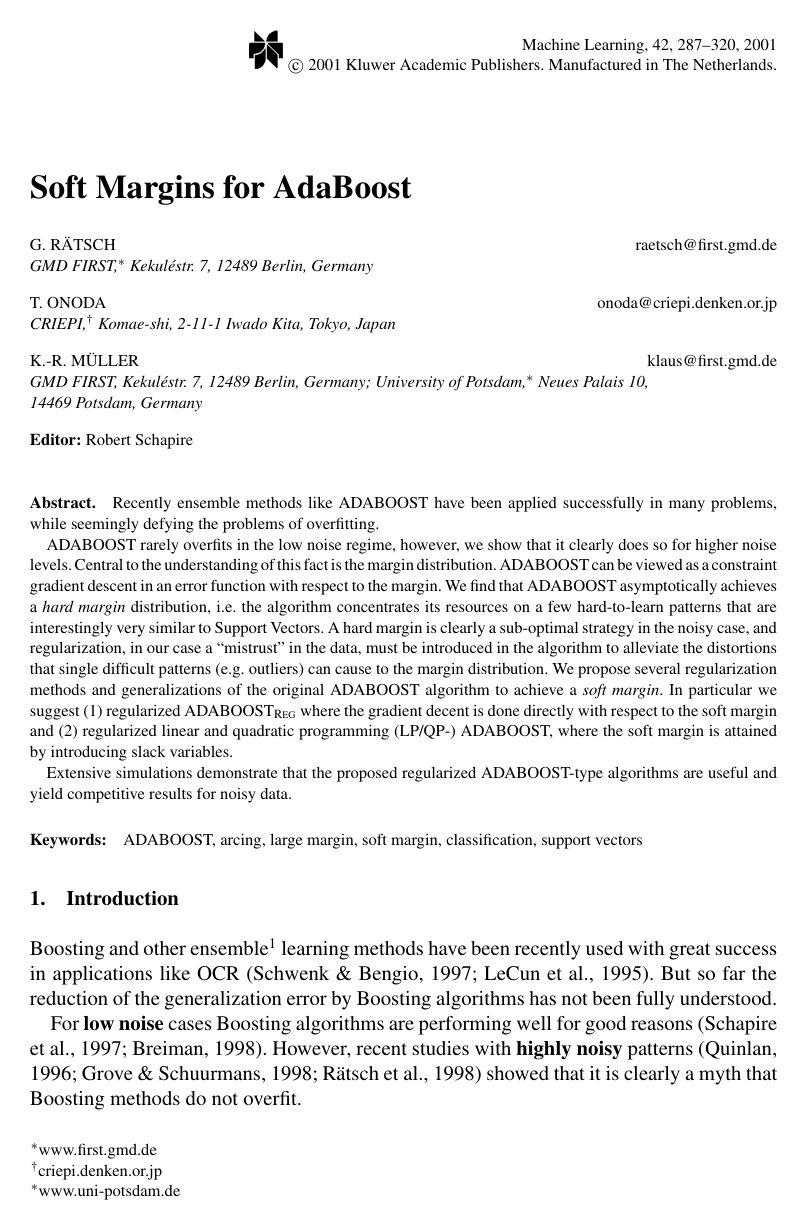
Soft Margins for AdaBoost
Gunnar Rätsch, T. Onoda, Klaus-Robert Müller
Why you should read this
Explains why AdaBoost overfits on noisy data by linking its asymptotic behavior to hard-margin maximization, and proposes soft-margin regularization techniques via gradient descent and mathematical programming to prevent outliers from degrading classification performance.
Recently ensemble methods like ADABOOST have been applied successfully in many problems, while seemingly defying the problems of overfitting. ADABOOST rarely overfits in the low noise regime, however, we show that it clearly does so for higher noise levels. Central to the understanding of this fact is the margin distribution. ADABOOST can be viewed as a constraint gradient descent in an error function with respect to the margin. We find that ADABOOST asymptotically achieves a hard margin distribution, i.e. the algorithm concentrates its resources on a few hard-to-learn patterns that are interestingly very similar to Support Vectors. A hard margin is clearly a sub-optimal strategy in the noisy case, and regularization, in our case a “mistrust” in the data, must be introduced in the algorithm to alleviate the distortions that single difficult patterns (e.g. outliers) can cause to the margin distribution. We propose several regularization methods and generalizations of the original ADABOOST algorithm to achieve a soft margin. In particular we suggest (1) regularized ADABOOSTREG where the gradient decent is done directly with respect to the soft margin and (2) regularized linear and quadratic programming (LP/QP-) ADABOOST, where the soft margin is attained by introducing slack variables. Extensive simulations demonstrate that the proposed regularized ADABOOST-type algorithms are useful and yield competitive results for noisy data.
Added
2026-09-25
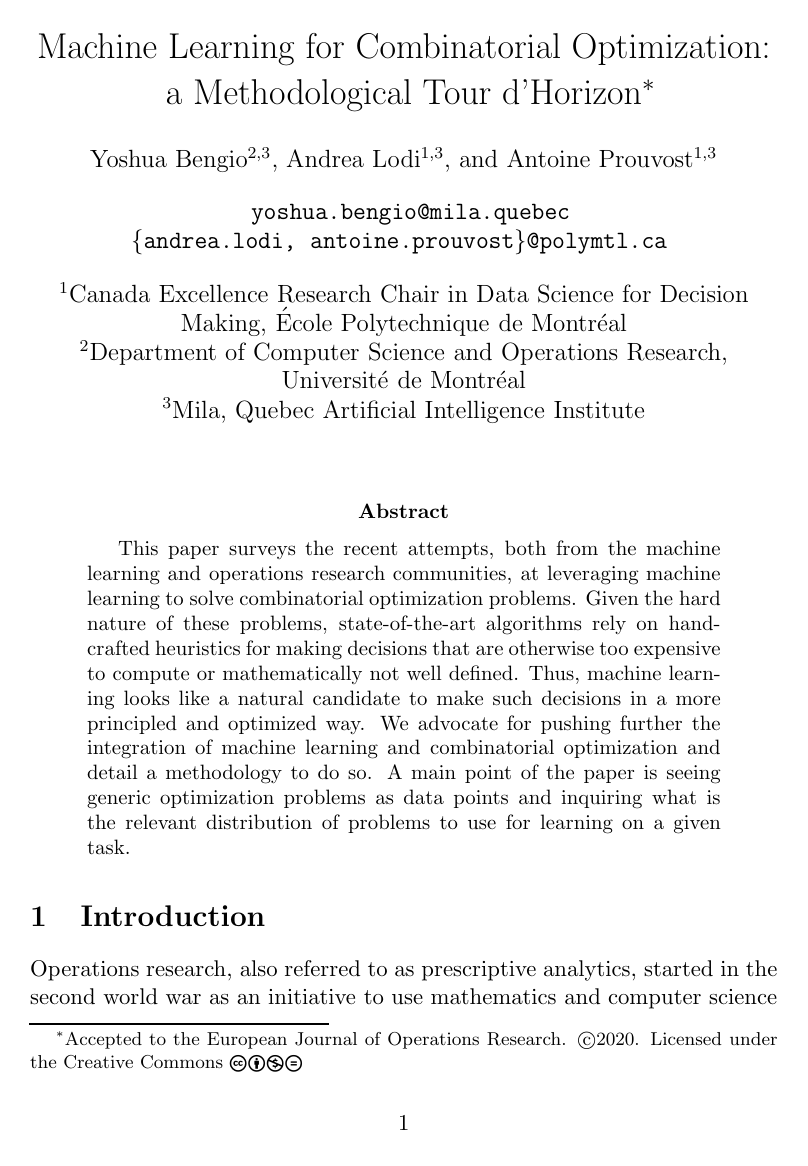
Machine Learning for Combinatorial Optimization: a Methodological Tour d'Horizon
Yoshua Bengio, Andrea Lodi, Antoine Prouvost
Why you should read this
Establishes a foundational methodological framework bridging operations research and machine learning to replace handcrafted heuristics with models trained on distributions of combinatorial optimization problems.
This paper surveys the recent attempts, both from the machine learning and operations research communities, at leveraging machine learning to solve combinatorial optimization problems. Given the hard nature of these problems, state-of-the-art algorithms rely on handcrafted heuristics for making decisions that are otherwise too expensive to compute or mathematically not well defined. Thus, machine learning looks like a natural candidate to make such decisions in a more principled and optimized way. We advocate for pushing further the integration of machine learning and combinatorial optimization and detail a methodology to do so. A main point of the paper is seeing generic optimization problems as data points and inquiring what is the relevant distribution of problems to use for learning on a given task.
Added
2026-09-18
Reluplex: An Efficient SMT Solver for Verifying Deep Neural Networks
Guy Katz, Clark Barrett, David Dill, Kyle Julian, Mykel Kochenderfer
Why you should read this
Introduces Reluplex, a dedicated SMT solver that extends the simplex method to handle non-convex ReLU activations and formally verify safety properties of deep neural networks an order of magnitude larger than prior approaches could support.
Deep neural networks have emerged as a widely used and effective means for tackling complex, real-world problems. However, a major obstacle in applying them to safety-critical systems is the great difficulty in providing formal guarantees about their behavior. We present a novel, scalable, and efficient technique for verifying properties of deep neural networks (or providing counter-examples). The technique is based on the simplex method, extended to handle the non-convex Rectified Linear Unit (ReLU) activation function, which is a crucial ingredient in many modern neural networks. The verification procedure tackles neural networks as a whole, without making any simplifying assumptions. We evaluated our technique on a prototype deep neural network implementation of the next-generation airborne collision avoidance system for unmanned aircraft (ACAS Xu). Results show that our technique can successfully prove properties of networks that are an order of magnitude larger than the largest networks verified using existing methods.
Added
2026-09-16
Cross apprenticeship learning framework: Properties and solution approaches
Ashwin Aravind, Debasish Chatterjee, Ashish Cherukuri
Why you should read this
Proposes the cross apprenticeship learning (CAL) framework to optimize agents across diverse environments by balancing specialized task performance with robust cross-environment generalization through a tunable centrality measure and convex outer approximation techniques.
Apprenticeship learning is a framework in which an agent learns a policy to perform a given task in an environment using example trajectories provided by an expert. In the real world, one might have access to expert trajectories in different environments where the system dynamics is different while the learning task is the same. For such scenarios, two types of learning objectives can be defined. One where the learned policy performs very well in one specific environment and another when it performs well across all environments. To balance these two objectives in a principled way, our work presents the cross apprenticeship learning (CAL) framework. This consists of an optimization problem where an optimal policy for each environment is sought while ensuring that all policies remain close to each other. This nearness is facilitated by one tuning parameter in the optimization problem. We derive properties of the optimizers of the problem as the tuning parameter varies. Since the problem is nonconvex, we provide a convex outer approximation. Finally, we demonstrate the attributes of our framework in the context of a navigation task in a windy gridworld environment.
Added
2026-02-21
Planning and acting in partially observable stochastic domains
Leslie Pack Kaelbling, Michael L. Littman, Anthony R. Cassandra
Why you should read this
Formalizes the POMDP framework, providing the mathematical tools for agents to maintain belief states and act under uncertainty.
In this paper, we bring techniques from operations research to bear on the problem of choosing optimal actions in partially observable stochastic domains. We begin by introducing the theory of Markov decision processes (MDPs) and partially observable MDPs (POMDPs). We then outline a novel algorithm for solving POMDPs off line and show how, in some cases, a finite-memory controller can be extracted from the solution to a POMDP. We conclude with a discussion of how our approach relates to previous work, the complexity of finding exact solutions to POMDPs, and of some possibilities for finding approximate solutions.
Added
2026-01-27