
keyword
latent variable models
Latent variable models are statistical and machine learning models that relate observed data to underlying, unobserved variables known as latent variables. In these frameworks, the high-dimensional or complex patterns found in observable data are assumed to be generated by, or conditioned on, a set of hidden factors that capture lower-dimensional structure, semantic concepts, or unmeasured causes. By formalizing a joint probability distribution over both observed and latent components, these models facilitate tasks such as density estimation, representation learning, missing data imputation, and generative sampling. Because the latent variables cannot be directly measured, learning and inference typically rely on approximate or iterative statistical methods, including the Expectation-Maximization algorithm, Markov chain Monte Carlo sampling, and variational inference, to estimate model parameters and infer posterior distributions over the hidden space.
13 items
Latent Diffusion for Language Generation
Justin Lovelace, Varsha Kishore, Chao Wan, Eliot Shekhtman, Kilian Q. Weinberger
Why you should read this
Presents a framework that applies continuous diffusion models within the compact latent space of pretrained encoder-decoder language models, outperforming existing text diffusion methods across conditional and sequence-to-sequence generation tasks with significantly fewer sampling steps.
Diffusion models have achieved great success in modeling continuous data modalities such as images, audio, and video, but have seen limited use in discrete domains such as language. Recent attempts to adapt diffusion to language have presented diffusion as an alternative to existing pretrained language models. We view diffusion and existing language models as complementary. We demonstrate that encoder-decoder language models can be utilized to efficiently learn high-quality language autoencoders. We then demonstrate that continuous diffusion models can be learned in the latent space of the language autoencoder, enabling us to sample continuous latent representations that can be decoded into natural language with the pretrained decoder. We validate the effectiveness of our approach for unconditional, class-conditional, and sequence-to-sequence language generation. We demonstrate across multiple diverse data sets that our latent language diffusion models are significantly more effective than previous diffusion language models. Our code is available at https://github.com/justinlovelace/latent-diffusion-for-language.
Added
2026-10-01
Self-Paced Learning for Latent Variable Models
M. P. Kumar, Ben Packer, D. Koller
Why you should read this
Introduces a self-paced learning framework that dynamically selects training samples from easiest to hardest to prevent latent variable models from getting trapped in poor local optima.
Latent variable models are a powerful tool for addressing several tasks in machine learning. However, the algorithms for learning the parameters of latent variable models are prone to getting stuck in a bad local optimum. To alleviate this problem, we build on the intuition that, rather than considering all samples simultaneously, the algorithm should be presented with the training data in a meaningful order that facilitates learning. The order of the samples is determined by how easy they are. The main challenge is that often we are not provided with a readily computable measure of the easiness of samples. We address this issue by proposing a novel, iterative self-paced learning algorithm where each iteration simultaneously selects easy samples and learns a new parameter vector. The number of samples selected is governed by a weight that is annealed until the entire training data has been considered. We empirically demonstrate that the self-paced learning algorithm outperforms the state of the art method for learning a latent structural SVM on four applications: object localization, noun phrase coreference, motif finding and handwritten digit recognition.
Added
2026-09-24
Unsupervised Learning by Probabilistic Latent Semantic Analysis
Thomas Hofmann
Why you should read this
Introduces Probabilistic Latent Semantic Analysis (PLSA), a generative latent variable framework trained with tempered Expectation-Maximization that overcomes the geometric limitations of standard LSA to effectively model polysemy and substantially improve document retrieval and language modeling performance.
This paper presents a novel statistical method for factor analysis of binary and count data which is closely related to a technique known as Latent Semantic Analysis. In contrast to the latter method which stems from linear algebra and performs a Singular Value Decomposition of co-occurrence tables, the proposed technique uses a generative latent class model to perform a probabilistic mixture decomposition. This results in a more principled approach with a solid foundation in statistical inference. More precisely, we propose to make use of a temperature controlled version of the Expectation Maximization algorithm for model fitting, which has shown excellent performance in practice. Probabilistic Latent Semantic Analysis has many applications, most prominently in information retrieval, natural language processing, machine learning from text, and in related areas. The paper presents perplexity results for different types of text and linguistic data collections and discusses an application in automated document indexing. The experiments indicate substantial and consistent improvements of the probabilistic method over standard Latent Semantic Analysis.
Added
2026-09-14
Probabilistic Latent Semantic Analysis
Thomas Hofmann
Why you should read this
Proposes Probabilistic Latent Semantic Analysis, replacing standard algebraic singular value decomposition with a statistical latent class mixture model fitted by tempered EM to substantially improve document modeling and information retrieval.
Probabilistic Latent Semantic Analysis is a novel statistical technique for the analysis of two-mode and co-occurrence data, which has applications in information retrieval and filtering, natural language processing, machine learning from text, and in related areas. Compared to standard Latent Semantic Analysis which stems from linear algebra and performs a Singular Value Decomposition of co-occurrence tables, the proposed method is based on a mixture decomposition derived from a latent class model. This results in a more principled approach which has a solid foundation in statistics. In order to avoid overfitting, we propose a widely applicable generalization of maximum likelihood model fitting by tempered EM. Our approach yields substantial and consistent improvements over Latent Semantic Analysis in a number of experiments.
Added
2026-09-14
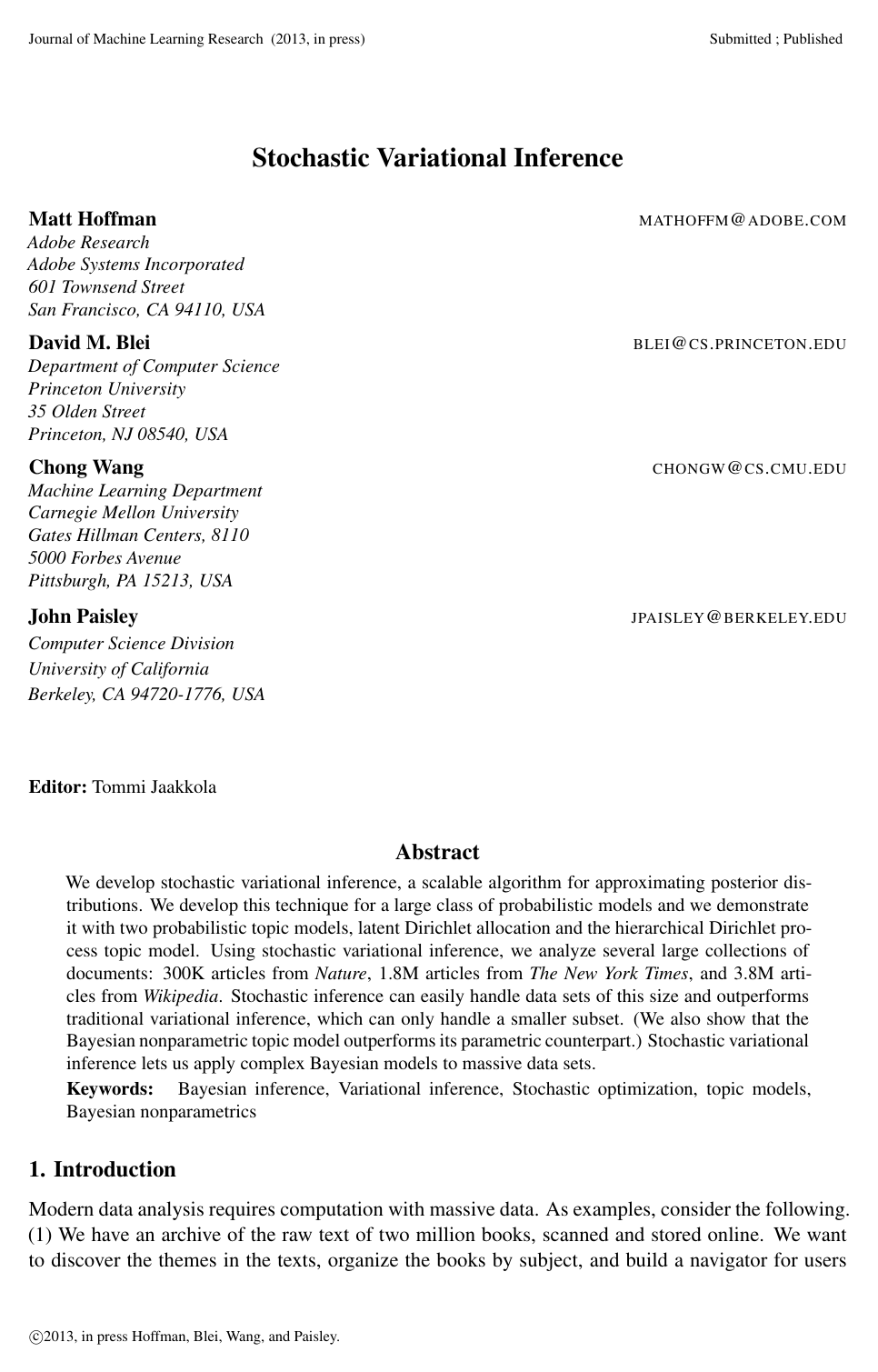
Stochastic variational inference
Matt Hoffman, David M. Blei, Chong Wang, John Paisley
Why you should read this
Develops stochastic variational inference, a scalable algorithm that applies stochastic optimization to variational bounds, enabling complex Bayesian models to perform posterior inference on massive datasets containing millions of documents.
We develop stochastic variational inference, a scalable algorithm for approximating posterior distributions. We develop this technique for a large class of probabilistic models and we demonstrate it with two probabilistic topic models, latent Dirichlet allocation and the hierarchical Dirichlet process topic model. Using stochastic variational inference, we analyze several large collections of documents: 300K articles from Nature, 1.8M articles from The New York Times, and 3.8M articles from Wikipedia. Stochastic inference can easily handle data sets of this size and outperforms traditional variational inference, which can only handle a smaller subset. (We also show that the Bayesian nonparametric topic model outperforms its parametric counterpart.) Stochastic variational inference lets us apply complex Bayesian models to massive data sets.
Added
2026-09-14
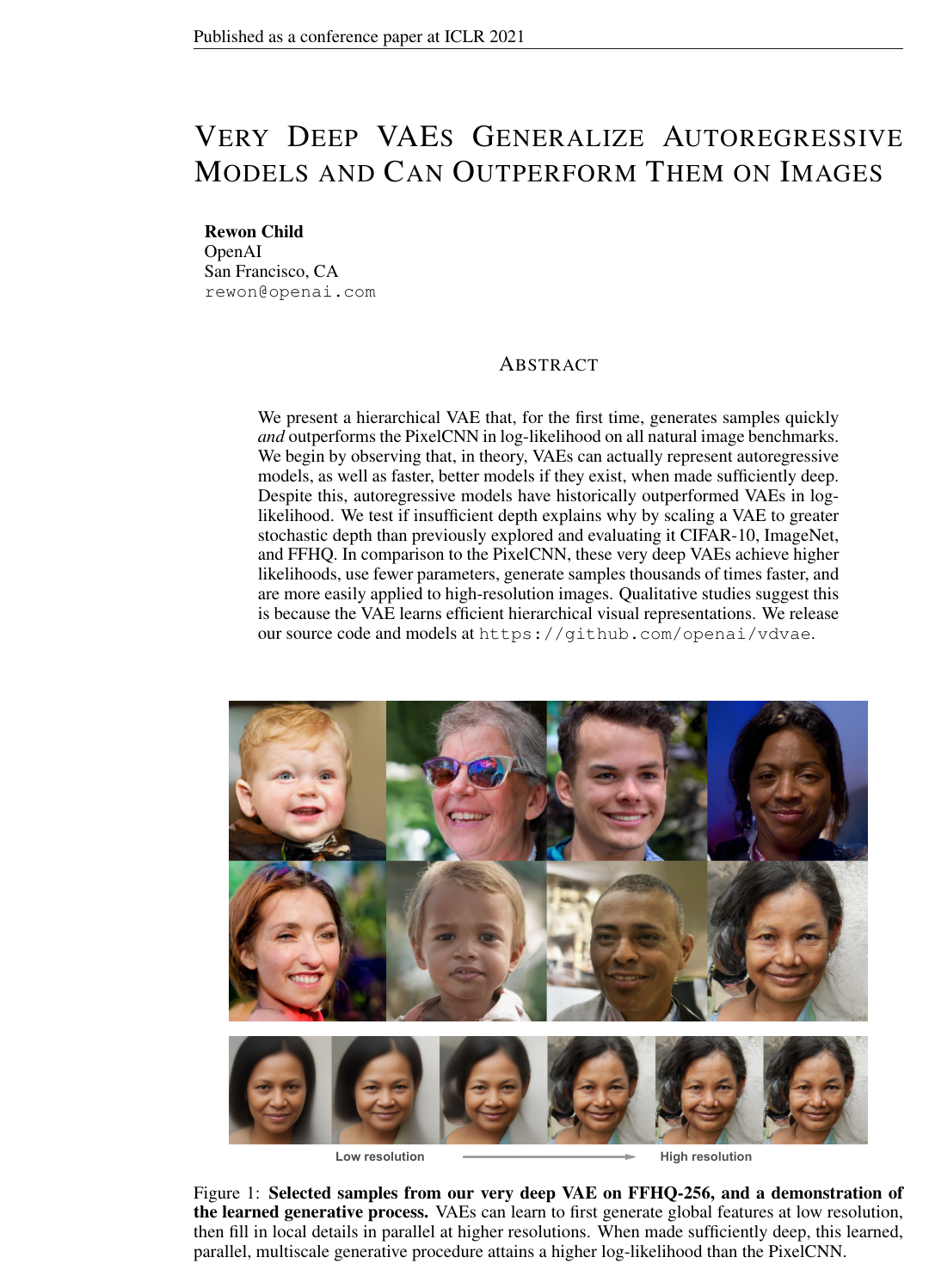
Very Deep VAEs Generalize Autoregressive Models and Can Outperform Them on Images
Rewon Child
Why you should read this
Shows that scaling VAEs to extreme depths allows them to outperform autoregressive models in density estimation (compression).
We present a hierarchical VAE that, for the first time, generates samples quickly while outperforming the PixelCNN in log-likelihood on all natural image benchmarks. We begin by observing that, in theory, VAEs can actually represent autoregressive models, as well as faster, better models if they exist, when made sufficiently deep. Despite this, autoregressive models have historically outperformed VAEs in log-likelihood. We test if insufficient depth explains why by scaling a VAE to greater stochastic depth than previously explored and evaluating it CIFAR-10, ImageNet, and FFHQ. In comparison to the PixelCNN, these very deep VAEs achieve higher likelihoods, use fewer parameters, generate samples thousands of times faster, and are more easily applied to high-resolution images. Qualitative studies suggest this is because the VAE learns efficient hierarchical visual representations. We release our source code and models at https://github.com/openai/vdvae.
Added
2026-03-09
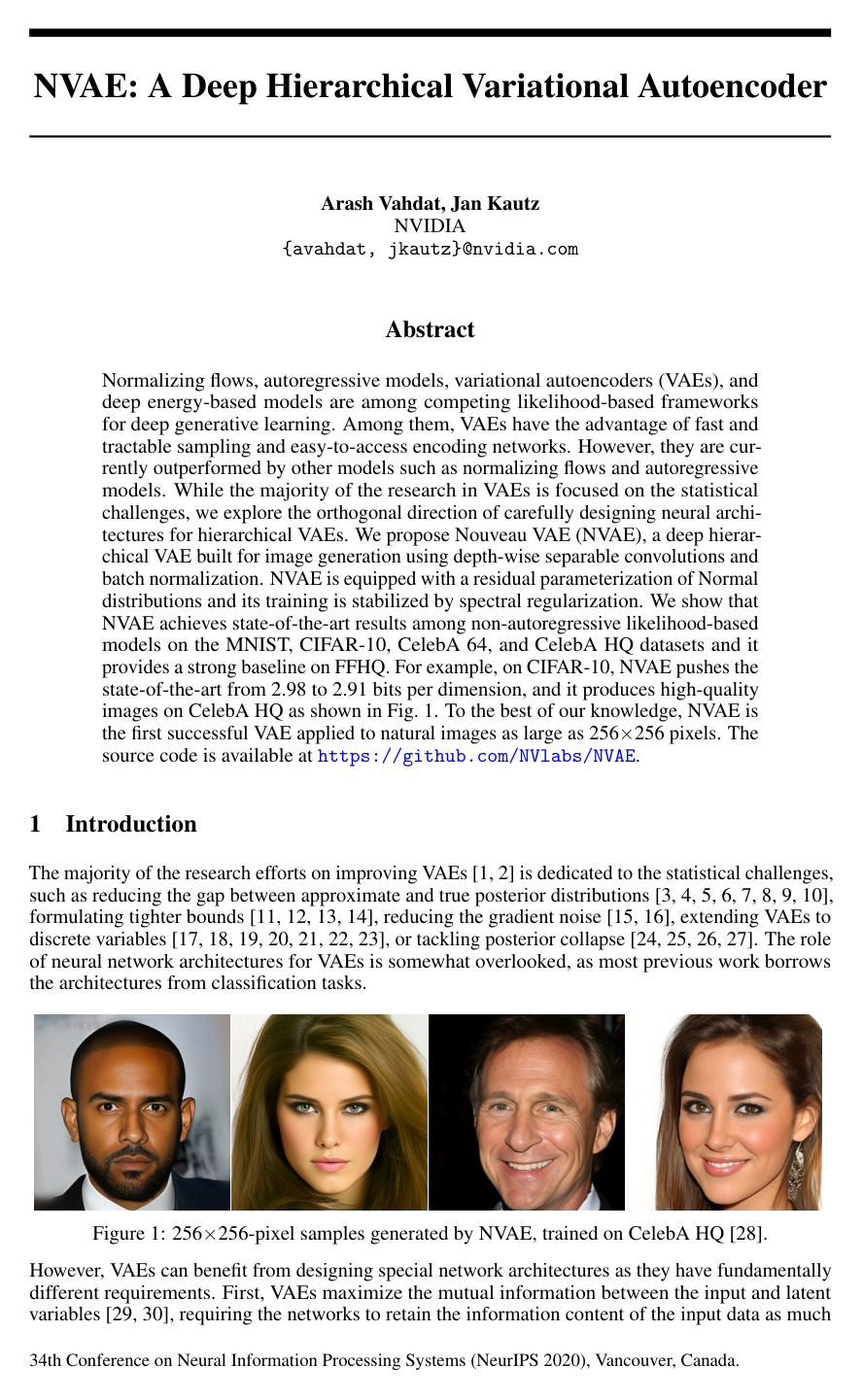
NVAE: A Deep Hierarchical Variational Autoencoder
Arash Vahdat, Jan Kautz
Why you should read this
Architectures a massive, multi-scale hierarchical continuous VAE that achieves state-of-the-art results without quantization.
Normalizing flows, autoregressive models, variational autoencoders (VAEs), and deep energy-based models are among competing likelihood-based frameworks for deep generative learning. Among them, VAEs have the advantage of fast and tractable sampling and easy-to-access encoding networks. However, they are currently outperformed by other models such as normalizing flows and autoregressive models. While the majority of the research in VAEs is focused on the statistical challenges, we explore the orthogonal direction of carefully designing neural architectures for hierarchical VAEs. We propose Nouveau VAE (NVAE), a deep hierarchical VAE built for image generation using depth-wise separable convolutions and batch normalization. NVAE is equipped with a residual parameterization of Normal distributions and its training is stabilized by spectral regularization. We show that NVAE achieves state-of-the-art results among non-autoregressive likelihood-based models on the MNIST, CIFAR-10, CelebA 64, and CelebA HQ datasets and it provides a strong baseline on FFHQ. For example, on CIFAR-10, NVAE pushes the state-of-the-art from 2.98 to 2.91 bits per dimension, and it produces high-quality images on CelebA HQ. To the best of our knowledge, NVAE is the first successful VAE applied to natural images as large as 256256 pixels. The source code is available at https://github.com/NVlabs/NVAE .
Added
2026-03-09
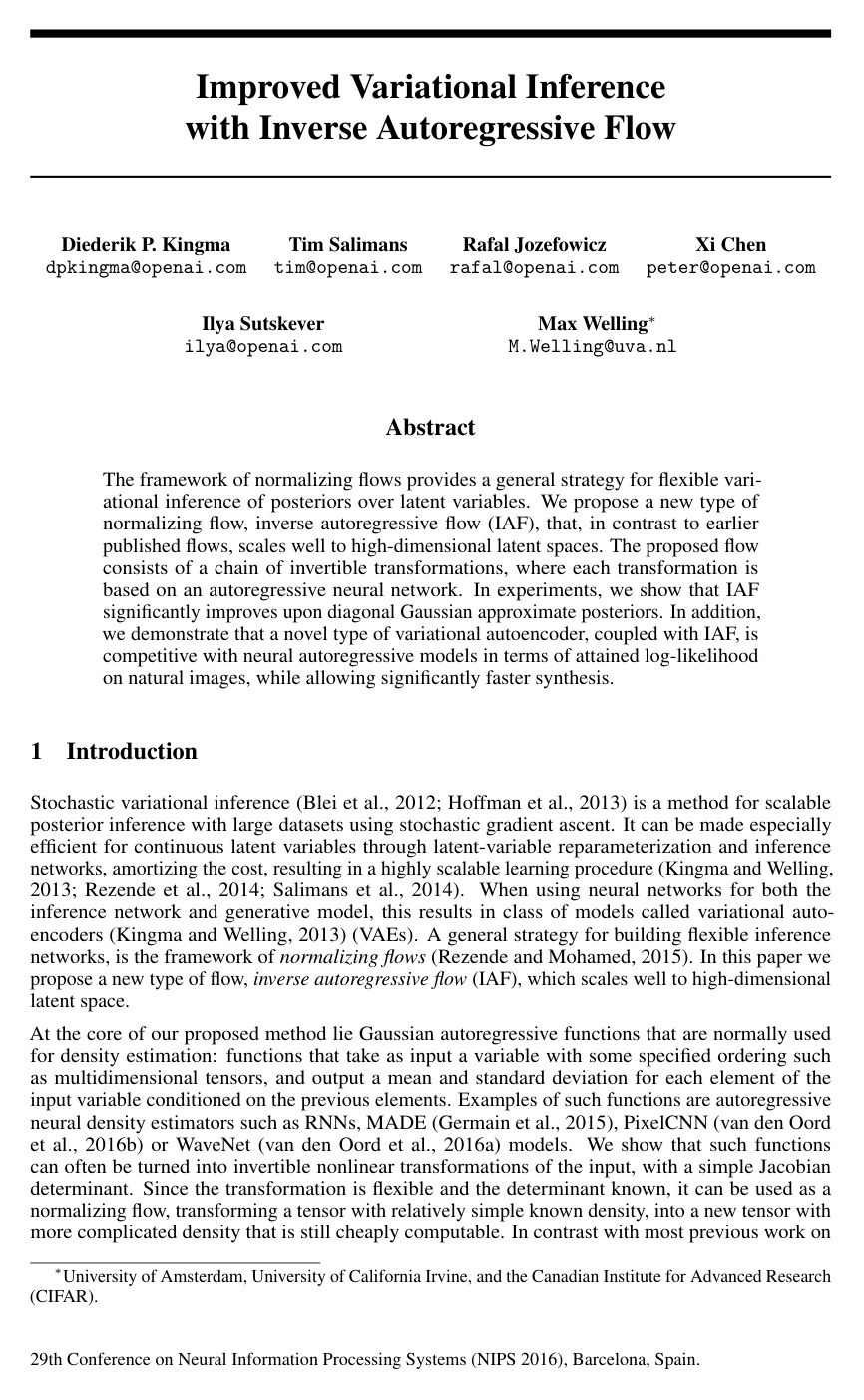
Improving Variational Inference with Inverse Autoregressive Flow
Diederik P. Kingma, Tim Salimans, Rafal Jozefowicz, Xi Chen, Ilya Sutskever, Max Welling
Why you should read this
Introduces Inverse Autoregressive Flow (IAF), a scalable normalizing flow that empowers variational autoencoders to model complex high-dimensional posterior distributions with the flexibility of autoregressive models and the synthesis speed of parallelizable architectures.
The framework of normalizing flows provides a general strategy for flexible variational inference of posteriors over latent variables. We propose a new type of normalizing flow, inverse autoregressive flow (IAF), that, in contrast to earlier published flows, scales well to high-dimensional latent spaces. The proposed flow consists of a chain of invertible transformations, where each transformation is based on an autoregressive neural network. In experiments, we show that IAF significantly improves upon diagonal Gaussian approximate posteriors. In addition, we demonstrate that a novel type of variational autoencoder, coupled with IAF, is competitive with neural autoregressive models in terms of attained log-likelihood on natural images, while allowing significantly faster synthesis.
Added
2026-03-09
Stochastic Backpropagation and Approximate Inference in Deep Generative Models
Danilo Jimenez Rezende, Shakir Mohamed, Daan Wierstra
Why you should read this
Develops a new algorithm for scalable inference and learning in deep generative models, enabling the creation of realistic samples, accurate data imputation, and high-dimensional visualization through a novel stochastic backpropagation technique.
We marry ideas from deep neural networks and approximate Bayesian inference to derive a generalised class of deep, directed generative models, endowed with a new algorithm for scalable inference and learning. Our algorithm introduces a recognition model to represent approximate posterior distributions, and that acts as a stochastic encoder of the data. We develop stochastic back-propagation -- rules for back-propagation through stochastic variables -- and use this to develop an algorithm that allows for joint optimisation of the parameters of both the generative and recognition model. We demonstrate on several real-world data sets that the model generates realistic samples, provides accurate imputations of missing data and is a useful tool for high-dimensional data visualisation.
Added
2026-03-01

Variational Diffusion Models
Diederik P. Kingma, Tim Salimans, Ben Poole, Jonathan Ho
Why you should read this
Presents a novel family of Variational Diffusion Models that achieve state-of-the-art likelihoods in image density estimation, surpassing long-dominant autoregressive models by optimizing the noise schedule and providing deeper theoretical understanding.
Diffusion-based generative models have demonstrated a capacity for perceptually impressive synthesis, but can they also be great likelihood-based models? We answer this in the affirmative, and introduce a family of diffusion-based generative models that obtain state-of-the-art likelihoods on standard image density estimation benchmarks. Unlike other diffusion-based models, our method allows for efficient optimization of the noise schedule jointly with the rest of the model. We show that the variational lower bound (VLB) simplifies to a remarkably short expression in terms of the signal-to-noise ratio of the diffused data, thereby improving our theoretical understanding of this model class. Using this insight, we prove an equivalence between several models proposed in the literature. In addition, we show that the continuous-time VLB is invariant to the noise schedule, except for the signal-to-noise ratio at its endpoints. This enables us to learn a noise schedule that minimizes the variance of the resulting VLB estimator, leading to faster optimization. Combining these advances with architectural improvements, we obtain state-of-the-art likelihoods on image density estimation benchmarks, outperforming autoregressive models that have dominated these benchmarks for many years, with often significantly faster optimization. In addition, we show how to use the model as part of a bits-back compression scheme, and demonstrate lossless compression rates close to the theoretical optimum. Code is available at this https URL .
Added
2026-02-25
Denoising Diffusion Implicit Models
Jiaming Song, Chenlin Meng, Stefano Ermon
Why you should read this
Develops a deterministic sampling process (non-Markovian) that allows diffusion models to generate high-quality images in 10-50 steps instead of 1000.
Denoising diffusion probabilistic models (DDPMs) have achieved high quality image generation without adversarial training, yet they require simulating a Markov chain for many steps to produce a sample. To accelerate sampling, we present denoising diffusion implicit models (DDIMs), a more efficient class of iterative implicit probabilistic models with the same training procedure as DDPMs. In DDPMs, the generative process is defined as the reverse of a Markovian diffusion process. We construct a class of non-Markovian diffusion processes that lead to the same training objective, but whose reverse process can be much faster to sample from. We empirically demonstrate that DDIMs can produce high quality samples to faster in terms of wall-clock time compared to DDPMs, allow us to trade off computation for sample quality, and can perform semantically meaningful image interpolation directly in the latent space.
Added
2026-02-25
Variational Lossy Autoencoder
Xi Chen, Diederik P. Kingma, Tim Salimans, Yan Duan, Prafulla Dhariwal, John Schulman, Ilya Sutskever, Pieter Abbeel
Why you should read this
Reveals that the common failure of VAEs to use their latent codes when paired with powerful decoders isn't a bug but a controllable feature—by deliberately limiting what the decoder can model locally (like small texture patches), you can force the latent code to capture exactly the global structure you care about while achieving state-of-the-art density estimation.
Representation learning seeks to expose certain aspects of observed data in a learned representation that's amenable to downstream tasks like classification. For instance, a good representation for 2D images might be one that describes only global structure and discards information about detailed texture. In this paper, we present a simple but principled method to learn such global representations by combining Variational Autoencoder (VAE) with neural autoregressive models such as RNN, MADE and PixelRNN/CNN. Our proposed VAE model allows us to have control over what the global latent code can learn and , by designing the architecture accordingly, we can force the global latent code to discard irrelevant information such as texture in 2D images, and hence the VAE only "autoencodes" data in a lossy fashion. In addition, by leveraging autoregressive models as both prior distribution p(z) and decoding distribution p(x|z), we can greatly improve generative modeling performance of VAEs, achieving new state-of-the-art results on MNIST, OMNIGLOT and Caltech-101 Silhouettes density estimation tasks.
Added
2026-02-21
Variational Autoencoders for Collaborative Filtering
Dawen Liang, Rahul G. Krishnan, Matthew D. Hoffman, Tony Jebara
Why you should read this
Applies variational inference to collaborative filtering, creating a generative model that outperforms standard autoencoders on sparse data.
We extend variational autoencoders (VAEs) to collaborative filtering for implicit feedback. This non-linear probabilistic model enables us to go beyond the limited modeling capacity of linear factor models which still largely dominate collaborative filtering research.We introduce a generative model with multinomial likelihood and use Bayesian inference for parameter estimation. Despite widespread use in language modeling and economics, the multinomial likelihood receives less attention in the recommender systems literature. We introduce a different regularization parameter for the learning objective, which proves to be crucial for achieving competitive performance. Remarkably, there is an efficient way to tune the parameter using annealing. The resulting model and learning algorithm has information-theoretic connections to maximum entropy discrimination and the information bottleneck principle. Empirically, we show that the proposed approach significantly outperforms several state-of-the-art baselines, including two recently-proposed neural network approaches, on several real-world datasets. We also provide extended experiments comparing the multinomial likelihood with other commonly used likelihood functions in the latent factor collaborative filtering literature and show favorable results. Finally, we identify the pros and cons of employing a principled Bayesian inference approach and characterize settings where it provides the most significant improvements.
Added
2026-01-25