
keyword
large vision-language model
A large vision-language model is an artificial intelligence system that integrates computer vision and natural language processing to jointly interpret, reason over, and generate text based on visual inputs, such as images and videos, alongside textual prompts. Typically constructed by coupling a visual encoder with a large language model backbone through cross-modal alignment modules, these models map visual features into a shared representation space that the language processor can interpret. This architecture enables the system to perform a wide range of complex multimodal tasks, including visual question answering, image captioning, document and scene analysis, visual grounding, and graphical user interface interaction.
2 items
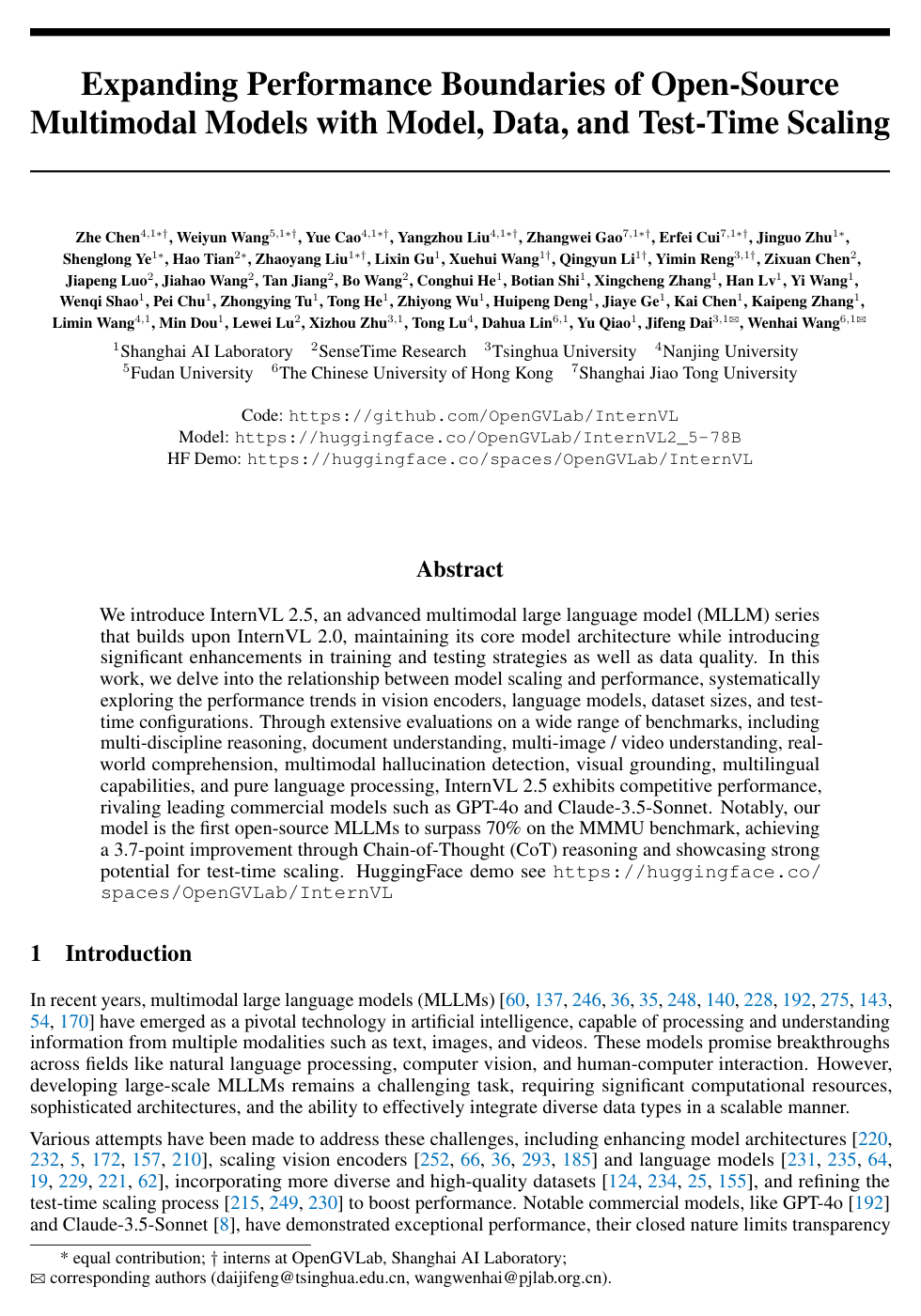
Expanding Performance Boundaries of Open-Source Multimodal Models with Model, Data, and Test-Time Scaling
Zhe Chen, Weiyun Wang, Yue Cao, Yang-Zhou Liu, Zhangwei Gao, Erfei Cui, Jinguo Zhu, Shenglong Ye, Hao Tian, Zhaoyang Liu, Lixin Gu, Xue-Hui Wang, Qing-Yun Li, Yi-Ming Ren, Zixuan Chen, Jia-Peng Luo, Jiahao Wang, Tan Jiang, Bo Wang, Conghui He, Botian Shi, Xingcheng Zhang, Han Lv, Yi Wang, Wenqi Shao, Pei Chu, Zhongying Tu, Tong He, Zhiyong Wu, Hui Deng, Jiaye Ge, Kaiming Chen, Min Dou, Lewei Lu, Xizhou Zhu, Tong Lu, Da-Hu Lin, Yunfeng Qiao, Jifeng Dai, Wenhai Wang
Why you should read this
Introduces InternVL 2.5, an open-source multimodal model series that rivals proprietary systems like GPT-4o and becomes the first open-source model to exceed 70% on the MMMU benchmark through model, data, and test-time scaling strategies.
We introduce InternVL 2.5, an advanced multimodal large language model (MLLM) series that builds upon InternVL 2.0, maintaining its core model architecture while introducing significant enhancements in training and testing strategies as well as data quality. In this work, we delve into the relationship between model scaling and performance, systematically exploring the performance trends in vision encoders, language models, dataset sizes, and test-time configurations. Through extensive evaluations on a wide range of benchmarks, including multi-discipline reasoning, document understanding, multi-image / video understanding, real-world comprehension, multimodal hallucination detection, visual grounding, multilingual capabilities, and pure language processing, InternVL 2.5 exhibits competitive performance, rivaling leading commercial models such as GPT-4o and Claude-3.5-Sonnet. Notably, our model is the first open-source MLLMs to surpass 70% on the MMMU benchmark, achieving a 3.7-point improvement through Chain-of-Thought (CoT) reasoning and showcasing strong potential for test-time scaling. We hope this model contributes to the open-source community by setting new standards for developing and applying multimodal AI systems. HuggingFace demo see this https URL
Added
2026-09-24
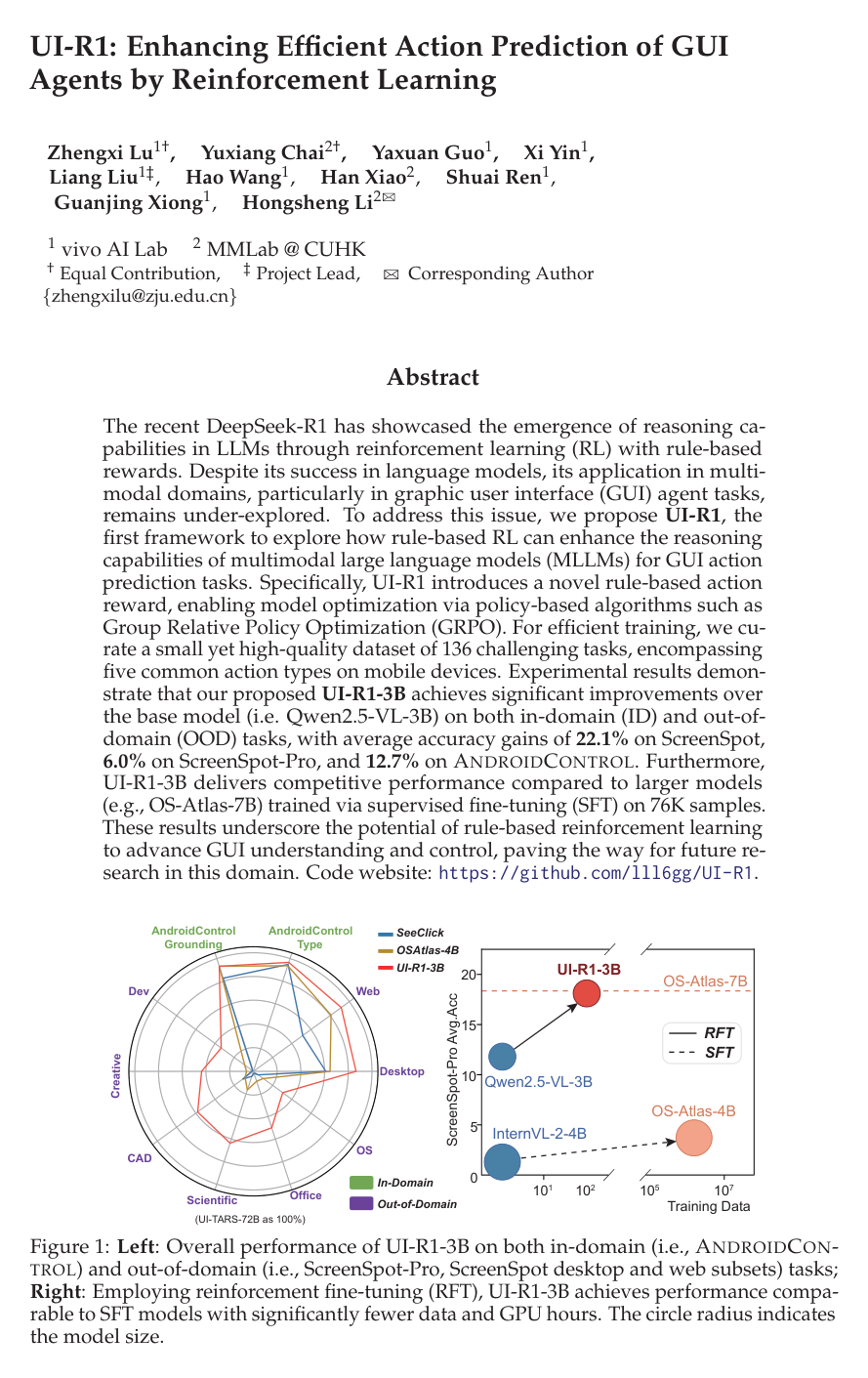
UI-R1: Enhancing Efficient Action Prediction of GUI Agents by Reinforcement Learning
Zhengxi Lu, Yuxiang Chai, Yaxuan Guo, Xi Yin, Liang Liu, Hao Wang, Han Xiao, Shuai Ren, Guanjing Xiong, Hongsheng Li
Why you should read this
Introduces UI-R1, the first framework demonstrating how rule-based reinforcement learning with a novel action reward significantly enhances multimodal large language models' reasoning capabilities for efficient and accurate GUI action prediction, outperforming larger supervised models on challenging in-domain and out-of-domain tasks.
The recent DeepSeek-R1 has showcased the emergence of reasoning capabilities in LLMs through reinforcement learning (RL) with rule-based rewards. Despite its success in language models, its application in multi-modal domains, particularly in graphic user interface (GUI) agent tasks, remains under-explored. To address this issue, we propose UI-R1, the first framework to explore how rule-based RL can enhance the reasoning capabilities of multimodal large language models (MLLMs) for GUI action prediction tasks. Specifically, UI-R1 introduces a novel rule-based action reward, enabling model optimization via policy-based algorithms such as Group Relative Policy Optimization (GRPO). For efficient training, we curate a small yet high-quality dataset of 136 challenging tasks, encompassing five common action types on mobile devices. Experimental results demonstrate that our proposed UI-R1-3B achieves significant improvements over the base model (i.e. Qwen2.5-VL-3B) on both in-domain (ID) and out-of-domain (OOD) tasks, with average accuracy gains of 22.1% on ScreenSpot, 6.0% on ScreenSpot-Pro, and 12.7% on ANDROIDCONTROL. Furthermore, UI-R1-3B delivers competitive performance compared to larger models (e.g., OS-Atlas-7B) trained via supervised fine-tuning (SFT) on 76K samples. We additionally develop an optimized version, UI-R1-E-3B, which significantly improves both grounding efficiency and accuracy. These results underscore the potential of rule-based reinforcement learning to advance GUI understanding and control, paving the way for future research in this domain. Code website: this https URL.
Added
2026-05-16
