
keyword
large-scale pretraining
Large-scale pretraining is the initial training of a machine-learning model on a very large dataset so it learns broadly useful patterns or representations before being adapted to specific tasks. It can use labeled, weakly labeled, or unlabeled data and may involve large models, extensive computation, or both.
4 items
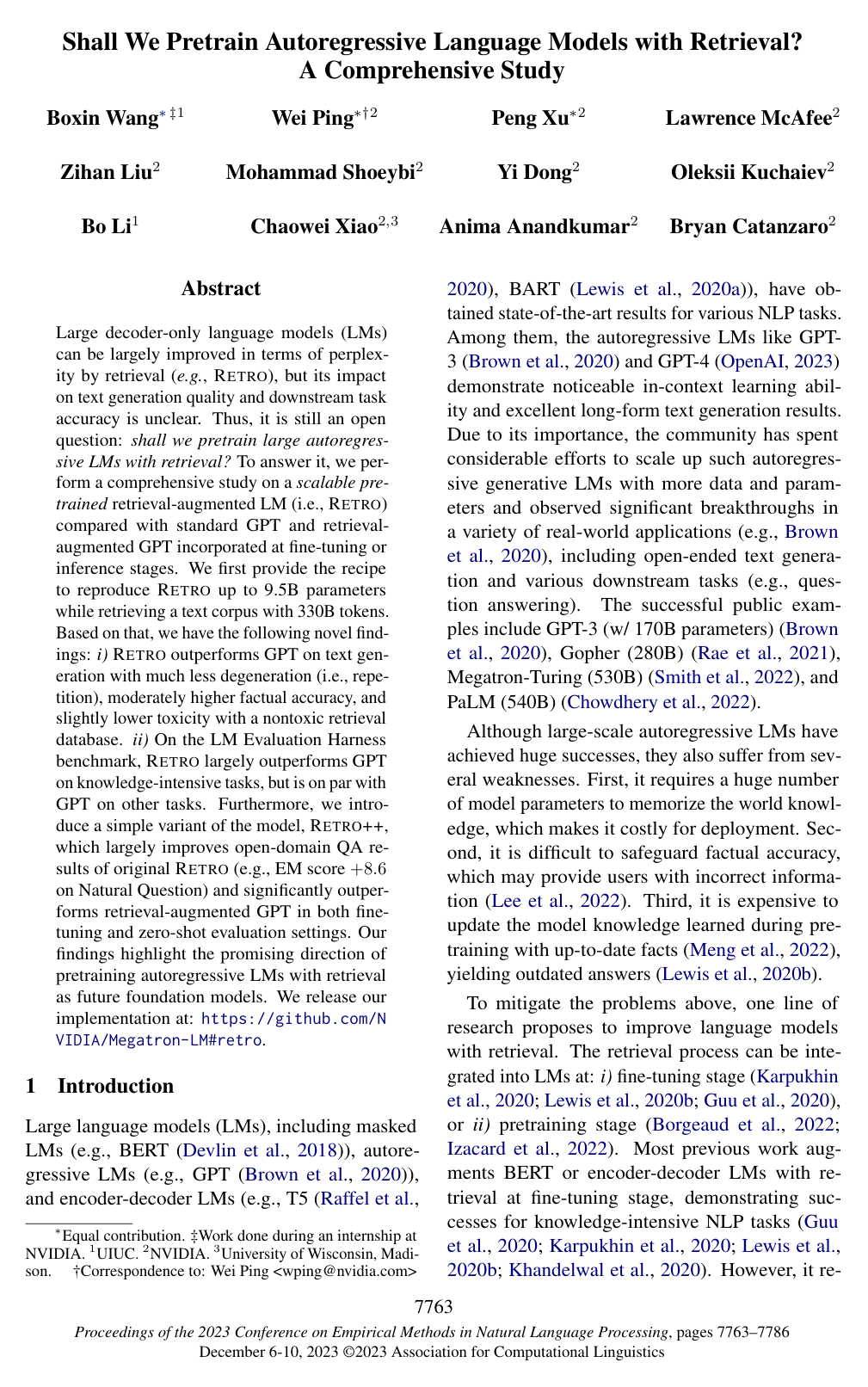
Shall We Pretrain Autoregressive Language Models with Retrieval? A Comprehensive Study
Boxin Wang, Wei Ping, Peng Xu, Lawrence McAfee, Zihan Liu, Mohammad Shoeybi, Yi Dong, Oleksii Kuchaiev, Bo Li, Chaowei Xiao, Anima Anandkumar, Bryan Catanzaro
Why you should read this
Demonstrates through scalable reproduction up to 9.5B parameters that pretraining autoregressive language models with retrieval substantially improves factual accuracy and downstream knowledge-intensive task performance over standard GPT baselines while introducing RETRO++ to boost open-domain question answering.
Added
2026-10-02
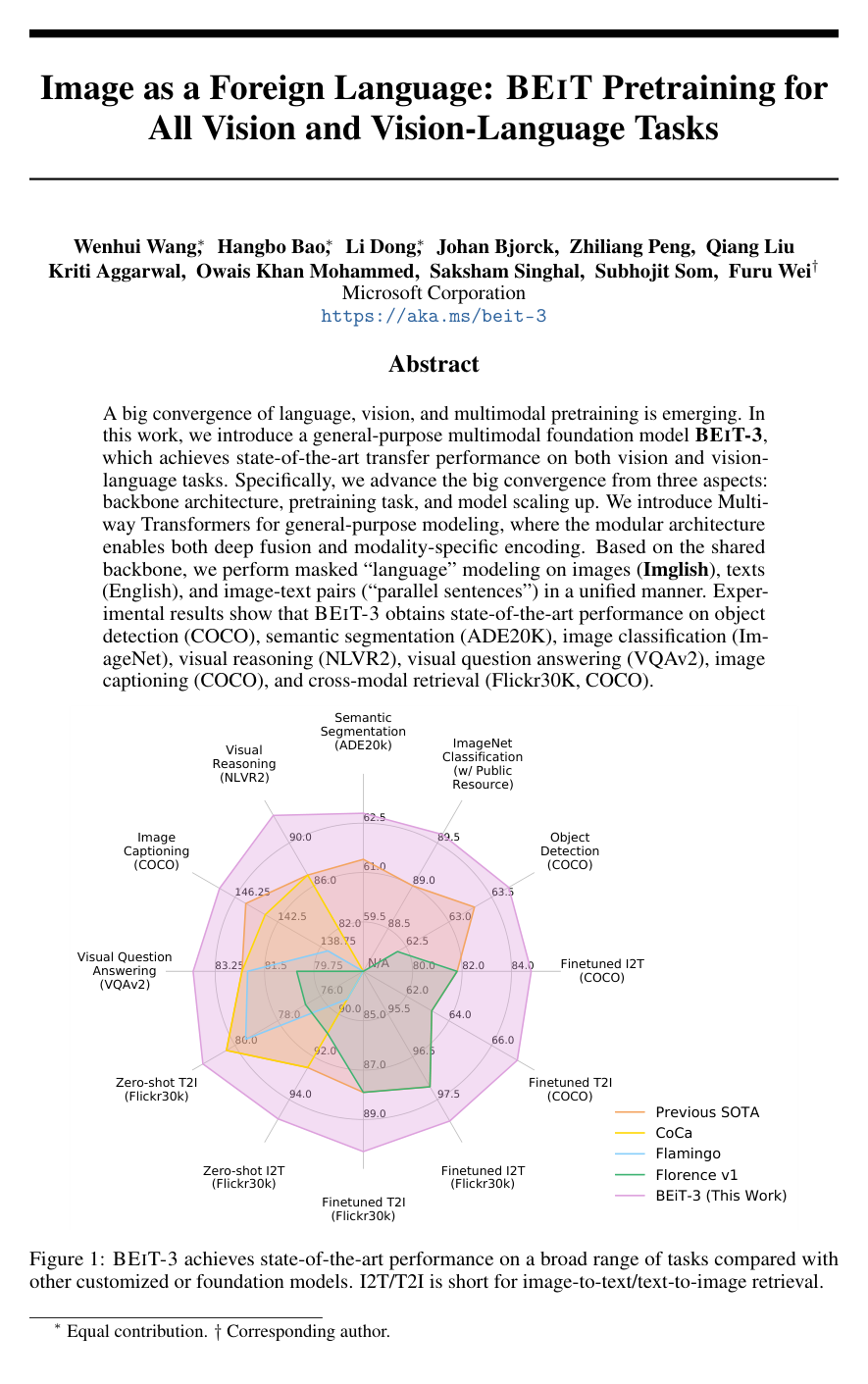
Image as a Foreign Language: BEIT Pretraining for Vision and Vision-Language Tasks
Wenhui Wang, Hangbo Bao, Li Dong, Johan Bjorck, Zhiliang Peng, Qiang Liu, Kriti Aggarwal, Owais Khan Mohammed, Saksham Singhal, Subhojit Som, Furu Wei
Why you should read this
Introduces BEiT-3, a unified multimodal foundation model that treats images as a foreign language and pretrains a Multiway Transformer via masked data modeling to achieve state-of-the-art transfer performance across major vision and vision-language benchmarks.
A big convergence of language, vision, and multimodal pretraining is emerging. In this work, we introduce a general-purpose multimodal foundation model BEiT-3, which achieves state-of-the-art transfer performance on both vision and vision-language tasks. Specifically, we advance the big convergence from three aspects: backbone architecture, pretraining task, and model scaling up. We introduce Multiway Transformers for general-purpose modeling, where the modular architecture enables both deep fusion and modality-specific encoding. Based on the shared backbone, we perform masked "language" modeling on images (Imglish), texts (English), and image-text pairs ("parallel sentences") in a unified manner. Experimental results show that BEiT-3 obtains state-of-the-art performance on object detection (COCO), semantic segmentation (ADE20K), image classification (ImageNet), visual reasoning (NLVR2), visual question answering (VQAv2), image captioning (COCO), and cross-modal retrieval (Flickr30K, COCO).
Added
2026-09-26
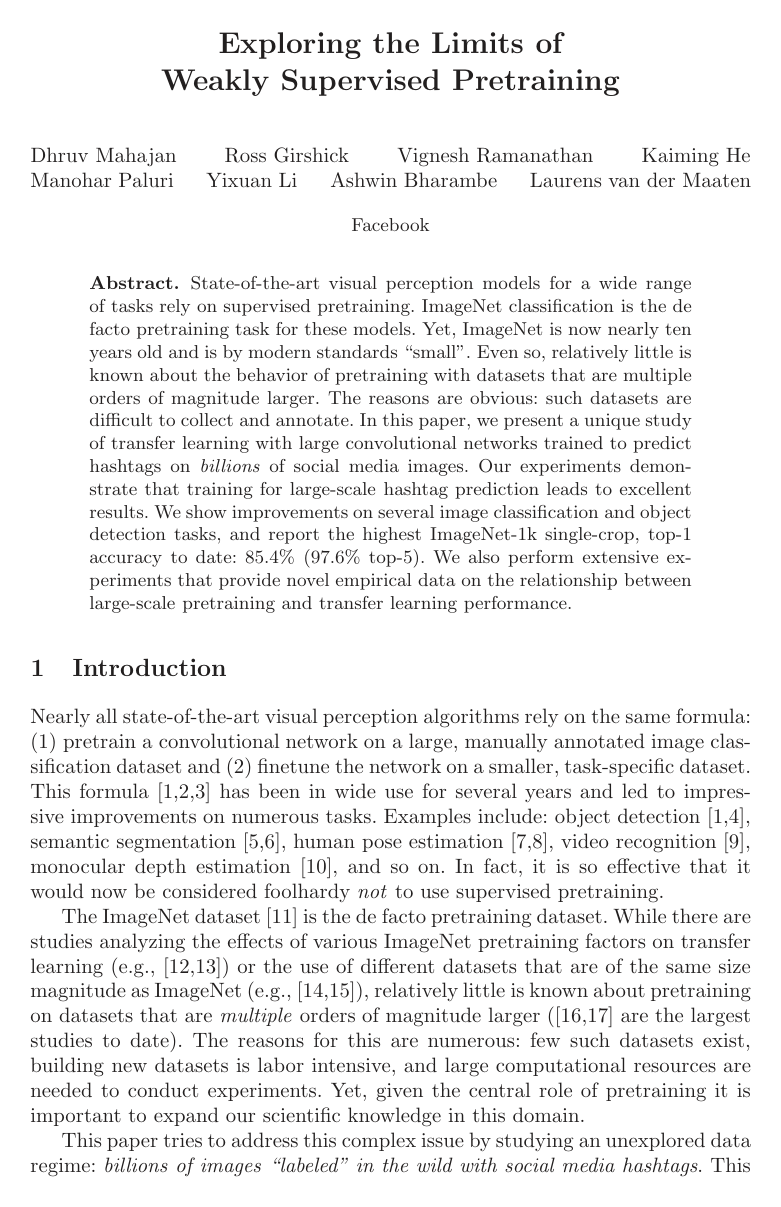
Exploring the Limits of Weakly Supervised Pretraining
Dhruv Mahajan, Ross Girshick, Vignesh Ramanathan, Kaiming He, Manohar Paluri, Yixuan Li, Ashwin Bharambe, Laurens van der Maaten
Why you should read this
Demonstrates that pretraining convolutional networks on billions of weakly supervised hashtagged social media images sets new state-of-the-art benchmarks across standard image classification and object detection tasks, including an 85.4% top-1 accuracy on ImageNet.
State-of-the-art visual perception models for a wide range of tasks rely on supervised pretraining. ImageNet classification is the de facto pretraining task for these models. Yet, ImageNet is now nearly ten years old and is by modern standards "small". Even so, relatively little is known about the behavior of pretraining with datasets that are multiple orders of magnitude larger. The reasons are obvious: such datasets are difficult to collect and annotate. In this paper, we present a unique study of transfer learning with large convolutional networks trained to predict hashtags on billions of social media images. Our experiments demonstrate that training for large-scale hashtag prediction leads to excellent results. We show improvements on several image classification and object detection tasks, and report the highest ImageNet-1k single-crop, top-1 accuracy to date: 85.4% (97.6% top-5). We also perform extensive experiments that provide novel empirical data on the relationship between large-scale pretraining and transfer learning performance.
Added
2026-09-25
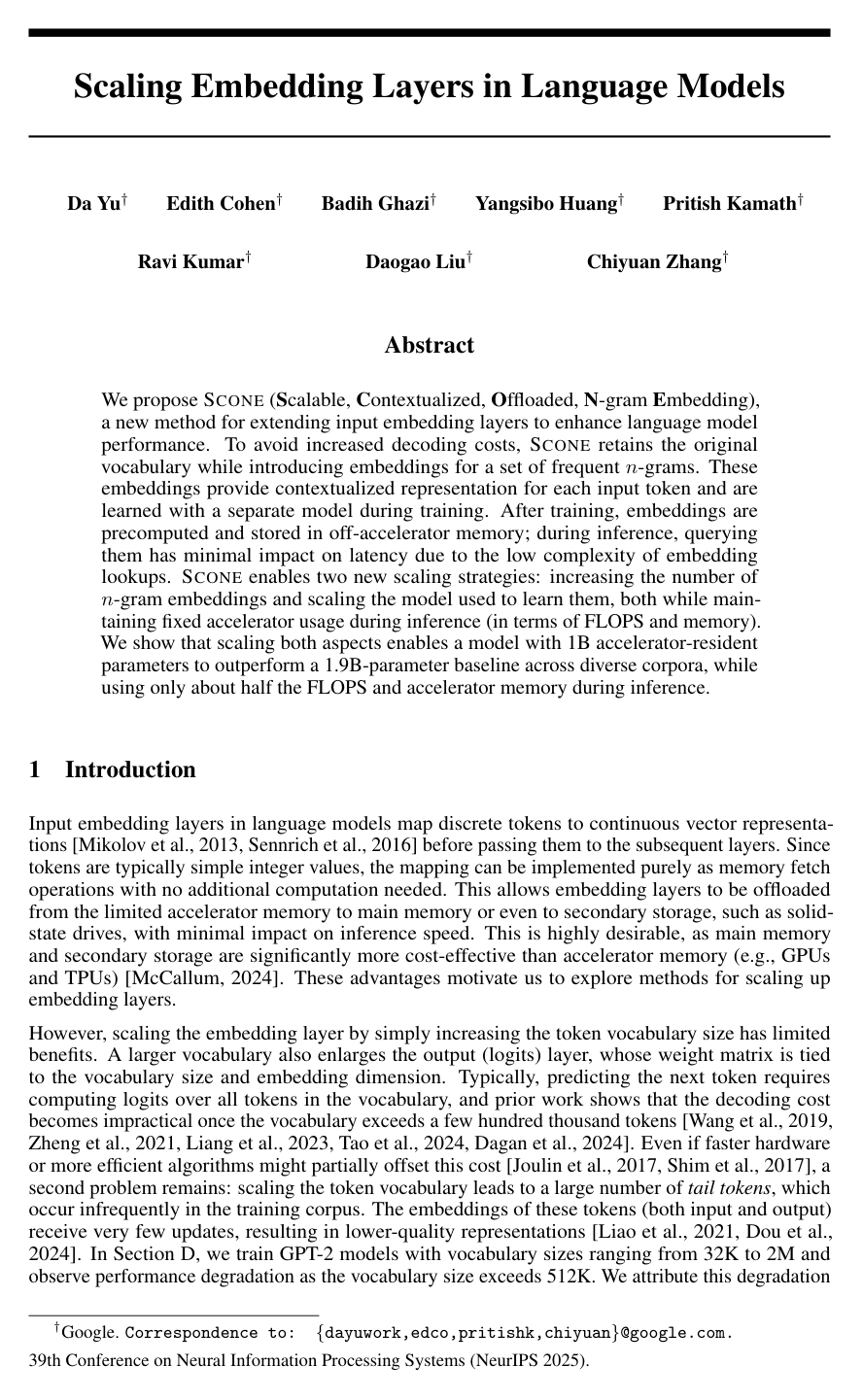
Scaling Embedding Layers in Language Models
Da Yu, Edith Cohen, Badih Ghazi, Yangsibo Huang, Pritish Kamath, Ravi Kumar, Daogao Liu, Chiyuan Zhang
Why you should read this
Introduces SCONE, a scalable method for enhancing language models by offloading frequent n-gram embeddings to system memory, allowing a 1B-parameter model to outperform a 1.9B-parameter baseline while using half the inference-time accelerator resources.
We propose (calable, ontextualized, ffloaded, -gram mbedding), a new method for extending input embedding layers to enhance language model performance. To avoid increased decoding costs, retains the original vocabulary while introducing embeddings for a set of frequent n-grams. These embeddings provide contextualized representation for each input token and are learned with a separate model during training. After training, embeddings are precomputed and stored in off-accelerator memory; during inference, querying them has minimal impact on latency due to the low complexity of embedding lookups. enables two new scaling strategies: increasing the number of n-gram embeddings and scaling the model used to learn them, both while maintaining fixed accelerator usage during inference (in terms of FLOPS and memory). We show that scaling both aspects enables a model with 1B accelerator-resident parameters to outperform a 1.9B-parameter baseline across diverse corpora, while using only about half the FLOPS and accelerator memory during inference.
Added
2026-02-01