
Built independently by an author, for readers. Read the story and support ChapterPal

keyword

large deformation metric mappings

Large deformation metric mappings refer to a mathematical framework in computational anatomy and image registration used to compute smooth, invertible transformations between complex shapes, surfaces, or images undergoing substantial geometric variations. The method models these transformations as dynamic flows of time-dependent velocity vector fields generated along geodesic curves within an infinite-dimensional space of diffeomorphisms, ensuring that the deformed objects maintain their underlying topological integrity without tearing or folding. By framing the matching process as a variational optimization problem that minimizes both deformation energy and structural mismatch, the framework establishes a rigorous Riemannian metric distance between anatomical structures based on the shortest transformation path connecting them.

1 item
Computing Large Deformation Metric Mappings via Geodesic Flows of Diffeomorphisms

Computing Large Deformation Metric Mappings via Geodesic Flows of Diffeomorphisms

MIRZA FAISAL BEG, MICHAEL I. MILLER, ALAIN TROUVÉ, LAURENT YOUNES

OrganizationsENS Paris-SaclayJohns Hopkins UniversitySimon Fraser University

Why you should read this

Develops the algorithmic and mathematical foundation for large deformation diffeomorphic metric mapping by deriving Euler-Lagrange equations and implementing a semi-Lagrangian particle flow method to compute shortest-path geodesic transformations between anatomical images.

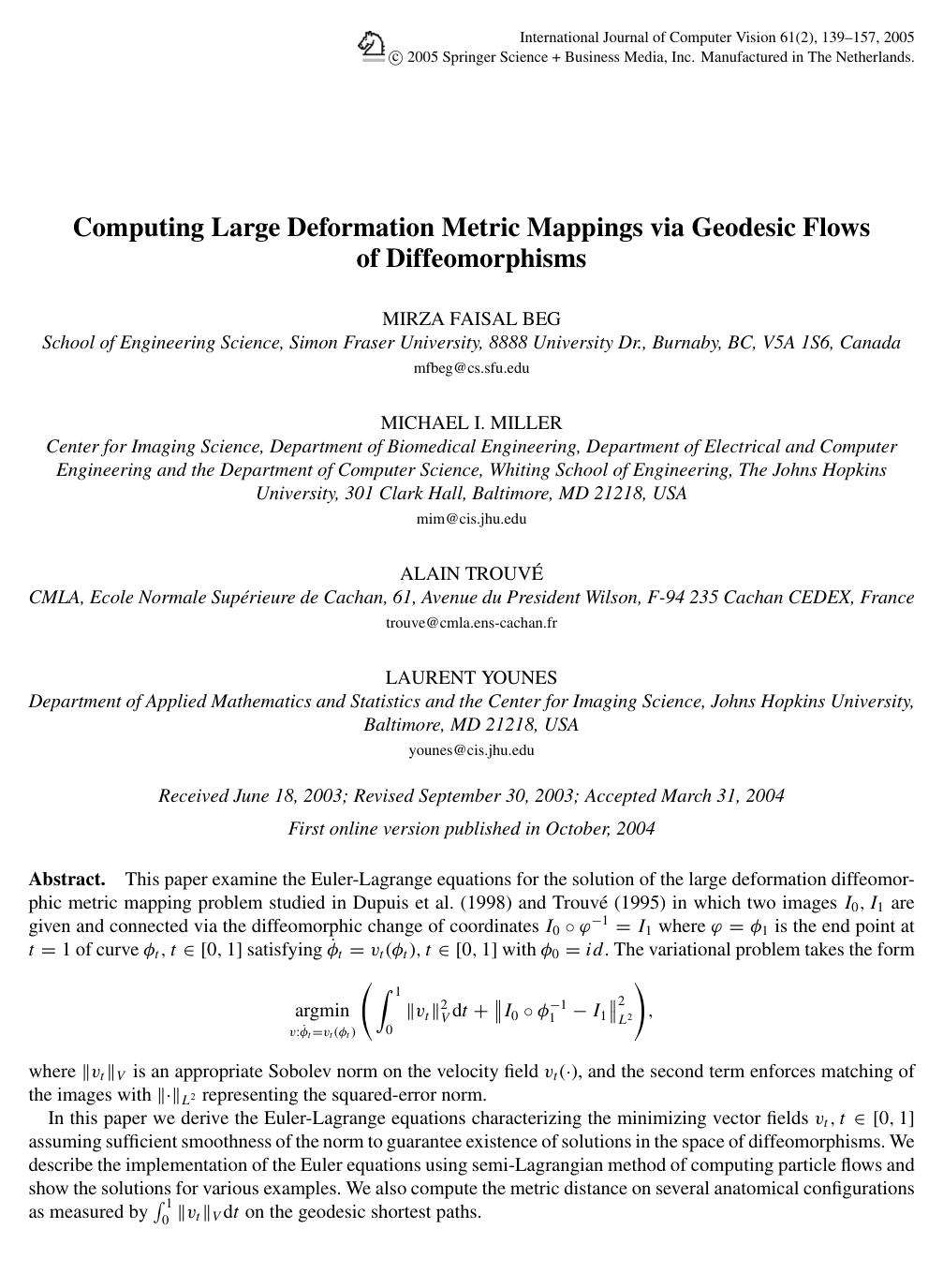
This paper examine the Euler-Lagrange equations for the solution of the large deformation diffeomorphic metric mapping problem studied in Dupuis et al. (1998) and Trouvé (1995) in which two images I0, I1 are given and connected via the diffeomorphic change of coordinates I0 ∘ φ−1 = I1 where φ = ϕ1 is the end point at t = 1 of curve ϕt, t ∈ [0, 1] satisfying ϕ̇t = vt(ϕt), t ∈ [0, 1] with ϕ0 = id. The variational problem takes the form argmin v:ϕ̇t=vt(ϕt) ( ∫0^1 ‖vt‖_V^2 dt + ‖I0 ∘ ϕ_1^−1 − I1‖_L^2^2 ), where ‖vt‖_V is an appropriate Sobolev norm on the velocity field vt(·), and the second term enforces matching of the images with ‖·‖_L^2 representing the squared-error norm. In this paper we derive the Euler-Lagrange equations characterizing the minimizing vector fields vt, t ∈ [0, 1] assuming sufficient smoothness of the norm to guarantee existence of solutions in the space of diffeomorphisms. We describe the implementation of the Euler equations using semi-Lagrangian method of computing particle flows and show the solutions for various examples. We also compute the metric distance on several anatomical configurations as measured by ∫0^1 ‖vt‖_V dt on the geodesic shortest paths.

Added

2026-09-18