
keyword
language model hallucinations
Language model hallucinations refer to instances where an artificial intelligence text model produces outputs that are factually incorrect, unfaithful to provided input, or entirely fabricated, despite presenting the information in a fluent, plausible, and confident manner. This phenomenon arises from the probabilistic nature of text generation, where models predict coherent sequences of words based on learned statistical patterns rather than genuine comprehension or verified knowledge retrieval. Hallucinations can manifest as minor factual errors, misattributed details, fabricated citations, or flawed multi-step reasoning that compounds over the course of an explanation. Because these errors often appear linguistically polished and convincing, they represent a fundamental challenge to the factual accuracy and dependability of language models in practical applications.
3 items
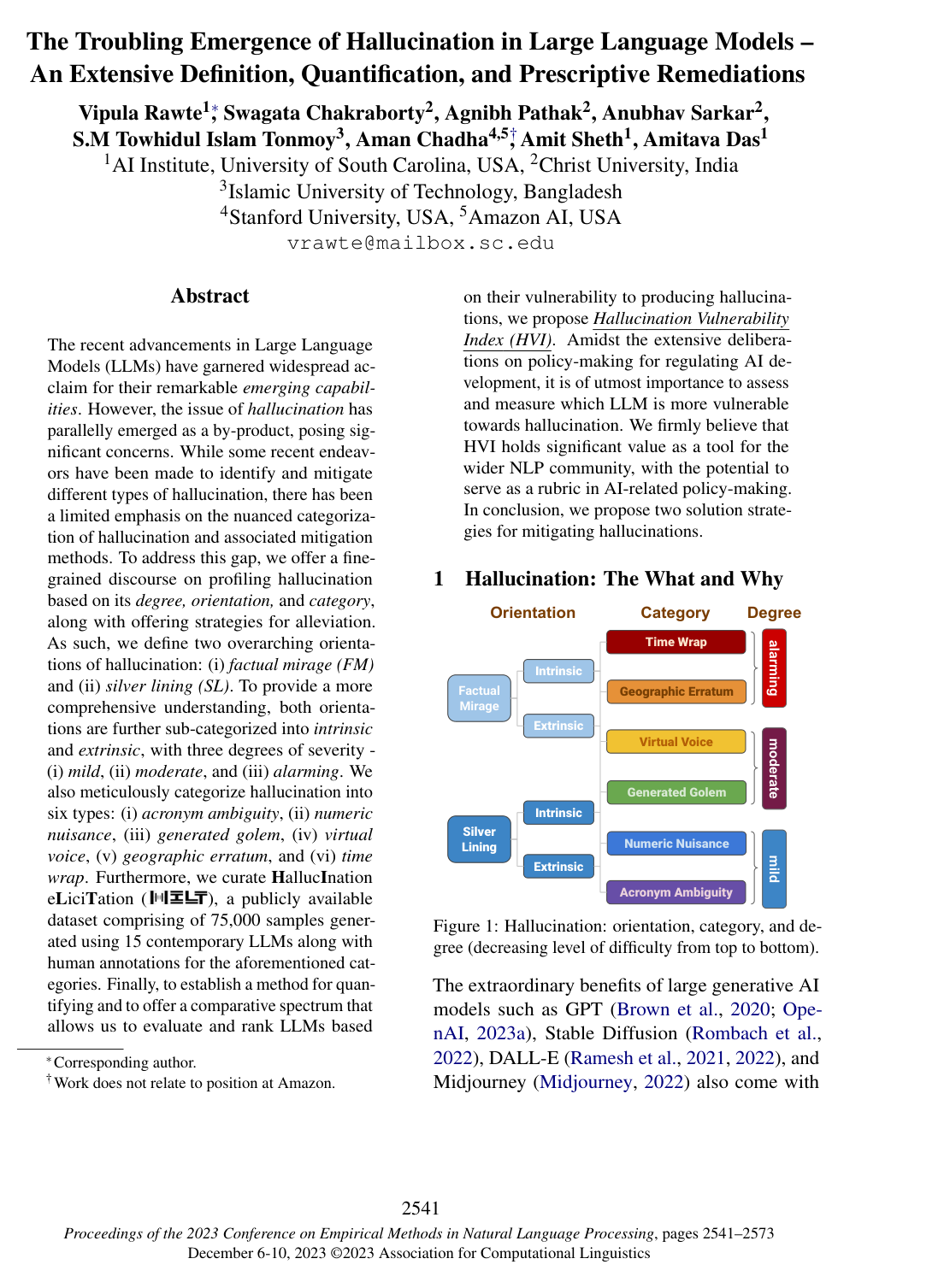
The Troubling Emergence of Hallucination in Large Language Models - An Extensive Definition, Quantification, and Prescriptive Remediations
Vipula Rawte, Swagata Chakraborty, Agnibh Pathak, Anubhav Sarkar, S. M. Towhidul Islam Tonmoy, Aman Chadha, Amit P. Sheth, Amitava Das
Why you should read this
Establishes a systematic taxonomy of language model hallucinations alongside a 75,000-sample human-annotated dataset, a vulnerability index to benchmark fifteen models, and targeted mitigation strategies for unfaithful generations.
The recent advancements in Large Language Models (LLMs) have garnered widespread acclaim for their remarkable emerging capabilities. However, the issue of hallucination has parallelly emerged as a by-product, posing significant concerns. While some recent endeavors have been made to identify and mitigate different types of hallucination, there has been a limited emphasis on the nuanced categorization of hallucination and associated mitigation methods. To address this gap, we offer a fine-grained discourse on profiling hallucination based on its degree, orientation, and category, along with offering strategies for alleviation. As such, we define two overarching orientations of hallucination: (i) factual mirage (FM) and (ii) silver lining (SL). To provide a more comprehensive understanding, both orientations are further sub-categorized into intrinsic and extrinsic, with three degrees of severity - (i) mild, (ii) moderate, and (iii) alarming. We also meticulously categorize hallucination into six types: (i) acronym ambiguity, (ii) numeric nuisance, (iii) generated golem, (iv) virtual voice, (v) geographic erratum, and (vi) time wrap. Furthermore, we curate Hallucination eLicitation (H-ELT), a publicly available dataset comprising of 75,000 samples generated using 15 contemporary LLMs along with human annotations for the aforementioned categories. Finally, to establish a method for quantifying and to offer a comparative spectrum that allows us to evaluate and rank LLMs based on their vulnerability to producing hallucinations, we propose Hallucination Vulnerability Index (HVI). Amidst the extensive deliberations on policy-making for regulating AI development, it is of utmost importance to assess and measure which LLM is more vulnerable towards hallucination. We firmly believe that HVI holds significant value as a tool for the wider NLP community, with the potential to serve as a rubric in AI-related policy-making. In conclusion, we propose two solution strategies for mitigating hallucinations.
Added
2026-10-05
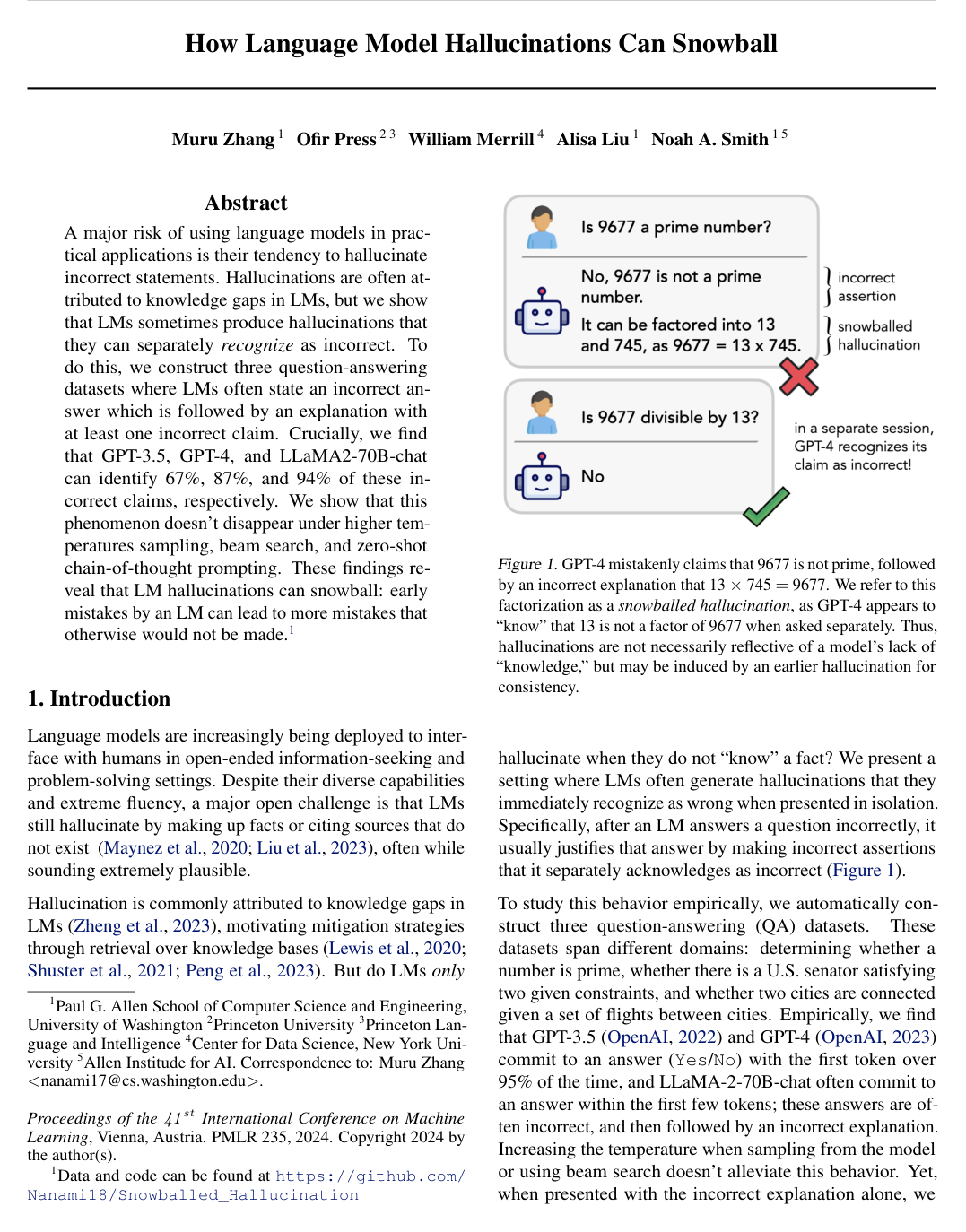
How Language Model Hallucinations Can Snowball
Muru Zhang, Ofir Press, William Merrill, Alisa Liu, Noah A. Smith
Why you should read this
Reveals that large language models frequently invent false justifications to maintain consistency with their own earlier mistakes, generating secondary errors that they are otherwise capable of correctly identifying as false in isolation.
A major risk of using language models in practical applications is their tendency to hallucinate incorrect statements. Hallucinations are often attributed to knowledge gaps in LMs, but we show that LMs sometimes produce hallucinations that they can separately recognize as incorrect. To do this, we construct three question-answering datasets where LMs often state an incorrect answer which is followed by an explanation with at least one incorrect claim. Crucially, we find that GPT-3.5, GPT-4, and LLaMA2-70B-chat can identify 67%, 87%, and 94% of these incorrect claims, respectively. We show that this phenomenon doesn’t disappear under higher temperatures sampling, beam search, and zero-shot chain-of-thought prompting. These findings reveal that LM hallucinations can snowball: early mistakes by an LM can lead to more mistakes that otherwise would not be made.
Added
2026-09-28
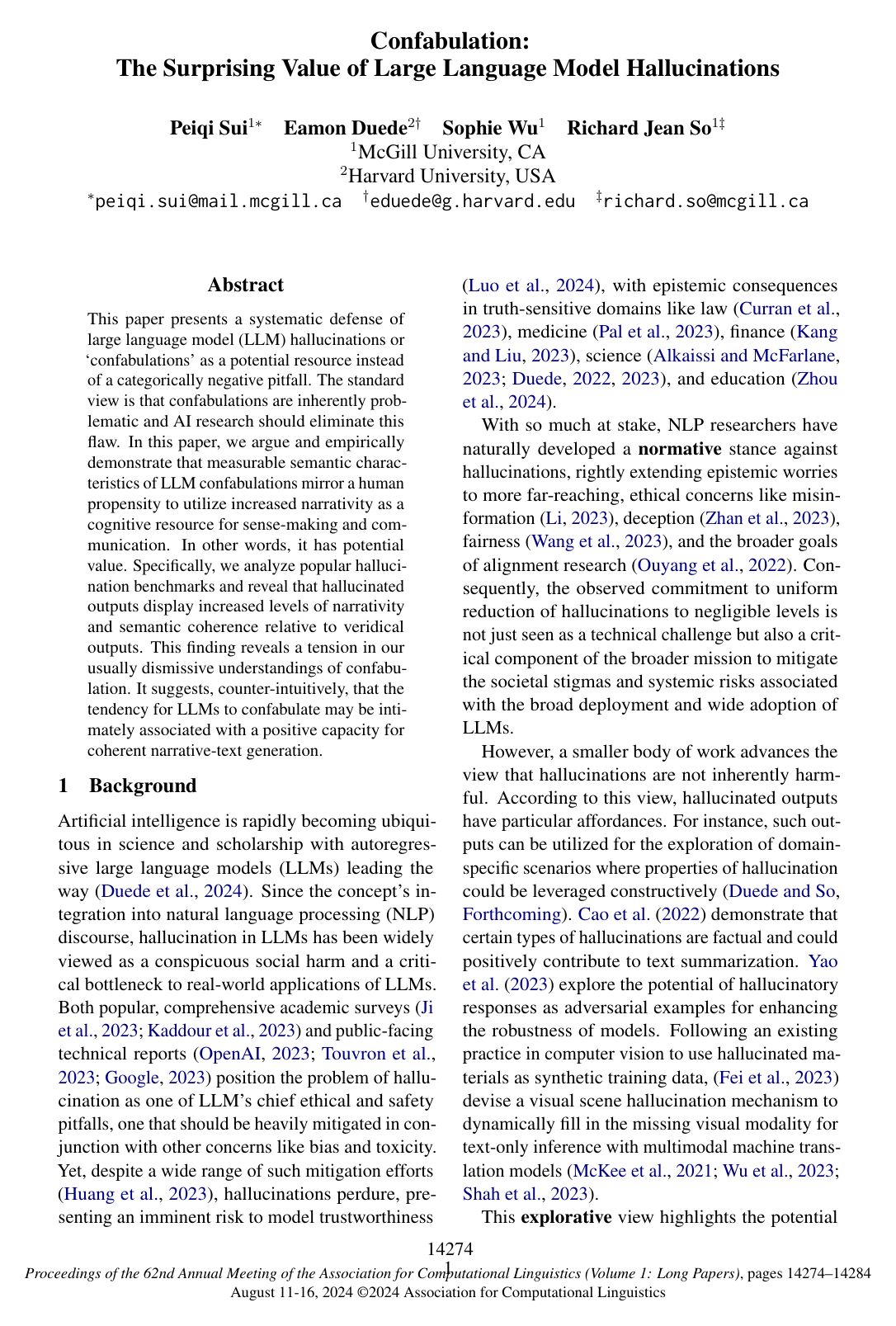
Confabulation: The Surprising Value of Large Language Model Hallucinations
Peiqi Sui, Eamon Duede, Sophie Wu, Richard Jean So
Why you should read this
Demonstrates that large language model hallucinations exhibit higher narrativity and semantic coherence than factual outputs, reframing these errors as confabulations that drive coherent story generation rather than purely harmful flaws.
This paper presents a systematic defense of large language model (LLM) hallucinations or ‘confabulations’ as a potential resource instead of a categorically negative pitfall. The standard view is that confabulations are inherently problematic and AI research should eliminate this flaw. In this paper, we argue and empirically demonstrate that measurable semantic characteristics of LLM confabulations mirror a human propensity to utilize increased narrativity as a cognitive resource for sense-making and communication. In other words, it has potential value. Specifically, we analyze popular hallucination benchmarks and reveal that hallucinated outputs display increased levels of narrativity and semantic coherence relative to veridical outputs. This finding reveals a tension in our usually dismissive understandings of confabulation. It suggests, counter-intuitively, that the tendency for LLMs to confabulate may be intimately associated with a positive capacity for coherent narrative-text generation.
Added
2026-09-26