Built independently by an author, for readers. Read the story and support ChapterPal

keyword

language model-based evaluation

Language model-based evaluation is an assessment method in artificial intelligence where a language model is employed to analyze, score, or compare the quality of generated text or the performance of other models. Unlike traditional reference-matching metrics that rely strictly on word overlap, this approach leverages the semantic understanding and instruction-following abilities of language models to evaluate complex criteria such as coherence, factual accuracy, helpfulness, and style. Common implementations include direct scoring against predefined rubrics, pairwise ranking of competing outputs, and generating explanatory critiques. While it offers a scalable, automated alternative or supplement to human evaluation, practitioners often monitor and calibrate evaluator models to address potential biases, inconsistencies, and discrepancies with human judgment.

1 item

Prometheus 2: An Open Source Language Model Specialized in Evaluating Other Language Models

Prometheus 2: An Open Source Language Model Specialized in Evaluating Other Language Models

Seungone Kim, Juyoung Suk, Shayne Longpre, Bill Yuchen Lin, Jamin Shin, Sean Welleck, Graham Neubig, Moontae Lee, Kyungjae Lee, Minjoon Seo

OrganizationsAllen Institute for AICarnegie Mellon UniversityKorea Advanced Institute of Science and TechnologyLG AI ResearchMassachusetts Institute of TechnologyUniversity of Illinois Chicago

Why you should read this

Presents Prometheus 2, an open-source evaluator language model that handles both direct assessment and pairwise ranking with custom criteria by merging models trained on separate evaluation formats, closely mirroring human and GPT-4 judgments.

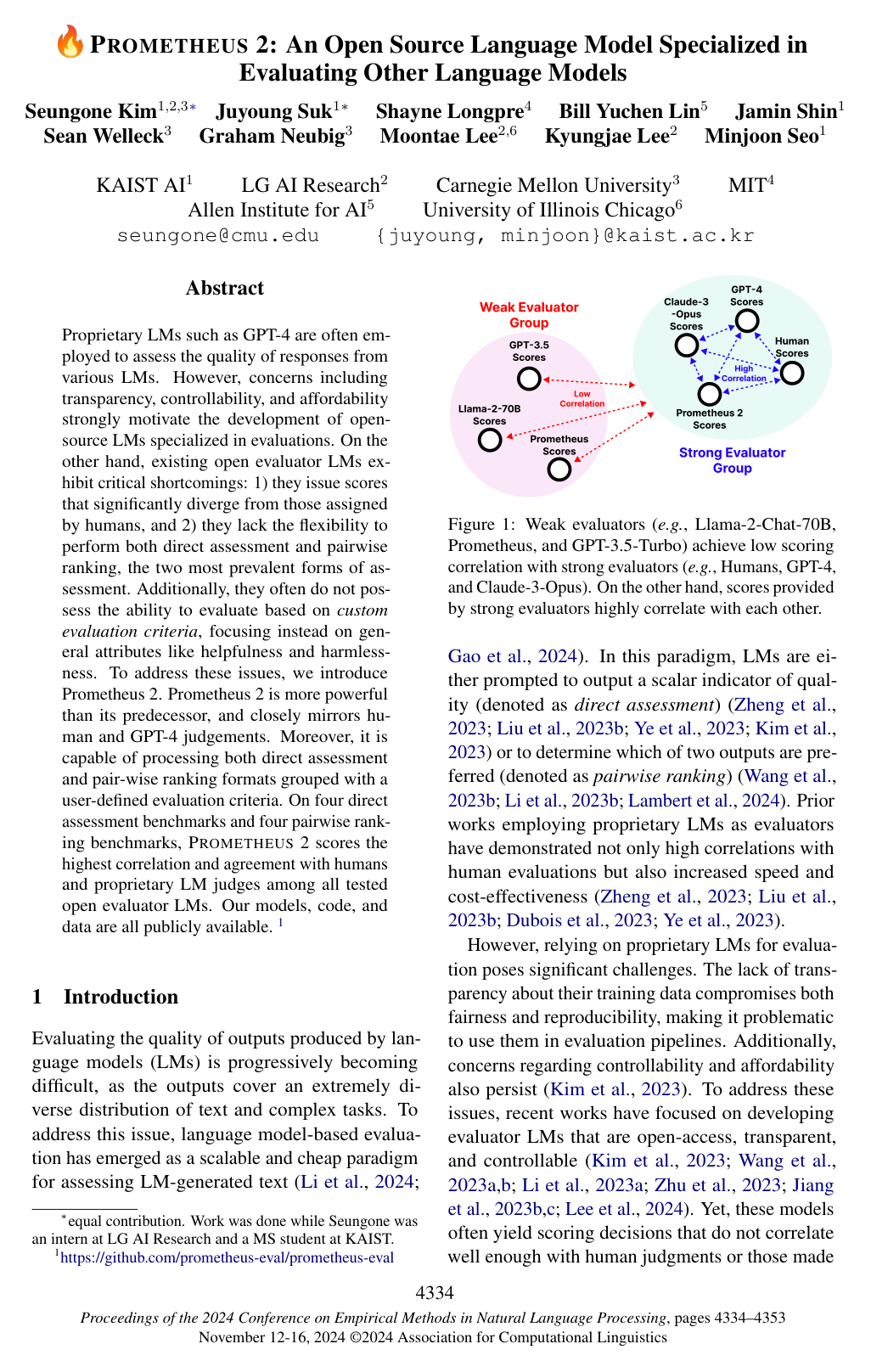
Proprietary LMs such as GPT-4 are often employed to assess the quality of responses from various LMs. However, concerns including transparency, controllability, and affordability strongly motivate the development of open-source LMs specialized in evaluations. On the other hand, existing open evaluator LMs exhibit critical shortcomings: 1) they issue scores that significantly diverge from those assigned by humans, and 2) they lack the flexibility to perform both direct assessment and pairwise ranking, the two most prevalent forms of assessment. Additionally, they often do not possess the ability to evaluate based on *custom evaluation criteria*, focusing instead on general attributes like helpfulness and harmlessness. To address these issues, we introduce Prometheus 2. Prometheus 2 is more powerful than its predecessor, and closely mirrors human and GPT-4 judgements. Moreover, it is capable of processing both direct assessment and pair-wise ranking formats grouped with a user-defined evaluation criteria. On four direct assessment benchmarks and four pairwise ranking benchmarks, PROMETHEUS 2 scores the highest correlation and agreement with humans and proprietary LM judges among all tested open evaluator LMs. Our models, code, and data are all publicly available. 1

Added

2026-09-28