
keyword
language generation
Language generation, often called natural language generation, is a subfield of artificial intelligence and computational linguistics focused on the automated production of coherent, contextually appropriate, and grammatically structured human text or speech. It encompasses transforming non-linguistic structured data, semantic representations, or textual prompts into fluent natural language. While early approaches relied on rule-based templates and statistical algorithms, contemporary language generation primarily utilizes deep neural networks, such as autoregressive transformer architectures and diffusion models, trained on extensive text corpora. This technology underpins a wide range of applications, including machine translation, automated summarization, conversational agents, and creative writing, while involving ongoing considerations around output controllability, factual consistency, and safety.
9 items
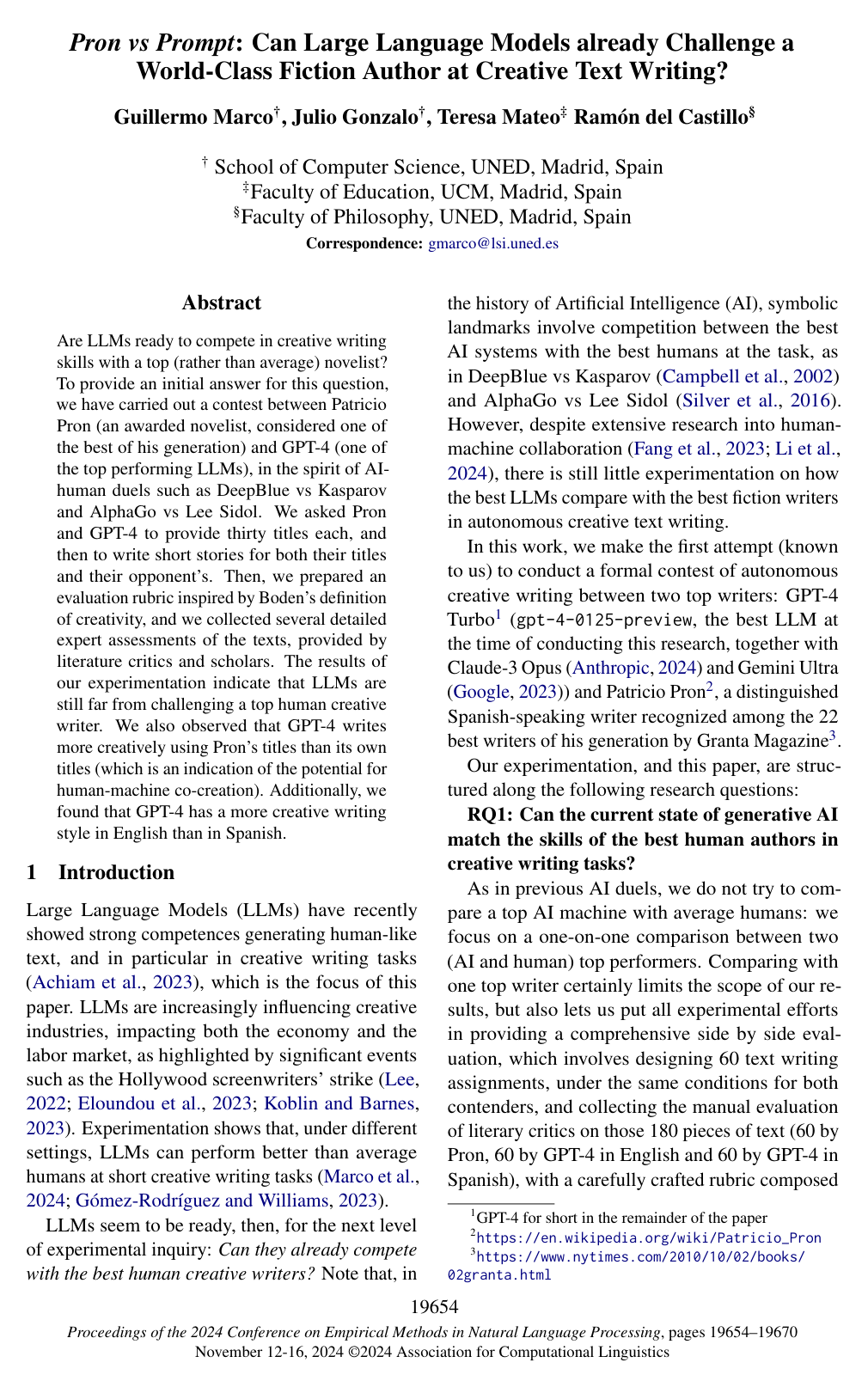
Pron vs Prompt: Can Large Language Models already Challenge a World-Class Fiction Author at Creative Text Writing?
Guillermo Marco, Julio Gonzalo, María Teresa Mateo Girona, Ramón Santos
Why you should read this
Demonstrates that state-of-the-art language models remain far behind elite human authors in creative fiction through a head-to-head contest between GPT-4 and an award-winning novelist evaluated across 5,400 expert literary assessments.
It has become routine to report research results where Large Language Models (LLMs) outperform average humans in a wide range of language-related tasks, and creative text writing is no exception. It seems natural, then, to raise the bid: Are LLMs ready to compete in creative writing skills with a top (rather than average) novelist? To provide an initial answer for this question, we have carried out a contest between Patricio Pron (an awarded novelist, considered one of the best of his generation) and GPT-4 (one of the top performing LLMs), in the spirit of AI-human duels such as DeepBlue vs Kasparov and AlphaGo vs Lee Sidol. We asked Pron and GPT-4 to provide thirty titles each, and then to write short stories for both their titles and their opponent's. Then, we prepared an evaluation rubric inspired by Boden's definition of creativity, and we collected 5,400 manual assessments provided by literature critics and scholars. The results of our experimentation indicate that LLMs are still far from challenging a top human creative writer, and that reaching such level of autonomous creative writing skills probably cannot be reached simply with larger language models.
Added
2026-10-05
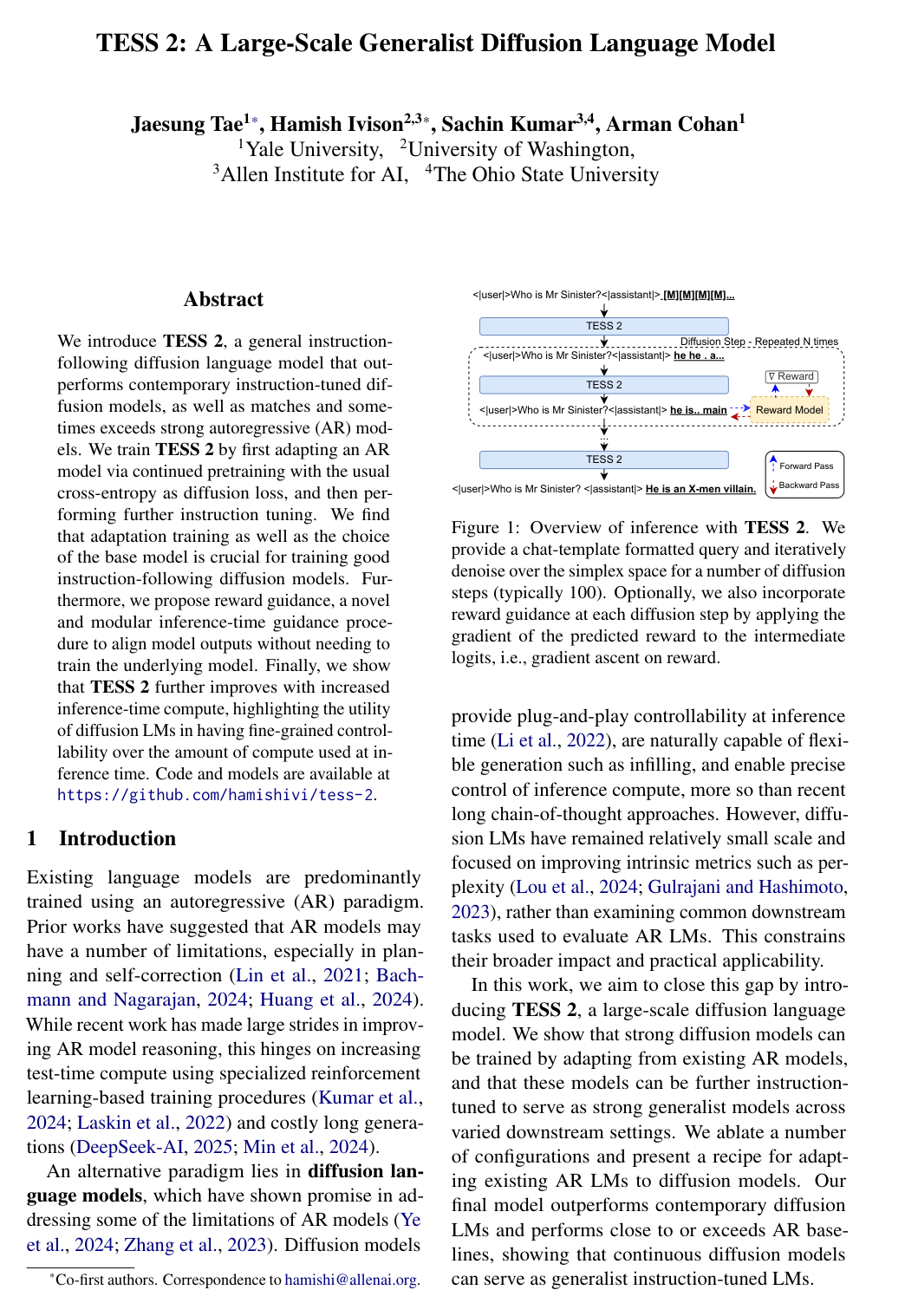
TESS 2: A Large-Scale Generalist Diffusion Language Model
Jaesung Tae, Hamish Ivison, Sachin Kumar, Arman Cohan
Why you should read this
Presents a method for adapting autoregressive models into competitive instruction-following diffusion language models that support modular, training-free reward guidance and scale effectively with inference-time compute.
We introduce TESS 2, a general instruction-following diffusion language model that outperforms contemporary instruction-tuned diffusion models, as well as matches and sometimes exceeds strong autoregressive (AR) models. We train TESS 2 by first adapting a strong AR model via continued pretraining with the usual cross-entropy as diffusion loss, and then performing further instruction tuning. We find that adaptation training as well as the choice of the base model is crucial for training good instruction-following diffusion models. We further propose reward guidance, a novel and modular inference-time guidance procedure to align model outputs without needing to train the underlying model. Finally, we show that TESS 2 further improves with increased inference-time compute, highlighting the utility of diffusion LMs in having fine-grained controllability over the amount of compute used at inference time. Code and models are available at this https URL.
Added
2026-10-04
Latent Diffusion for Language Generation
Justin Lovelace, Varsha Kishore, Chao Wan, Eliot Shekhtman, Kilian Q. Weinberger
Why you should read this
Presents a framework that applies continuous diffusion models within the compact latent space of pretrained encoder-decoder language models, outperforming existing text diffusion methods across conditional and sequence-to-sequence generation tasks with significantly fewer sampling steps.
Diffusion models have achieved great success in modeling continuous data modalities such as images, audio, and video, but have seen limited use in discrete domains such as language. Recent attempts to adapt diffusion to language have presented diffusion as an alternative to existing pretrained language models. We view diffusion and existing language models as complementary. We demonstrate that encoder-decoder language models can be utilized to efficiently learn high-quality language autoencoders. We then demonstrate that continuous diffusion models can be learned in the latent space of the language autoencoder, enabling us to sample continuous latent representations that can be decoded into natural language with the pretrained decoder. We validate the effectiveness of our approach for unconditional, class-conditional, and sequence-to-sequence language generation. We demonstrate across multiple diverse data sets that our latent language diffusion models are significantly more effective than previous diffusion language models. Our code is available at https://github.com/justinlovelace/latent-diffusion-for-language.
Added
2026-10-01
Scaling Language Models: Methods, Analysis & Insights from Training Gopher
Jack W. Rae, Sebastian Borgeaud, Trevor Cai, Katie Millican, Jordan Hoffmann, Francis Song, John Aslanides, Sarah Henderson, Roman Ring, Susannah Young, Eliza Rutherford, Tom Hennigan, Jacob Menick, Albin Cassirer, Richard Powell, George van den Driessche, Lisa Anne Hendricks, Maribeth Rauh, Po-Sen Huang, Amelia Glaese, Johannes Welbl, Sumanth Dathathri, Saffron Huang, Jonathan Uesato, John Mellor, Irina Higgins, Antonia Creswell, Nat McAleese, Amy Wu, Erich Elsen, Siddhant Jayakumar, Elena Buchatskaya, David Budden, Esme Sutherland, Karen Simonyan, Michela Paganini, Laurent Sifre, Lena Martens, Xiang Lorraine Li, Adhiguna Kuncoro, Aida Nematzadeh, Elena Gribovskaya, Domenic Donato, Angeliki Lazaridou, Arthur Mensch, Jean-Baptiste Lespiau, Maria Tsimpoukelli, Nikolai Grigorev, Doug Fritz, Thibault Sottiaux, Mantas Pajarskas, Toby Pohlen, Zhitao Gong, Daniel Toyama, Cyprien de Masson d'Autume, Yujia Li, Tayfun Terzi, Vladimir Mikulik, Igor Babuschkin, Aidan Clark, Diego de Las Casas, Aurelia Guy, Chris Jones, James Bradbury, Matthew Johnson, Blake Hechtman, Laura Weidinger, Iason Gabriel, William Isaac, Ed Lockhart, Simon Osindero, Laura Rimell, Chris Dyer, Oriol Vinyals, Kareem Ayoub, Jeff Stanway, Lorrayne Bennett, Demis Hassabis, Koray Kavukcuoglu, Geoffrey Irving
Why you should read this
Analyzes the performance of Transformer language models scaled up to the 280-billion-parameter Gopher across 152 tasks, providing empirical evidence on which capabilities improve with size and where logical reasoning and safety limitations persist.
Language modelling provides a step towards intelligent communication systems by harnessing large repositories of written human knowledge to better predict and understand the world. In this paper, we present an analysis of Transformer-based language model performance across a wide range of model scales -- from models with tens of millions of parameters up to a 280 billion parameter model called Gopher. These models are evaluated on 152 diverse tasks, achieving state-of-the-art performance across the majority. Gains from scale are largest in areas such as reading comprehension, fact-checking, and the identification of toxic language, but logical and mathematical reasoning see less benefit. We provide a holistic analysis of the training dataset and model's behaviour, covering the intersection of model scale with bias and toxicity. Finally we discuss the application of language models to AI safety and the mitigation of downstream harms.
Added
2026-09-24
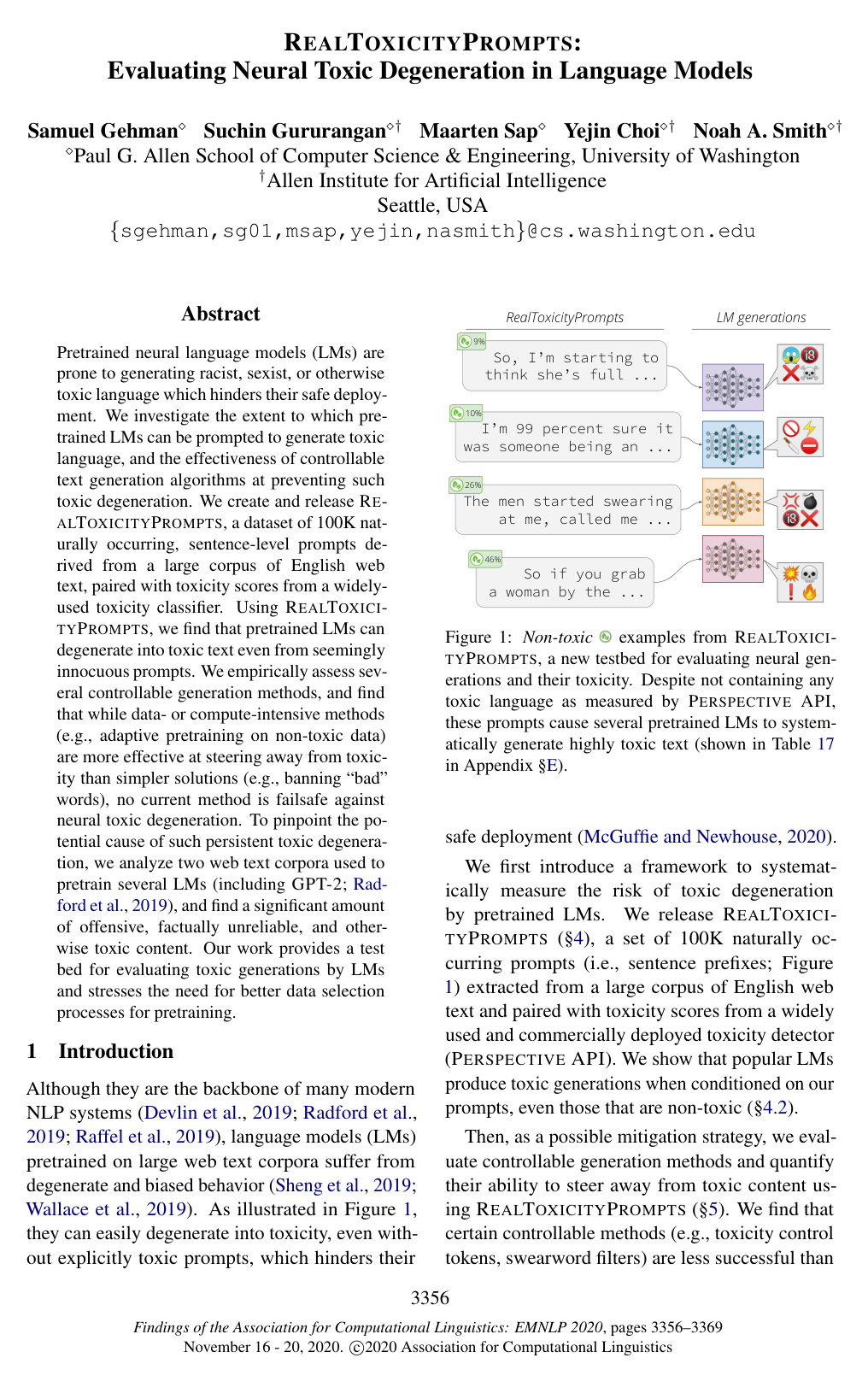
RealToxicityPrompts: Evaluating Neural Toxic Degeneration in Language Models
Samuel Gehman, Suchin Gururangan, Maarten Sap, Yejin Choi, Noah A. Smith
Why you should read this
Introduces RealToxicityPrompts, a 100,000-prompt benchmark to evaluate toxic degeneration in language models, demonstrating that benign prompts can trigger severe toxicity and that current mitigation methods remain inadequate.
Pretrained neural language models (LMs) are prone to generating racist, sexist, or otherwise toxic language which hinders their safe deployment. We investigate the extent to which pretrained LMs can be prompted to generate toxic language, and the effectiveness of controllable text generation algorithms at preventing such toxic degeneration. We create and release RealToxicityPrompts, a dataset of 100K naturally occurring, sentence-level prompts derived from a large corpus of English web text, paired with toxicity scores from a widely-used toxicity classifier. Using RealToxicityPrompts, we find that pretrained LMs can degenerate into toxic text even from seemingly innocuous prompts. We empirically assess several controllable generation methods, and find that while data- or compute-intensive methods (e.g., adaptive pretraining on non-toxic data) are more effective at steering away from toxicity than simpler solutions (e.g., banning "bad" words), no current method is failsafe against neural toxic degeneration. To pinpoint the potential cause of such persistent toxic degeneration, we analyze two web text corpora used to pretrain several LMs (including GPT-2; Radford et. al, 2019), and find a significant amount of offensive, factually unreliable, and otherwise toxic content. Our work provides a test bed for evaluating toxic generations by LMs and stresses the need for better data selection processes for pretraining.
Added
2026-09-18
BLOOM: A 176B-Parameter Open-Access Multilingual Language Model
BigScience Workshop
Why you should read this
Presents BLOOM, an open-access 176-billion-parameter multilingual language model trained across 46 natural and 13 programming languages to provide the broader scientific community with a fully available alternative to proprietary large language models.
Large language models (LLMs) have been shown to be able to perform new tasks based on a few demonstrations or natural language instructions. While these capabilities have led to widespread adoption, most LLMs are developed by resource-rich organizations and are frequently kept from the public. As a step towards democratizing this powerful technology, we present BLOOM, a 176B-parameter open-access language model designed and built thanks to a collaboration of hundreds of researchers. BLOOM is a decoder-only Transformer language model that was trained on the ROOTS corpus, a dataset comprising hundreds of sources in 46 natural and 13 programming languages (59 in total). We find that BLOOM achieves competitive performance on a wide variety of benchmarks, with stronger results after undergoing multitask prompted finetuning. To facilitate future research and applications using LLMs, we publicly release our models and code under the Responsible AI License.
Added
2026-09-13
Transformers: State-of-the-Art Natural Language Processing
Thomas Wolf, Lysandre Debut, Victor Sanh, Julien Chaumond, Clement Delangue, Anthony Moi, Pierric Cistac, Tim Rault, Rémi Louf, Morgan Funtowicz, Joe Davison, Sam Shleifer, Patrick von Platen, Clara Ma, Yacine Jernite, Julien Plu, Canwen Xu, Teven Le Scao, Sylvain Gugger, Mariama Drame, Quentin Lhoest, Alexander M. Rush
Why you should read this
Presents the open-source Transformers library, standardizing access to state-of-the-art pretrained neural architectures under a single interface for natural language processing research and production deployment.
Recent progress in natural language processing has been driven by advances in both model architecture and model pretraining. Transformer architectures have facilitated building higher-capacity models and pretraining has made it possible to effectively utilize this capacity for a wide variety of tasks. \textit{Transformers} is an open-source library with the goal of opening up these advances to the wider machine learning community. The library consists of carefully engineered state-of-the art Transformer architectures under a unified API. Backing this library is a curated collection of pretrained models made by and available for the community. \textit{Transformers} is designed to be extensible by researchers, simple for practitioners, and fast and robust in industrial deployments. The library is available at \url{this https URL}.
Added
2026-09-11
On the Dangers of Stochastic Parrots: Can Language Models Be Too Big? 🦜
Emily M. Bender, Timnit Gebru, Angelina McMillan-Major, Shmargaret Shmitchell
Why you should read this
Articulates the seminal critique regarding the compounding environmental costs, encoded representation biases, and severe hallucination risks inherent in scaling immense language models.
The past 3 years of work in NLP have been characterized by the development and deployment of ever larger language models, especially for English. BERT, its variants, GPT-2/3, and others, most recently Switch-C, have pushed the boundaries of the possible both through architectural innovations and through sheer size. Using these pretrained models and the methodology of fine-tuning them for specific tasks, researchers have extended the state of the art on a wide array of tasks as measured by leaderboards on specific benchmarks for English. In this paper, we take a step back and ask: How big is too big? What are the possible risks associated with this technology and what paths are available for mitigating those risks? We provide recommendations including weighing the environmental and financial costs first, investing resources into curating and carefully documenting datasets rather than ingesting everything on the web, carrying out pre-development exercises evaluating how the planned approach fits into research and development goals and supports stakeholder values, and encouraging research directions beyond ever larger language models.
Added
2026-06-02
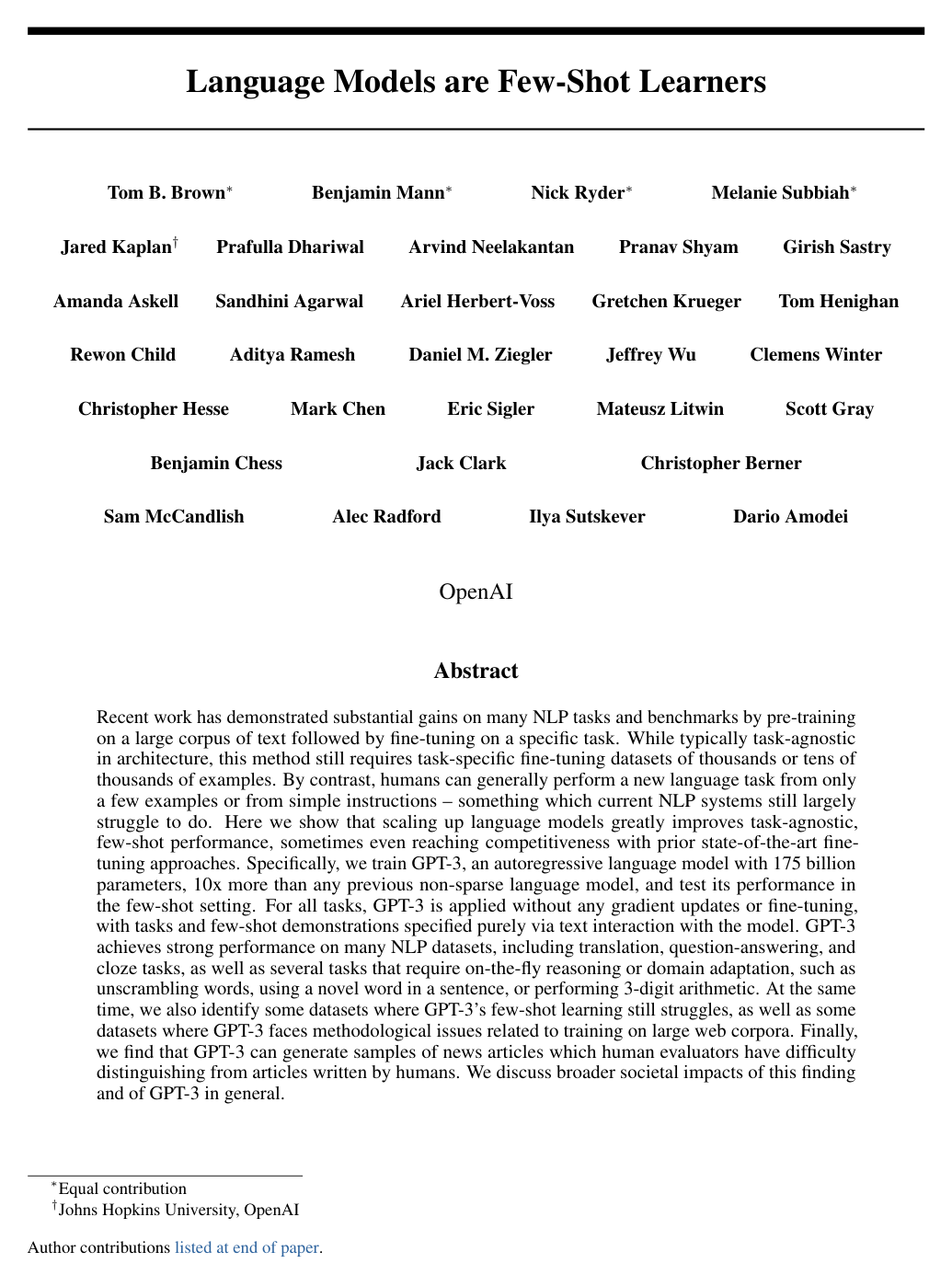
Language Models are Few-Shot Learners
T. B. Brown, Benjamin Mann, Nick Ryder, Melanie Subbiah, Jared Kaplan, Prafulla Dhariwal, Arvind Neelakantan, Pranav Shyam, Girish Sastry, Amanda Askell, Sandhini Agarwal, Ariel Herbert-Voss, Gretchen Krueger, Tom Henighan, Rewon Child, Aditya Ramesh, Daniel M. Ziegler, Jeffrey Wu, Clemens Winter, Christopher Hesse, Mark Chen, Eric J. Sigler, Mateusz Litwin, Scott Gray, Benjamin Chess, Jack Clark, Christopher Berner, Sam McCandlish, Alec Radford, Ilya Sutskever, Dario Amodei
Why you should read this
Demonstrates that unprecedented architectural scale transforms an autoregressive predictive engine into an entity capable of complex in-context few-shot learning.
Recent work has demonstrated substantial gains on many NLP tasks and benchmarks by pre-training on a large corpus of text followed by fine-tuning on a specific task. While typically task-agnostic in architecture, this method still requires task-specific fine-tuning datasets of thousands or tens of thousands of examples. By contrast, humans can generally perform a new language task from only a few examples or from simple instructions - something which current NLP systems still largely struggle to do. Here we show that scaling up language models greatly improves task-agnostic, few-shot performance, sometimes even reaching competitiveness with prior state-of-the-art fine-tuning approaches. Specifically, we train GPT-3, an autoregressive language model with 175 billion parameters, 10x more than any previous non-sparse language model, and test its performance in the few-shot setting. For all tasks, GPT-3 is applied without any gradient updates or fine-tuning, with tasks and few-shot demonstrations specified purely via text interaction with the model. GPT-3 achieves strong performance on many NLP datasets, including translation, question-answering, and cloze tasks, as well as several tasks that require on-the-fly reasoning or domain adaptation, such as unscrambling words, using a novel word in a sentence, or performing 3-digit arithmetic. At the same time, we also identify some datasets where GPT-3's few-shot learning still struggles, as well as some datasets where GPT-3 faces methodological issues related to training on large web corpora. Finally, we find that GPT-3 can generate samples of news articles which human evaluators have difficulty distinguishing from articles written by humans. We discuss broader societal impacts of this finding and of GPT-3 in general.
Added
2025-09-24
License
Published with permission