
keyword
knowledge triples
A knowledge triple is a fundamental data structure used to represent factual information in a standardized format consisting of three components: a subject, a predicate, and an object. The subject denotes the primary entity or concept being described, the predicate specifies the relationship or property connecting the elements, and the object represents the related target entity, concept, or literal value. By expressing discrete facts through this machine-readable arrangement, knowledge triples serve as the core building blocks for constructing knowledge graphs and ontologies, enabling automated reasoning, semantic data integration, and structured information retrieval across artificial intelligence systems.
4 items
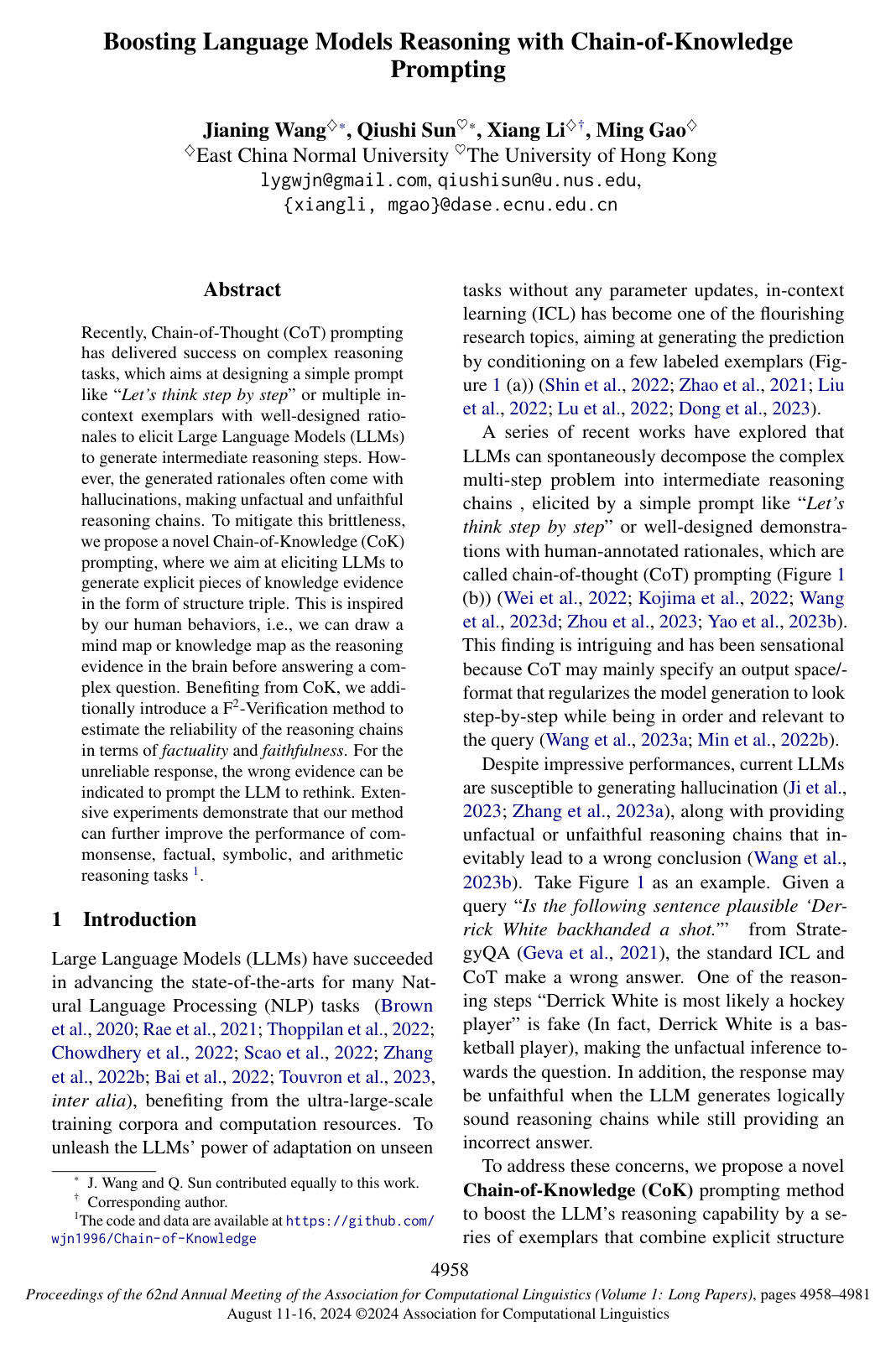
Boosting Language Models Reasoning with Chain-of-Knowledge Prompting
Jianing Wang, Qiushi Sun, Xiang Li, Ming Gao
Why you should read this
Proposes Chain-of-Knowledge prompting to reduce hallucinations in large language models by generating structured knowledge triples alongside natural language explanations and using an F²-Verification mechanism to evaluate factuality and faithfulness before triggering iterative correction.
Recently, Chain-of-Thought (CoT) prompting has delivered success on complex reasoning tasks, which aims at designing a simple prompt like “Let’s think step by step” or multiple in-context exemplars with well-designed rationales to elicit Large Language Models (LLMs) to generate intermediate reasoning steps. However, the generated rationales often come with hallucinations, making unfactual and unfaithful reasoning chains. To mitigate this brittleness, we propose a novel Chain-of-Knowledge (CoK) prompting, where we aim at eliciting LLMs to generate explicit pieces of knowledge evidence in the form of structure triple. This is inspired by our human behaviors, i.e., we can draw a mind map or knowledge map as the reasoning evidence in the brain before answering a complex question. Benefiting from CoK, we additionally introduce a F²-Verification method to estimate the reliability of the reasoning chains in terms of factuality and faithfulness. For the unreliable response, the wrong evidence can be indicated to prompt the LLM to rethink. Extensive experiments demonstrate that our method can further improve the performance of commonsense, factual, symbolic, and arithmetic reasoning tasks¹.
Added
2026-10-01
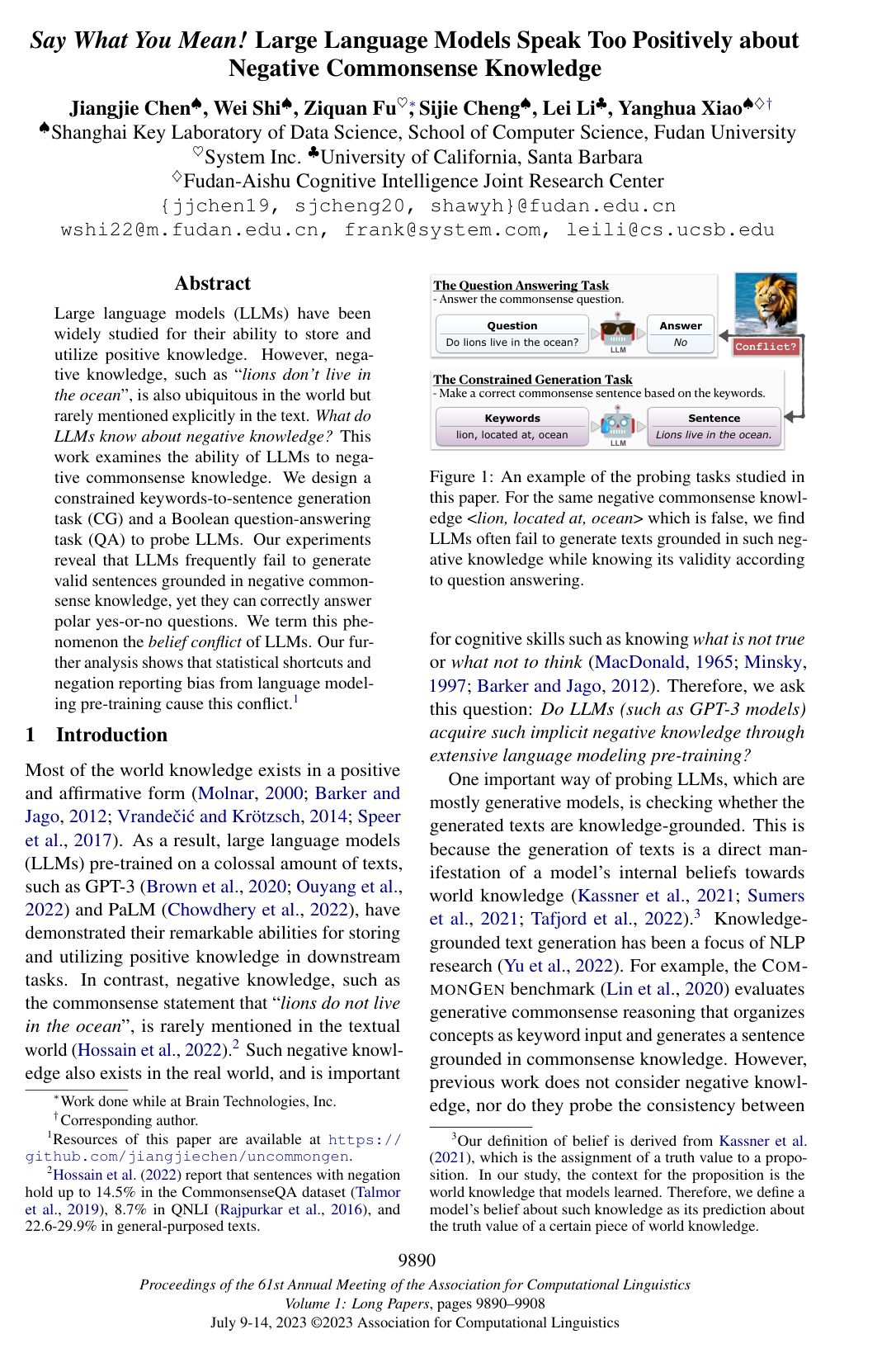
Say What You Mean! Large Language Models Speak Too Positively about Negative Commonsense Knowledge
Jiangjie Chen, Wei Shi, Ziquan Fu, Sijie Cheng, Lei Li, Yanghua Xiao
Why you should read this
Reveals a fundamental belief conflict in large language models where they correctly answer yes-or-no questions about negative commonsense facts yet fail to generate text incorporating that same negative knowledge due to pre-training reporting biases.
Large language models (LLMs) have been widely studied for their ability to store and utilize positive knowledge. However, negative knowledge, such as “lions don’t live in the ocean”, is also ubiquitous in the world but rarely mentioned explicitly in the text. What do LLMs know about negative knowledge? This work examines the ability of LLMs to negative commonsense knowledge. We design a constrained keywords-to-sentence generation task (CG) and a Boolean question-answering task (QA) to probe LLMs. Our experiments reveal that LLMs frequently fail to generate valid sentences grounded in negative commonsense knowledge, yet they can correctly answer polar yes-or-no questions. We term this phenomenon the belief conflict of LLMs. Our further analysis shows that statistical shortcuts and negation reporting bias from language modeling pre-training cause this conflict.
Added
2026-09-26
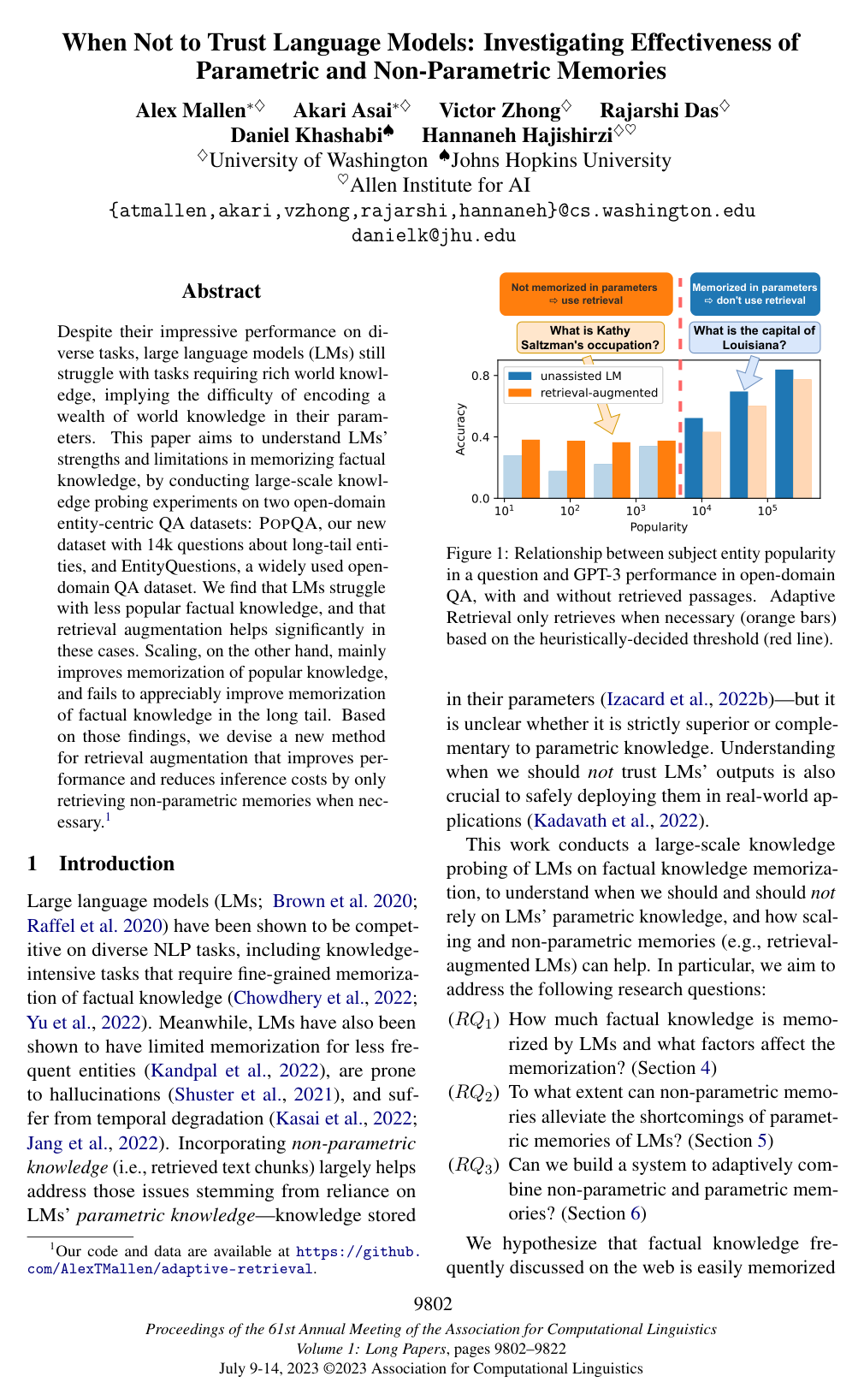
When Not to Trust Language Models: Investigating Effectiveness of Parametric and Non-Parametric Memories
Alex Troy Mallen, Akari Asai, Victor Zhong, Rajarshi Das, Hannaneh Hajishirzi, Daniel Khashabi
Why you should read this
Reveals that scaling language models fails to resolve factual errors on long-tail knowledge and introduces an adaptive retrieval strategy on the PopQA benchmark that queries external memory only when needed, significantly cutting inference costs while improving factual accuracy.
Despite their impressive performance on diverse tasks, large language models (LMs) still struggle with tasks requiring rich world knowledge, implying the limitations of relying solely on their parameters to encode a wealth of world knowledge. This paper aims to understand LMs' strengths and limitations in memorizing factual knowledge, by conducting large-scale knowledge probing experiments of 10 models and 4 augmentation methods on PopQA, our new open-domain QA dataset with 14k questions. We find that LMs struggle with less popular factual knowledge, and that scaling fails to appreciably improve memorization of factual knowledge in the long tail. We then show that retrieval-augmented LMs largely outperform orders of magnitude larger LMs, while unassisted LMs remain competitive in questions about high-popularity entities. Based on those findings, we devise a simple, yet effective, method for powerful and efficient retrieval-augmented LMs, which retrieves non-parametric memories only when necessary. Experimental results show that this significantly improves models' performance while reducing the inference costs.
Added
2026-09-25
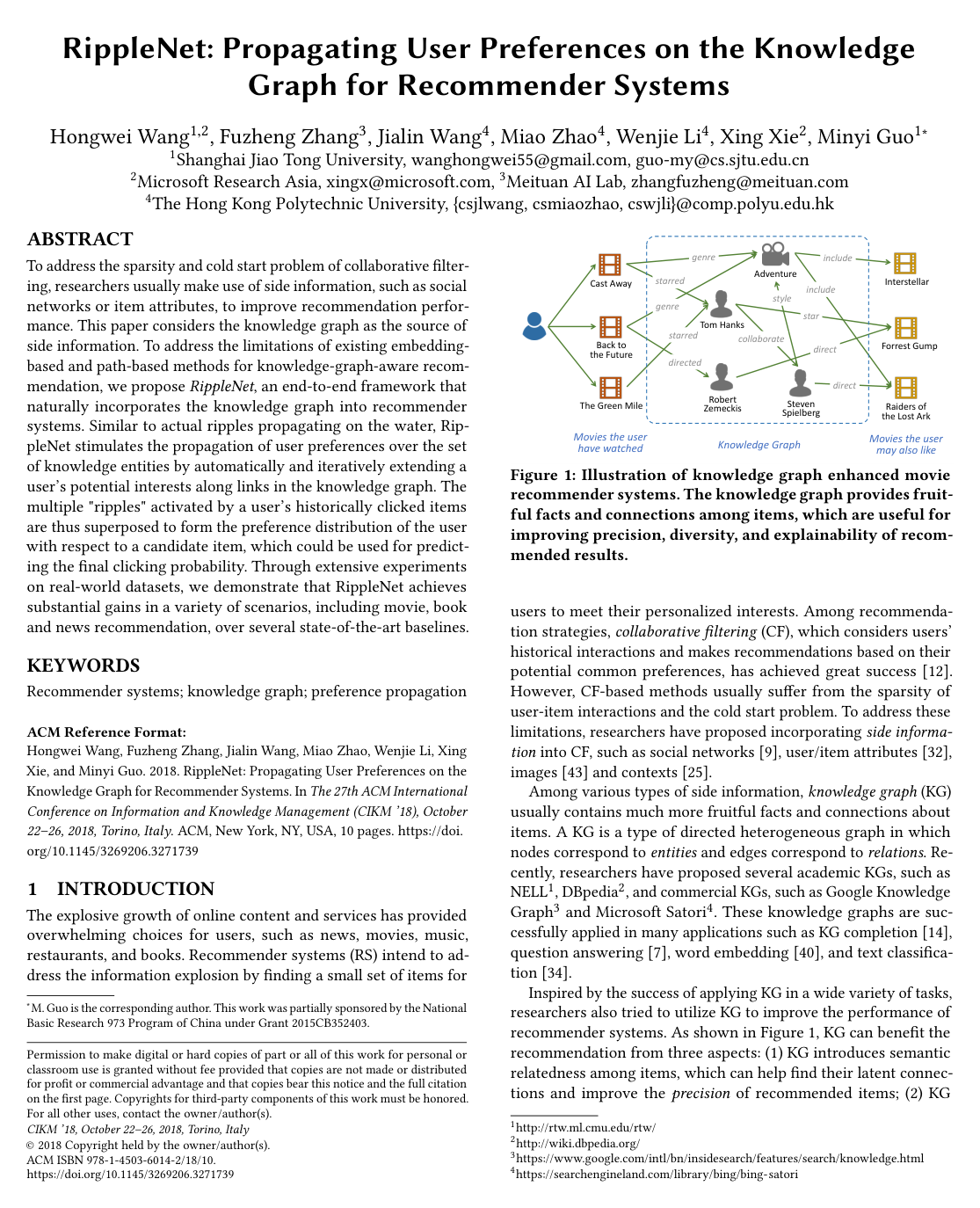
RippleNet: Propagating user preferences on the knowledge graph for recommender systems
Hongwei Wang, Fuzheng Zhang, Jialin Wang, Miao Zhao, Wenjie Li, Xing Xie, Minyi Guo
Why you should read this
Introduces Ripple Network, a novel approach that propagates user preferences through knowledge graph structures like ripples on water, elegantly solving the cold start problem in recommendation systems by automatically discovering user interests along entity connections rather than relying on explicit path-based or embedding methods alone.
To address the sparsity and cold start problem of collaborative filtering, researchers usually make use of side information, such as social networks or item attributes, to improve recommendation performance. This paper considers the knowledge graph as the source of side information. To address the limitations of existing embedding-based and path-based methods for knowledge-graph-aware recommendation, we propose Ripple Network, an end-to-end framework that naturally incorporates the knowledge graph into recommender systems. Similar to actual ripples propagating on the surface of water, Ripple Network stimulates the propagation of user preferences over the set of knowledge entities by automatically and iteratively extending a user's potential interests along links in the knowledge graph. The multiple "ripples" activated by a user's historically clicked items are thus superposed to form the preference distribution of the user with respect to a candidate item, which could be used for predicting the final clicking probability. Through extensive experiments on real-world datasets, we demonstrate that Ripple Network achieves substantial gains in a variety of scenarios, including movie, book and news recommendation, over several state-of-the-art baselines.
Added
2026-01-25