
keyword
knowledge-intensive NLP tasks
Knowledge-intensive NLP tasks are language-processing tasks whose successful completion depends on accessing and using substantial factual or domain-specific knowledge, often beyond what is stated in the input. Examples include open-domain question answering, fact verification, and dialogue, where relevant information may need to be retrieved from external sources and used to produce an accurate response.
5 items
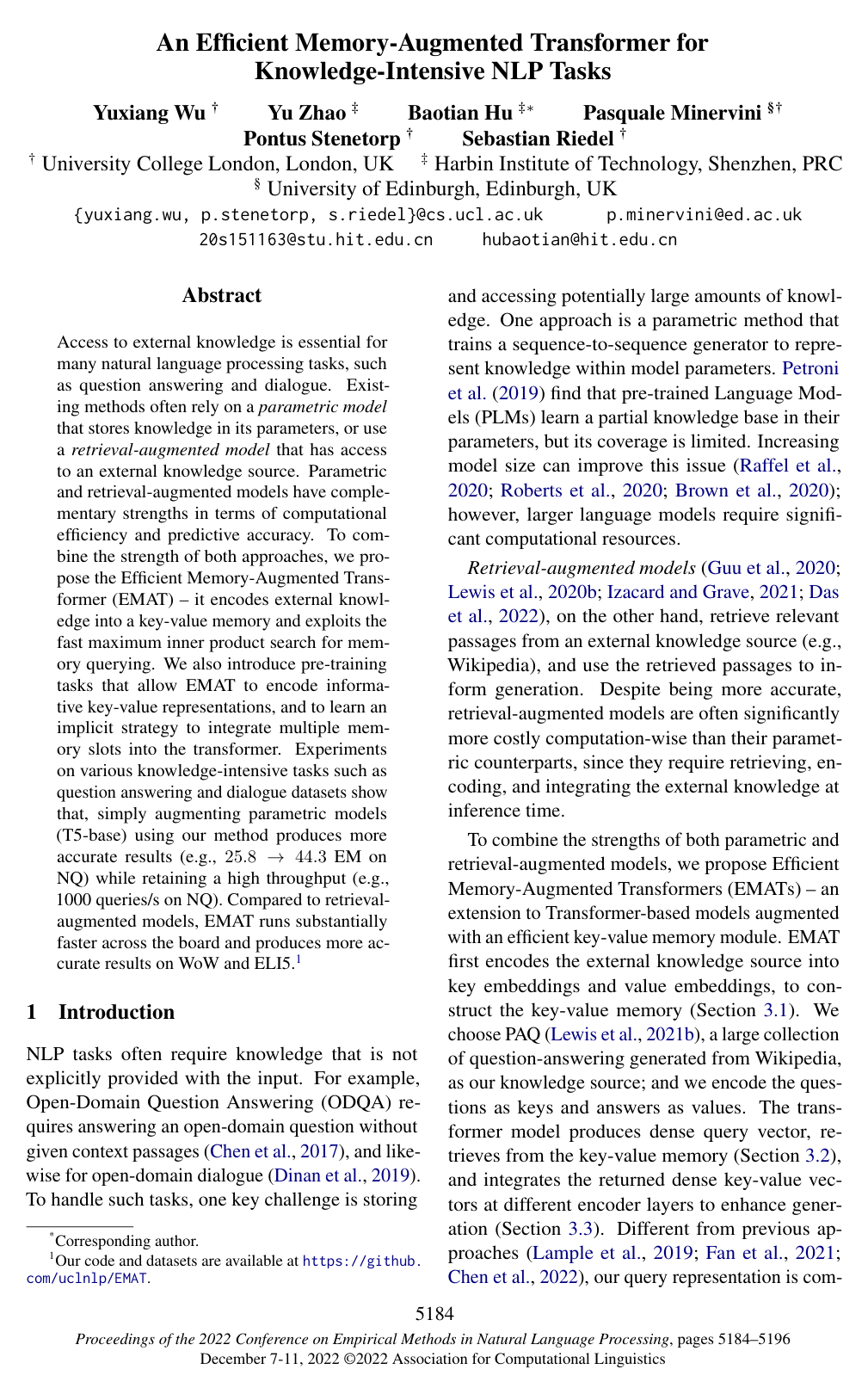
An Efficient Memory-Augmented Transformer for Knowledge-Intensive NLP Tasks
Yuxiang Wu, Yu Zhao, Baotian Hu, Pasquale Minervini, Pontus Stenetorp, Sebastian Riedel
Why you should read this
Proposes an efficient memory-augmented transformer that stores external question-answer knowledge in a fast key-value memory queried during a single forward pass, matching or exceeding the accuracy of retrieval-augmented models on open-domain NLP benchmarks while processing up to a thousand queries per second.
Access to external knowledge is essential for many natural language processing tasks, such as question answering and dialogue. Existing methods often rely on a parametric model that stores knowledge in its parameters, or use a retrieval-augmented model that has access to an external knowledge source. Parametric and retrieval-augmented models have complementary strengths in terms of computational efficiency and predictive accuracy. To combine the strength of both approaches, we propose the Efficient Memory-Augmented Transformer (EMAT) – it encodes external knowledge into a key-value memory and exploits the fast maximum inner product search for memory querying. We also introduce pre-training tasks that allow EMAT to encode informative key-value representations, and to learn an implicit strategy to integrate multiple memory slots into the transformer. Experiments on various knowledge-intensive tasks such as question answering and dialogue datasets show that, simply augmenting parametric models (T5-base) using our method produces more accurate results (e.g., 25.8 → 44.3 EM on NQ) while retaining a high throughput (e.g., 1000 queries/s on NQ). Compared to retrieval-augmented models, EMAT runs substantially faster across the board and produces more accurate results on WoW and ELI5.
Added
2026-10-03
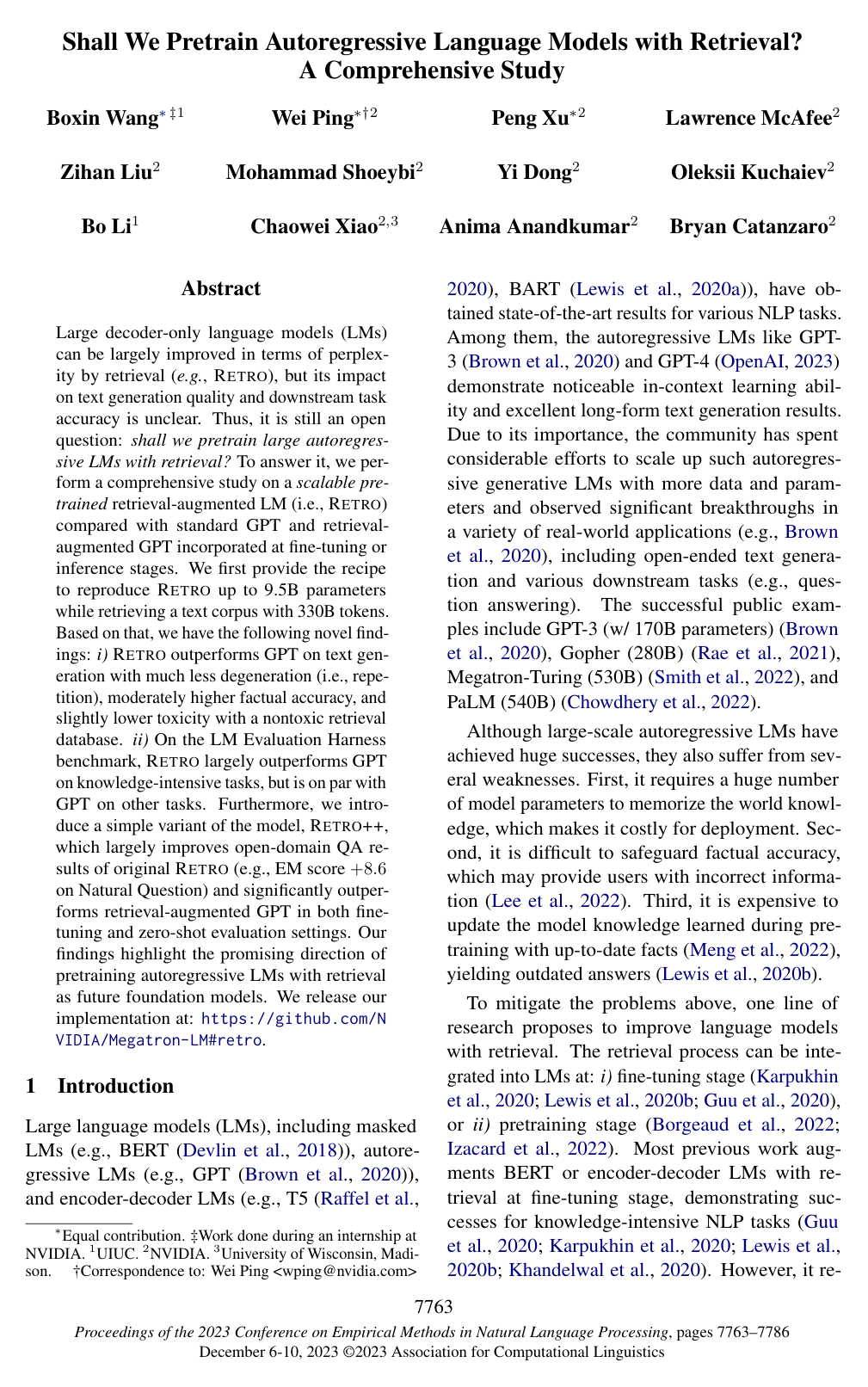
Shall We Pretrain Autoregressive Language Models with Retrieval? A Comprehensive Study
Boxin Wang, Wei Ping, Peng Xu, Lawrence McAfee, Zihan Liu, Mohammad Shoeybi, Yi Dong, Oleksii Kuchaiev, Bo Li, Chaowei Xiao, Anima Anandkumar, Bryan Catanzaro
Why you should read this
Demonstrates through scalable reproduction up to 9.5B parameters that pretraining autoregressive language models with retrieval substantially improves factual accuracy and downstream knowledge-intensive task performance over standard GPT baselines while introducing RETRO++ to boost open-domain question answering.
Added
2026-10-02
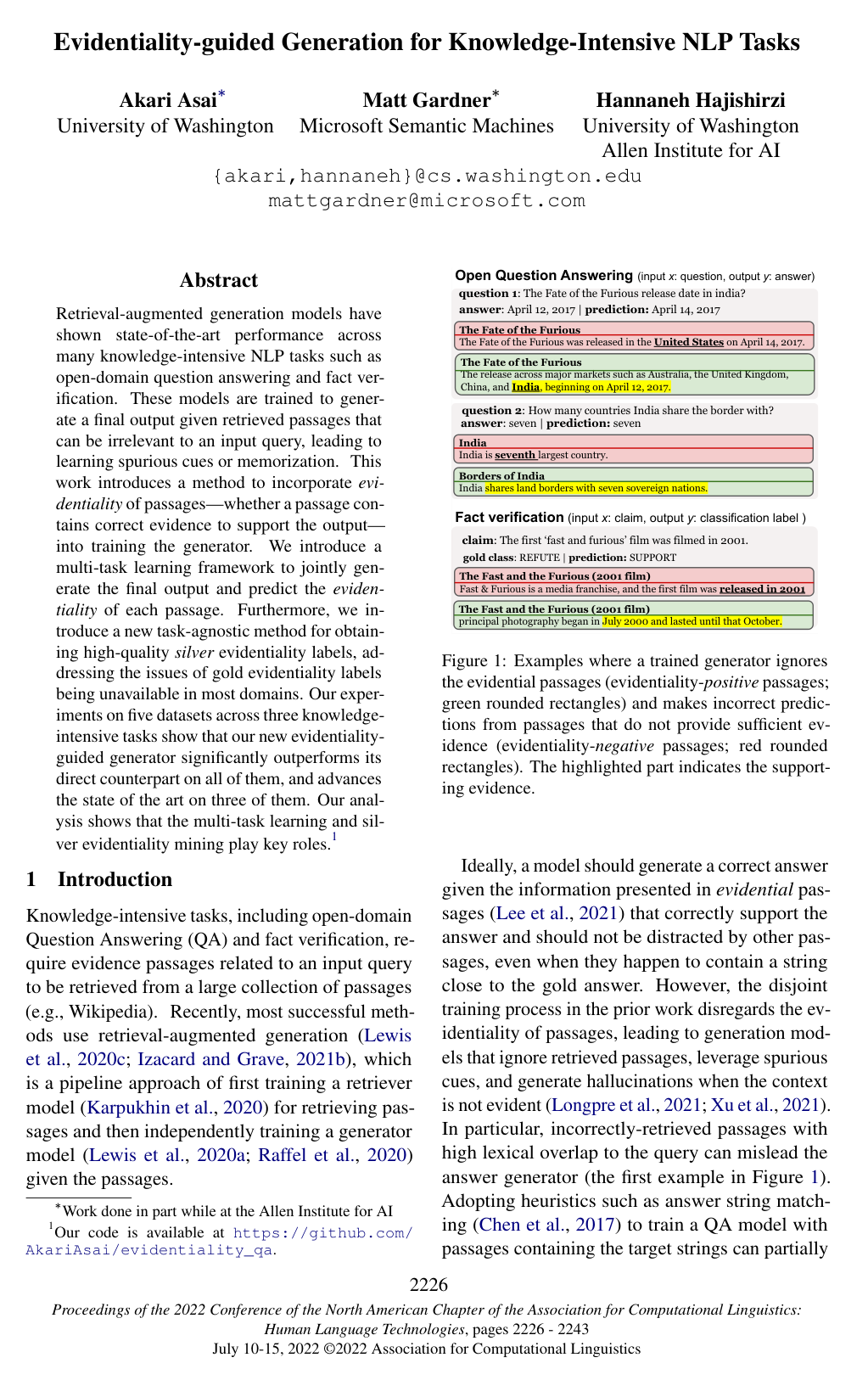
Evidentiality-guided Generation for Knowledge-Intensive NLP Tasks
Akari Asai, Matt Gardner, Hannaneh Hajishirzi
Why you should read this
Proposes a multi-task learning framework and silver-label mining method that train retrieval-augmented generators to evaluate passage evidence, preventing models from relying on spurious cues across knowledge-intensive NLP benchmarks.
Retrieval-augmented generation models have shown state-of-the-art performance across many knowledge-intensive NLP tasks such as open-domain question answering and fact verification. These models are trained to generate a final output given retrieved passages that can be irrelevant to an input query, leading to learning spurious cues or memorization. This work introduces a method to incorporate evidentiality of passages—whether a passage contains correct evidence to support the output—into training the generator. We introduce a multi-task learning framework to jointly generate the final output and predict the evidentiality of each passage. Furthermore, we introduce a new task-agnostic method for obtaining high-quality silver evidentiality labels, addressing the issues of gold evidentiality labels being unavailable in most domains. Our experiments on five datasets across three knowledge-intensive tasks show that our new evidentiality-guided generator significantly outperforms its direct counterpart on all of them, and advances the state of the art on three of them. Our analysis shows that the multi-task learning and silver evidentiality mining play key roles.
Added
2026-09-26
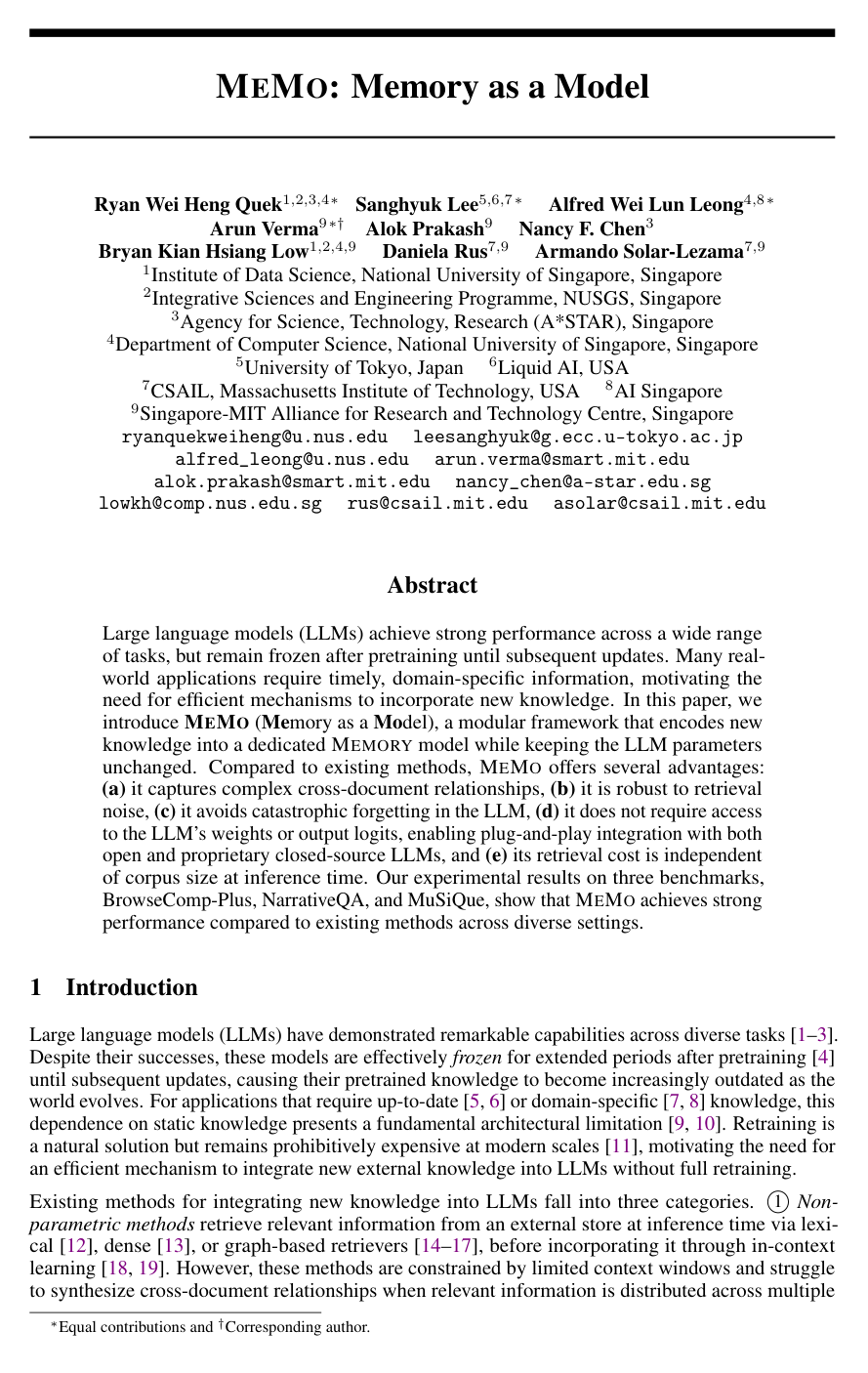
MeMo: Memory as a Model
Ryan Wei Heng Quek, Sanghyuk Lee, Alfred Wei Lun Leong, Arun Verma, Alok Prakash, Nancy F. Chen, Bryan Kian Hsiang Low, Daniela Rus, Armando Solar-Lezama
Why you should read this
Introduces MeMo, a modular framework that efficiently incorporates new knowledge into frozen LLMs by encoding it into a dedicated memory model, offering robustness to noise, avoiding catastrophic forgetting, and ensuring plug-and-play compatibility with both open and closed-source LLMs with inference costs independent of corpus size.
Large language models (LLMs) achieve strong performance across a wide range of tasks, but remain frozen after pretraining until subsequent updates. Many real-world applications require timely, domain-specific information, motivating the need for efficient mechanisms to incorporate new knowledge. In this paper, we introduce MeMo (Memory as a Model), a modular framework that encodes new knowledge into a dedicated memory model while keeping the LLM parameters unchanged. Compared to existing methods, MeMo offers several advantages: (a) it captures complex cross-document relationships, (b) it is robust to retrieval noise, (c) it avoids catastrophic forgetting in the LLM, (d) it does not require access to the LLM's weights or output logits, enabling plug-and-play integration with both open and proprietary closed-source LLMs, and (e) its retrieval cost is independent of corpus size at inference time. Our experimental results on three benchmarks, BrowseComp-Plus, NarrativeQA, and MuSiQue, show that MeMo achieves strong performance compared to existing methods across diverse settings.
Added
2026-06-11

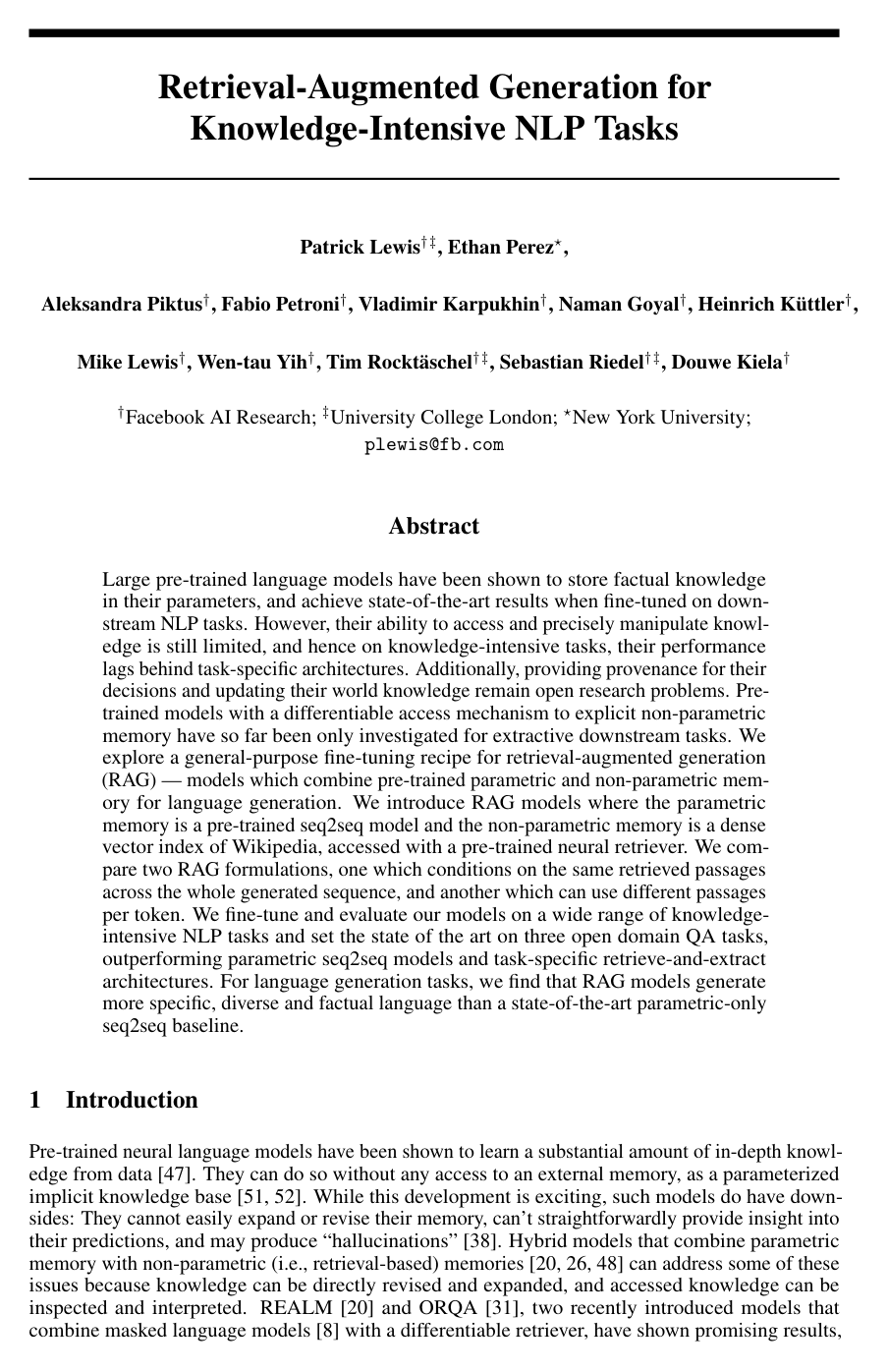
Retrieval-Augmented Generation for Knowledge-Intensive NLP Tasks
Patrick Lewis, Ethan Perez, Aleksandra Piktus, Fabio Petroni, Vladimir Karpukhin, Naman Goyal, Heinrich Küttler, Mike Lewis, Wen-tau Yih, Tim Rocktäschel, Sebastian Riedel, Douwe Kiela
Why you should read this
Proposes the definitive retrieval-augmented architecture linking a pre-trained retriever with a sequence-to-sequence generator trained end-to-end to mitigate hallucinations.
Large pre-trained language models have been shown to store factual knowledge in their parameters, and achieve state-of-the-art results when fine-tuned on downstream NLP tasks. However, their ability to access and precisely manipulate knowledge is still limited, and hence on knowledge-intensive tasks, their performance lags behind task-specific architectures. Additionally, providing provenance for their decisions and updating their world knowledge remain open research problems. Pre-trained models with a differentiable access mechanism to explicit non-parametric memory can overcome this issue, but have so far been only investigated for extractive downstream tasks. We explore a general-purpose fine-tuning recipe for retrieval-augmented generation (RAG) -- models which combine pre-trained parametric and non-parametric memory for language generation. We introduce RAG models where the parametric memory is a pre-trained seq2seq model and the non-parametric memory is a dense vector index of Wikipedia, accessed with a pre-trained neural retriever. We compare two RAG formulations, one which conditions on the same retrieved passages across the whole generated sequence, the other can use different passages per token. We fine-tune and evaluate our models on a wide range of knowledge-intensive NLP tasks and set the state-of-the-art on three open domain QA tasks, outperforming parametric seq2seq models and task-specific retrieve-and-extract architectures. For language generation tasks, we find that RAG models generate more specific, diverse and factual language than a state-of-the-art parametric-only seq2seq baseline.
Added
2026-02-14