
keyword
knowledge conflicts
Knowledge conflicts refer to situations in artificial intelligence and natural language processing where different sources of factual information provide contradictory or incompatible evidence for a given task or query. In the context of large language models and retrieval-augmented generation systems, these discrepancies typically manifest when a model's internal parametric memory contradicts external information provided in its input context, or when multiple retrieved documents present opposing claims, outdated details, or differing viewpoints. Such conflicts present substantial challenges for system reliability and reasoning, as they force a model to discern between competing knowledge sources, mitigate hallucinations, and reliably select or synthesize the most accurate and trustworthy information during inference.
4 items
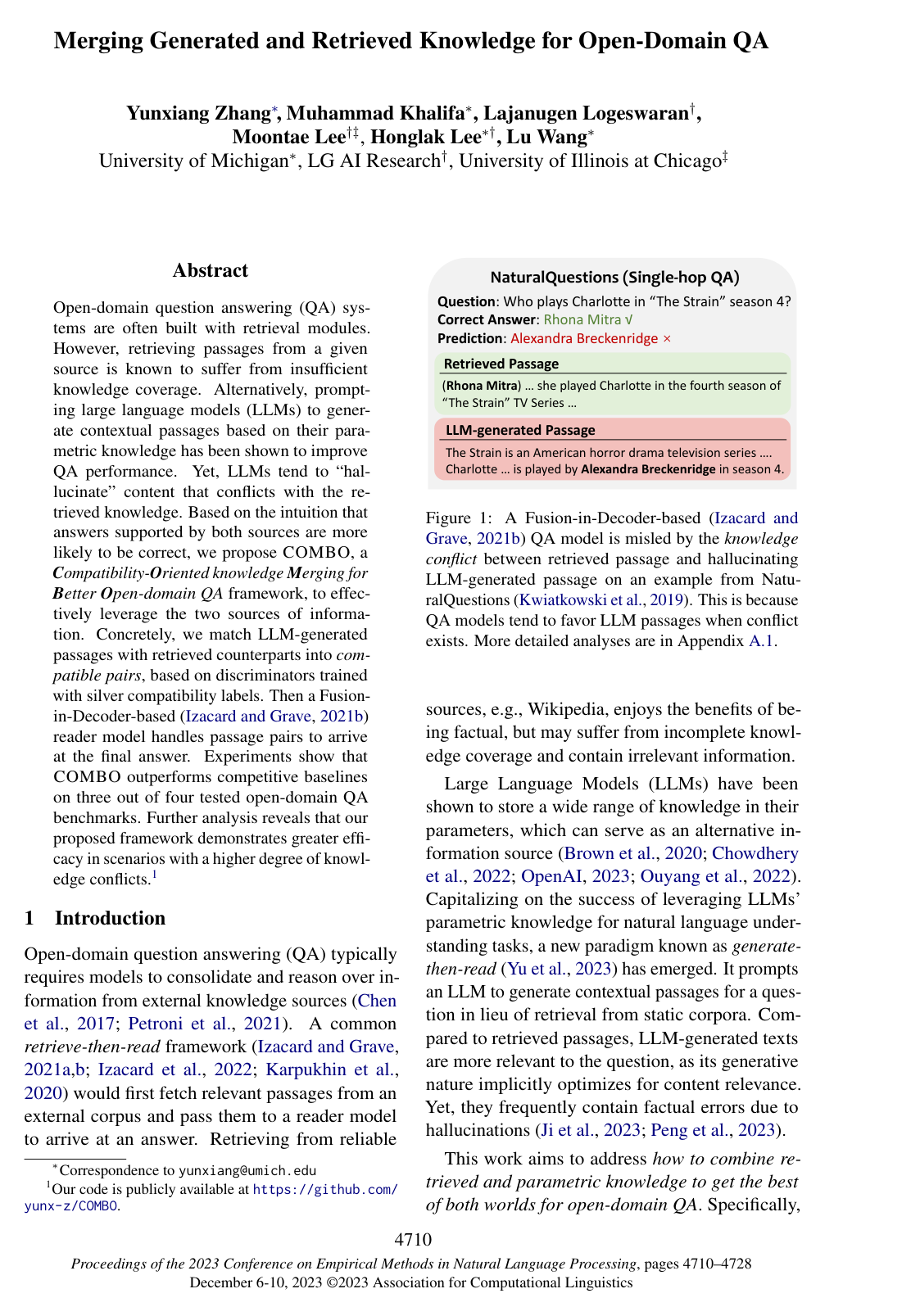
Merging Generated and Retrieved Knowledge for Open-Domain QA
Yunxiang Zhang, Muhammad Khalifa, Lajanugen Logeswaran, Moontae Lee, Honglak Lee, Lu Wang
Why you should read this
Proposes a compatibility-oriented framework that pairs LLM-generated texts with retrieved documents to resolve knowledge conflicts and improve open-domain question answering accuracy.
Open-domain question answering (QA) systems are often built with retrieval modules. However, retrieving passages from a given source is known to suffer from insufficient knowledge coverage. Alternatively, prompting large language models (LLMs) to generate contextual passages based on their parametric knowledge has been shown to improve QA performance. Yet, LLMs tend to “hallucinate” content that conflicts with the retrieved knowledge. Based on the intuition that answers supported by both sources are more likely to be correct, we propose COMBO, a Compatibility-Oriented Knowledge Merging for Better Open-domain QA framework, to effectively leverage the two sources of information. Concretely, we match LLM-generated passages with retrieved counterparts into compatible pairs, based on discriminators trained with silver compatibility labels. Then a Fusion-in-Decoder-based (Izacard and Grave, 2021b) reader model handles passage pairs to arrive at the final answer. Experiments show that COMBO outperforms competitive baselines on three out of four tested open-domain QA benchmarks. Further analysis reveals that our proposed framework demonstrates greater efficacy in scenarios with a higher degree of knowledge conflicts.¹
Added
2026-10-03
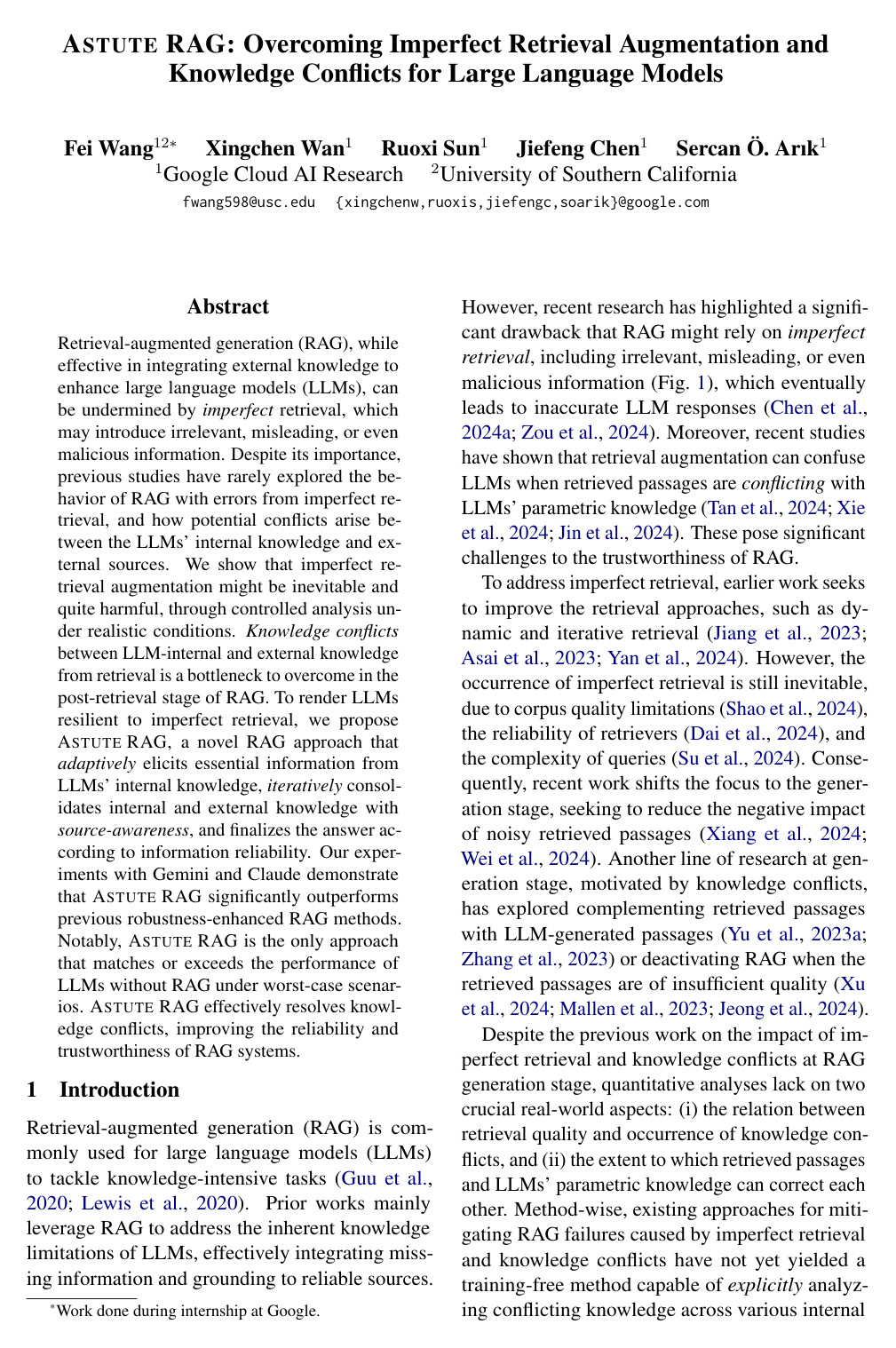
Astute RAG: Overcoming Imperfect Retrieval Augmentation and Knowledge Conflicts for Large Language Models
Fei Wang, Xingchen Wan, Ruoxi Sun, Jiefeng Chen, Sercan . Arik
Why you should read this
Proposes Astute RAG, a source-aware framework that resolves knowledge conflicts between large language models and noisy retrieved documents to prevent performance degradation during retrieval failures.
Retrieval augmented generation (RAG), while effectively integrating external knowledge to address the inherent limitations of large language models (LLMs), can be hindered by imperfect retrieval that contain irrelevant, misleading, or even malicious information. Previous studies have rarely connected the behavior of RAG through joint analysis, particularly regarding error propagation coming from imperfect retrieval and potential conflicts between LLMs' internal knowledge and external sources. Through comprehensive and controlled analyses under realistic conditions, we find that imperfect retrieval augmentation is inevitable, common, and harmful. We identify the knowledge conflicts between LLM-internal and external knowledge from retrieval as a bottleneck to overcome imperfect retrieval in the post-retrieval stage of RAG. To address this, we propose Astute RAG, a novel RAG approach designed to be resilient to imperfect retrieval augmentation. It adaptively elicits essential information from LLMs' internal knowledge, iteratively consolidates internal and external knowledge with source-awareness, and finalizes the answer according to information reliability. Our experiments with Gemini and Claude demonstrate the superior performance of Astute RAG compared to previous robustness-enhanced RAG approaches. Specifically, Astute RAG is the only RAG method that achieves performance comparable to or even surpassing conventional use of LLMs under the worst-case scenario. Further analysis reveals the effectiveness of Astute RAG in resolving knowledge conflicts, thereby improving the trustworthiness of RAG.
Added
2026-10-02
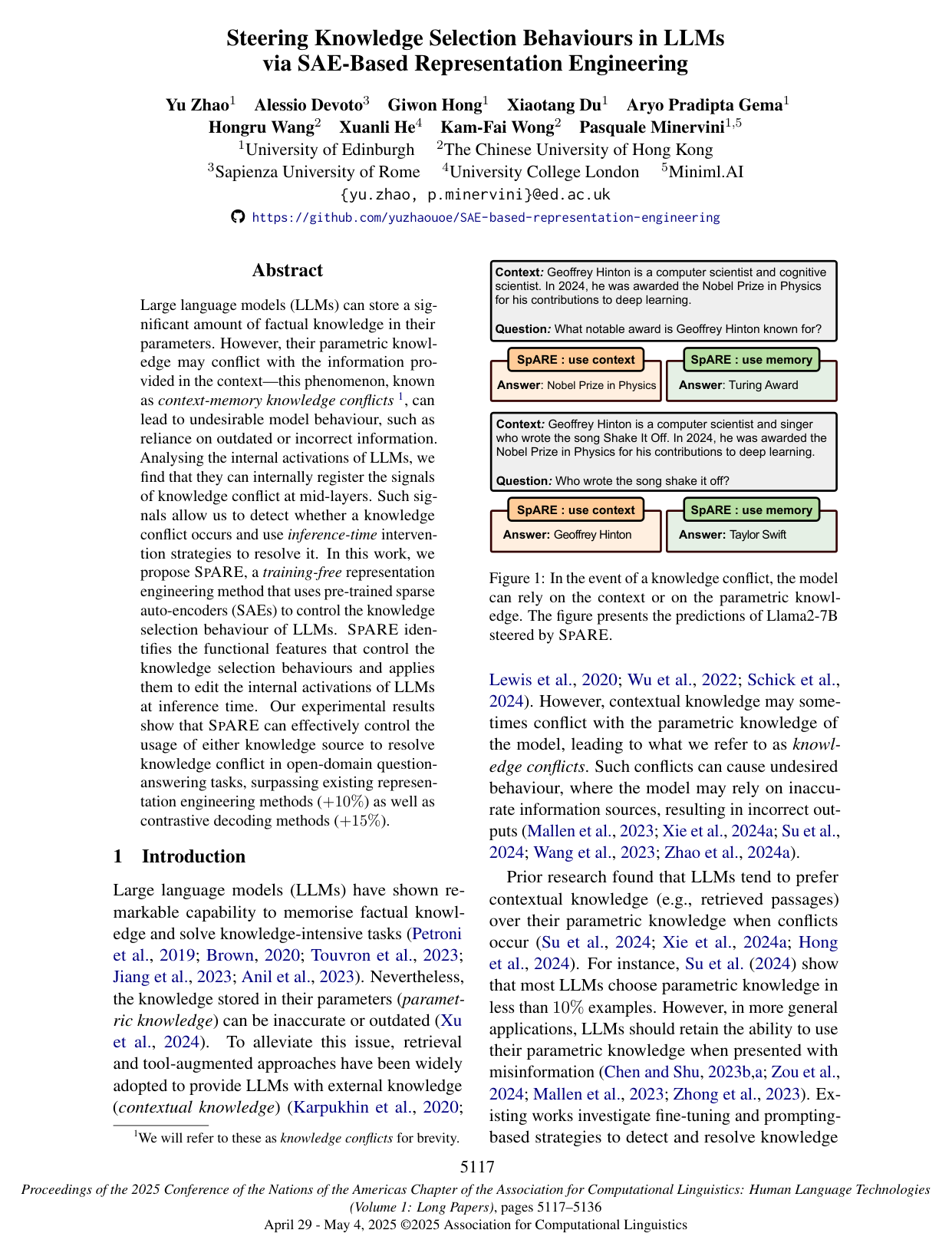
Steering Knowledge Selection Behaviours in LLMs via SAE-Based Representation Engineering
Yu Zhao, Alessio Devoto, Giwon Hong, Xiaotang Du, Aryo Pradipta Gema, Hongru Wang, Xuanli He, Kam-Fai Wong, Pasquale Minervini
Why you should read this
Introduces SPARE, a training-free representation engineering method that leverages sparse auto-encoders to detect mid-layer conflict signals and steer whether large language models rely on parametric memory or contextual evidence during question answering.
Large language models (LLMs) can store a significant amount of factual knowledge in their parameters. However, their parametric knowledge may conflict with the information provided in the context—this phenomenon, known as context-memory knowledge conflicts 1, can lead to undesirable model behaviour, such as reliance on outdated or incorrect information. Analysing the internal activations of LLMs, we find that they can internally register the signals of knowledge conflict at mid-layers. Such signals allow us to detect whether a knowledge conflict occurs and use inference-time intervention strategies to resolve it. In this work, we propose SPARE, a training-free representation engineering method that uses pre-trained sparse auto-encoders (SAEs) to control the knowledge selection behaviour of LLMs. SPARE identifies the functional features that control the knowledge selection behaviours and applies them to edit the internal activations of LLMs at inference time. Our experimental results show that SPARE can effectively control the usage of either knowledge source to resolve knowledge conflict in open-domain question-answering tasks, surpassing existing representation engineering methods (+10%) as well as contrastive decoding methods (+15%).
Added
2026-09-26
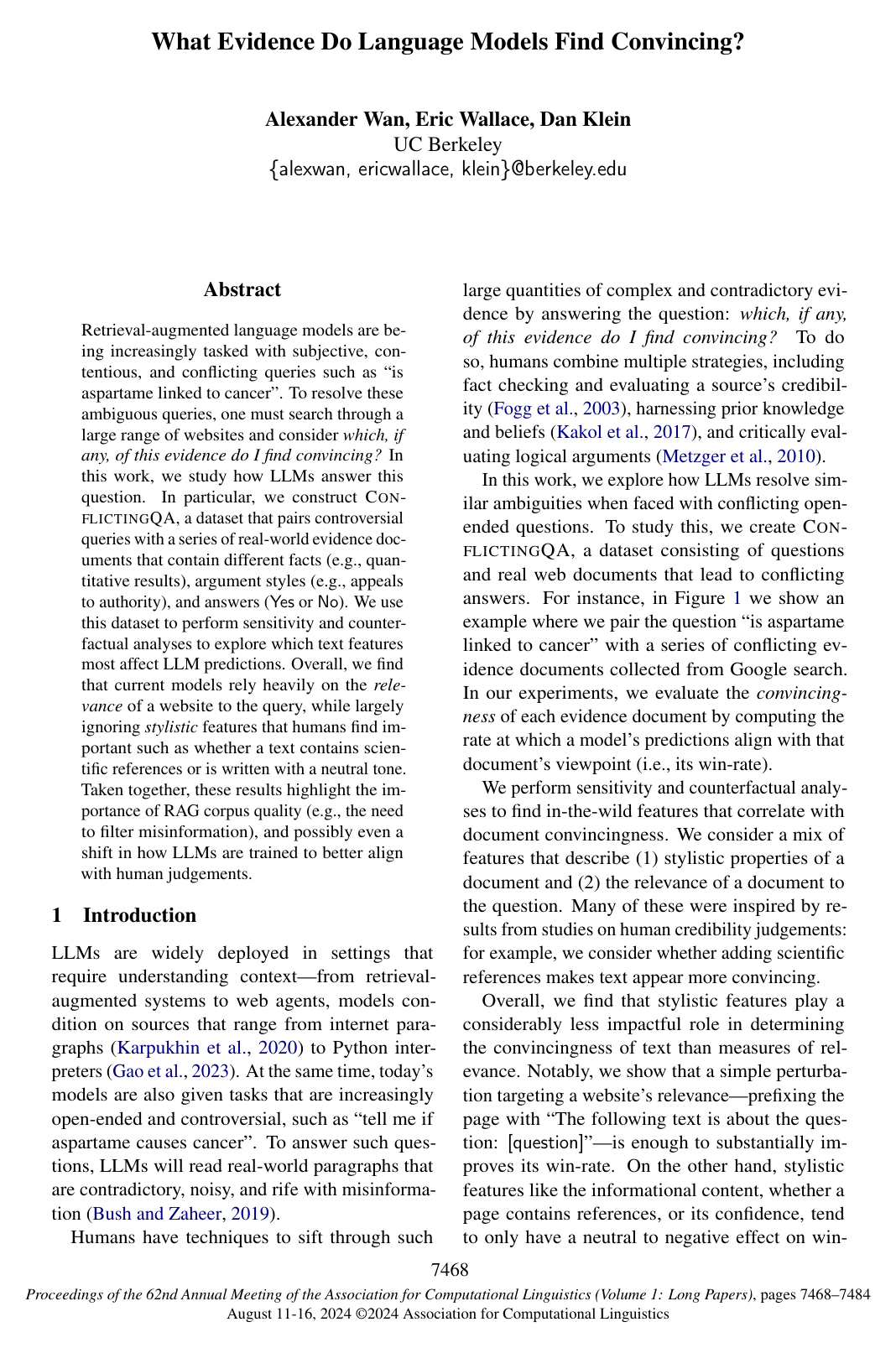
What Evidence Do Language Models Find Convincing?
Alexander Wan, Eric Wallace, Dan Klein
Why you should read this
Reveals that retrieval-augmented language models judge evidence primarily by topical relevance rather than human credibility markers like scientific citations or neutral tone, exposing critical vulnerabilities in how AI handles contentious queries.
Retrieval-augmented language models are being increasingly tasked with subjective, contentious, and conflicting queries such as “is aspartame linked to cancer”. To resolve these ambiguous queries, one must search through a large range of websites and consider which, if any, of this evidence do I find convincing? In this work, we study how LLMs answer this question. In particular, we construct CONFLICTINGQA, a dataset that pairs controversial queries with a series of real-world evidence documents that contain different facts (e.g., quantitative results), argument styles (e.g., appeals to authority), and answers (Yes or No). We use this dataset to perform sensitivity and counterfactual analyses to explore which text features most affect LLM predictions. Overall, we find that current models rely heavily on the relevance of a website to the query, while largely ignoring stylistic features that humans find important such as whether a text contains scientific references or is written with a neutral tone. Taken together, these results highlight the importance of RAG corpus quality (e.g., the need to filter misinformation), and possibly even a shift in how LLMs are trained to better align with human judgements.
Added
2026-09-26