
keyword
key-value memories
Key-value memories are neural network components that store and retrieve information through associative lookup mechanisms, where key vectors detect specific patterns in input representations and corresponding value vectors produce target output representations or distributions. In transformer architectures, feed-forward sublayers are frequently modeled as key-value memories, with the first parameter matrix functioning as a collection of keys that match textual or semantic patterns, and the second parameter matrix acting as a bank of values retrieved in proportion to how strongly their associated keys are activated. This structure allows the network to encode factual associations and learned features directly within its model weights, dynamically composing retrieved values across successive layers to generate predictions.
4 items
Dissecting Recall of Factual Associations in Auto-Regressive Language Models
Mor Geva, Jasmijn Bastings, Katja Filippova, Amir Globerson
Why you should read this
Reveals the step-by-step internal mechanism auto-regressive language models use to recall facts, demonstrating that early feed-forward layers enrich subject representations while upper attention heads directly extract the correct attributes.
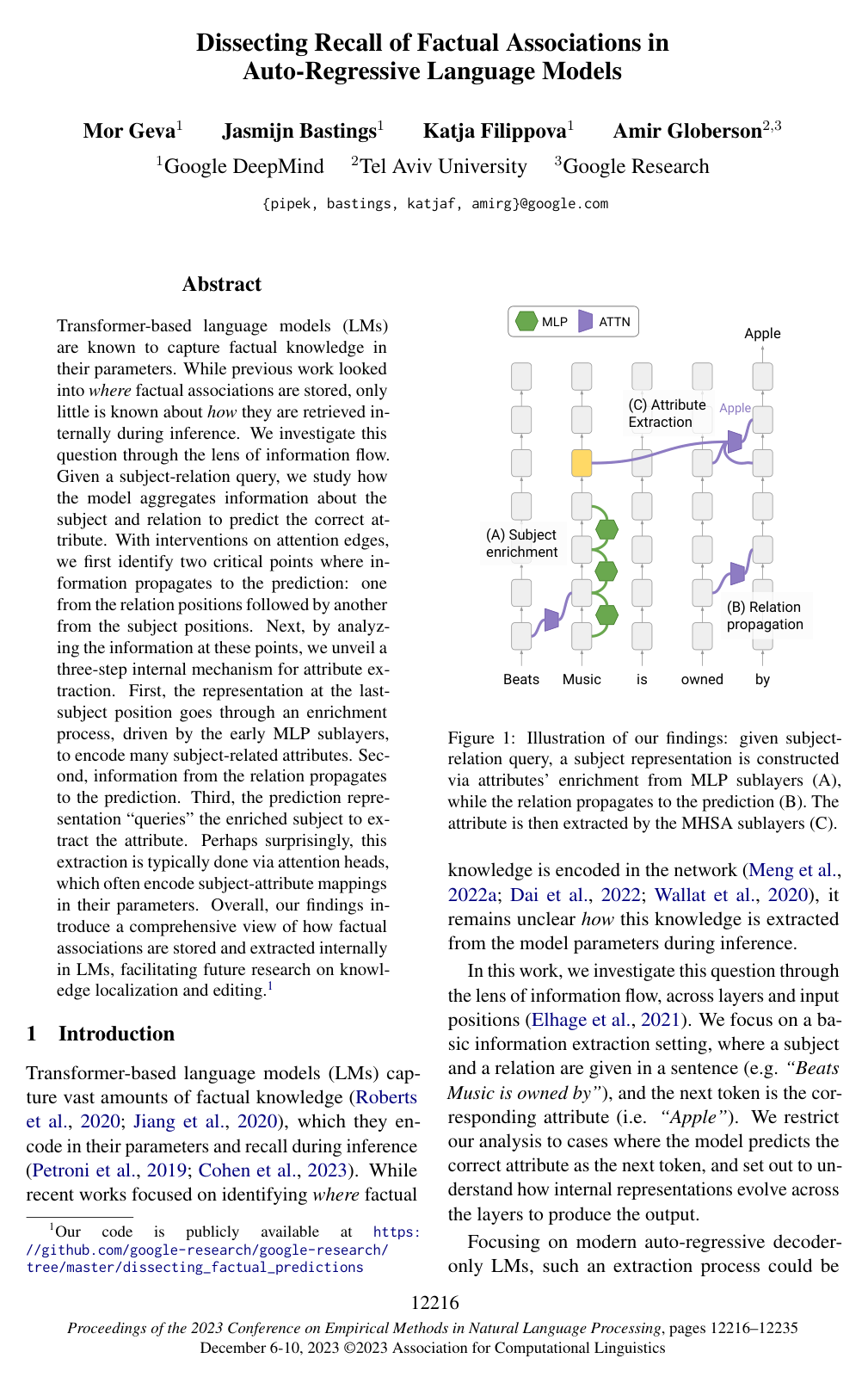
Transformer-based language models (LMs) are known to capture factual knowledge in their parameters. While previous work looked into where factual associations are stored, only little is known about how they are retrieved internally during inference. We investigate this question through the lens of information flow. Given a subject-relation query, we study how the model aggregates information about the subject and relation to predict the correct attribute. With interventions on attention edges, we first identify two critical points where information propagates to the prediction: one from the relation positions followed by another from the subject positions. Next, by analyzing the information at these points, we unveil a three-step internal mechanism for attribute extraction. First, the representation at the last-subject position goes through an enrichment process, driven by the early MLP sublayers, to encode many subject-related attributes. Second, information from the relation propagates to the prediction. Third, the prediction representation “queries” the enriched subject to extract the attribute. Perhaps surprisingly, this extraction is typically done via attention heads, which often encode subject-attribute mappings in their parameters. Overall, our findings introduce a comprehensive view of how factual associations are stored and extracted internally in LMs, facilitating future research on knowledge localization and editing.¹
Added
2026-09-28
Future Lens: Anticipating Subsequent Tokens from a Single Hidden State
Koyena Pal, Jiuding Sun, Andrew Yuan, Byron C. Wallace, David Bau
Why you should read this
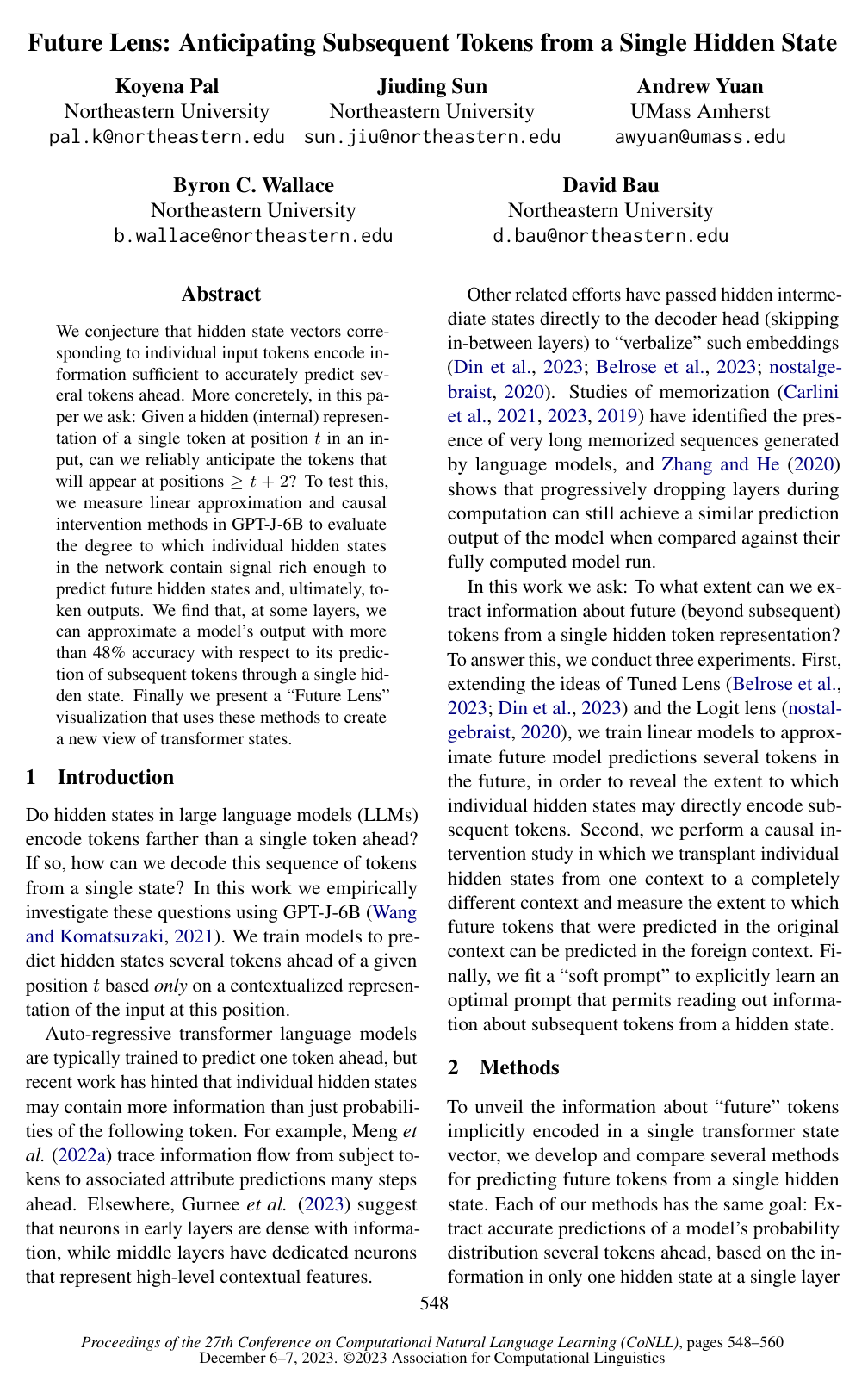
Demonstrates through linear probing and causal state transplantation that single intermediate hidden states in autoregressive transformers encode information capable of predicting tokens multiple steps into the future.
Added
2026-09-26
PMET: Precise Model Editing in a Transformer
Xiaopeng Li, Shasha Li, Shezheng Song, Jing Yang, Jun Ma, Jie Yu
Why you should read this
Proposes PMET, a model editing framework that jointly optimizes attention and feed-forward hidden states while selectively updating feed-forward weights, preventing the transfer of irrelevant attention signals for more accurate factual updates in large language models.
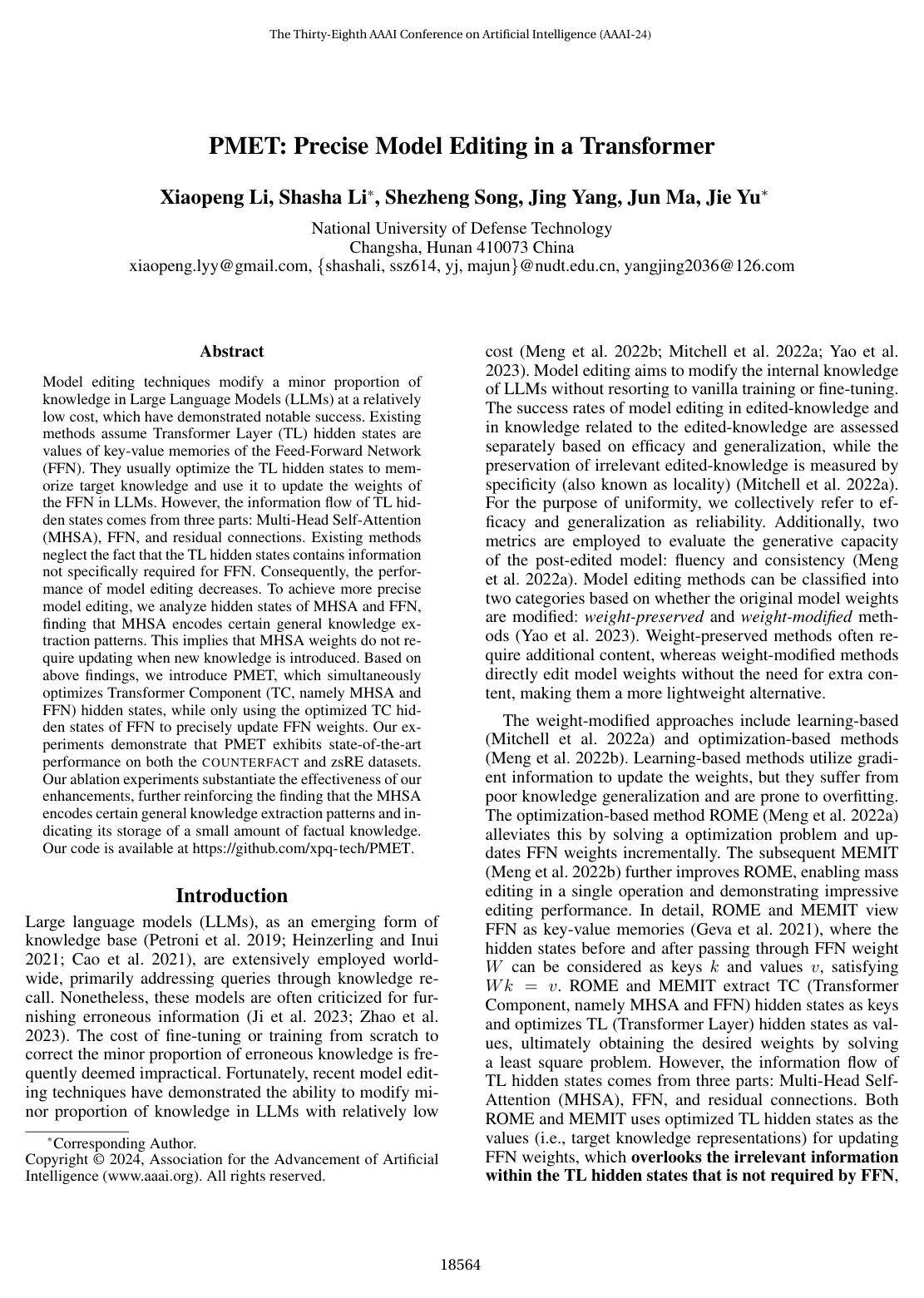
Model editing techniques modify a minor proportion of knowledge in Large Language Models (LLMs) at a relatively low cost, which have demonstrated notable success. Existing methods assume Transformer Layer (TL) hidden states are values of key-value memories of the Feed-Forward Network (FFN). They usually optimize the TL hidden states to memorize target knowledge and use it to update the weights of the FFN in LLMs. However, the information flow of TL hidden states comes from three parts: Multi-Head Self-Attention (MHSA), FFN, and residual connections. Existing methods neglect the fact that the TL hidden states contains information not specifically required for FFN. Consequently, the performance of model editing decreases. To achieve more precise model editing, we analyze hidden states of MHSA and FFN, finding that MHSA encodes certain general knowledge extraction patterns. This implies that MHSA weights do not require updating when new knowledge is introduced. Based on above findings, we introduce PMET, which simultaneously optimizes Transformer Component (TC, namely MHSA and FFN) hidden states, while only using the optimized TC hidden states of FFN to precisely update FFN weights. Our experiments demonstrate that PMET exhibits state-of-the-art performance on both the COUNTERFACT and zsRE datasets. Our ablation experiments substantiate the effectiveness of our enhancements, further reinforcing the finding that the MHSA encodes certain general knowledge extraction patterns and indicating its storage of a small amount of factual knowledge. Our code is available at https://github.com/xpq-tech/PMET.
Added
2026-09-26
Transformer Feed-Forward Layers Are Key-Value Memories
Mor Geva, Roei Schuster, Jonathan Berant, Omer Levy
Why you should read this
Shows that transformer feed-forward layers function as key-value memories, revealing how the majority of network parameters store human-interpretable textual patterns and directly predict next-token distributions.
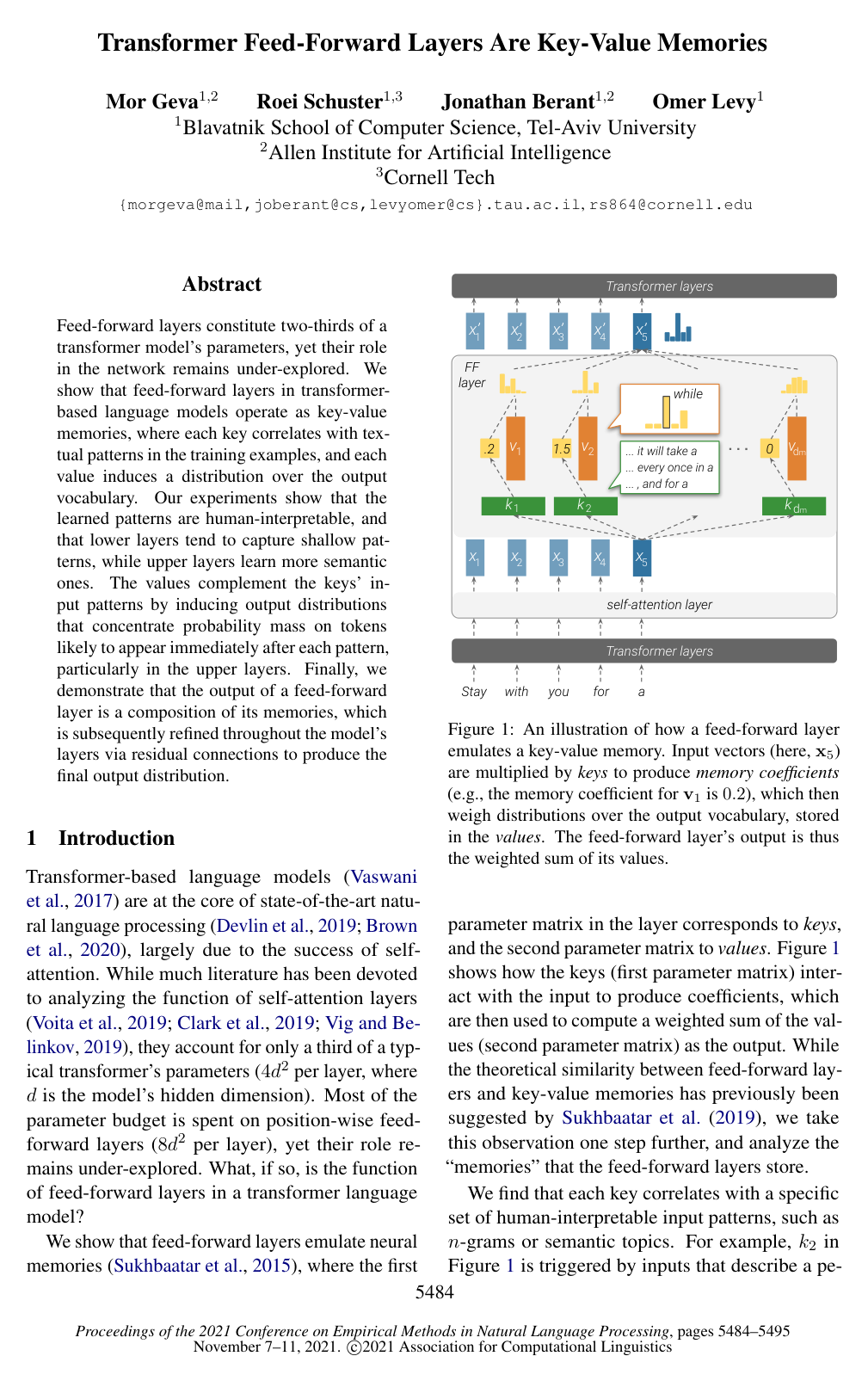
Feed-forward layers constitute two-thirds of a transformer model's parameters, yet their role in the network remains under-explored. We show that feed-forward layers in transformer-based language models operate as key-value memories, where each key correlates with textual patterns in the training examples, and each value induces a distribution over the output vocabulary. Our experiments show that the learned patterns are human-interpretable, and that lower layers tend to capture shallow patterns, while upper layers learn more semantic ones. The values complement the keys' input patterns by inducing output distributions that concentrate probability mass on tokens likely to appear immediately after each pattern, particularly in the upper layers. Finally, we demonstrate that the output of a feed-forward layer is a composition of its memories, which is subsequently refined throughout the model's layers via residual connections to produce the final output distribution.
Added
2026-09-24