
keyword
joint reasoning
Joint reasoning is an artificial intelligence inference process in which multiple distinct information sources or data representations, such as unstructured text and structured knowledge graphs, are integrated and evaluated simultaneously to solve complex reasoning tasks. Unlike sequential or isolated processing pipelines, joint reasoning facilitates bidirectional interaction and continuous mutual feature exchange between different modalities or knowledge stores throughout the reasoning procedure. This collaborative approach allows implicit parametric knowledge stored within neural language models to seamlessly combine with explicit relational facts from structured knowledge bases, thereby enhancing factual accuracy, contextual grounding, and interpretability in automated decision-making and question-answering systems.
2 items
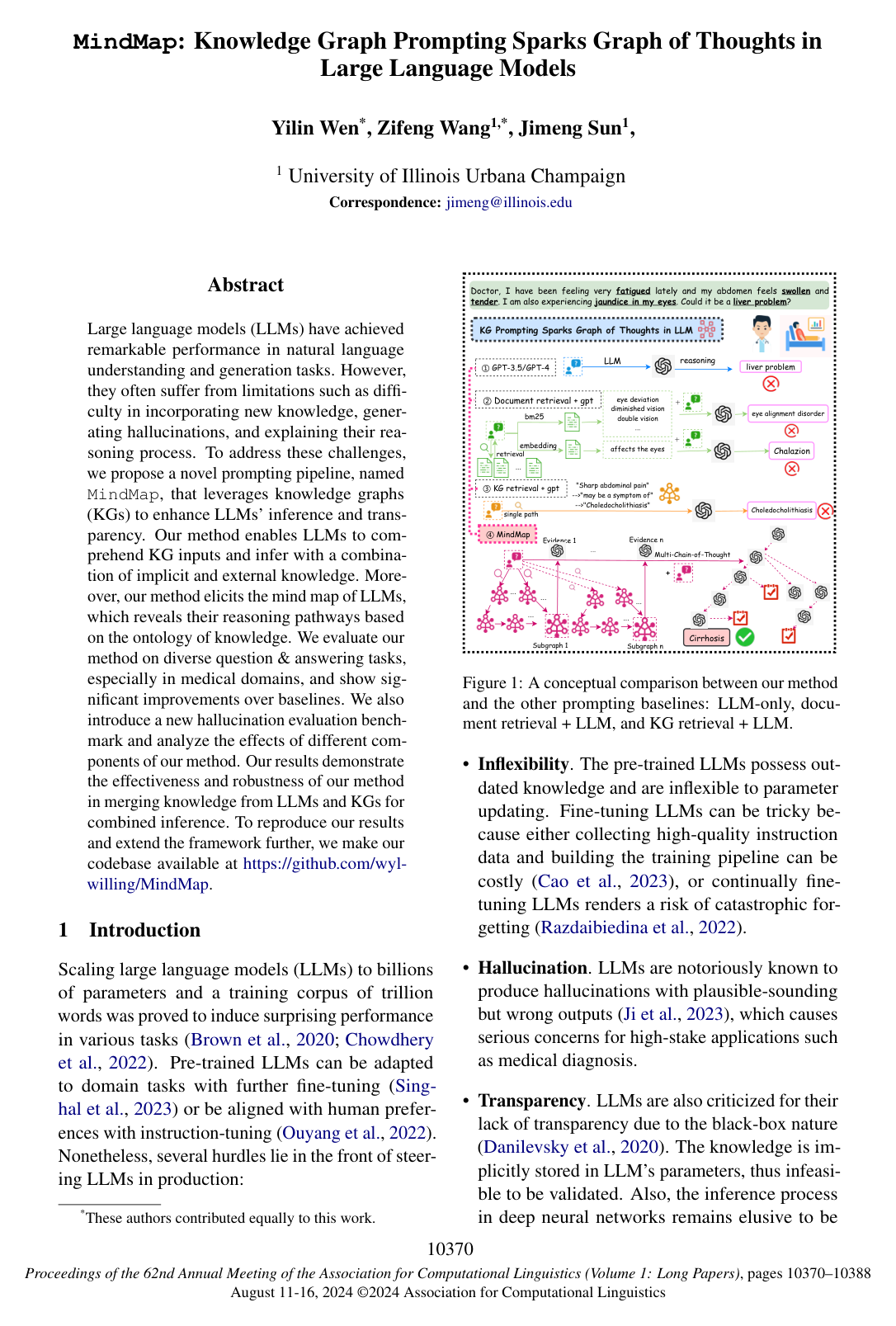
MindMap: Knowledge Graph Prompting Sparks Graph of Thoughts in Large Language Models
Yilin Wen, Zifeng Wang, Jimeng Sun
Why you should read this
Proposes a plug-and-play prompting framework that combines external knowledge graphs with large language models to construct transparent reasoning pathways and reduce hallucinations in complex question answering.
Large language models (LLMs) have achieved remarkable performance in natural language understanding and generation tasks. However, they often suffer from limitations such as difficulty in incorporating new knowledge, generating hallucinations, and explaining their reasoning process. To address these challenges, we propose a novel prompting pipeline, named MindMap, that leverages knowledge graphs (KGs) to enhance LLMs' inference and transparency. Our method enables LLMs to comprehend KG inputs and infer with a combination of implicit and external knowledge. Moreover, our method elicits the mind map of LLMs, which reveals their reasoning pathways based on the ontology of knowledge. We evaluate our method on diverse question & answering tasks, especially in medical domains, and show significant improvements over baselines. We also introduce a new hallucination evaluation benchmark and analyze the effects of different components of our method. Our results demonstrate the effectiveness and robustness of our method in merging knowledge from LLMs and KGs for combined inference. To reproduce our results and extend the framework further, we make our codebase available at https://github.com/wyl-willing/MindMap.
Added
2026-10-01
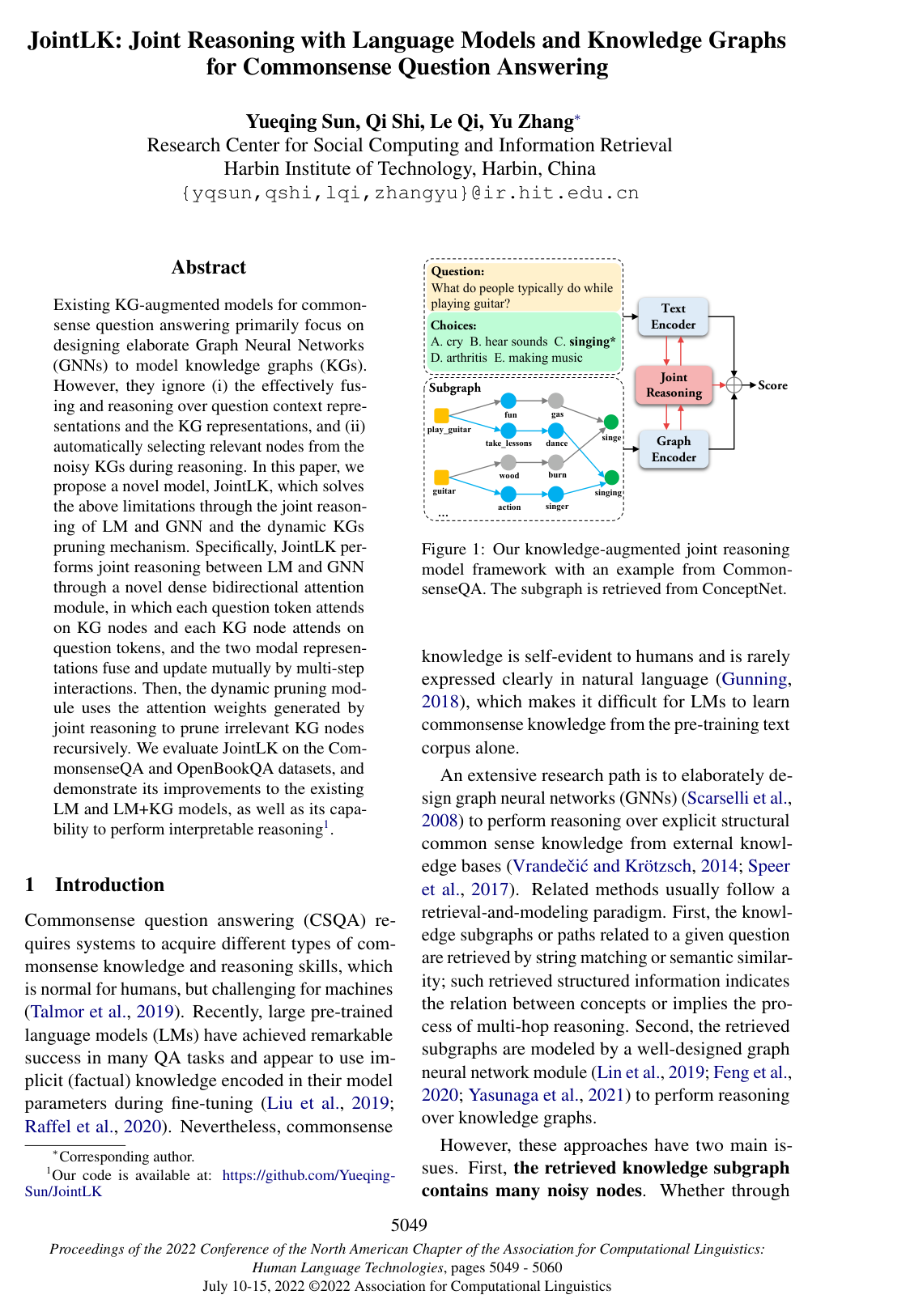
JointLK: Joint Reasoning with Language Models and Knowledge Graphs for Commonsense Question Answering
Yueqing Sun, Qi Shi, Le Qi, Yu Zhang
Why you should read this
Proposes JointLK, a model that unites pretrained language models and graph neural networks through fine-grained bidirectional attention and dynamic node pruning to filter irrelevant knowledge and deliver interpretable commonsense question answering.
Existing KG-augmented models for common-sense question answering primarily focus on designing elaborate Graph Neural Networks (GNNs) to model knowledge graphs (KGs). However, they ignore (i) the effectively fusing and reasoning over question context representations and the KG representations, and (ii) automatically selecting relevant nodes from the noisy KGs during reasoning. In this paper, we propose a novel model, JointLK, which solves the above limitations through the joint reasoning of LM and GNN and the dynamic KGs pruning mechanism. Specifically, JointLK performs joint reasoning between LM and GNN through a novel dense bidirectional attention module, in which each question token attends on KG nodes and each KG node attends on question tokens, and the two modal representations fuse and update mutually by multi-step interactions. Then, the dynamic pruning module uses the attention weights generated by joint reasoning to prune irrelevant KG nodes recursively. We evaluate JointLK on the CommonsenseQA and OpenBookQA datasets, and demonstrate its improvements to the existing LM and LM+KG models, as well as its capability to perform interpretable reasoning¹.
Added
2026-09-26