
keyword
iterative computation
Iterative computation is a process in mathematics and computer science where a fixed sequence of operations is applied repeatedly to update and refine data or internal states across multiple steps until a target result or convergence criterion is reached. Rather than executing a strictly single-pass procedure, iterative approaches feed the output of one step as the input to the next, enabling the execution of algorithmic routines, state refinement, and dynamic data propagation. In computational modeling and artificial neural networks, this paradigm allows specific functional components or layer blocks to be reused across successive cycles, facilitating multi-step reasoning, variable computation depth, and complex problem-solving without necessarily increasing the total number of structural parameters.
4 items
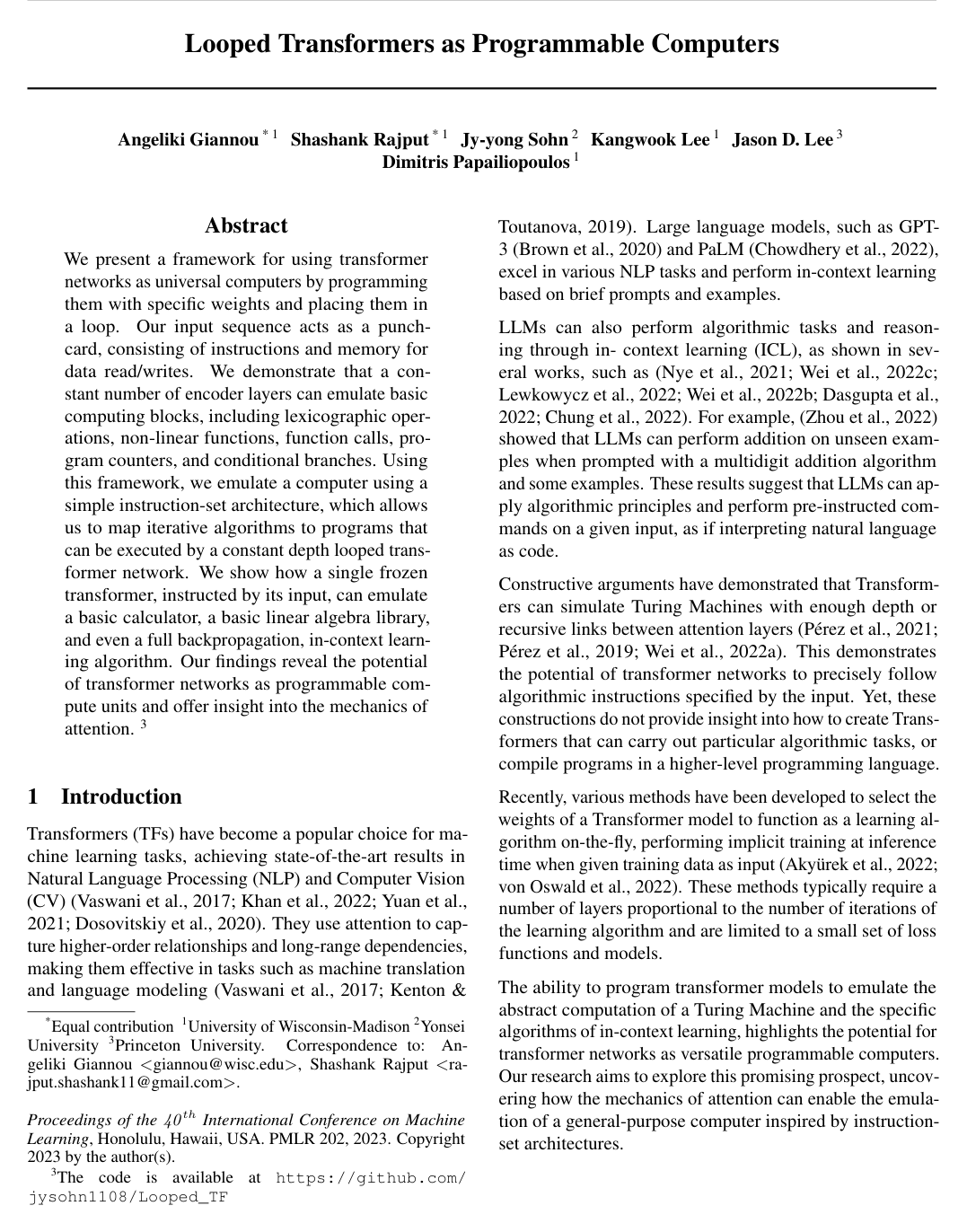
Looped Transformers as Programmable Computers
Angeliki Giannou, Shashank Rajput, Jy-yong Sohn, Kangwook Lee, Jason D. Lee, Dimitris Papailiopoulos
Why you should read this
Demonstrates how constant-depth looped transformers can function as universal computers by executing instruction sets directly from input prompts to run iterative algorithms, linear algebra operations, and in-context backpropagation.
We present a framework for using transformer networks as universal computers by programming them with specific weights and placing them in a loop. Our input sequence acts as a punch-card, consisting of instructions and memory for data read/writes. We demonstrate that a constant number of encoder layers can emulate basic computing blocks, including lexicographic operations, non-linear functions, function calls, program counters, and conditional branches. Using this framework, we emulate a computer using a simple instruction-set architecture, which allows us to map iterative algorithms to programs that can be executed by a constant depth looped transformer network. We show how a single frozen transformer, instructed by its input, can emulate a basic calculator, a basic linear algebra library, and even a full backpropagation, in-context learning algorithm. Our findings reveal the potential of transformer networks as programmable compute units and offer insight into the mechanics of attention. 3
Added
2026-09-30
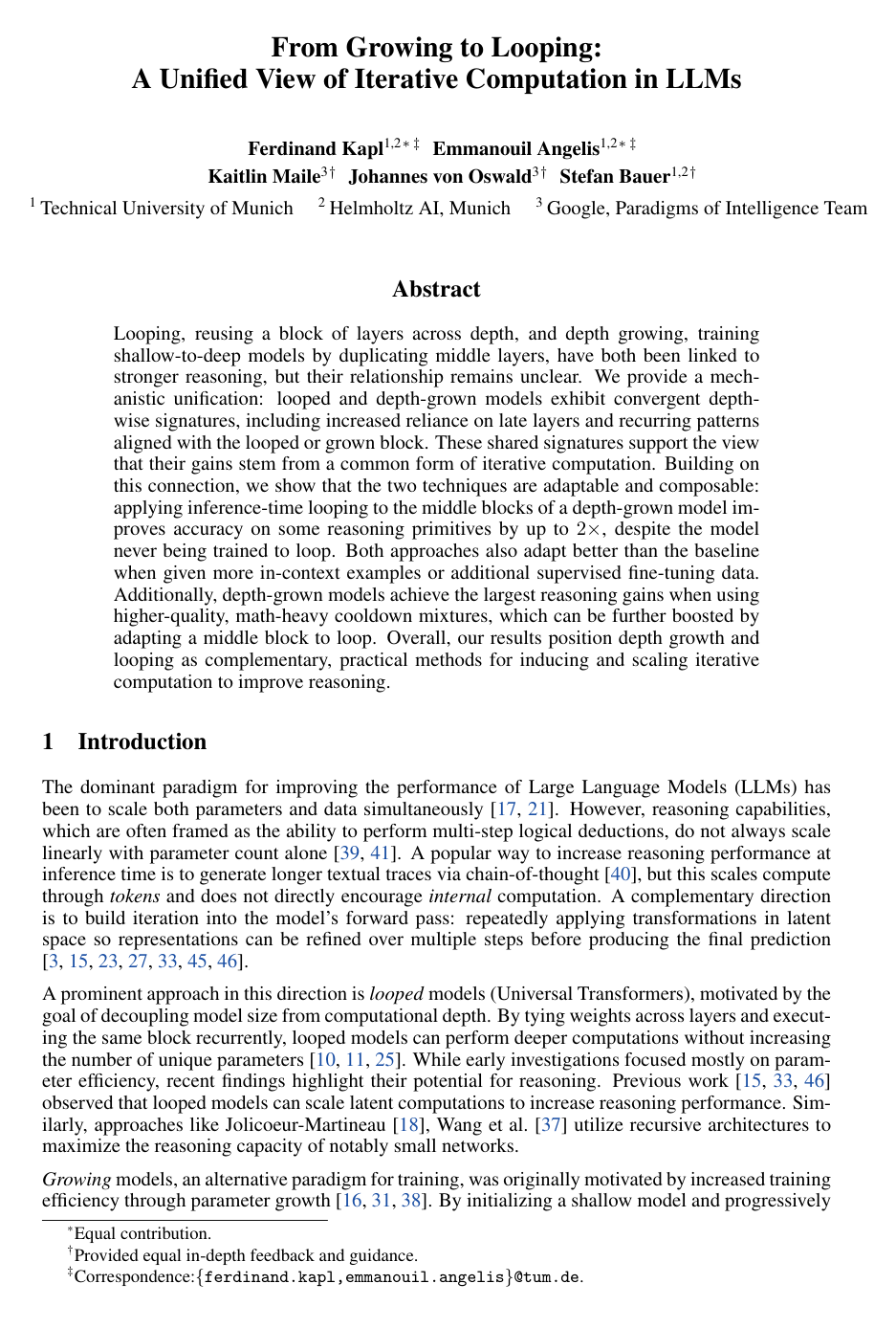
From Growing to Looping: A Unified View of Iterative Computation in LLMs
Ferdinand Kapl, Emmanouil Angelis, Kaitlin Maile, Johannes von Oswald, Stefan Bauer
Why you should read this
Establishes a mechanistic link between layer looping and depth growth in language models, showing that applying inference-time looping to depth-grown architectures can double reasoning accuracy without loop-specific training.
Looping, reusing a block of layers across depth, and depth growing, training shallow-to-deep models by duplicating middle layers, have both been linked to stronger reasoning, but their relationship remains unclear. We provide a mechanistic unification: looped and depth-grown models exhibit convergent depth-wise signatures, including increased reliance on late layers and recurring patterns aligned with the looped or grown block. These shared signatures support the view that their gains stem from a common form of iterative computation. Building on this connection, we show that the two techniques are adaptable and composable: applying inference-time looping to the middle blocks of a depth-grown model improves accuracy on some reasoning primitives by up to , despite the model never being trained to loop. Both approaches also adapt better than the baseline when given more in-context examples or additional supervised fine-tuning data. Additionally, depth-grown models achieve the largest reasoning gains when using higher-quality, math-heavy cooldown mixtures, which can be further boosted by adapting a middle block to loop. Overall, our results position depth growth and looping as complementary, practical methods for inducing and scaling iterative computation to improve reasoning.
Added
2026-09-30
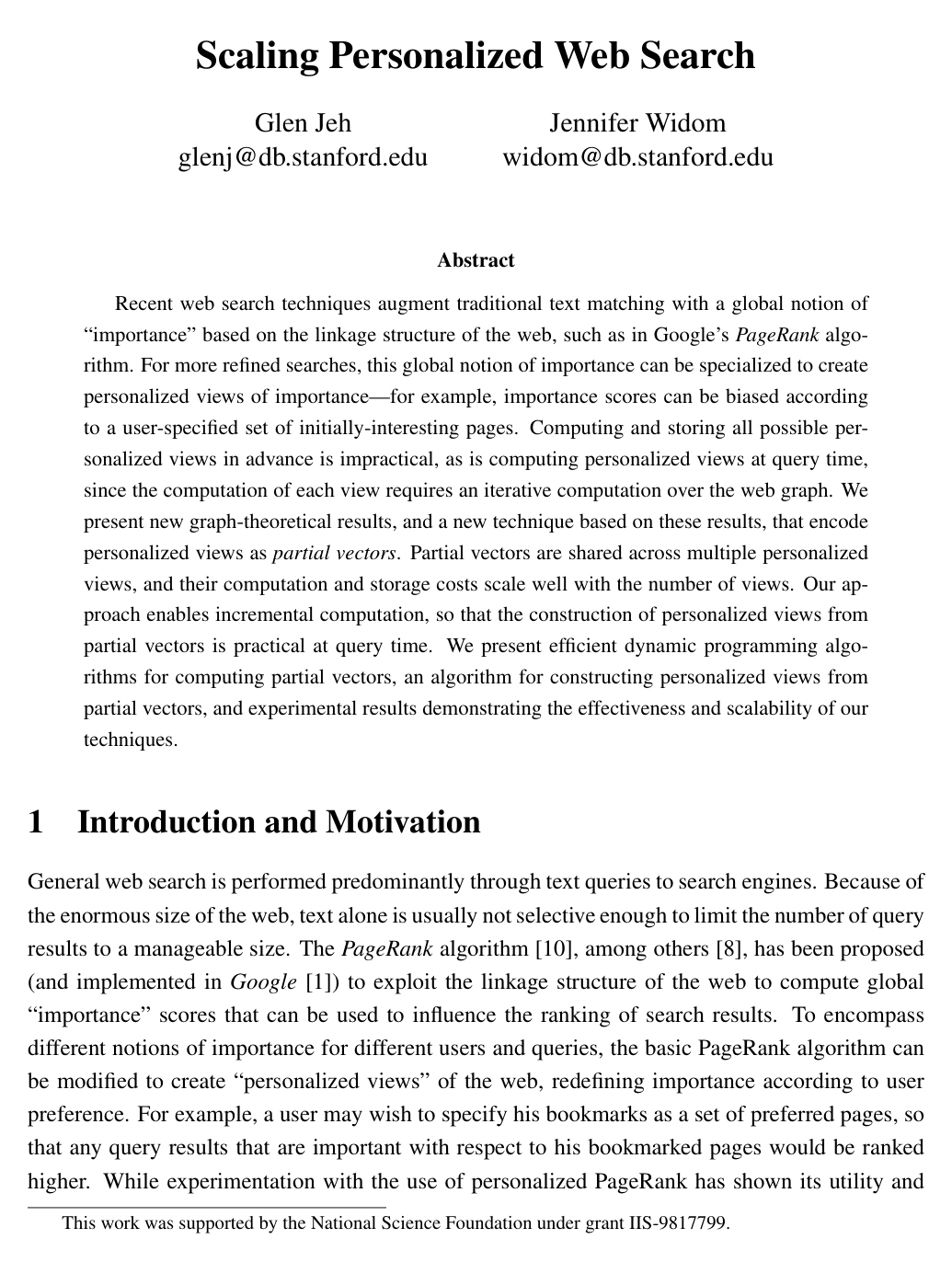
Scaling personalized web search
Glen Jeh, Jennifer Widom
Why you should read this
Develops a scalable framework for personalized PageRank by decomposing personalized views into precomputed, shared partial vectors that enable fast, query-time customization for arbitrary user preference sets.
Recent web search techniques augment traditional text matching with a global notion of “importance” based on the linkage structure of the web, such as in Google’s PageRank algorithm. For more refined searches, this global notion of importance can be specialized to create personalized views of importance—for example, importance scores can be biased according to a user-specified set of initially-interesting pages. Computing and storing all possible personalized views in advance is impractical, as is computing personalized views at query time, since the computation of each view requires an iterative computation over the web graph. We present new graph-theoretical results, and a new technique based on these results, that encode personalized views as partial vectors. Partial vectors are shared across multiple personalized views, and their computation and storage costs scale well with the number of views. Our approach enables incremental computation, so that the construction of personalized views from partial vectors is practical at query time. We present efficient dynamic programming algorithms for computing partial vectors, an algorithm for constructing personalized views from partial vectors, and experimental results demonstrating the effectiveness and scalability of our techniques.
Added
2026-09-25
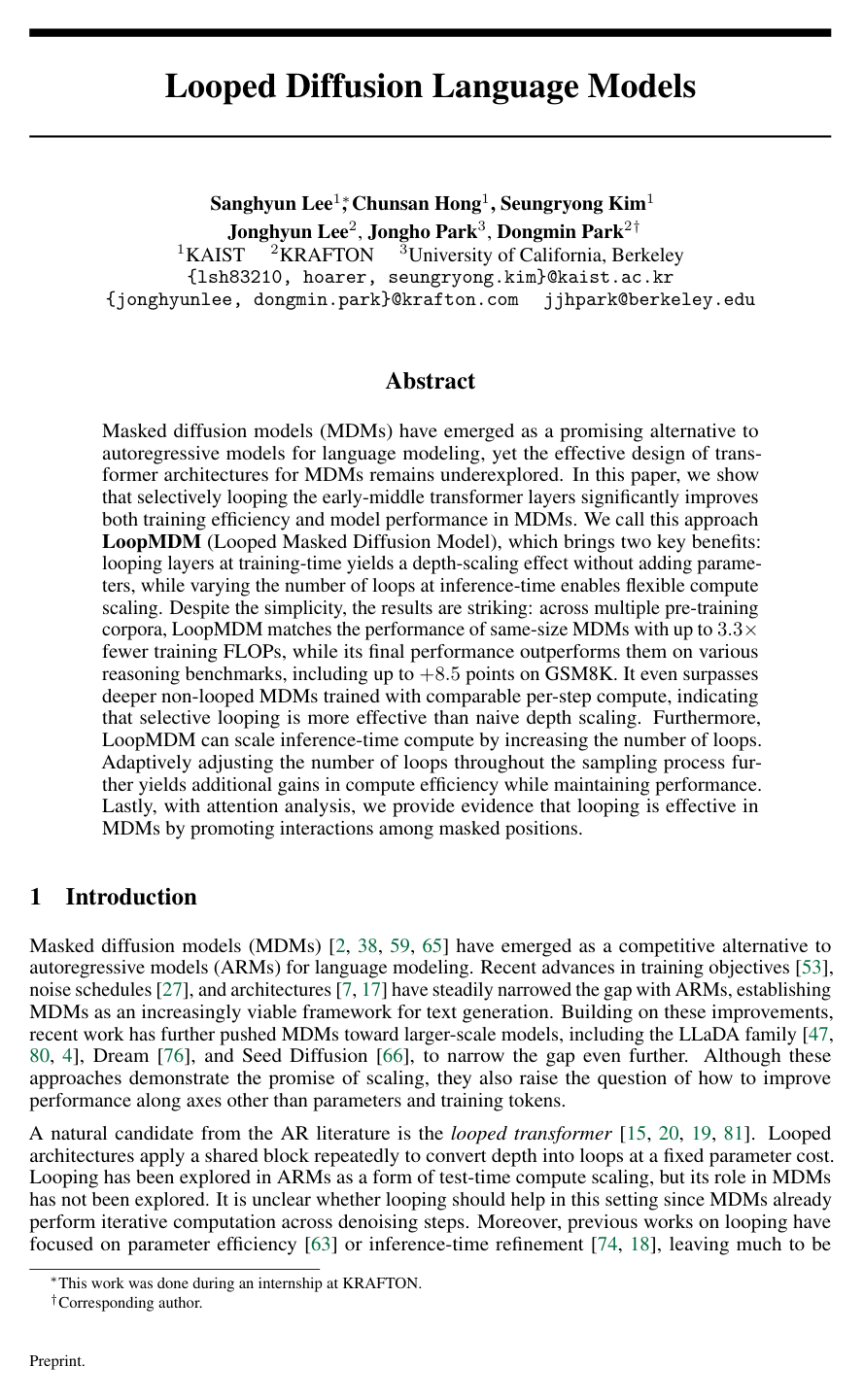
Looped Diffusion Language Models
Sanghyun Lee, Chunsan Hong, Seungryong Kim, Jonghyun Lee, Jongho Park, Dongmin Park
Why you should read this
Introduces LoopMDM, a novel transformer architecture for masked diffusion language models that significantly boosts training efficiency and performance on reasoning benchmarks by selectively looping early-middle layers, achieving depth-scaling effects without added parameters and enabling flexible inference-time compute scaling.
Masked diffusion models (MDMs) have emerged as a promising alternative to autoregressive models for language modeling, yet the effective design of transformer architectures for MDMs remains underexplored. In this paper, we show that selectively looping the early-middle transformer layers significantly improves both training efficiency and model performance in MDMs. We call this approach LoopMDM(Looped Masked Diffusion Model), which brings two key benefits: looping layers at training-time yields a depth-scaling effect without adding parameters, while varying the number of loops at inference-time enables flexible compute scaling. Despite the simplicity, the results are striking: across multiple pre-training corpora, LoopMDM matches the performance of same-size MDMs with up to 3.3 fewer training FLOPs, while its final performance outperforms them on various reasoning benchmarks, including up to 8.5 points on GSM8K. It even surpasses deeper non-looped MDMs trained with comparable per-step compute, indicating that selective looping is more effective than naive depth scaling. Furthermore, LoopMDM can scale inference-time compute by increasing the number of loops. Adaptively adjusting the number of loops throughout the sampling process further yields additional gains in compute efficiency while maintaining performance. Lastly, with attention analysis, we provide evidence that looping is effective in MDMs by promoting interactions among masked positions. Our code and weights will be publicly released.
Added
2026-07-31
