
Built independently by an author, for readers. Read the story and support ChapterPal

keyword

IOI circuit

An IOI circuit, short for indirect object identification circuit, is a specific computational subnetwork within a transformer language model that mechanistically implements the ability to identify and predict the indirect object in a sentence. In the field of mechanistic interpretability, it refers to an identified subgraph of interconnected attention heads and pathways that cooperatively resolve references in natural language, such as completing a narrative prompt with the appropriate non-repeated individual when two names are introduced and one is later repeated as the subject. The circuit operates through distinct functional groups of attention heads, including duplicate token heads that identify repeated names, inhibition mechanisms that suppress those candidates, and name mover heads that extract and boost the probability of the correct indirect object for the final output token prediction.

1 item
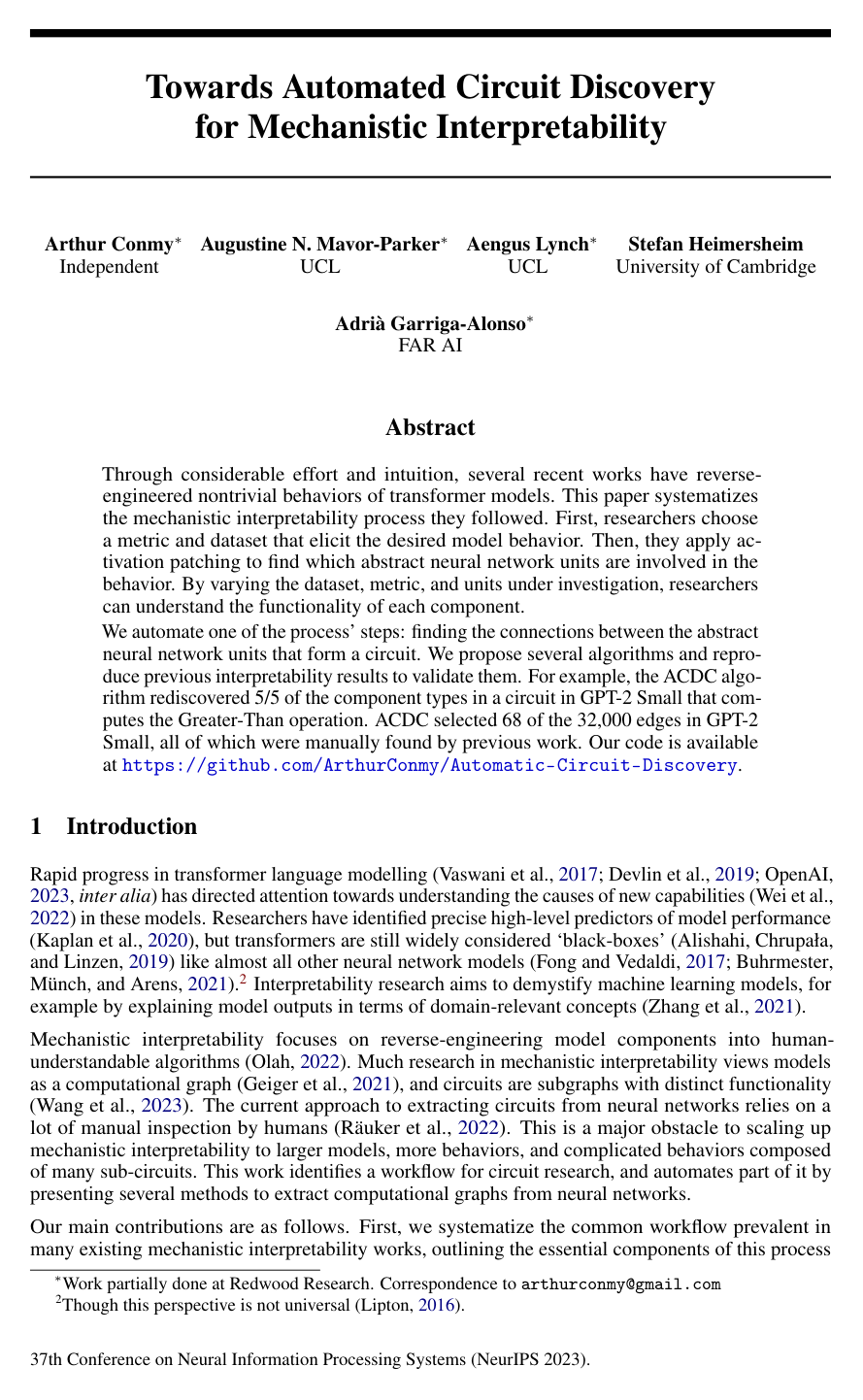
Towards Automated Circuit Discovery for Mechanistic Interpretability

Towards Automated Circuit Discovery for Mechanistic Interpretability

Arthur Conmy, Augustine N. Mavor-Parker, Aengus Lynch, Stefan Heimersheim, Adrià Garriga-Alonso

OrganizationsFAR AIUniversity College LondonUniversity of Cambridge

Why you should read this

Proposes an automated circuit discovery algorithm that replaces labor-intensive manual patching to efficiently isolate the computational subgraphs responsible for specific behaviors in transformer models.

Through considerable effort and intuition, several recent works have reverse-engineered nontrivial behaviors of transformer models. This paper systematizes the mechanistic interpretability process they followed. First, researchers choose a metric and dataset that elicit the desired model behavior. Then, they apply activation patching to find which abstract neural network units are involved in the behavior. By varying the dataset, metric, and units under investigation, researchers can understand the functionality of each component. We automate one of the process' steps: to identify the circuit that implements the specified behavior in the model's computational graph. We propose several algorithms and reproduce previous interpretability results to validate them. For example, the ACDC algorithm rediscovered 5/5 of the component types in a circuit in GPT-2 Small that computes the Greater-Than operation. ACDC selected 68 of the 32,000 edges in GPT-2 Small, all of which were manually found by previous work. Our code is available at this https URL.

Added

2026-09-25