Built independently by an author, for readers. Read the story and support ChapterPal

keyword

internal pivot language

An internal pivot language is an intermediate language representation that a multilingual neural language model uses across its hidden layers to process and bridge information between different languages. In models trained predominantly on data from a dominant language, such as English, intermediate computations for non-dominant language inputs are temporarily transformed into latent semantic representations that align closely with that dominant language. These intermediate representations serve as a shared conceptual space for reasoning before the model projects the final states back into the requested output language in its upper layers. While this internal routing facilitates cross-lingual generalization and knowledge transfer, it can also propagate linguistic and cultural biases associated with the dominant language across multilingual tasks.

1 item

Do Llamas Work in English? On the Latent Language of Multilingual Transformers

Do Llamas Work in English? On the Latent Language of Multilingual Transformers

Chris Wendler, Veniamin Veselovsky, Giovanni Monea, Robert West

OrganizationsÉcole Polytechnique Fédérale de Lausanne

Why you should read this

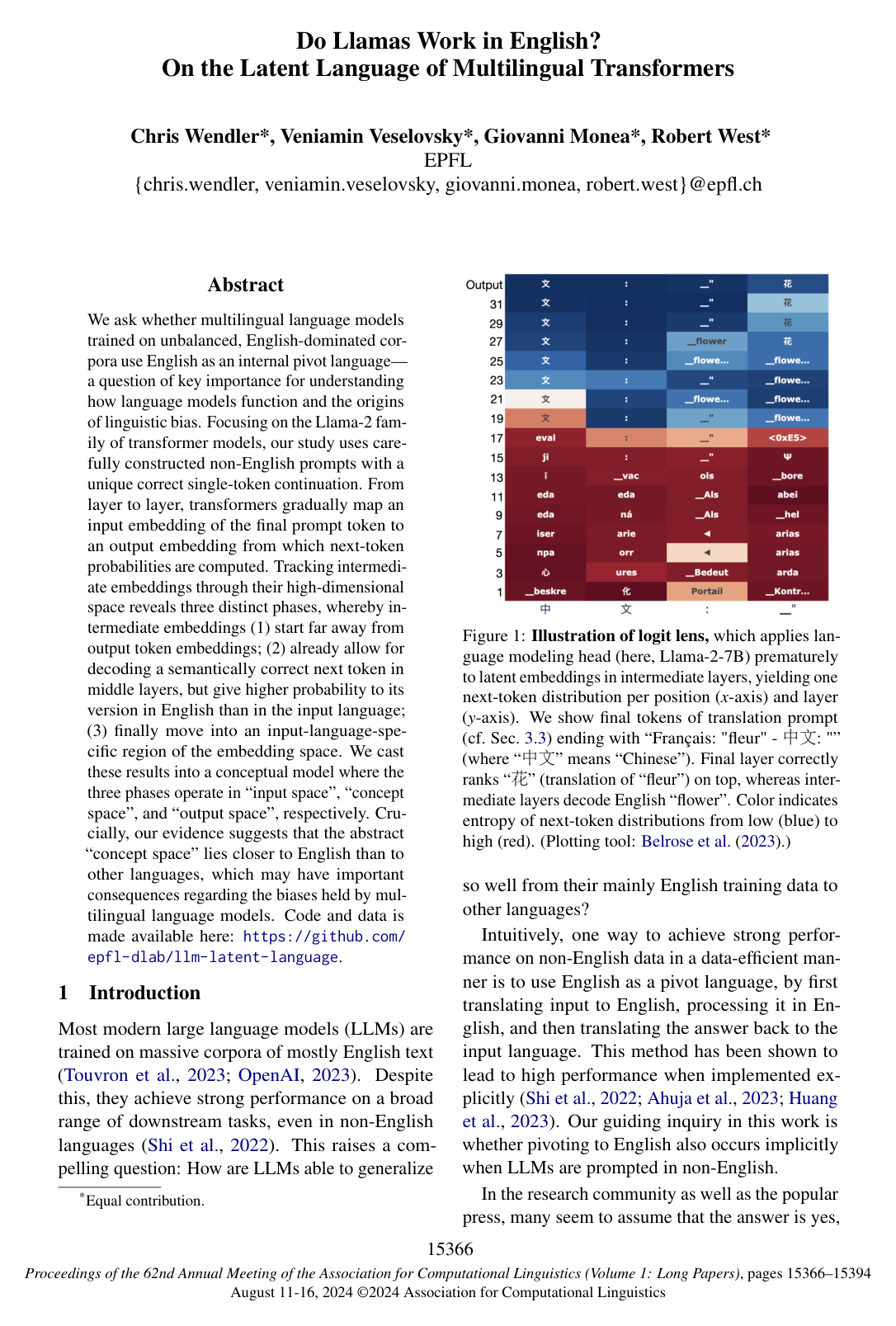
Reveals through logit lens analysis that multilingual transformer models route non-English inputs through an internal, English-aligned concept space in intermediate layers before decoding them into the target language.

We ask whether multilingual language models trained on unbalanced, English-dominated corpora use English as an internal pivot language—a question of key importance for understanding how language models function and the origins of linguistic bias. Focusing on the Llama-2 family of transformer models, our study uses carefully constructed non-English prompts with a unique correct single-token continuation. From layer to layer, transformers gradually map an input embedding of the final prompt token to an output embedding from which next-token probabilities are computed. Tracking intermediate embeddings through their high-dimensional space reveals three distinct phases, whereby intermediate embeddings (1) start far away from output token embeddings; (2) already allow for decoding a semantically correct next token in middle layers, but give higher probability to its version in English than in the input language; (3) finally move into an input-language-specific region of the embedding space. We cast these results into a conceptual model where the three phases operate in “input space”, “concept space”, and “output space”, respectively. Crucially, our evidence suggests that the abstract “concept space” lies closer to English than to other languages, which may have important consequences regarding the biases held by multilingual language models. Code and data is made available here: https://github.com/epfl-dlab/llm-latent-language.

Added

2026-09-26