
keyword
intermediate representations
In machine learning and deep neural networks, intermediate representations are the internal feature encodings or hidden activation states produced by the hidden layers situated between the input and the final output layer. Instead of representing raw input data or the network final predictions, these mid-depth representations capture progressively refined and abstract properties of the processed information. They retain structural and semantic features learned through successive computational transformations, making them valuable for downstream feature extraction, knowledge distillation, representation learning, and analyzing how information is compressed and preserved across a model depth.
7 items
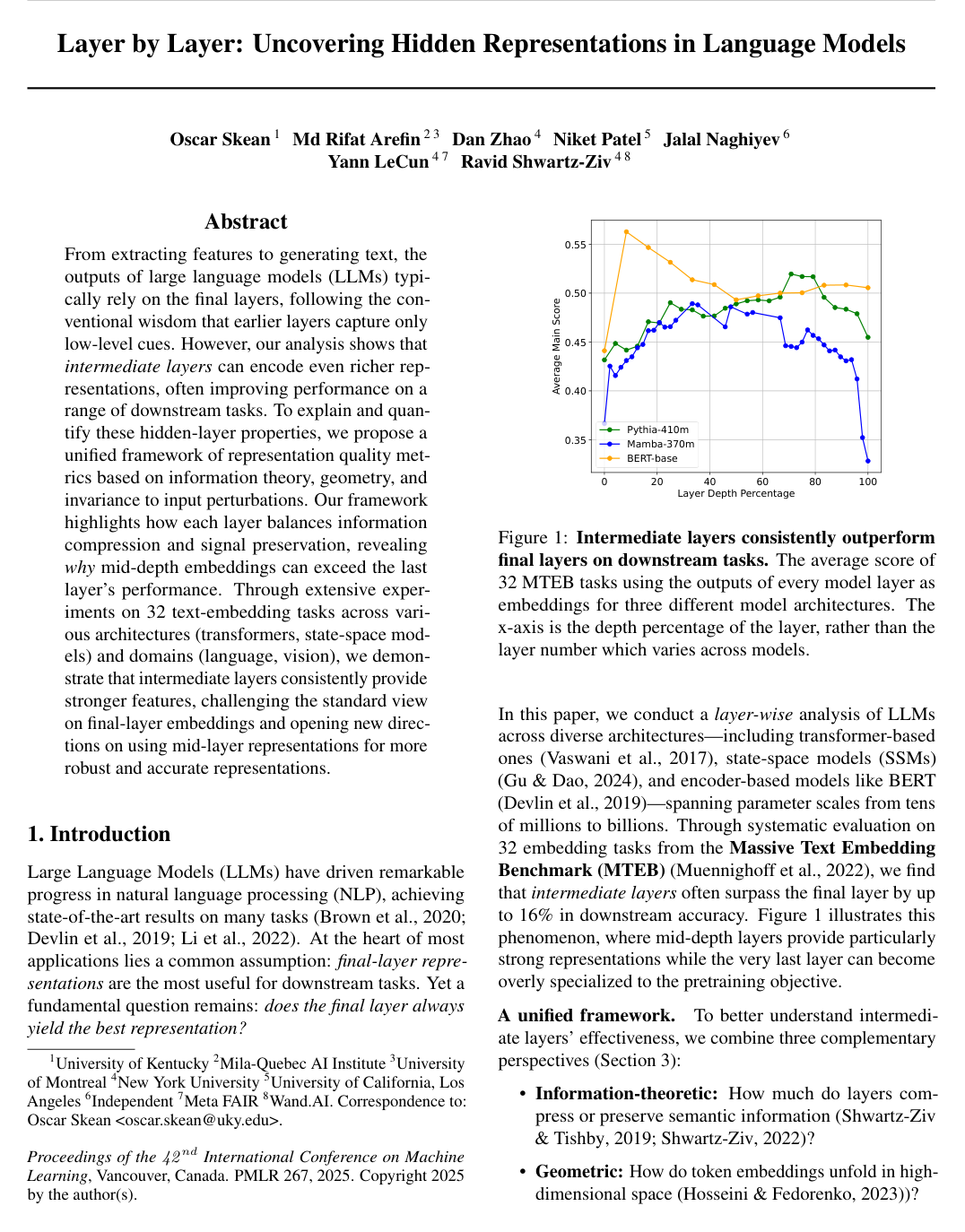
Layer by Layer: Uncovering Hidden Representations in Language Models
Oscar Skean, Md Rifat Arefin, Dan Zhao, Niket Patel, Jalal Naghiyev, Yann LeCun, Ravid Shwartz-Ziv
Why you should read this
Demonstrates that intermediate layers in language models consistently produce richer representations than the final layer, introducing a geometric and information-theoretic framework that explains why mid-depth embeddings achieve superior performance across diverse downstream tasks.
From extracting features to generating text, the outputs of large language models (LLMs) typically rely on the final layers, following the conventional wisdom that earlier layers capture only low-level cues. However, our analysis shows that intermediate layers can encode even richer representations, often improving performance on a range of downstream tasks. To explain and quantify these hidden-layer properties, we propose a unified framework of representation quality metrics based on information theory, geometry, and invariance to input perturbations. Our framework highlights how each layer balances information compression and signal preservation, revealing why mid-depth embeddings can exceed the last layer's performance. Through extensive experiments on 32 text-embedding tasks across various architectures (transformers, state-space models) and domains (language, vision), we demonstrate that intermediate layers consistently provide stronger features, challenging the standard view on final-layer embeddings and opening new directions on using mid-layer representations for more robust and accurate representations.
Added
2026-09-28
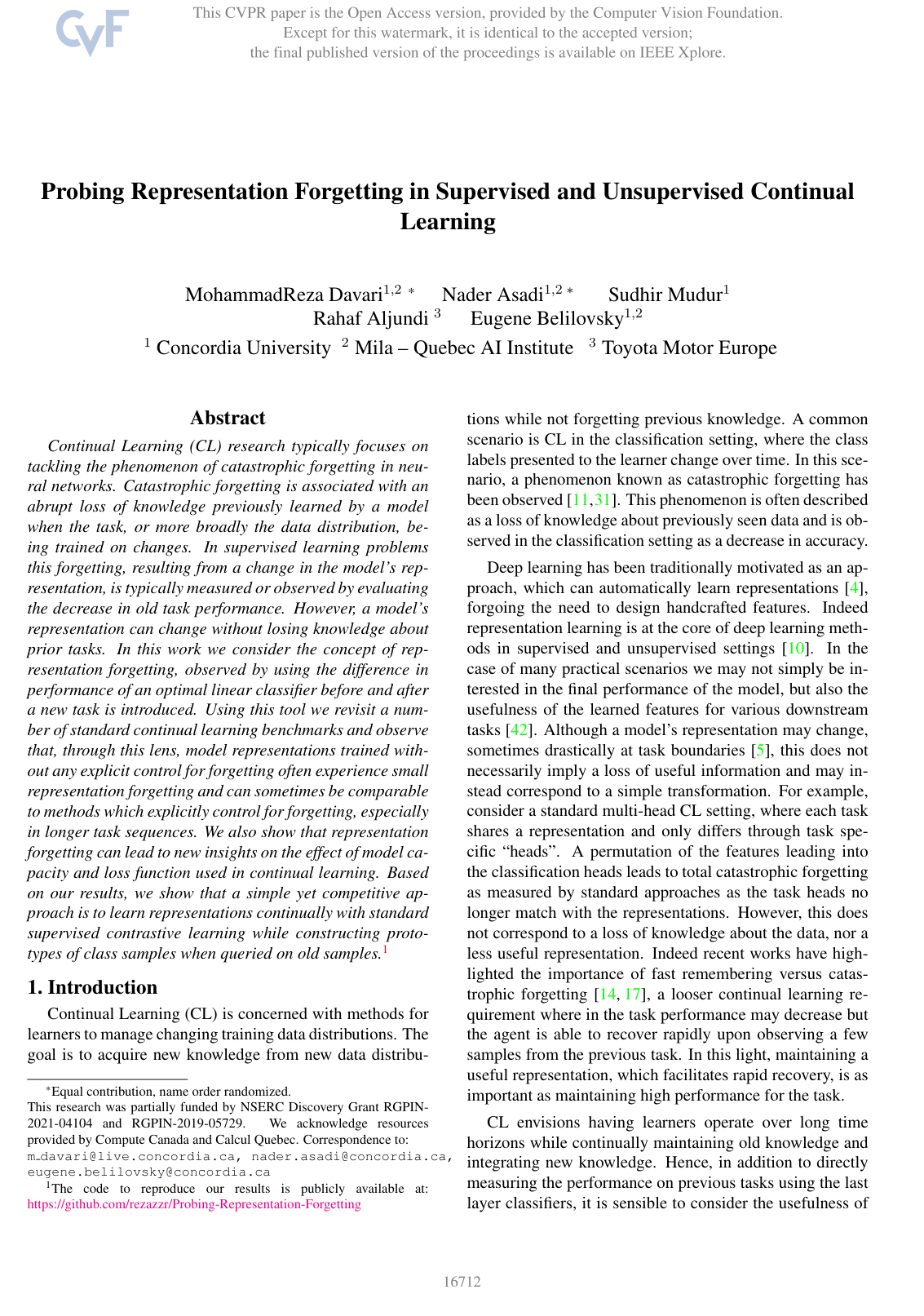
Probing Representation Forgetting in Supervised and Unsupervised Continual Learning
MohammadReza Davari, Nader Asadi, Sudhir P. Mudur, Rahaf Aljundi, Eugene Belilovsky
Why you should read this
Reveals through linear probing that neural networks retain substantially more past-task information during continual learning than standard accuracy metrics suggest, enabling a competitive rehearsal-free method based on supervised contrastive learning and class prototypes.
Continual Learning (CL) research typically focuses on tackling the phenomenon of catastrophic forgetting in neural networks. Catastrophic forgetting is associated with an abrupt loss of knowledge previously learned by a model when the task, or more broadly the data distribution, being trained on changes. In supervised learning problems this forgetting, resulting from a change in the model’s representation, is typically measured or observed by evaluating the decrease in old task performance. However, a model’s representation can change without losing knowledge about prior tasks. In this work we consider the concept of representation forgetting, observed by using the difference in performance of an optimal linear classifier before and after a new task is introduced. Using this tool we revisit a number of standard continual learning benchmarks and observe that, through this lens, model representations trained without any explicit control for forgetting often experience small representation forgetting and can sometimes be comparable to methods which explicitly control for forgetting, especially in longer task sequences. We also show that representation forgetting can lead to new insights on the effect of model capacity and loss function used in continual learning. Based on our results, we show that a simple yet competitive approach is to learn representations continually with standard supervised contrastive learning while constructing prototypes of class samples when queried on old samples.
Added
2026-09-26
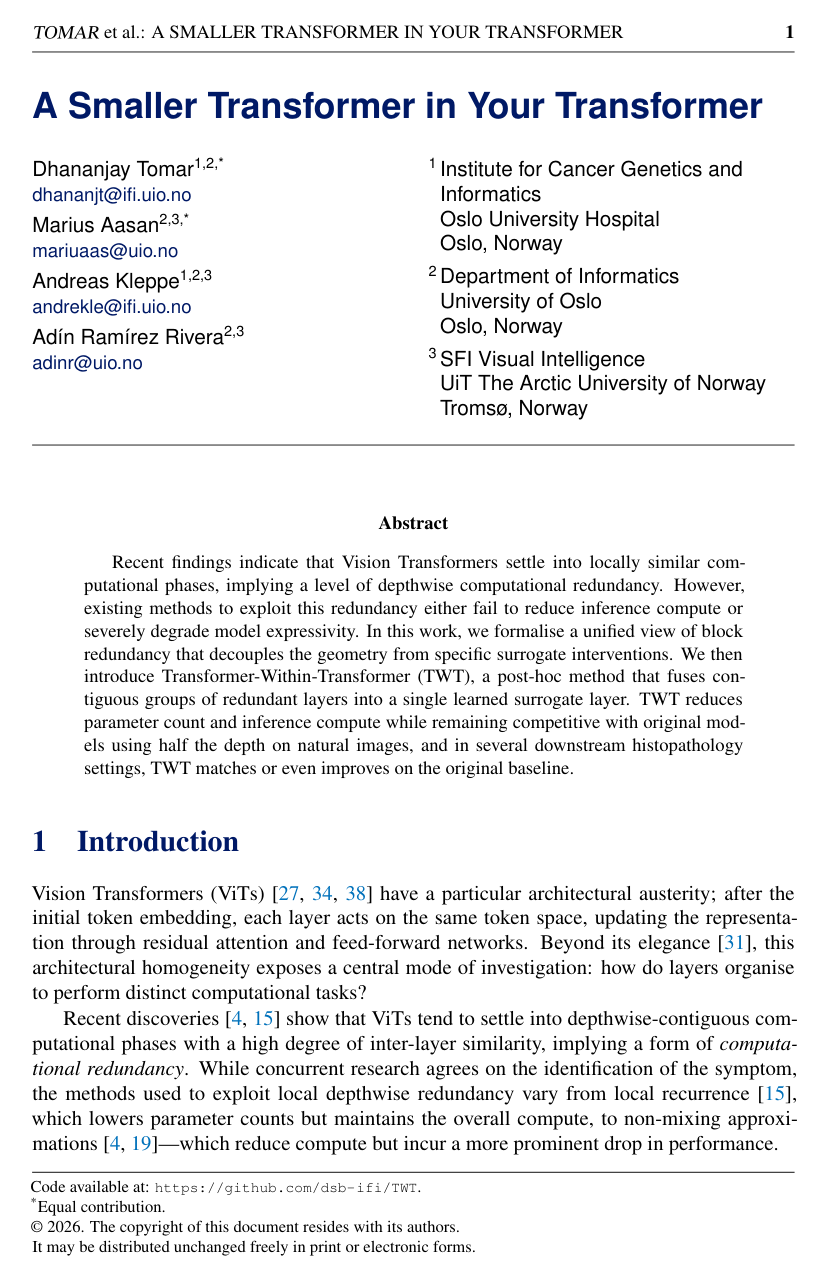
A Smaller Transformer in Your Transformer
Dhananjay Tomar, Marius Aasan, Andreas Kleppe, Adín Ramírez Rivera
Why you should read this
Proposes Transformer-Within-Transformer, a post-hoc compression technique that fuses contiguous redundant Vision Transformer layers into single learned surrogate blocks, halving model depth and inference computation while matching or exceeding baseline accuracy across natural image and histopathology domains.
Recent findings indicate that Vision Transformers settle into locally similar computational phases, implying a level of depthwise computational redundancy. However, existing methods to exploit this redundancy either fail to reduce inference compute or severely degrade model expressivity. In this work, we formalise a unified view of block redundancy that decouples the geometry from specific surrogate interventions. We then introduce Transformer-Within-Transformer (TWT), a post-hoc method that fuses contiguous groups of redundant layers into a single learned surrogate layer. TWT reduces parameter count and inference compute while remaining competitive with original models using half the depth on natural images, and in several downstream histopathology settings, TWT matches or even improves on the original baseline.
Added
2026-09-20

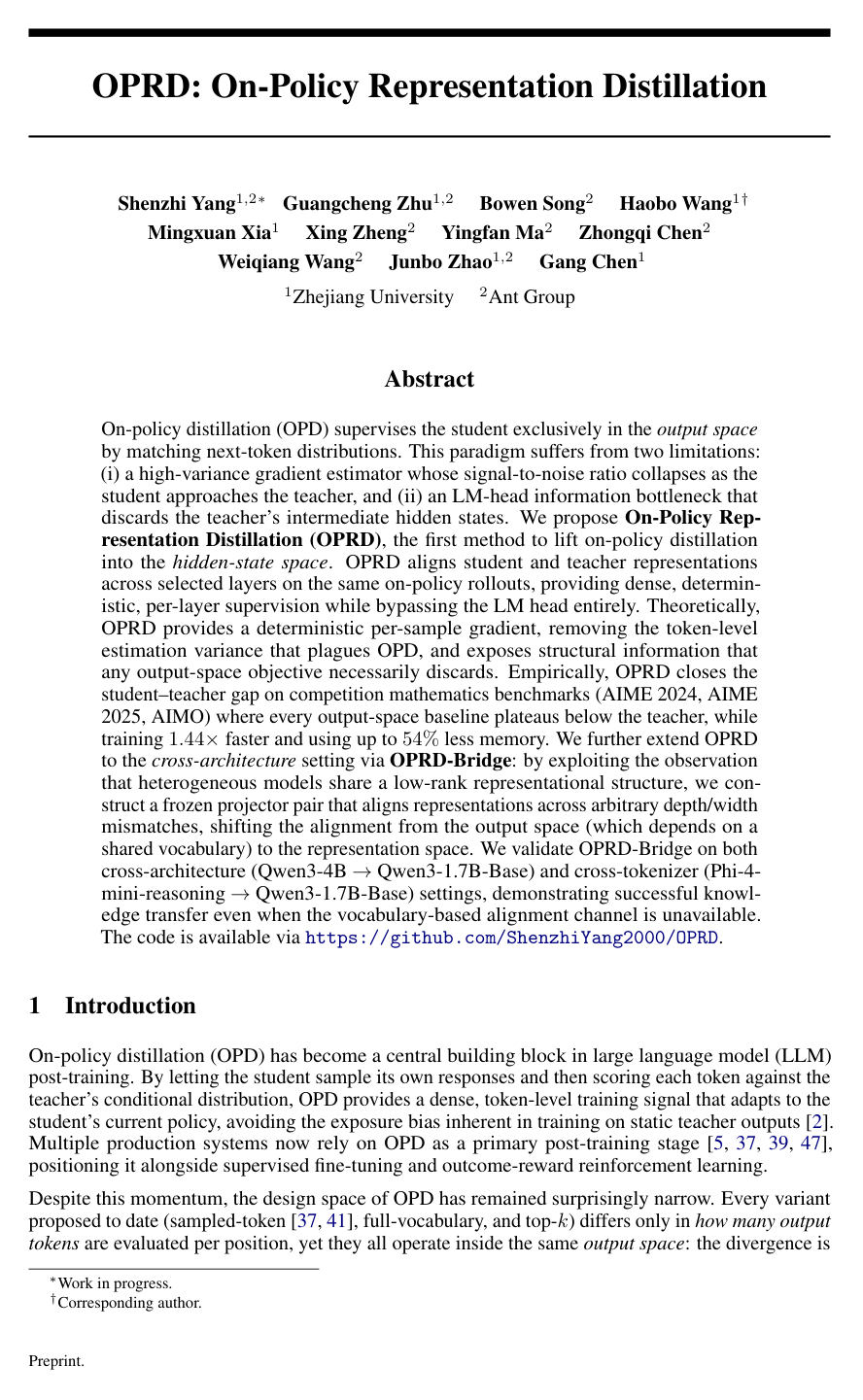
OPRD: On-Policy Representation Distillation
Shenzhi Yang, Guangcheng Zhu, Bowen Song, Haobo Wang, Mingxuan Xia, Xing Zheng, Yingfan Ma, Zhongqi Chen, Weiqiang Wang, Junbo Zhao, Gang Chen
On-policy distillation (OPD) supervises the student exclusively in the output space by matching next-token distributions. This paradigm suffers from two limitations: (i) a high-variance gradient estimator whose signal-to-noise ratio collapses as the student approaches the teacher, and (ii) an LM-head information bottleneck that discards the teacher's intermediate hidden states. We propose On-Policy Representation Distillation (OPRD), the first method to lift on-policy distillation into the hidden-state space. OPRD aligns student and teacher representations across selected layers on the same on-policy rollouts, providing dense, deterministic, per-layer supervision while bypassing the LM head entirely. Theoretically, OPRD provides a deterministic per-sample gradient, removing the token-level estimation variance that plagues OPD, and exposes structural information that any output-space objective necessarily discards. Empirically, OPRD closes the student-teacher gap on competition mathematics benchmarks (AIME 2024, AIME 2025, and AIMO), where every output-space baseline plateaus below the teacher, while training 1.44x faster and using up to 54% less memory. We further extend OPRD to the cross-architecture setting via OPRD-Bridge. By exploiting the observation that heterogeneous models share a low-rank representational structure, we construct a frozen projector pair that aligns representations across arbitrary depth and width mismatches, shifting the alignment from the output space (which depends on a shared vocabulary) to the representation space. We validate OPRD-Bridge on both cross-architecture (Qwen3-4B -> Qwen3-1.7B-Base) and cross-tokenizer (Phi-4-mini-reasoning -> Qwen3-1.7B-Base) settings, demonstrating successful knowledge transfer even when the vocabulary-based alignment channel is unavailable. Code: this https URL.
Added
2026-09-03
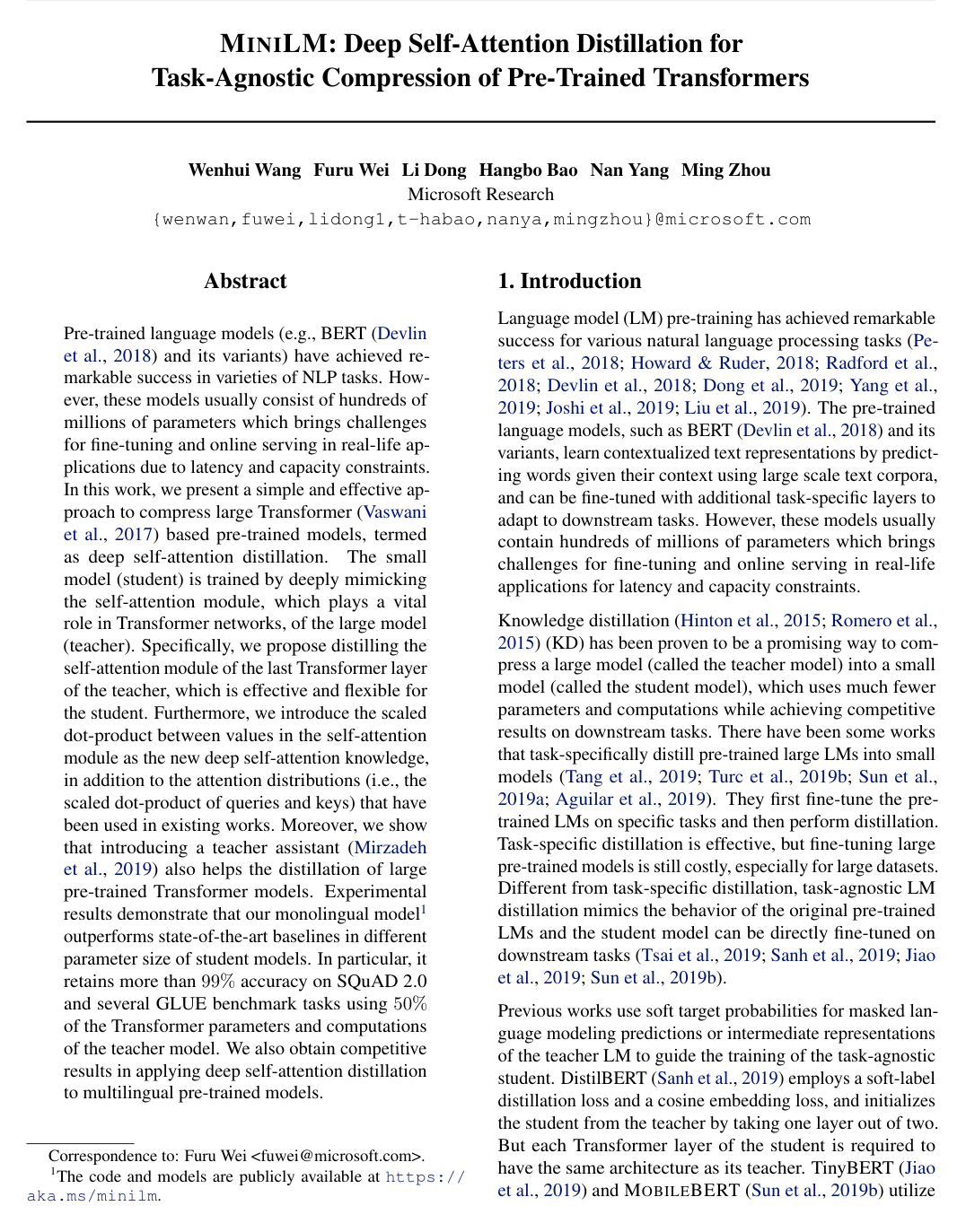
MiniLM: Deep Self-Attention Distillation for Task-Agnostic Compression of Pre-Trained Transformers
Wenhui Wang, Furu Wei, Li Dong, Hangbo Bao, Nan Yang, Ming Zhou
Why you should read this
Simplifies transformer distillation by isolating and transferring the value relations and query-key dot products within deep self-attention modules to allow for fully agnostic student dimensions.
Pre-trained language models (e.g., BERT (Devlin et al., 2018) and its variants) have achieved remarkable success in varieties of NLP tasks. However, these models usually consist of hundreds of millions of parameters which brings challenges for fine-tuning and online serving in real-life applications due to latency and capacity constraints. In this work, we present a simple and effective approach to compress large Transformer (Vaswani et al., 2017) based pre-trained models, termed as deep self-attention distillation. The small model (student) is trained by deeply mimicking the self-attention module, which plays a vital role in Transformer networks, of the large model (teacher). Specifically, we propose distilling the self-attention module of the last Transformer layer of the teacher, which is effective and flexible for the student. Furthermore, we introduce the scaled dot-product between values in the self-attention module as the new deep self-attention knowledge, in addition to the attention distributions (i.e., the scaled dot-product of queries and keys) that have been used in existing works. Moreover, we show that introducing a teacher assistant (Mirzadeh et al., 2019) also helps the distillation of large pre-trained Transformer models. Experimental results demonstrate that our monolingual model outperforms state-of-the-art baselines in different parameter size of student models. In particular, it retains more than 99% accuracy on SQuAD 2.0 and several GLUE benchmark tasks using 50% of the Transformer parameters and computations of the teacher model. We also obtain competitive results in applying deep self-attention distillation to multilingual pre-trained models.
Added
2026-06-19
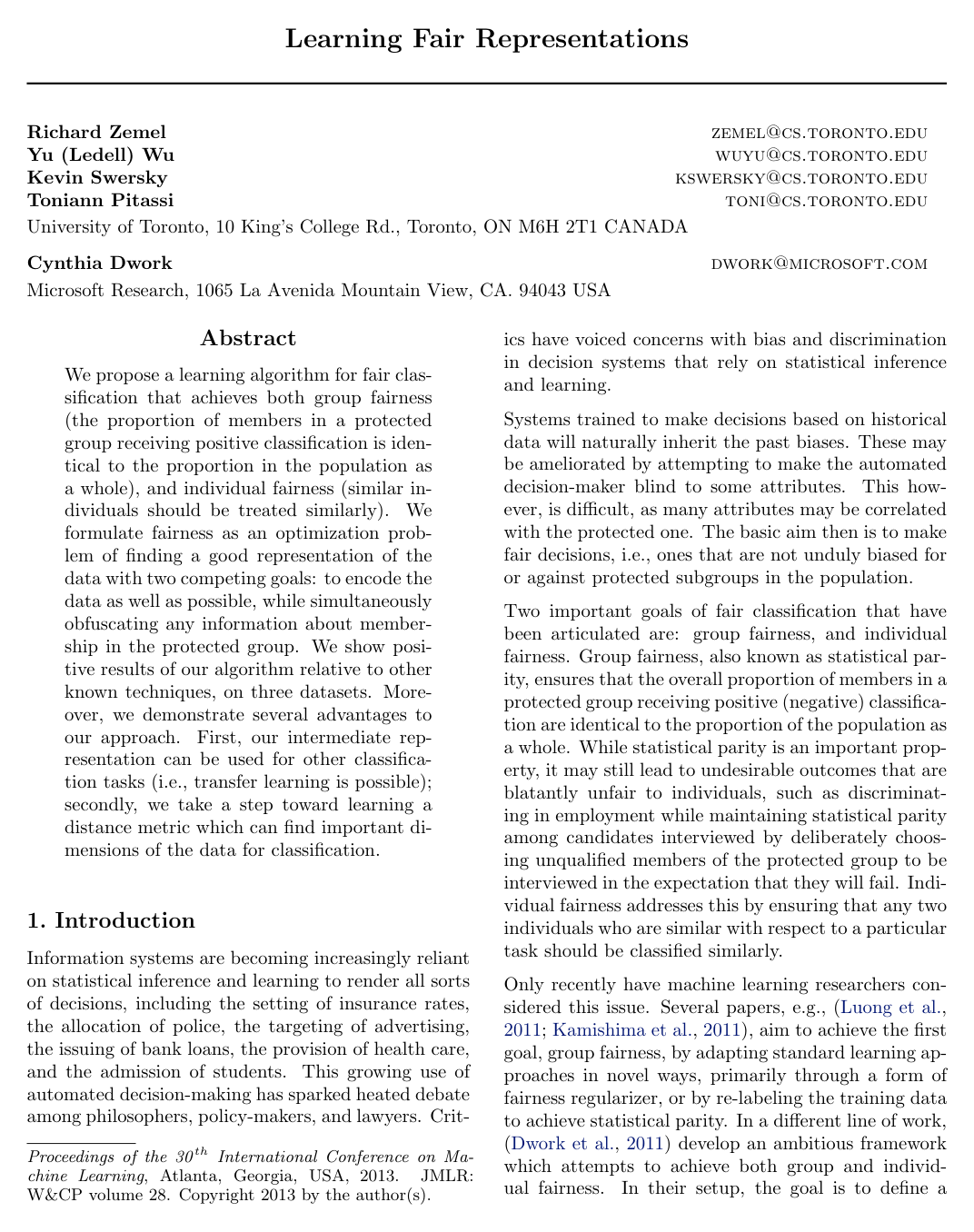
Learning Fair Representations
Richard Zemel, Yu (Ledell) Wu, Kevin Swersky, Toniann Pitassi, Cynthia Dwork
Why you should read this
Introduces a novel optimization framework to learn intermediate data representations that satisfy both group and individual fairness constraints while maintaining classification accuracy.
We propose a learning algorithm for fair classification that achieves both group fairness (the proportion of members in a protected group receiving positive classification is identical to the proportion in the population as a whole), and individual fairness (similar individuals should be treated similarly). We formulate fairness as an optimization problem of finding a good representation of the data with two competing goals: to encode the data as well as possible, while simultaneously obfuscating any information about membership in the protected group.
Added
2026-06-06
License
Published with permission
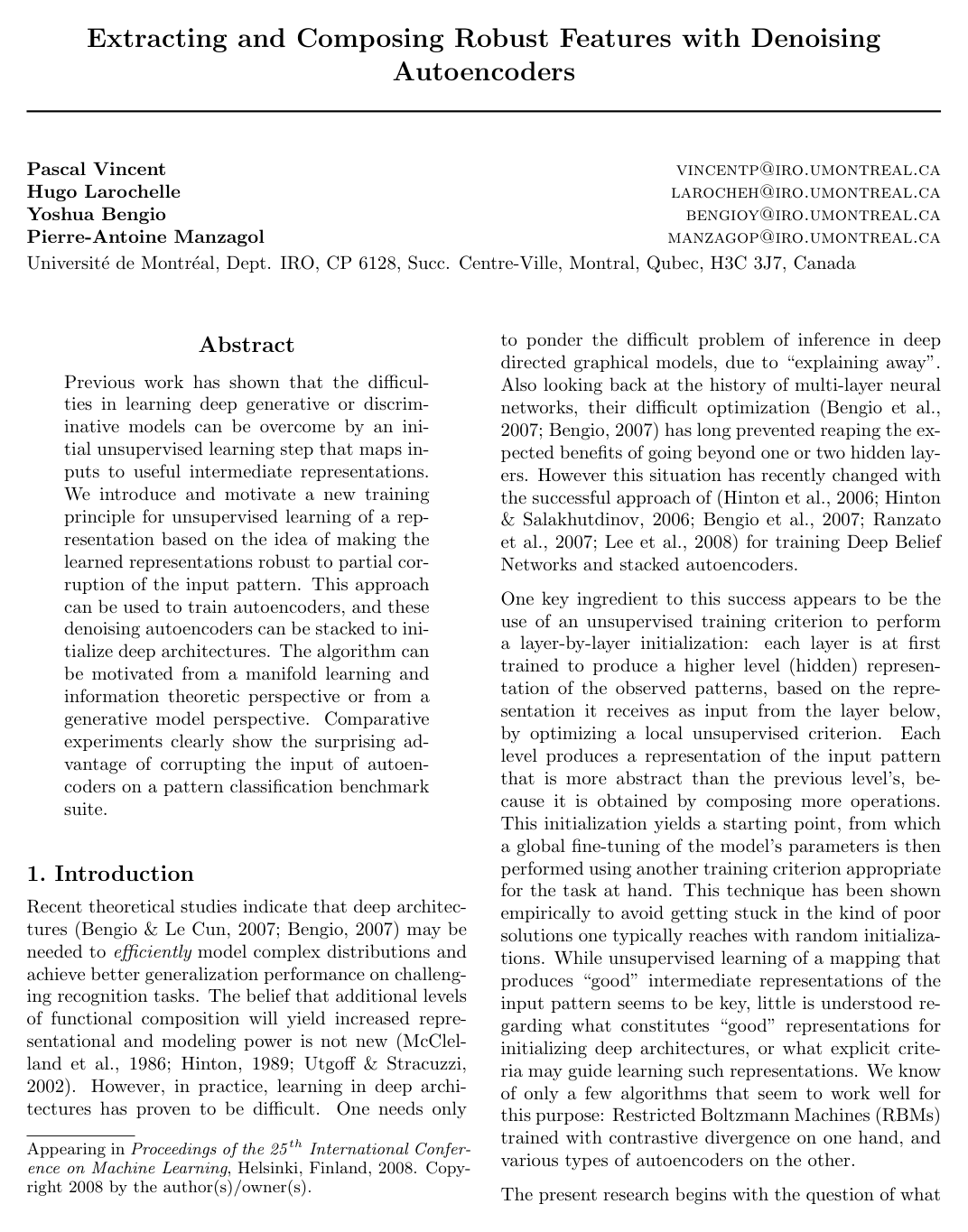
Extracting and composing robust features with denoising autoencoders
Pascal Vincent, Hugo Larochelle, Yoshua Bengio, Pierre-Antoine Manzagol
Why you should read this
Demonstrates that training autoencoders to reconstruct inputs from corrupted versions produces more robust feature representations that dramatically improve performance when initializing deep learning models, revealing a simple yet powerful principle for unsupervised learning.
Previous work has shown that the difficulties in learning deep generative or discriminative models can be overcome by an initial unsupervised learning step that maps inputs to useful intermediate representations. We introduce and motivate a new training principle for unsupervised learning of a representation based on the idea of making the learned representations robust to partial corruption of the input pattern. This approach can be used to train autoencoders, and these denoising autoencoders can be stacked to initialize deep architectures. The algorithm can be motivated from a manifold learning and information theoretic perspective or from a generative model perspective. Comparative experiments clearly show the surprising advantage of corrupting the input of autoencoders on a pattern classification benchmark suite.
Added
2026-02-21