
keyword
interaction decoder
An interaction decoder is a specialized neural network module, commonly utilized in transformer-based computer vision architectures for human-object interaction detection, designed to interpret and classify the semantic actions or relationships occurring between entities. Unlike standard instance decoders that locate and identify individual subjects and objects in an image, an interaction decoder processes relational queries, contextual image features, and entity representations to determine the interaction categories connecting specific pairs. By employing attention mechanisms over visual, positional, and entity embeddings, it enables deep learning models to resolve complex contextual dependencies and accurately output structured relational predictions.
2 items
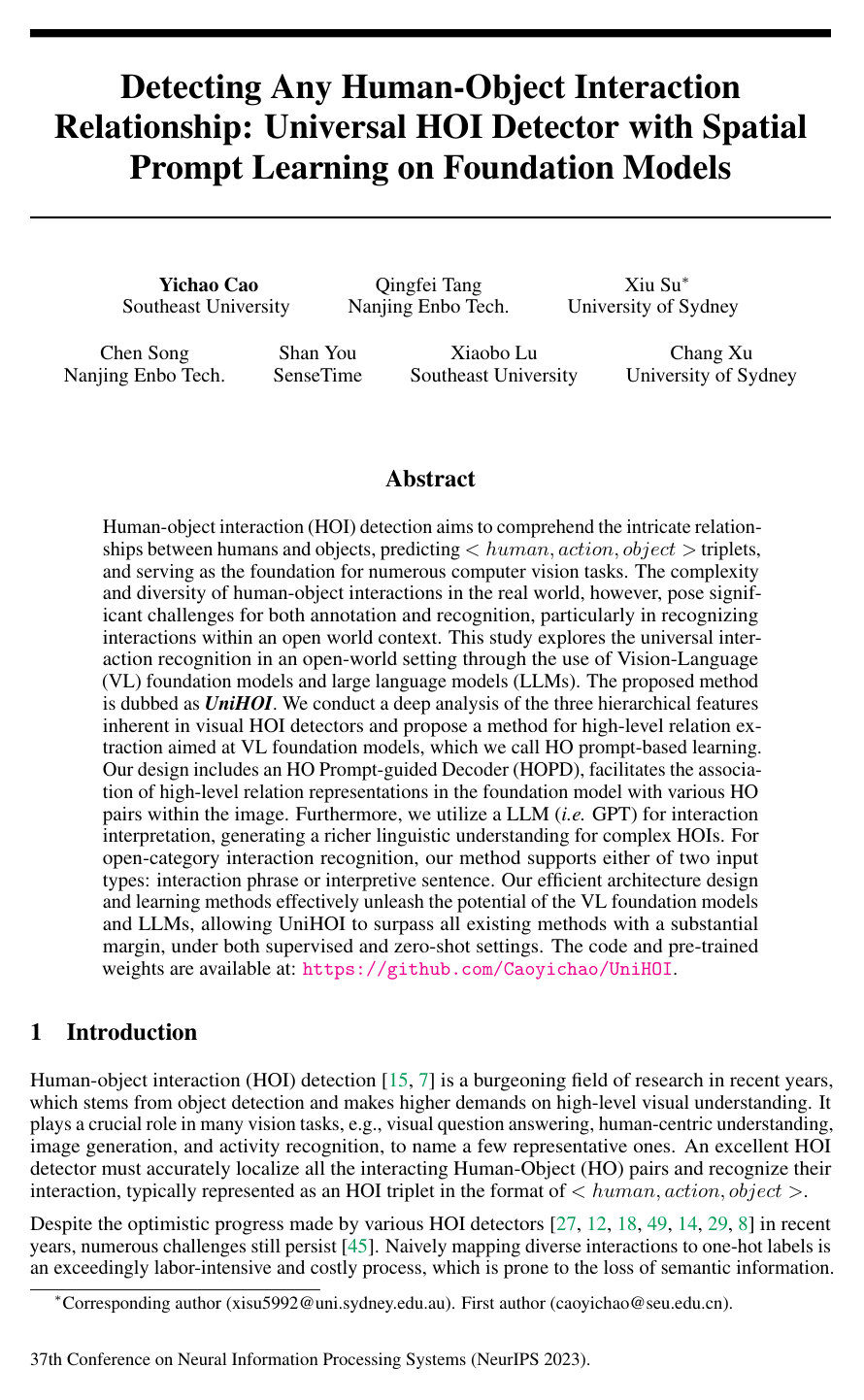
Detecting Any Human-Object Interaction Relationship: Universal HOI Detector with Spatial Prompt Learning on Foundation Models
Yichao Cao, Qingfei Tang, Xiu Su, Song Chen, Shan You, Xiaobo Lu, Chang Xu
Why you should read this
Proposes UniHOI, a framework that integrates vision-language foundation models with language-model-generated knowledge via spatial prompt learning to advance open-world and zero-shot human-object interaction detection.
Human-object interaction (HOI) detection aims to comprehend the intricate relationships between humans and objects, predicting < human, action, object > triplets, and serving as the foundation for numerous computer vision tasks. The complexity and diversity of human-object interactions in the real world, however, pose significant challenges for both annotation and recognition, particularly in recognizing interactions within an open world context. This study explores the universal interaction recognition in an open-world setting through the use of Vision-Language (VL) foundation models and large language models (LLMs). The proposed method is dubbed as UniHOI. We conduct a deep analysis of the three hierarchical features inherent in visual HOI detectors and propose a method for high-level relation extraction aimed at VL foundation models, which we call HO prompt-based learning. Our design includes an HO Prompt-guided Decoder (HOPD), facilitates the association of high-level relation representations in the foundation model with various HO pairs within the image. Furthermore, we utilize a LLM (i.e. GPT) for interaction interpretation, generating a richer linguistic understanding for complex HOIs. For open-category interaction recognition, our method supports either of two input types: interaction phrase or interpretive sentence. Our efficient architecture design and learning methods effectively unleash the potential of the VL foundation models and LLMs, allowing UniHOI to surpass all existing methods with a substantial margin, under both supervised and zero-shot settings. The code and pre-trained weights are available at: https://github.com/Caoyichao/UniHOI.
Added
2026-09-26
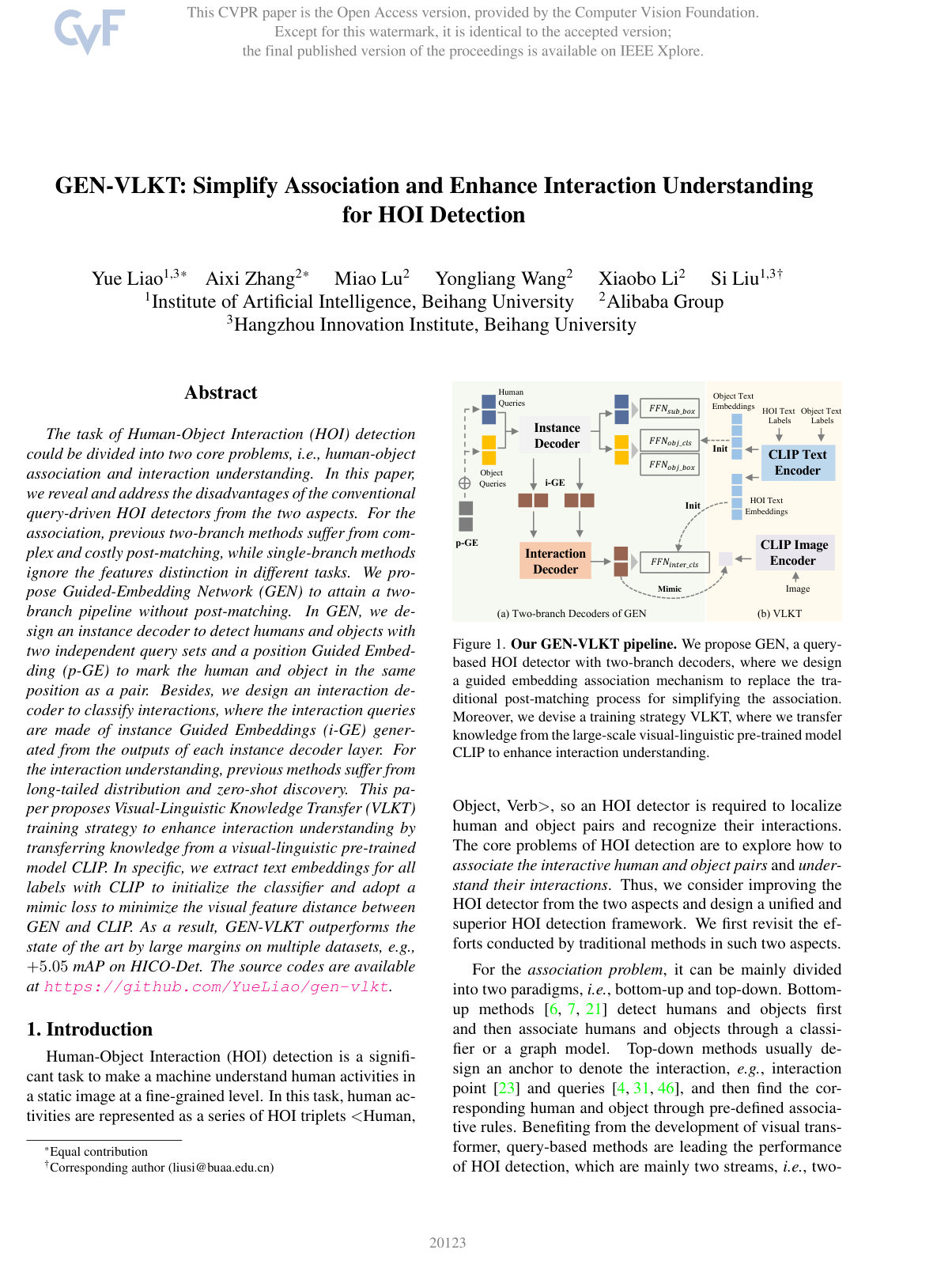
GEN-VLKT: Simplify Association and Enhance Interaction Understanding for HOI Detection
Yue Liao, Aixi Zhang, Miao Lu, Yongliang Wang, Xiaobo Li, Si Liu
Why you should read this
Presents a two-branch query-based framework that eliminates complex post-matching via guided embeddings and transfers knowledge from CLIP to significantly boost zero-shot and standard human-object interaction detection.
The task of Human-Object Interaction (HOI) detection could be divided into two core problems, i.e., human-object association and interaction understanding. In this paper, we reveal and address the disadvantages of the conventional query-driven HOI detectors from the two aspects. For the association, previous two-branch methods suffer from complex and costly post-matching, while single-branch methods ignore the features distinction in different tasks. We propose Guided-Embedding Network (GEN) to attain a two-branch pipeline without post-matching. In GEN, we design an instance decoder to detect humans and objects with two independent query sets and a position Guided Embedding (p-GE) to mark the human and object in the same position as a pair. Besides, we design an interaction decoder to classify interactions, where the interaction queries are made of instance Guided Embeddings (i-GE) generated from the outputs of each instance decoder layer. For the interaction understanding, previous methods suffer from long-tailed distribution and zero-shot discovery. This paper proposes Visual-Linguistic Knowledge Transfer (VLKT) training strategy to enhance interaction understanding by transferring knowledge from a visual-linguistic pre-trained model CLIP. In specific, we extract text embeddings for all labels with CLIP to initialize the classifier and adopt a mimic loss to minimize the visual feature distance between GEN and CLIP. As a result, GEN-VLKT outperforms the state of the art by large margins on multiple datasets, e.g., +5.05 mAP on HICO-Det. The source codes are available at https://github.com/YueLiao/gen-vlkt.
Added
2026-09-26