
keyword
inter-annotator agreement
Inter-annotator agreement is a measure of the degree of consensus among two or more independent annotators when assigning labels, categories, or ratings to the same set of data. In machine learning and natural language processing, it serves as a standard metric to evaluate the clarity of annotation guidelines, determine the consistency and quality of dataset annotations, and establish a benchmark for human-level performance. It is frequently calculated using statistical metrics such as Cohens kappa, Fleiss kappa, or Krippendorffs alpha, which adjust for the amount of agreement that could occur purely by chance. While high agreement generally reflects clear task definitions and reliable ground-truth data, patterns of disagreement are also analyzed to identify genuine ambiguity, task subjectivity, and diverse perspectives across human annotators.
10 items
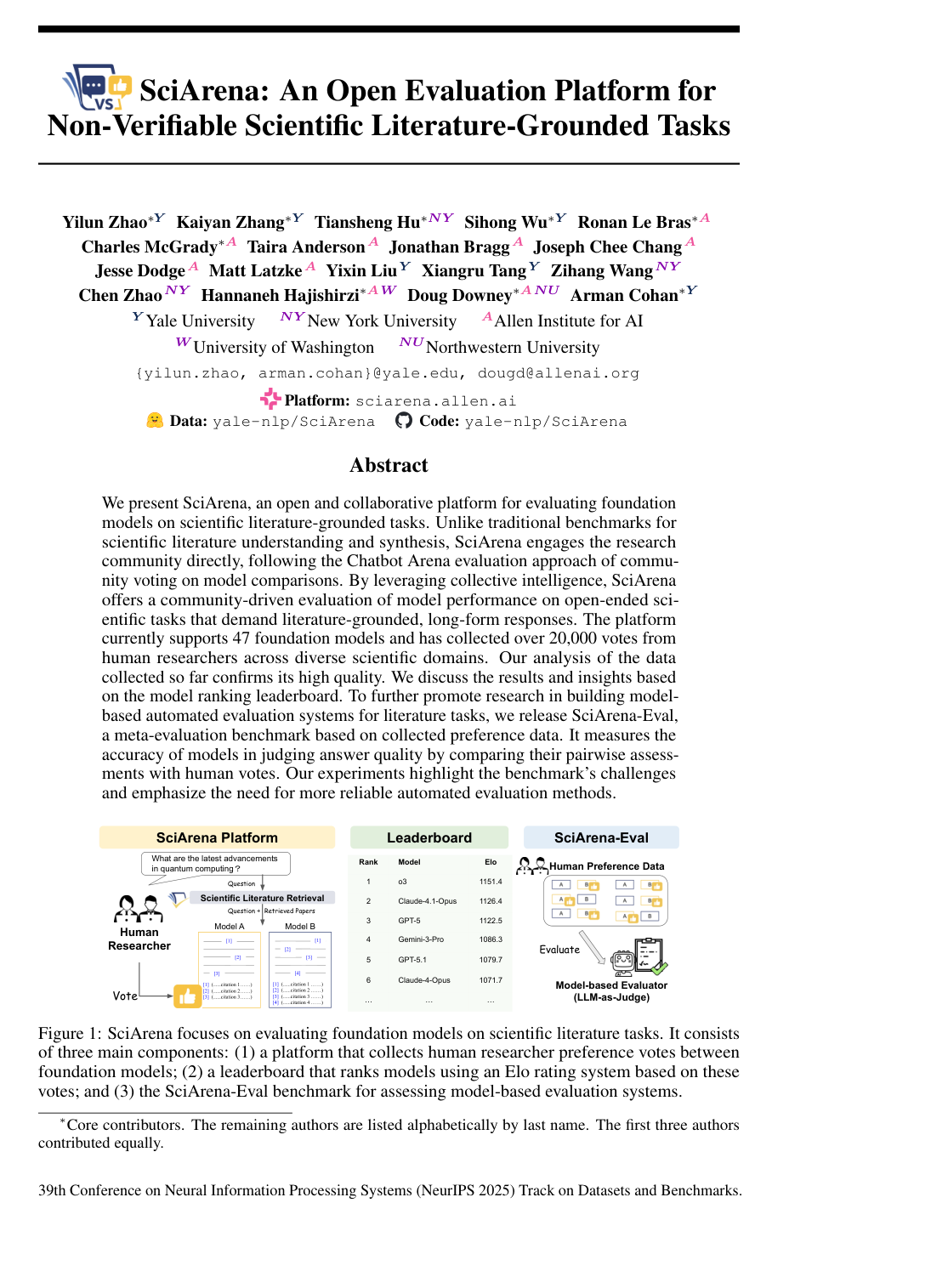
SciArena: An Open Evaluation Platform for Non-Verifiable Scientific Literature-Grounded Tasks
Yilun Zhao Kaiyan Zhang Tiansheng Hu Arman Cohan
Why you should read this
Presents a community-driven evaluation platform and benchmark containing over 20,000 human expert votes to evaluate how foundation models generate and judge complex scientific literature-grounded responses.
We present SciArena, an open and collaborative platform for evaluating foundation models on scientific literature-grounded tasks. Unlike traditional benchmarks for scientific literature understanding and synthesis, SciArena engages the research community directly, following the Chatbot Arena evaluation approach of community voting on model comparisons. By leveraging collective intelligence, SciArena offers a community-driven evaluation of model performance on open-ended scientific tasks that demand literature-grounded, long-form responses. The platform currently supports 47 foundation models and has collected over 20,000 votes from human researchers across diverse scientific domains. Our analysis of the data collected so far confirms its high quality. We discuss the results and insights based on the model ranking leaderboard. To further promote research in building model-based automated evaluation systems for literature tasks, we release SciArena-Eval, a meta-evaluation benchmark based on collected preference data. It measures the accuracy of models in judging answer quality by comparing their pairwise assessments with human votes. Our experiments highlight the benchmark's challenges and emphasize the need for more reliable automated evaluation methods.
Added
2026-10-04
The Perspectivist Paradigm Shift: Assumptions and Challenges of Capturing Human Labels
Eve Fleisig, Su Lin Blodgett, Dan Klein, Zeerak Talat
Why you should read this
Critiques standard machine learning practices that aggregate human labels into a single ground truth, providing practical recommendations to treat annotator disagreement as valuable signal rather than noise.
Longstanding data labeling practices in machine learning involve collecting and aggregating labels from multiple annotators. But what should we do when annotators disagree? Though annotator disagreement has long been seen as a problem to minimize, new perspectivist approaches challenge this assumption by treating disagreement as a valuable source of information. In this position paper, we examine practices and assumptions surrounding the causes of disagreement—some challenged by perspectivist approaches, and some that remain to be addressed—as well as practical and normative challenges for work operating under these assumptions. We conclude with recommendations for the data labeling pipeline and avenues for future research engaging with subjectivity and disagreement.
Added
2026-10-04
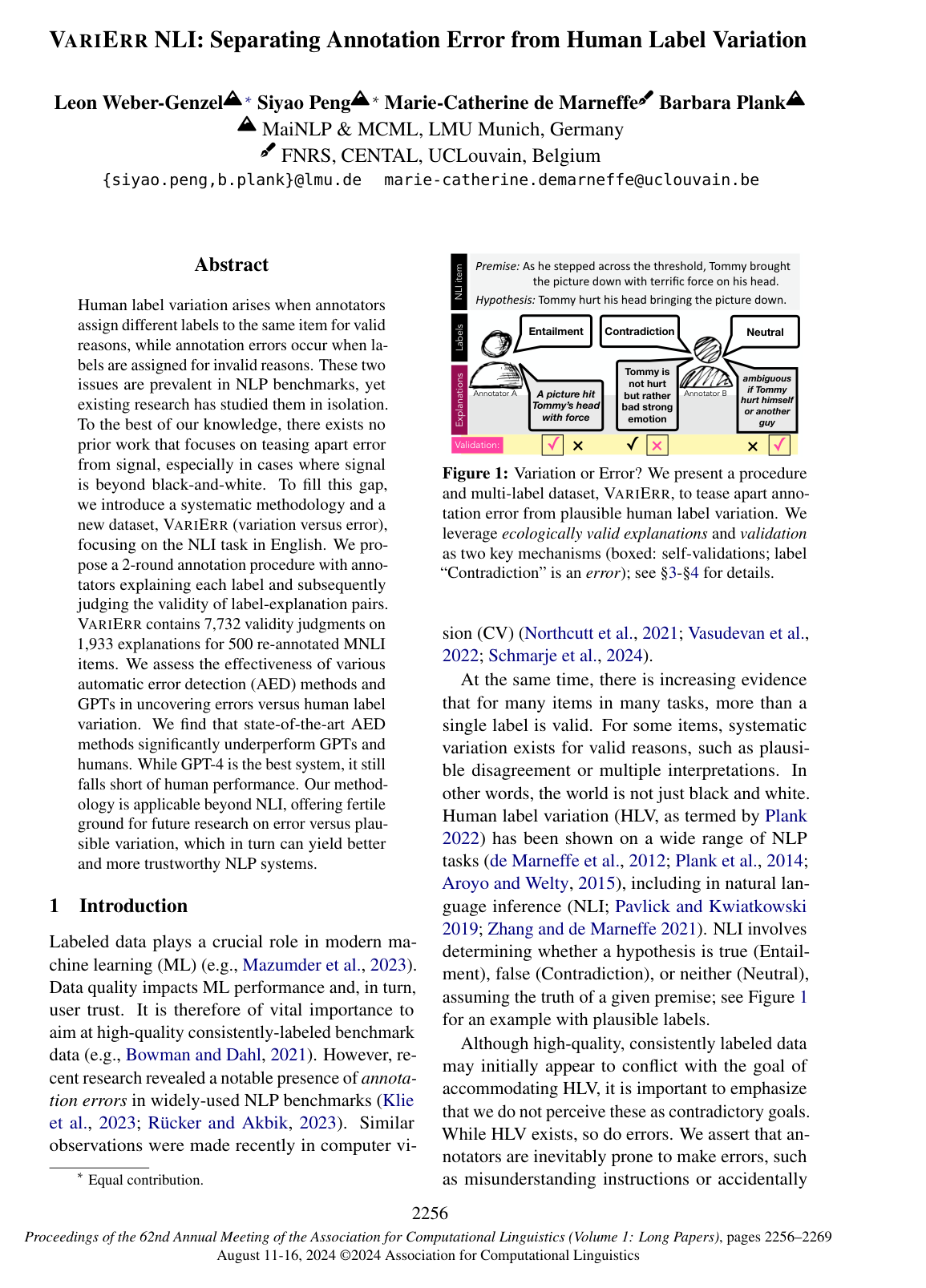
VariErr NLI: Separating Annotation Error from Human Label Variation
Leon Weber-Genzel, Siyao Peng, Marie-Catherine de Marneffe, Barbara Plank
Why you should read this
Introduces the VariErr benchmark and a two-round explanation-validation methodology to disentangle genuine human label variation from true annotation errors in natural language inference, exposing critical performance gaps in automatic error detection methods.
Human label variation arises when annotators assign different labels to the same item for valid reasons, while annotation errors occur when labels are assigned for invalid reasons. These two issues are prevalent in NLP benchmarks, yet existing research has studied them in isolation. To the best of our knowledge, there exists no prior work that focuses on teasing apart error from signal, especially in cases where signal is beyond black-and-white. To fill this gap, we introduce a systematic methodology and a new dataset, VariErr (variation versus error), focusing on the NLI task in English. We propose a 2-round annotation procedure with annotators explaining each label and subsequently judging the validity of label-explanation pairs. VariErr contains 7,732 validity judgments on 1,933 explanations for 500 re-annotated MNLI items. We assess the effectiveness of various automatic error detection (AED) methods and GPTs in uncovering errors versus human label variation. We find that state-of-the-art AED methods significantly underperform GPTs and humans. While GPT-4 is the best system, it still falls short of human performance. Our methodology is applicable beyond NLI, offering fertile ground for future research on error versus plausible variation, which in turn can yield better and more trustworthy NLP systems.
Added
2026-10-04
JudgeBlender: Ensembling Judgments for Automatic Relevance Assessment
Hossein A. Rahmani, Emine Yilmaz, Nick Craswell, Bhaskar Mitra
Why you should read this
Proposes JudgeBlender, an ensembling framework that combines judgments from smaller open-source language models across multiple architectures and prompts to match proprietary models in retrieval evaluation at lower cost and with reduced bias.
The effective training and evaluation of retrieval systems require a substantial amount of relevance judgments, which are traditionally collected from human assessors -- a process that is both costly and time-consuming. Large Language Models (LLMs) have shown promise in generating relevance labels for search tasks, offering a potential alternative to manual assessments. Current approaches often rely on a single LLM, such as GPT-4, which, despite being effective, are expensive and prone to intra-model biases that can favour systems leveraging similar models. In this work, we introduce JudgeBlender, a framework that employs smaller, open-source models to provide relevance judgments by combining evaluations across multiple LLMs (LLMBlender) or multiple prompts (PromptBlender). By leveraging the LLMJudge benchmark [18], we compare JudgeBlender with state-of-the-art methods and the top performers in the LLMJudge challenge. Our results show that JudgeBlender achieves competitive performance, demonstrating that very large models are often unnecessary for reliable relevance assessments.
Added
2026-09-30
FineSurE: Fine-grained Summarization Evaluation using LLMs
Hwanjun Song, Hang Su, Igor Shalyminov, Jason Cai, Saab Mansour
Added
2026-09-26
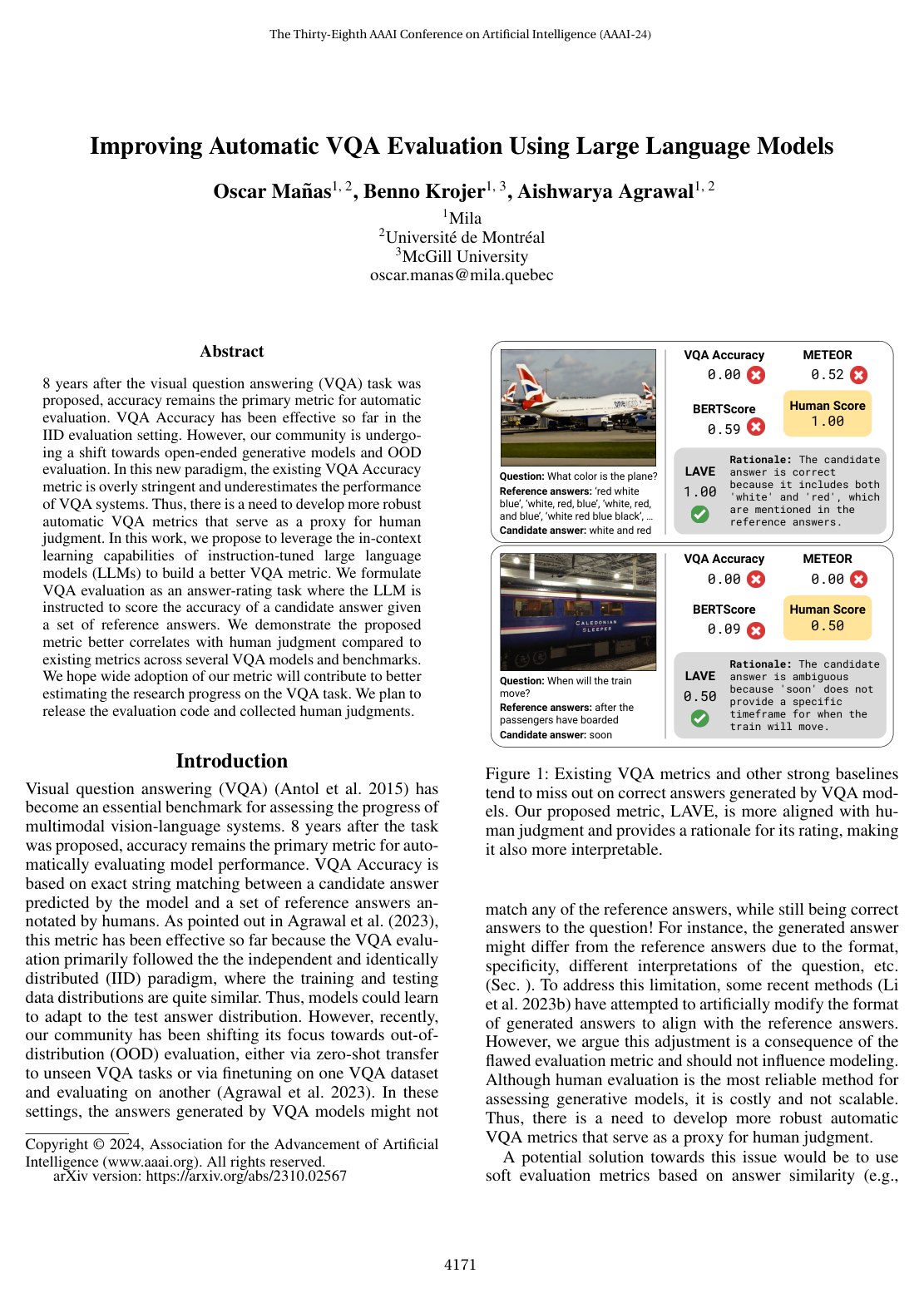
Improving Automatic VQA Evaluation Using Large Language Models
Oscar Mañas, Benno Krojer, Aishwarya Agrawal
Why you should read this
Proposes LAVE, an LLM-based evaluation metric that formulates visual question answering assessment as an in-context answer-rating task to align closely with human judgment where traditional exact-match accuracy fails on open-ended generative models.
8 years after the visual question answering (VQA) task was proposed, accuracy remains the primary metric for automatic evaluation. VQA Accuracy has been effective so far in the IID evaluation setting. However, our community is undergoing a shift towards open-ended generative models and OOD evaluation. In this new paradigm, the existing VQA Accuracy metric is overly stringent and underestimates the performance of VQA systems. Thus, there is a need to develop more robust automatic VQA metrics that serve as a proxy for human judgment. In this work, we propose to leverage the in-context learning capabilities of instruction-tuned large language models (LLMs) to build a better VQA metric. We formulate VQA evaluation as an answer-rating task where the LLM is instructed to score the accuracy of a candidate answer given a set of reference answers. We demonstrate the proposed metric better correlates with human judgment compared to existing metrics across several VQA models and benchmarks. We hope wide adoption of our metric will contribute to better estimating the research progress on the VQA task. We plan to release the evaluation code and collected human judgments.
Added
2026-09-26
PaLM 2 Technical Report
Rohan Anil, Andrew M. Dai, Orhan Firat, Melvin Johnson, Dmitry Lepikhin, Alexandre Passos, Siamak Shakeri, Emanuel Taropa, Paige Bailey, Zhifeng Chen, Eric Chu, Jonathan H. Clark, Laurent El Shafey, Yanping Huang, Kathy Meier-Hellstern, Gaurav Mishra, Erica Moreira, Mark Omernick, Kevin Robinson, Sebastian Ruder, Yi Tay, Kefan Xiao, Yuanzhong Xu, Yujing Zhang, Gustavo Hernandez Abrego, Junwhan Ahn, Jacob Austin, Paul Barham, Jan Botha, James Bradbury, Siddhartha Brahma, Kevin Brooks, Michele Catasta, Yong Cheng, Colin Cherry, Christopher A. Choquette-Choo, Aakanksha Chowdhery, Clément Crepy, Shachi Dave, Mostafa Dehghani, Sunipa Dev, Jacob Devlin, Mark Díaz, Nan Du, Ethan Dyer, Vlad Feinberg, Fangxiaoyu Feng, Vlad Fienber, Markus Freitag, Xavier Garcia, Sebastian Gehrmann, Lucas Gonzalez, Guy Gur-Ari, Steven Hand, Hadi Hashemi, Le Hou, Joshua Howland, Andrea Hu, Jeffrey Hui, Jeremy Hurwitz, Michael Isard, Abe Ittycheriah, Matthew Jagielski, Wenhao Jia, Kathleen Kenealy, Maxim Krikun, Sneha Kudugunta, Chang Lan, Katherine Lee, Benjamin Lee, Eric Li, Music Li, Wei Li, YaGuang Li, Jian Li, Hyeontaek Lim, Hanzhao Lin, Zhongtao Liu, Frederick Liu, Marcello Maggioni, Aroma Mahendru, Joshua Maynez, Vedant Misra, Maysam Moussalem, Zachary Nado, John Nham, Eric Ni, Andrew Nystrom, Alicia Parrish, Marie Pellat, Martin Polacek, Alex Polozov, Reiner Pope, Siyuan Qiao, Emily Reif, Bryan Richter, Parker Riley, Alex Castro Ros, Aurko Roy, Brennan Saeta, Rajkumar Samuel, Renee Shelby, Ambrose Slone, Daniel Smilkov, David R. So, Daniel Sohn, Simon Tokumine, Dasha Valter, Vijay Vasudevan, Kiran Vodrahalli, Xuezhi Wang, Pidong Wang, Zirui Wang, Tao Wang, John Wieting, Yuhuai Wu, Kelvin Xu, Yunhan Xu, Linting Xue, Pengcheng Yin, Jiahui Yu, Qiao Zhang, Steven Zheng, Ce Zheng, Weikang Zhou, Denny Zhou, Slav Petrov, Yonghui Wu
Why you should read this
Presents a family of compute-efficient language models trained on diverse objectives that achieve state-of-the-art multilingual and reasoning performance while providing faster inference and built-in toxicity control across multiple deployment scales.
We introduce PaLM 2, a new state-of-the-art language model that has better multilingual and reasoning capabilities and is more compute-efficient than its predecessor PaLM. PaLM 2 is a Transformer-based model trained using a mixture of objectives. Through extensive evaluations on English and multilingual language, and reasoning tasks, we demonstrate that PaLM 2 has significantly improved quality on downstream tasks across different model sizes, while simultaneously exhibiting faster and more efficient inference compared to PaLM. This improved efficiency enables broader deployment while also allowing the model to respond faster, for a more natural pace of interaction. PaLM 2 demonstrates robust reasoning capabilities exemplified by large improvements over PaLM on BIG-Bench and other reasoning tasks. PaLM 2 exhibits stable performance on a suite of responsible AI evaluations, and enables inference-time control over toxicity without additional overhead or impact on other capabilities. Overall, PaLM 2 achieves state-of-the-art performance across a diverse set of tasks and capabilities. When discussing the PaLM 2 family, it is important to distinguish between pre-trained models (of various sizes), fine-tuned variants of these models, and the user-facing products that use these models. In particular, user-facing products typically include additional pre- and post-processing steps. Additionally, the underlying models may evolve over time. Therefore, one should not expect the performance of user-facing products to exactly match the results reported in this report.
Added
2026-09-24
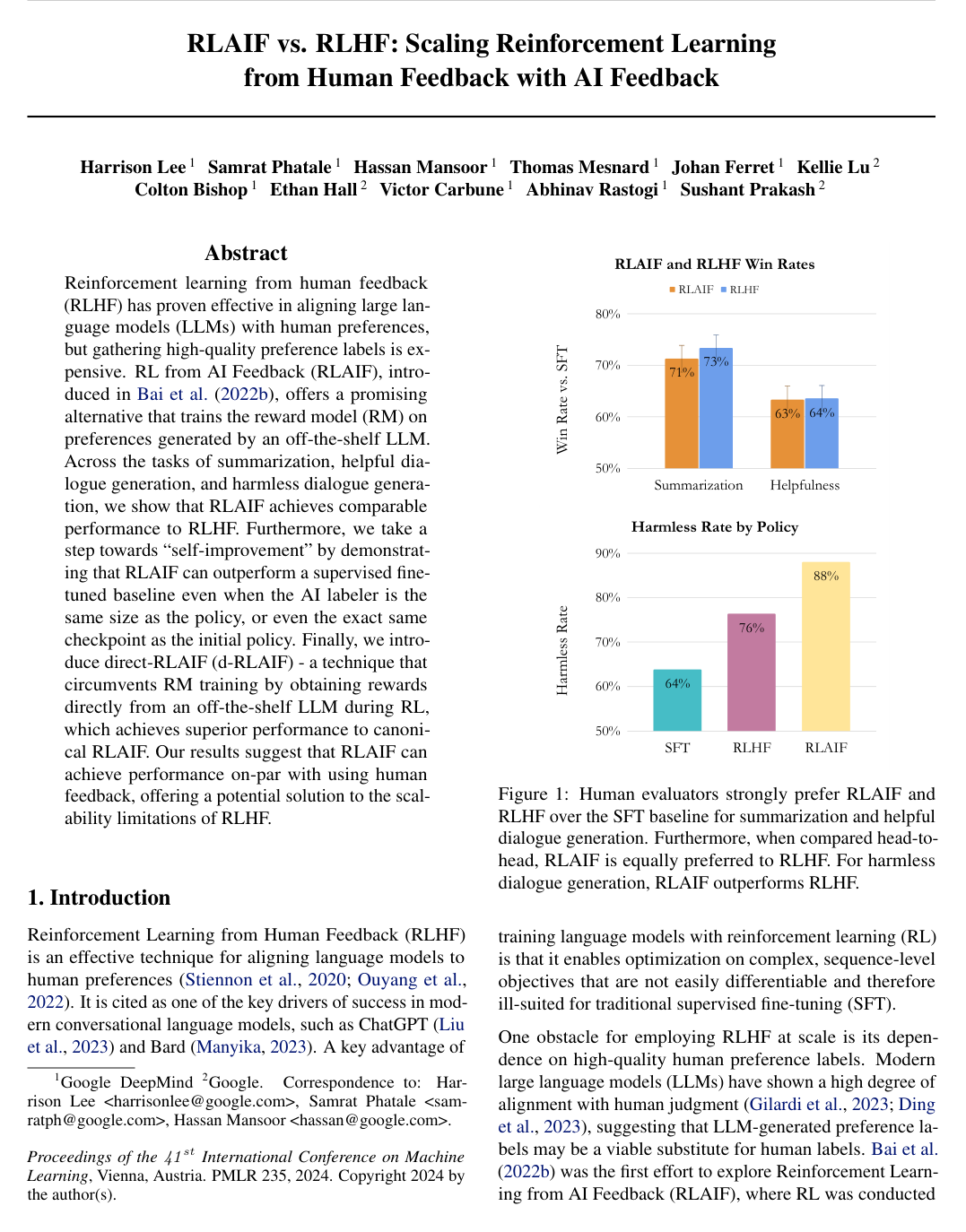
RLAIF vs. RLHF: Scaling Reinforcement Learning from Human Feedback with AI Feedback
Harrison Lee, Samrat Phatale, Hassan Mansoor, Thomas Mesnard, Johan Ferret, Kellie Lu, Colton Bishop, Ethan Hall, Victor Carbune, Abhinav Rastogi, Sushant Prakash
Why you should read this
Demonstrates that reinforcement learning from AI feedback achieves alignment performance comparable to human feedback across dialogue and summarization tasks, showing that language models can self-improve without costly human annotations and introducing direct-RLAIF to bypass reward model training.
Reinforcement learning from human feedback (RLHF) has proven effective in aligning large language models (LLMs) with human preferences, but gathering high-quality preference labels is expensive. RL from AI Feedback (RLAIF), introduced in Bai et al., offers a promising alternative that trains the reward model (RM) on preferences generated by an off-the-shelf LLM. Across the tasks of summarization, helpful dialogue generation, and harmless dialogue generation, we show that RLAIF achieves comparable performance to RLHF. Furthermore, we take a step towards "self-improvement" by demonstrating that RLAIF can outperform a supervised fine-tuned baseline even when the AI labeler is the same size as the policy, or even the exact same checkpoint as the initial policy. Finally, we introduce direct-RLAIF (d-RLAIF) - a technique that circumvents RM training by obtaining rewards directly from an off-the-shelf LLM during RL, which achieves superior performance to canonical RLAIF. Our results suggest that RLAIF can achieve performance on-par with using human feedback, offering a potential solution to the scalability limitations of RLHF.
Added
2026-09-22

Cheap and Fast – But is it Good? Evaluating Non-Expert Annotations for Natural Language Tasks
Rion Snow, Brendan O'Connor, Daniel Jurafsky, Andrew Y. Ng
Why you should read this
Demonstrates that carefully designed non-expert crowdsourcing can produce reliable NLP labels at a fraction of expert annotation cost.
Human linguistic annotation is crucial for many natural language processing tasks but can be expensive and time-consuming. We explore the use of Amazon’s Mechanical Turk system, a significantly cheaper and faster method for collecting annotations from a broad base of paid non-expert contributors over the Web. We investigate five tasks: affect recognition, word similarity, recognizing textual entailment, event temporal ordering, and word sense disambiguation. For all five, we show high agreement between Mechanical Turk non-expert annotations and existing gold standard labels provided by expert labelers. For the task of affect recognition, we also show that using non-expert labels for training machine learning algorithms can be as effective as using gold standard annotations from experts. We propose a technique for bias correction that significantly improves annotation quality on two tasks. We conclude that many large labeling tasks can be effectively designed and carried out in this method at a fraction of the usual expense.
Added
2026-09-14
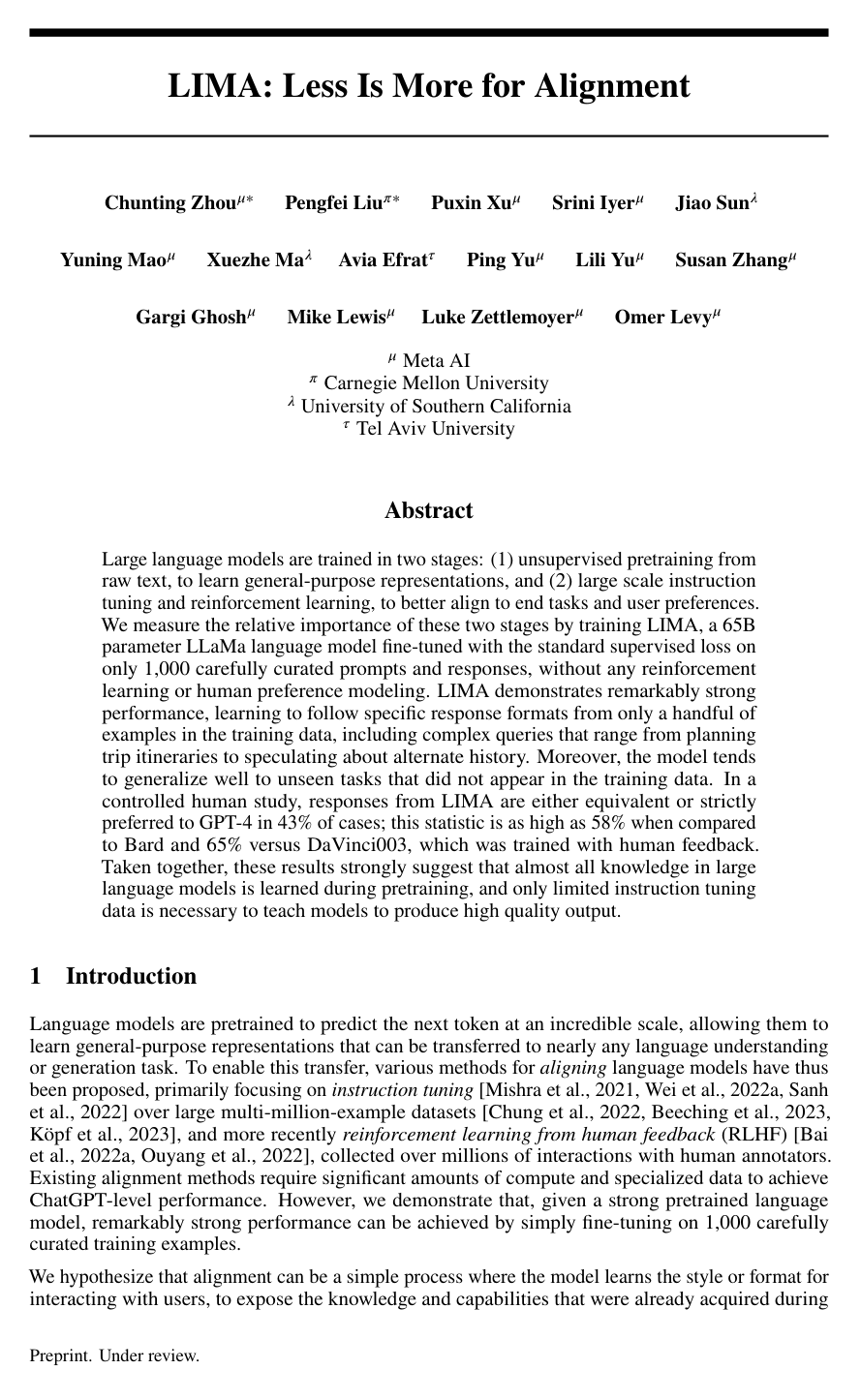
LIMA: Less Is More for Alignment
Chunting Zhou, Pengfei Liu, Puxin Xu, Srini Iyer, Jiao Sun, Yuning Mao, Xuezhe Ma, Avia Efrat, Ping Yu, Lili Yu, Susan Zhang, Gargi Ghosh, Mike Lewis, Luke Zettlemoyer, Omer Levy
Why you should read this
Demonstrates that high-quality language model alignment can be achieved with only 1,000 curated instruction tuning examples, challenging the necessity of extensive instruction tuning and RLHF.
Large language models are trained in two stages: (1) unsupervised pretraining from raw text, to learn general-purpose representations, and (2) large scale instruction tuning and reinforcement learning, to better align to end tasks and user preferences. We measure the relative importance of these two stages by training LIMA, a 65B parameter LLaMa language model fine-tuned with the standard supervised loss on only 1,000 carefully curated prompts and responses, without any reinforcement learning or human preference modeling. LIMA demonstrates remarkably strong performance, learning to follow specific response formats from only a handful of examples in the training data, including complex queries that range from planning trip itineraries to speculating about alternate history. Moreover, the model tends to generalize well to unseen tasks that did not appear in the training data. In a controlled human study, responses from LIMA are either equivalent or strictly preferred to GPT-4 in 43% of cases; this statistic is as high as 58% when compared to Bard and 65% versus DaVinci003, which was trained with human feedback. Taken together, these results strongly suggest that almost all knowledge in large language models is learned during pretraining, and only limited instruction tuning data is necessary to teach models to produce high quality output.
Added
2026-05-07