
keyword
integral images
An integral image is a data structure and technique in computer vision and image processing that enables the calculation of the sum of pixel values within any rectangular region of an image in constant time. In an integral image, the value at each coordinate corresponds to the cumulative sum of all pixels located above and to the left of that position in the original image. Following a precomputation step performed in a single pass over the input, the sum of intensities across any arbitrary rectangular area can be evaluated using only four array lookups and simple arithmetic operations regardless of the region size. This computational efficiency makes integral images a standard tool for accelerating operations such as box filtering, multi-scale feature extraction, real-time object detection, and regional statistical modeling.
3 items
TextonBoost: Joint Appearance, Shape and Context Modeling for Multi-class Object Recognition and Segmentation
J. Shotton, J. Winn, C. Rother, A. Criminisi
Why you should read this
Introduces the TextonBoost framework, which unifies appearance, shape, and spatial context using boosted texton features within a conditional random field to achieve accurate, multi-class semantic segmentation and object recognition.
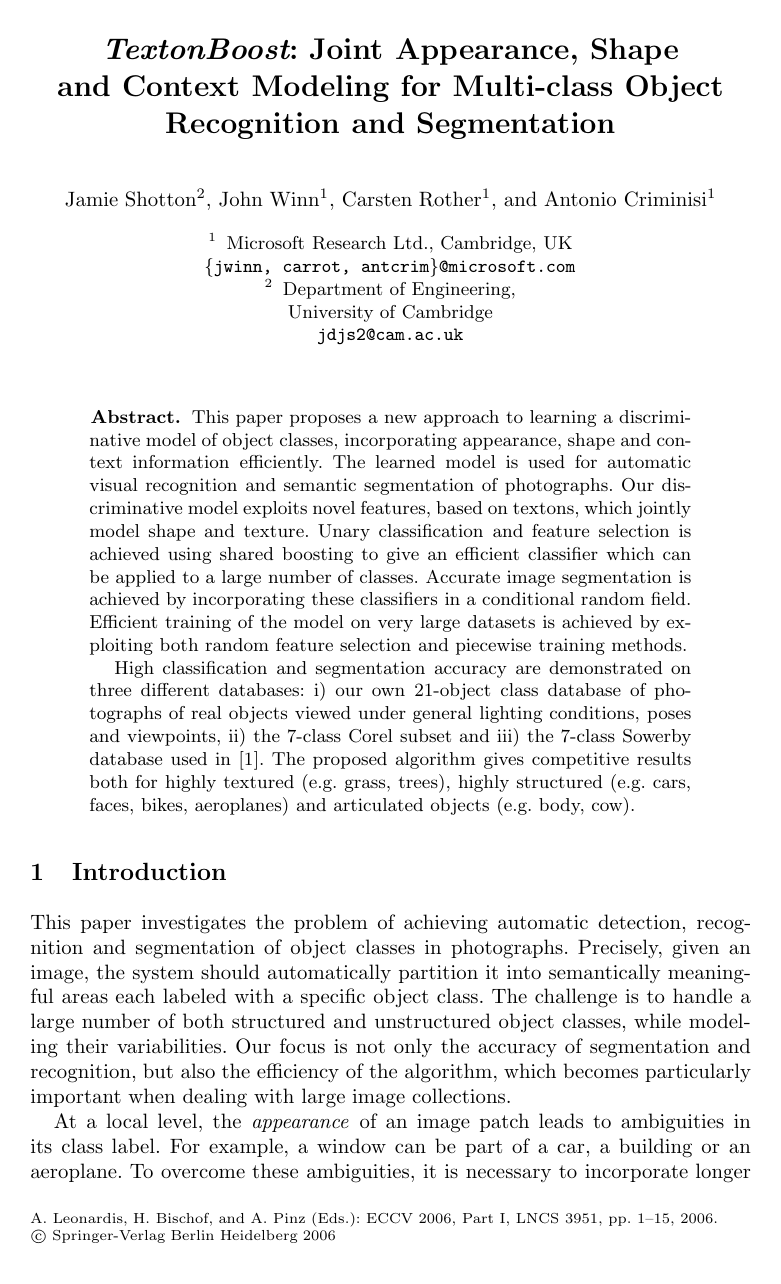
This paper proposes a new approach to learning a discriminative model of object classes, incorporating appearance, shape and context information efficiently. The learned model is used for automatic visual recognition and semantic segmentation of photographs. Our discriminative model exploits novel features, based on textons, which jointly model shape and texture. Unary classification and feature selection is achieved using shared boosting to give an efficient classifier which can be applied to a large number of classes. Accurate image segmentation is achieved by incorporating these classifiers in a conditional random field. Efficient training of the model on very large datasets is achieved by exploiting both random feature selection and piecewise training methods. High classification and segmentation accuracy are demonstrated on three different databases: i) our own 21-object class database of photographs of real objects viewed under general lighting conditions, poses and viewpoints, ii) the 7-class Corel subset and iii) the 7-class Sowerby database used in [1]. The proposed algorithm gives competitive results both for highly textured (e.g. grass, trees), highly structured (e.g. cars, faces, bikes, aeroplanes) and articulated objects (e.g. body, cow).
Added
2026-09-25
Region Covariance: A Fast Descriptor for Detection and Classification
Oncel Tuzel, Fatih Porikli, Peter Meer
Why you should read this
Proposes a fast, low-dimensional region covariance descriptor computed via integral images and matched using a Riemannian distance metric, enabling highly accurate and efficient object detection and texture classification that naturally resists variations in rotation and illumination.
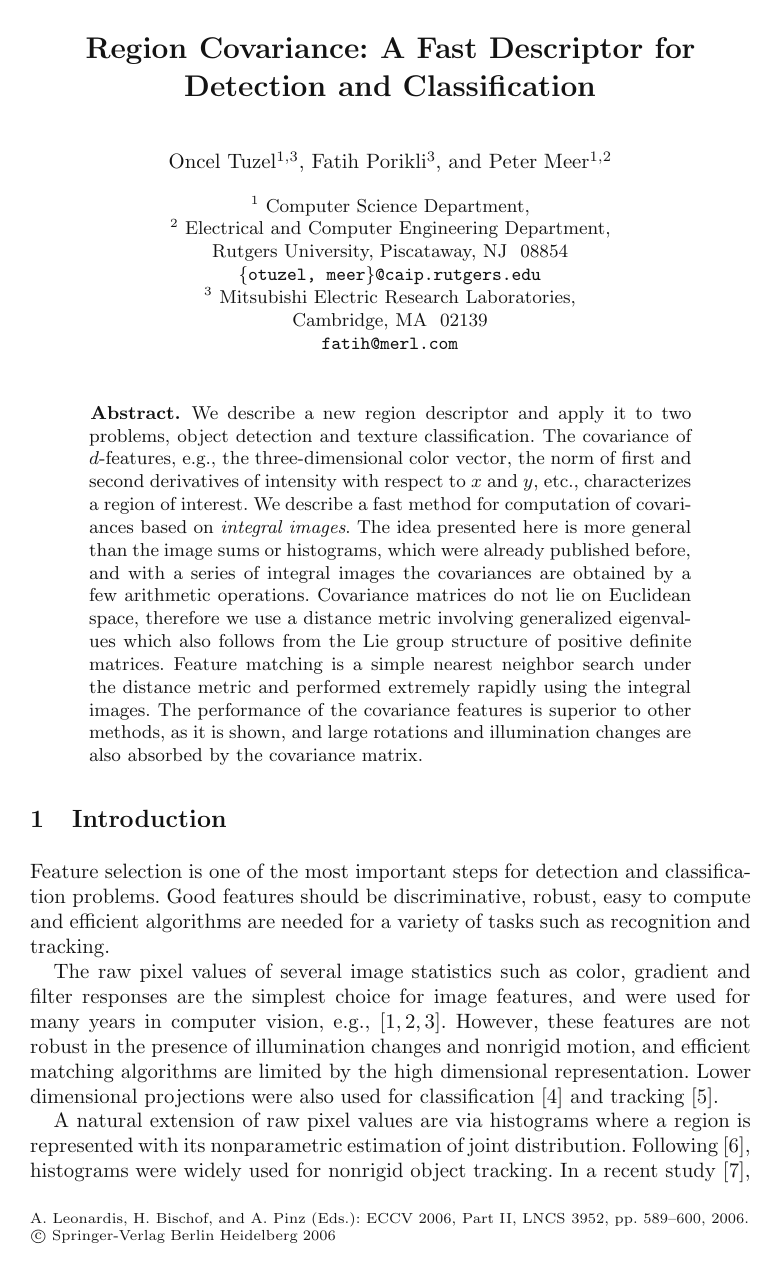
We describe a new region descriptor and apply it to two problems, object detection and texture classification. The covariance of d-features, e.g., the three-dimensional color vector, the norm of first and second derivatives of intensity with respect to x and y, etc., characterizes a region of interest. We describe a fast method for computation of covariances based on integral images. The idea presented here is more general than the image sums or histograms, which were already published before, and with a series of integral images the covariances are obtained by a few arithmetic operations. Covariance matrices do not lie on Euclidean space, therefore we use a distance metric involving generalized eigenvalues which also follows from the Lie group structure of positive definite matrices. Feature matching is a simple nearest neighbor search under the distance metric and performed extremely rapidly using the integral images. The performance of the covariance features is superior to other methods, as it is shown, and large rotations and illumination changes are also absorbed by the covariance matrix.
Added
2026-09-25
SURF: Speeded Up Robust Features
Herbert Bay, Tinne Tuytelaars, Luc Van Goo
Why you should read this
Introduces SURF, a scale- and rotation-invariant local feature detector and descriptor that uses integral images and Hessian matrix approximations to deliver distinctiveness and repeatability comparable to existing methods at a fraction of the computational cost.
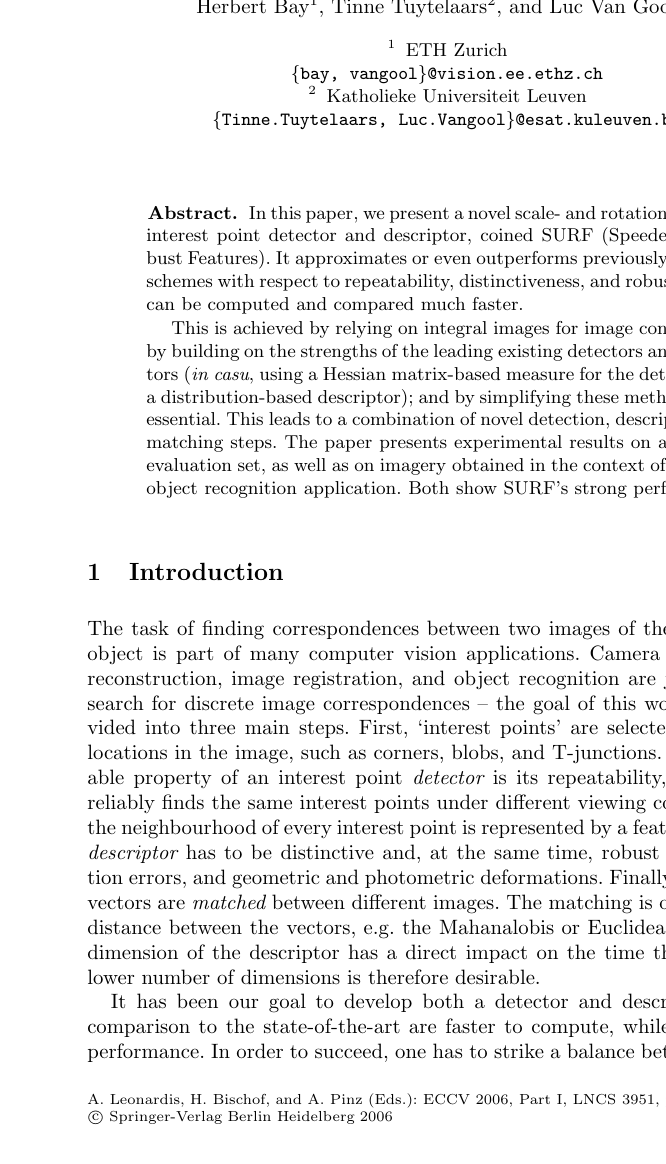
Abstract. In this paper, we present a novel scale- and rotation interest point detector and descriptor, coined SURF (Speede bust Features). It approximates or even outperforms previously schemes with respect to repeatability, distinctiveness, and robus can be computed and compared much faster. This is achieved by relying on integral images for image con by building on the strengths of the leading existing detectors an tors (in casu, using a Hessian matrix-based measure for the det a distribution-based descriptor); and by simplifying these meth essential. This leads to a combination of novel detection, descri matching steps. The paper presents experimental results on a evaluation set, as well as on imagery obtained in the context of object recognition application. Both show SURF’s strong perf
Added
2026-09-06