
keyword
instance-level recognition
Instance-level recognition is a visual recognition task in computer vision focused on identifying, distinguishing, or retrieving specific, individual instances of objects, landmarks, or scenes rather than classifying items into broad semantic categories. While category-level recognition assigns visual inputs to general classes such as buildings or vehicles, instance-level recognition identifies the exact, unique entity depicted, such as a particular historical landmark, a specific piece of artwork, or a distinct physical item. The concept encompasses both delineating individual object instances within an image through detection and instance segmentation, as well as matching and retrieving the same physical entity across different viewpoints, lighting conditions, scales, and partial occlusions in large-scale visual search.
4 items
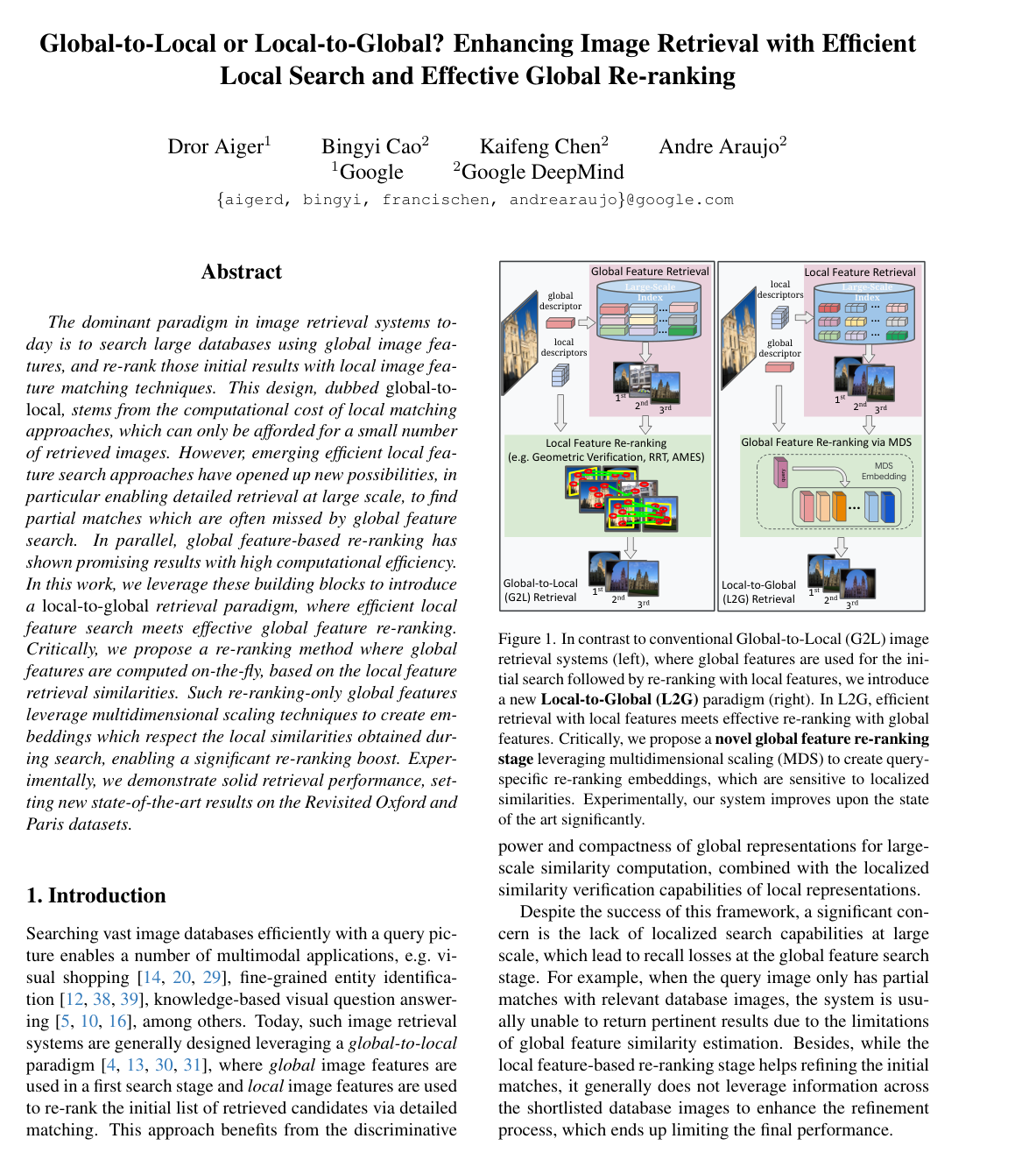
Global-to-Local or Local-to-Global? Enhancing Image Retrieval with Efficient Local Search and Effective Global Re-ranking
Dror Aiger, Bingyi Cao, Andre Araujo, Kaifeng Chen
Why you should read this
Inverts the standard image retrieval workflow by using scalable local feature search for initial candidate retrieval and multidimensional scaling to build query-time global embeddings for fast, highly accurate re-ranking on benchmark datasets.
The dominant paradigm in image retrieval systems today is to search large databases using global image features, and re-rank those initial results with local image feature matching techniques. This design, dubbed global-to-local, stems from the computational cost of local matching approaches, which can only be afforded for a small number of retrieved images. However, emerging efficient local feature search approaches have opened up new possibilities, in particular enabling detailed retrieval at large scale, to find partial matches which are often missed by global feature search. In parallel, global feature-based re-ranking has shown promising results with high computational efficiency. In this work, we leverage these building blocks to introduce a local-to-global retrieval paradigm, where efficient local feature search meets effective global feature re-ranking. Critically, we propose a re-ranking method where global features are computed on-the-fly, based on the local feature retrieval similarities. Such re-ranking-only global features leverage multidimensional scaling techniques to create embeddings which respect the local similarities obtained during search, enabling a significant re-ranking boost. Experimentally, we demonstrate solid retrieval performance, setting new state-of-the-art results on the Revisited Oxford and Paris datasets.
Added
2026-09-29
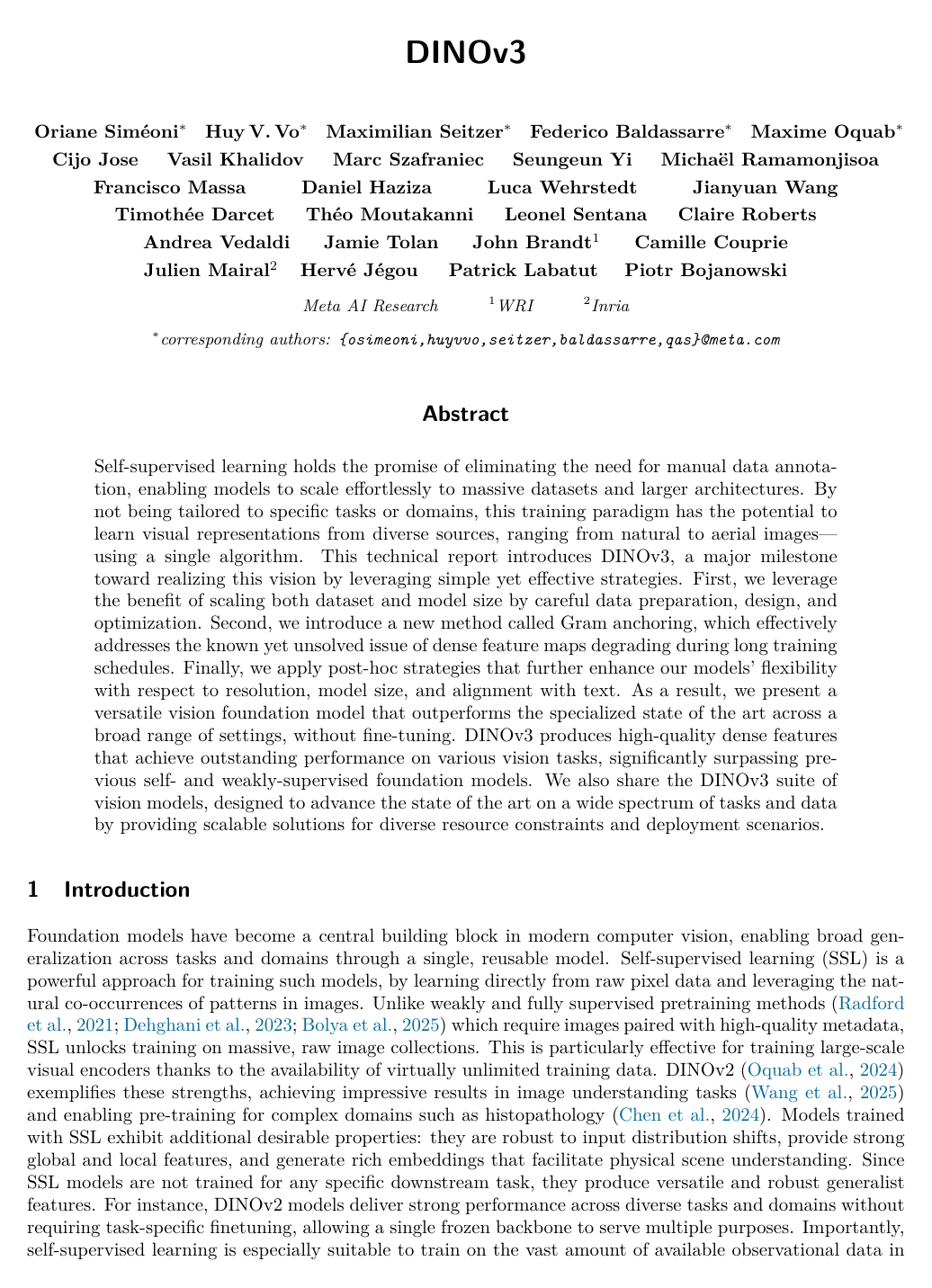
DINOv3
Oriane Siméoni, Huy V. Vo, Maximilian Seitzer, Federico Baldassarre, Maxime Oquab, Cijo Jose, Vasil Khalidov, Marc Szafraniec, Seungeun Yi, Michaël Ramamonjisoa, Francisco Massa, Daniel Haziza, Luca Wehrstedt, Jianyuan Wang, Timothée Darcet, Théo Moutakanni, Leonel Sentana, Claire Roberts, Andrea Vedaldi, Jamie Tolan, John Brandt, Camille Couprie, Julien Mairal, Hervé Jégou, Patrick Labatut, Piotr Bojanowski
Why you should read this
Introduces DINOv3, a self-supervised vision foundation model that incorporates Gram anchoring to prevent feature degradation during extended training and achieves state-of-the-art dense representation performance across diverse visual tasks without fine-tuning.
Self-supervised learning holds the promise of eliminating the need for manual data annotation, enabling models to scale effortlessly to massive datasets and larger architectures. By not being tailored to specific tasks or domains, this training paradigm has the potential to learn visual representations from diverse sources, ranging from natural to aerial images -- using a single algorithm. This technical report introduces DINOv3, a major milestone toward realizing this vision by leveraging simple yet effective strategies. First, we leverage the benefit of scaling both dataset and model size by careful data preparation, design, and optimization. Second, we introduce a new method called Gram anchoring, which effectively addresses the known yet unsolved issue of dense feature maps degrading during long training schedules. Finally, we apply post-hoc strategies that further enhance our models' flexibility with respect to resolution, model size, and alignment with text. As a result, we present a versatile vision foundation model that outperforms the specialized state of the art across a broad range of settings, without fine-tuning. DINOv3 produces high-quality dense features that achieve outstanding performance on various vision tasks, significantly surpassing previous self- and weakly-supervised foundation models. We also share the DINOv3 suite of vision models, designed to advance the state of the art on a wide spectrum of tasks and data by providing scalable solutions for diverse resource constraints and deployment scenarios.
Added
2026-09-25
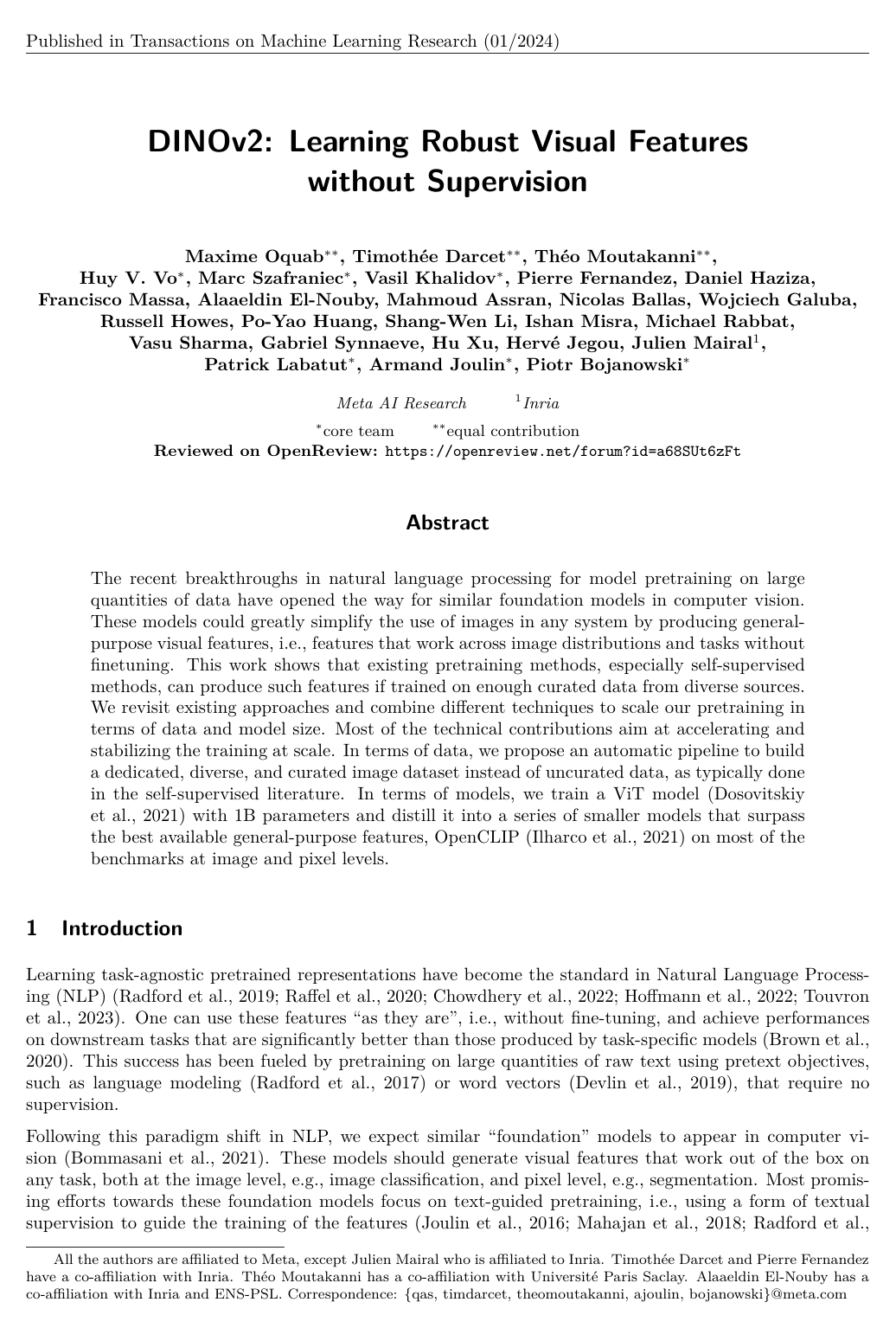
DINOv2: Learning Robust Visual Features without Supervision
Maxime Oquab, Timothée Darcet, Théo Moutakanni, Huy Vo, Marc Szafraniec, Vasil Khalidov, Pierre Fernandez, Daniel Haziza, Francisco Massa, Alaaeldin El-Nouby, Mahmoud Assran, Nicolas Ballas, Wojciech Galuba, Russell Howes, Po-Yao Huang, Shang-Wen Li, Ishan Misra, Michael Rabbat, Vasu Sharma, Gabriel Synnaeve, Hu Xu, Hervé Jegou, Julien Mairal, Patrick Labatut, Armand Joulin, Piotr Bojanowski
Why you should read this
Demonstrates that scaling self-supervised vision transformers to one billion parameters with automated data filtering produces universal visual representations that surpass leading text-supervised models across both image- and pixel-level tasks without fine-tuning.
The recent breakthroughs in natural language processing for model pretraining on large quantities of data have opened the way for similar foundation models in computer vision. These models could greatly simplify the use of images in any system by producing all-purpose visual features, i.e., features that work across image distributions and tasks without finetuning. This work shows that existing pretraining methods, especially self-supervised methods, can produce such features if trained on enough curated data from diverse sources. We revisit existing approaches and combine different techniques to scale our pretraining in terms of data and model size. Most of the technical contributions aim at accelerating and stabilizing the training at scale. In terms of data, we propose an automatic pipeline to build a dedicated, diverse, and curated image dataset instead of uncurated data, as typically done in the self-supervised literature. In terms of models, we train a ViT model (Dosovitskiy et al., 2020) with 1B parameters and distill it into a series of smaller models that surpass the best available all-purpose features, OpenCLIP (Ilharco et al., 2021) on most of the benchmarks at image and pixel levels.
Added
2026-09-24
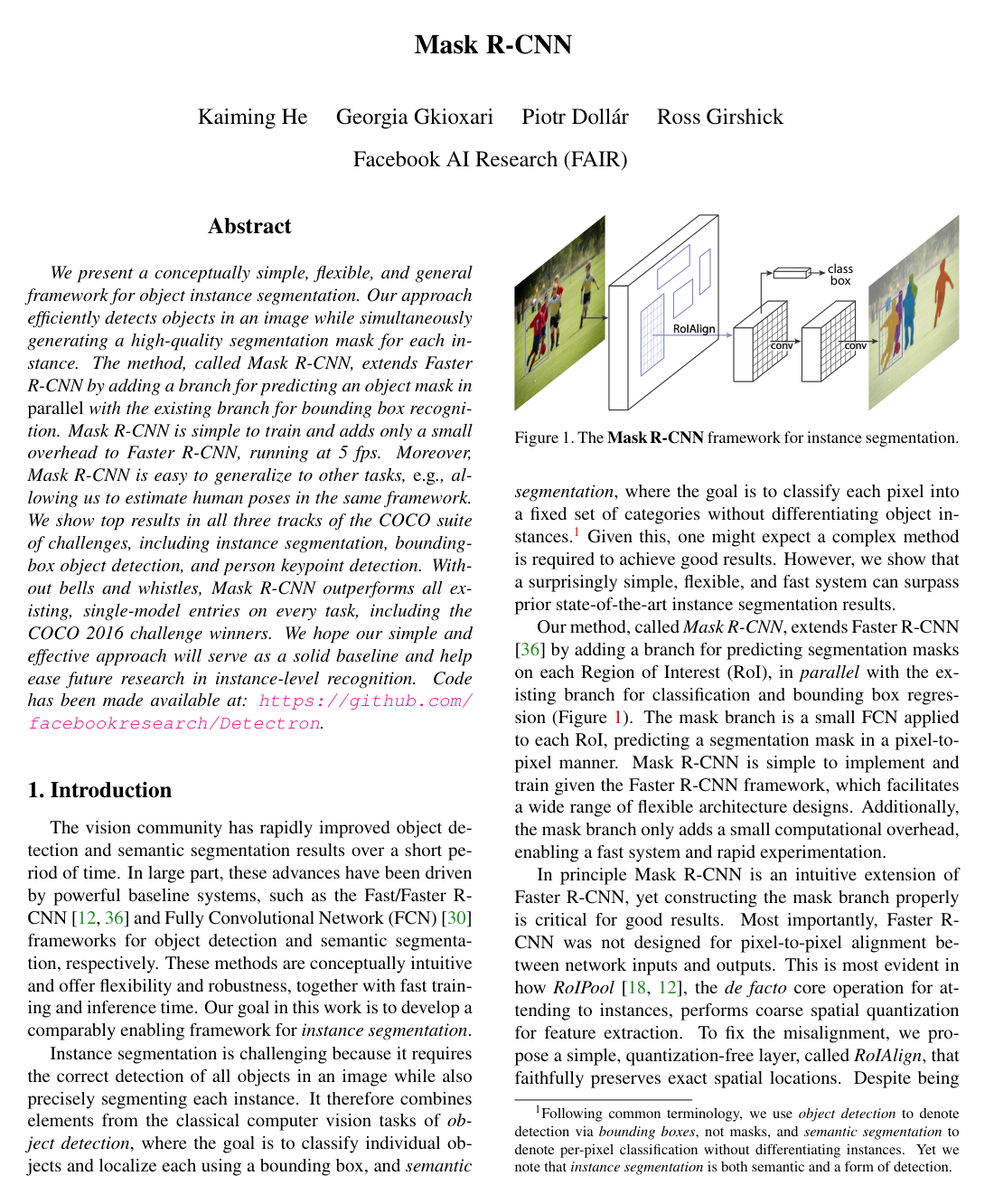
Mask R-CNN
Kaiming He, Georgia Gkioxari, Piotr Dollár, Ross B. Girshick
Why you should read this
Presents Mask R-CNN, a simple and highly effective framework that extends Faster R-CNN by adding a parallel branch for predicting pixel-level masks, establishing a standard architecture for instance segmentation and keypoint detection.
We present a conceptually simple, flexible, and general framework for object instance segmentation. Our approach efficiently detects objects in an image while simultaneously generating a high-quality segmentation mask for each instance. The method, called Mask R-CNN, extends Faster R-CNN by adding a branch for predicting an object mask in parallel with the existing branch for bounding box recognition. Mask R-CNN is simple to train and adds only a small overhead to Faster R-CNN, running at 5 fps. Moreover, Mask R-CNN is easy to generalize to other tasks, e.g., allowing us to estimate human poses in the same framework. We show top results in all three tracks of the COCO suite of challenges, including instance segmentation, bounding-box object detection, and person keypoint detection. Without bells and whistles, Mask R-CNN outperforms all existing, single-model entries on every task, including the COCO 2016 challenge winners. We hope our simple and effective approach will serve as a solid baseline and help ease future research in instance-level recognition. Code has been made available at: this https URL
Added
2026-02-18