keyword
informative disagreement
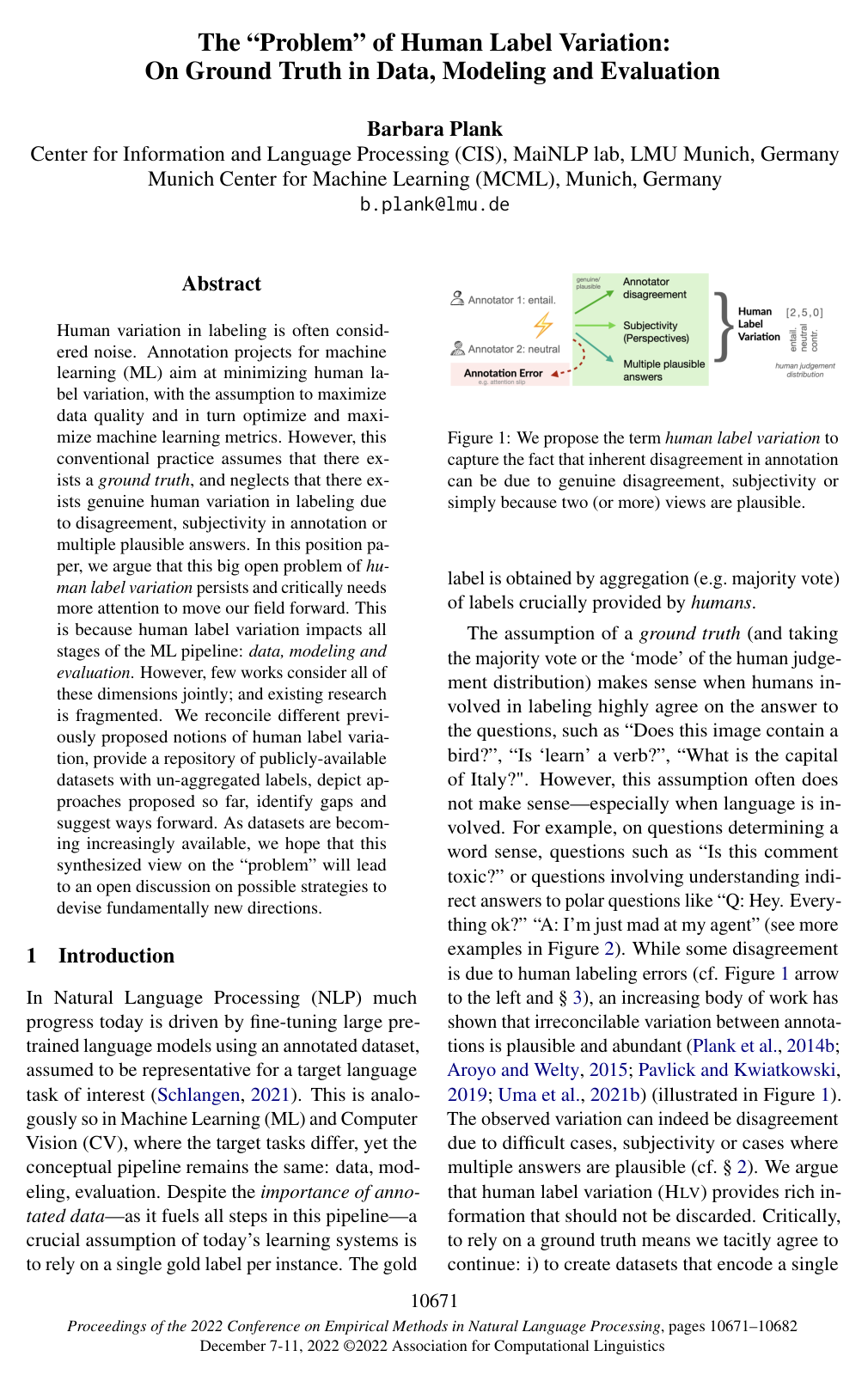
Informative disagreement refers to variation in judgment or labeling among human evaluators that reflects genuine differences in perspective, subjective interpretation, or inherent ambiguity in the data, rather than random error or noise. In data annotation and computational evaluation, conventional practices frequently treat discrepancies between annotators as flaws to be eliminated or collapsed into a single consensus label. By contrast, informative disagreement treats these divergent assessments as valuable signals that capture legitimate alternative meanings, varied cultural or demographic viewpoints, and task complexity. Accounting for such disagreement enables predictive systems and evaluation pipelines to represent real-world uncertainty, preserve diverse viewpoints, and handle nuanced or subjective concepts more faithfully.
1 item