
keyword
information flow
Information flow is the transmission, transformation, and aggregation of data representations across the internal components of a neural network as it processes inputs to generate outputs. In mechanistic interpretability, the term specifically refers to the pathways through which computational signals propagate among sequence positions, attention heads, feed-forward layers, and residual connections. By tracing and intervening on these causal routes, researchers determine how intermediate features are passed, enriched, and integrated to execute distinct sub-tasks, localize internal computational circuits, and explain how a model transforms raw input into final predictions.
4 items
MIB: A Mechanistic Interpretability Benchmark
Aaron Mueller, Atticus Geiger, Sarah Wiegreffe, Dana Arad, Iván Arcuschin, Adam Belfki, Yik Siu Chan, Jaden Fiotto-Kaufman, Tal Haklay, Michael Hanna, Jing Huang, Rohan Gupta, Yaniv Nikankin, Hadas Orgad, Nikhil Prakash, Anja Reusch, Aruna Sankaranarayanan, Shun Shao, Alessandro Stolfo, Martin Tutek, Amir Zur, David Bau, Yonatan Belinkov
Why you should read this
Establishes a standardized benchmark to rigorously evaluate mechanistic interpretability methods across circuit and causal variable localization, revealing critical performance differences among popular techniques like sparse autoencoders and attribution patching.
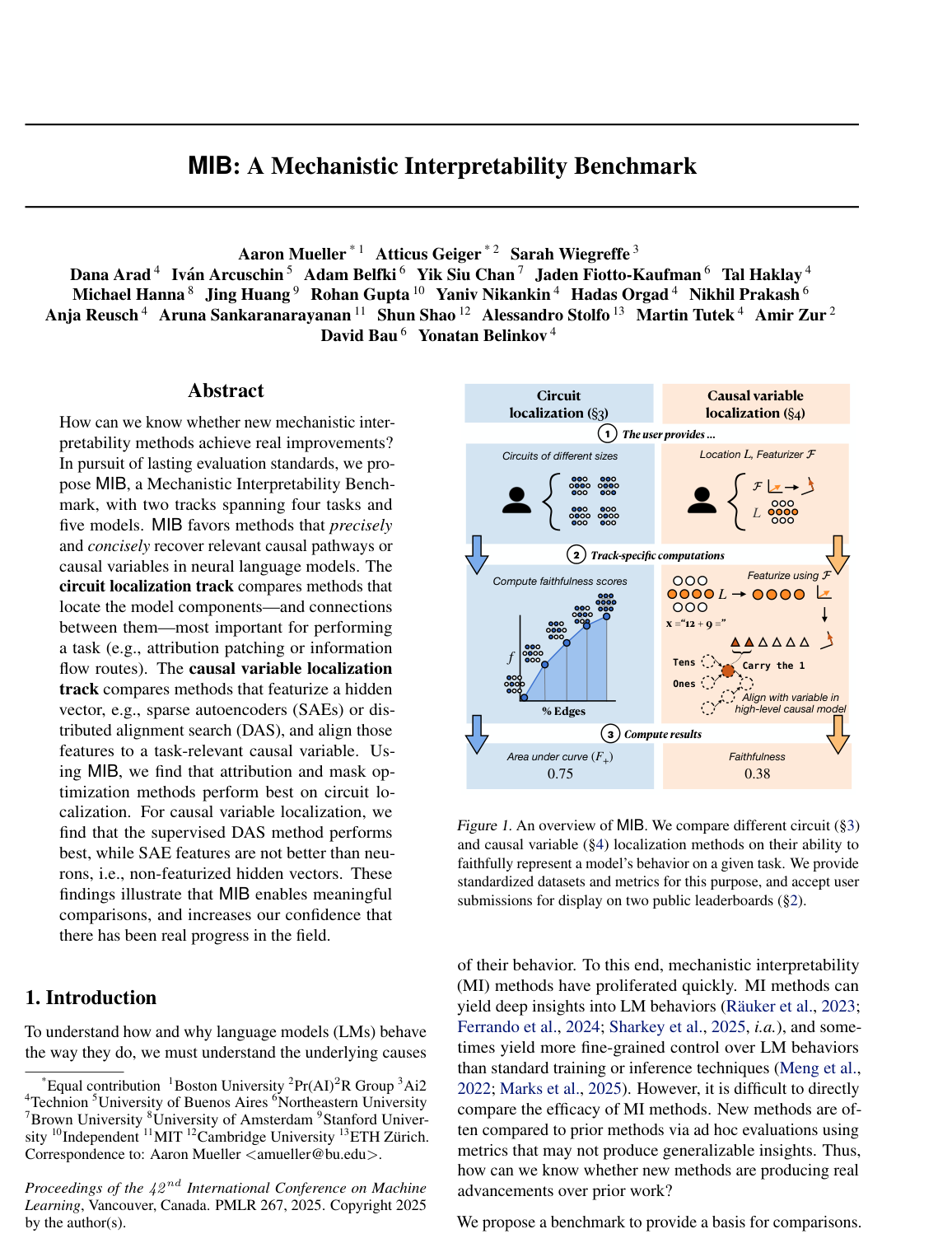
How can we know whether new mechanistic interpretability methods achieve real improvements? In pursuit of lasting evaluation standards, we propose MIB, a Mechanistic Interpretability Benchmark, with two tracks spanning four tasks and five models. MIB favors methods that precisely and concisely recover relevant causal pathways or causal variables in neural language models. The circuit localization track compares methods that locate the model components - and connections between them - most important for performing a task (e.g., attribution patching or information flow routes). The causal variable localization track compares methods that featurize a hidden vector, e.g., sparse autoencoders (SAEs) or distributed alignment search (DAS), and align those features to a task-relevant causal variable. Using MIB, we find that attribution and mask optimization methods perform best on circuit localization. For causal variable localization, we find that the supervised DAS method performs best, while SAE features are not better than neurons, i.e., non-featurized hidden vectors. These findings illustrate that MIB enables meaningful comparisons, and increases our confidence that there has been real progress in the field.
Added
2026-10-04
Interpretability in the Wild: a Circuit for Indirect Object Identification in GPT-2 small
Kevin Wang, Alexandre Variengien, Arthur Conmy, Buck Shlegeris, Jacob Steinhardt
Why you should read this
Reverse-engineers the 26-attention-head circuit that GPT-2 small uses for indirect object identification, establishing quantitative criteria to validate mechanistic interpretability in transformer language models.
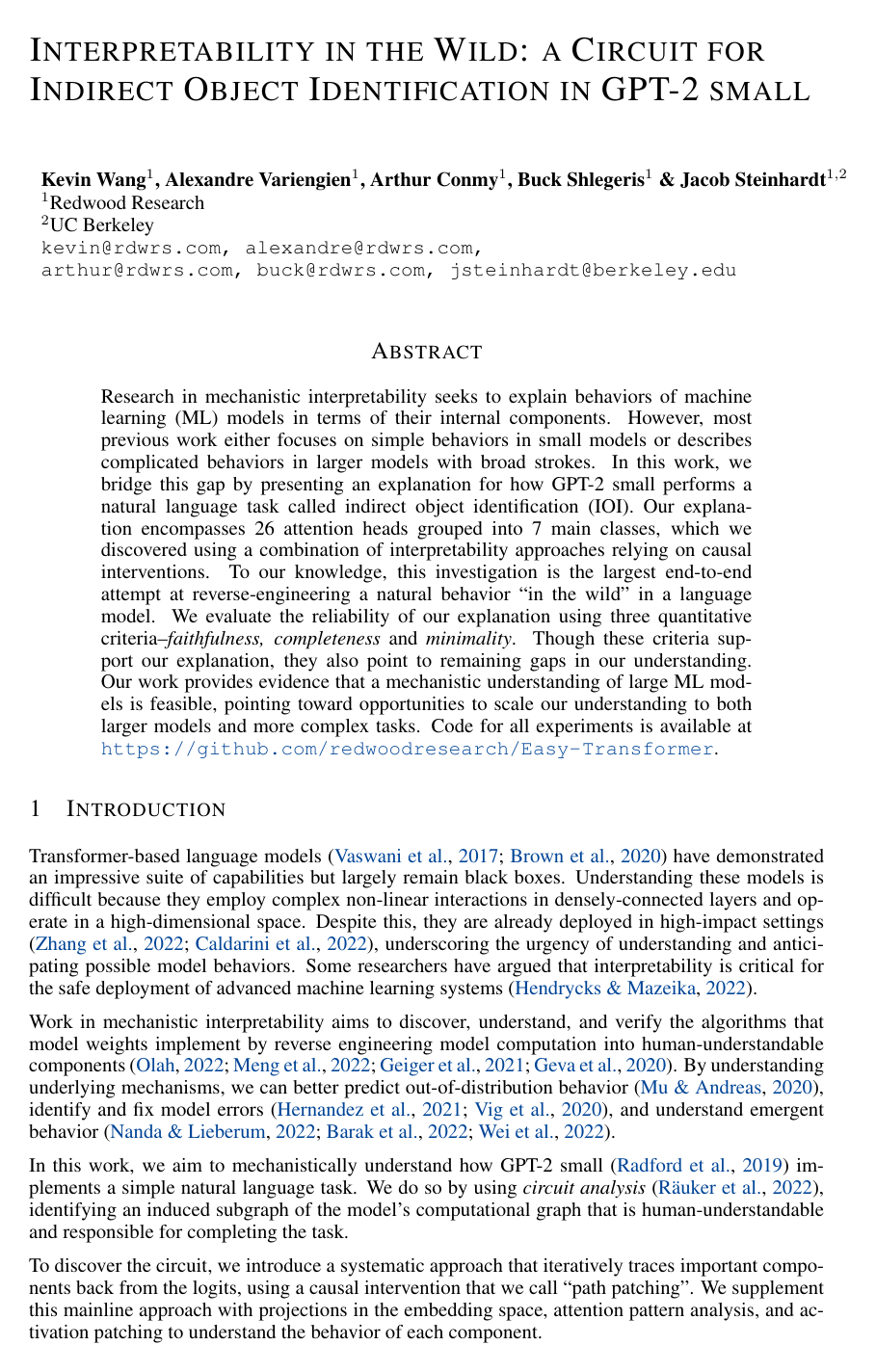
Research in mechanistic interpretability seeks to explain behaviors of machine learning models in terms of their internal components. However, most previous work either focuses on simple behaviors in small models, or describes complicated behaviors in larger models with broad strokes. In this work, we bridge this gap by presenting an explanation for how GPT-2 small performs a natural language task called indirect object identification (IOI). Our explanation encompasses 26 attention heads grouped into 7 main classes, which we discovered using a combination of interpretability approaches relying on causal interventions. To our knowledge, this investigation is the largest end-to-end attempt at reverse-engineering a natural behavior "in the wild" in a language model. We evaluate the reliability of our explanation using three quantitative criteria--faithfulness, completeness and minimality. Though these criteria support our explanation, they also point to remaining gaps in our understanding. Our work provides evidence that a mechanistic understanding of large ML models is feasible, opening opportunities to scale our understanding to both larger models and more complex tasks.
Added
2026-10-04
Dissecting Recall of Factual Associations in Auto-Regressive Language Models
Mor Geva, Jasmijn Bastings, Katja Filippova, Amir Globerson
Why you should read this
Reveals the step-by-step internal mechanism auto-regressive language models use to recall facts, demonstrating that early feed-forward layers enrich subject representations while upper attention heads directly extract the correct attributes.
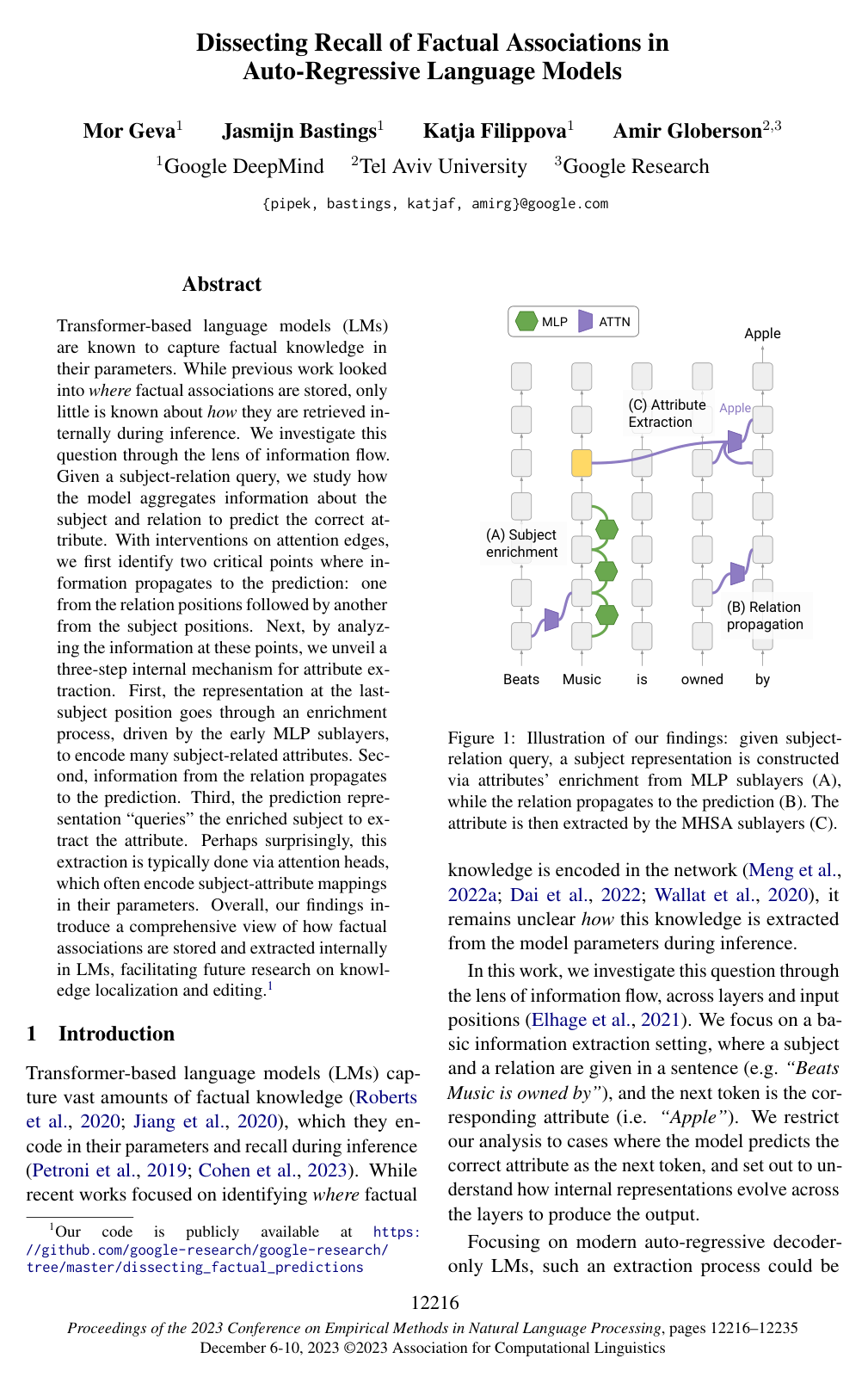
Transformer-based language models (LMs) are known to capture factual knowledge in their parameters. While previous work looked into where factual associations are stored, only little is known about how they are retrieved internally during inference. We investigate this question through the lens of information flow. Given a subject-relation query, we study how the model aggregates information about the subject and relation to predict the correct attribute. With interventions on attention edges, we first identify two critical points where information propagates to the prediction: one from the relation positions followed by another from the subject positions. Next, by analyzing the information at these points, we unveil a three-step internal mechanism for attribute extraction. First, the representation at the last-subject position goes through an enrichment process, driven by the early MLP sublayers, to encode many subject-related attributes. Second, information from the relation propagates to the prediction. Third, the prediction representation “queries” the enriched subject to extract the attribute. Perhaps surprisingly, this extraction is typically done via attention heads, which often encode subject-attribute mappings in their parameters. Overall, our findings introduce a comprehensive view of how factual associations are stored and extracted internally in LMs, facilitating future research on knowledge localization and editing.¹
Added
2026-09-28
Future Lens: Anticipating Subsequent Tokens from a Single Hidden State
Koyena Pal, Jiuding Sun, Andrew Yuan, Byron C. Wallace, David Bau
Why you should read this
Demonstrates through linear probing and causal state transplantation that single intermediate hidden states in autoregressive transformers encode information capable of predicting tokens multiple steps into the future.
Added
2026-09-26