
keyword
information bottleneck method
The information bottleneck method is an information-theoretic approach to finding a compact representation of data that preserves as much information as possible about a relevant variable, such as a target to be predicted. It balances compression of the input against retention of information useful for predicting that target.
3 items
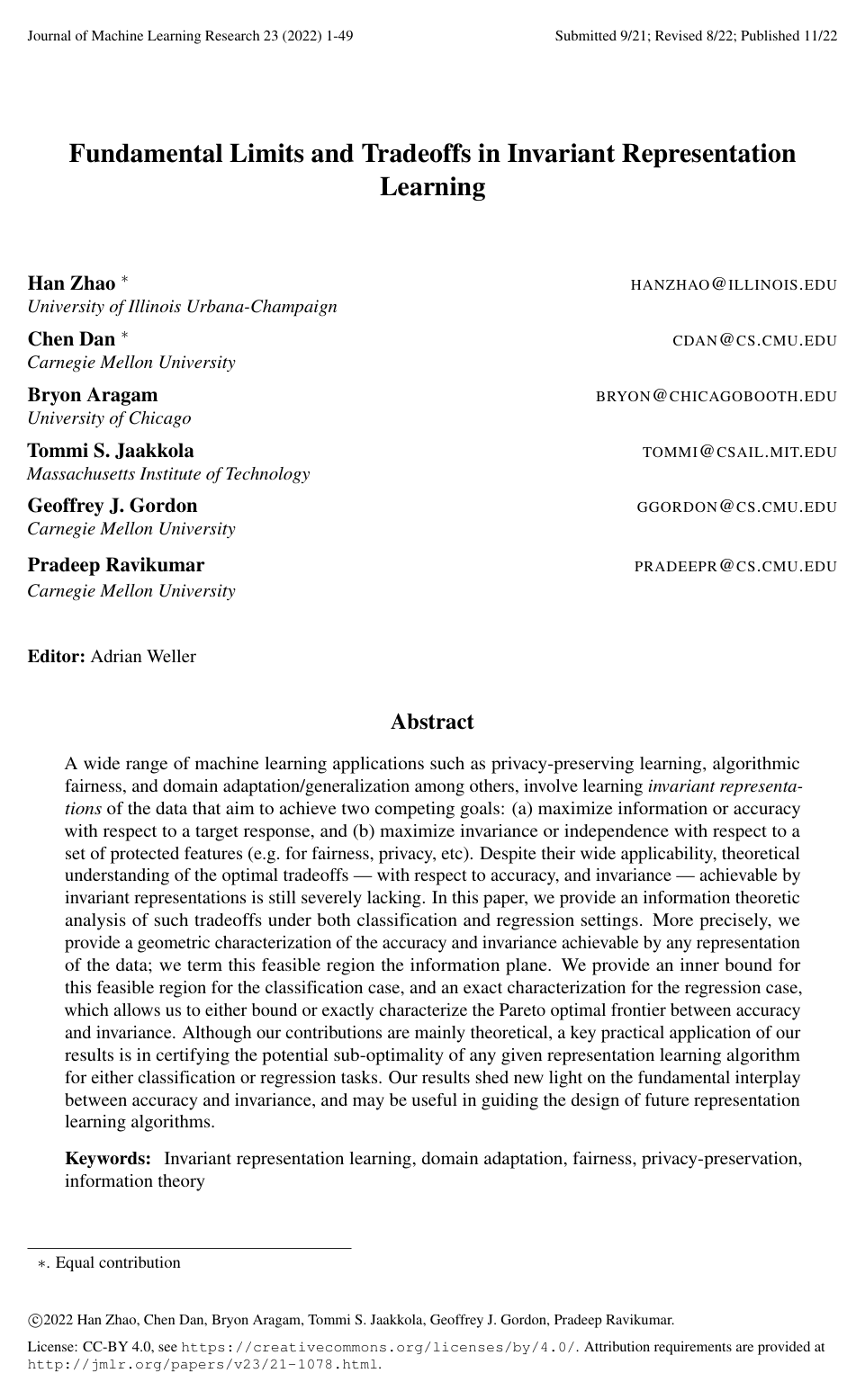
Fundamental Limits and Tradeoffs in Invariant Representation Learning
Han Zhao, Chen Dan, Bryon Aragam, Tommi S. Jaakkola, Geoffrey J. Gordon, Pradeep Ravikumar
Why you should read this
Establishes an information-theoretic framework that bounds the achievable tradeoffs between predictive accuracy and feature invariance across classification and regression tasks, providing a method to certify the suboptimality of representation learning algorithms.
A wide range of machine learning applications such as privacy-preserving learning, algorithmic fairness, and domain adaptation/generalization among others, involve learning invariant representations of the data that aim to achieve two competing goals: (a) maximize information or accuracy with respect to a target response, and (b) maximize invariance or independence with respect to a set of protected features (e.g. for fairness, privacy, etc). Despite their wide applicability, theoretical understanding of the optimal tradeoffs — with respect to accuracy, and invariance — achievable by invariant representations is still severely lacking. In this paper, we provide an information theoretic analysis of such tradeoffs under both classification and regression settings. More precisely, we provide a geometric characterization of the accuracy and invariance achievable by any representation of the data; we term this feasible region the information plane. We provide an inner bound for this feasible region for the classification case, and an exact characterization for the regression case, which allows us to either bound or exactly characterize the Pareto optimal frontier between accuracy and invariance. Although our contributions are mainly theoretical, a key practical application of our results is in certifying the potential sub-optimality of any given representation learning algorithm for either classification or regression tasks. Our results shed new light on the fundamental interplay between accuracy and invariance, and may be useful in guiding the design of future representation learning algorithms.
Added
2026-10-03
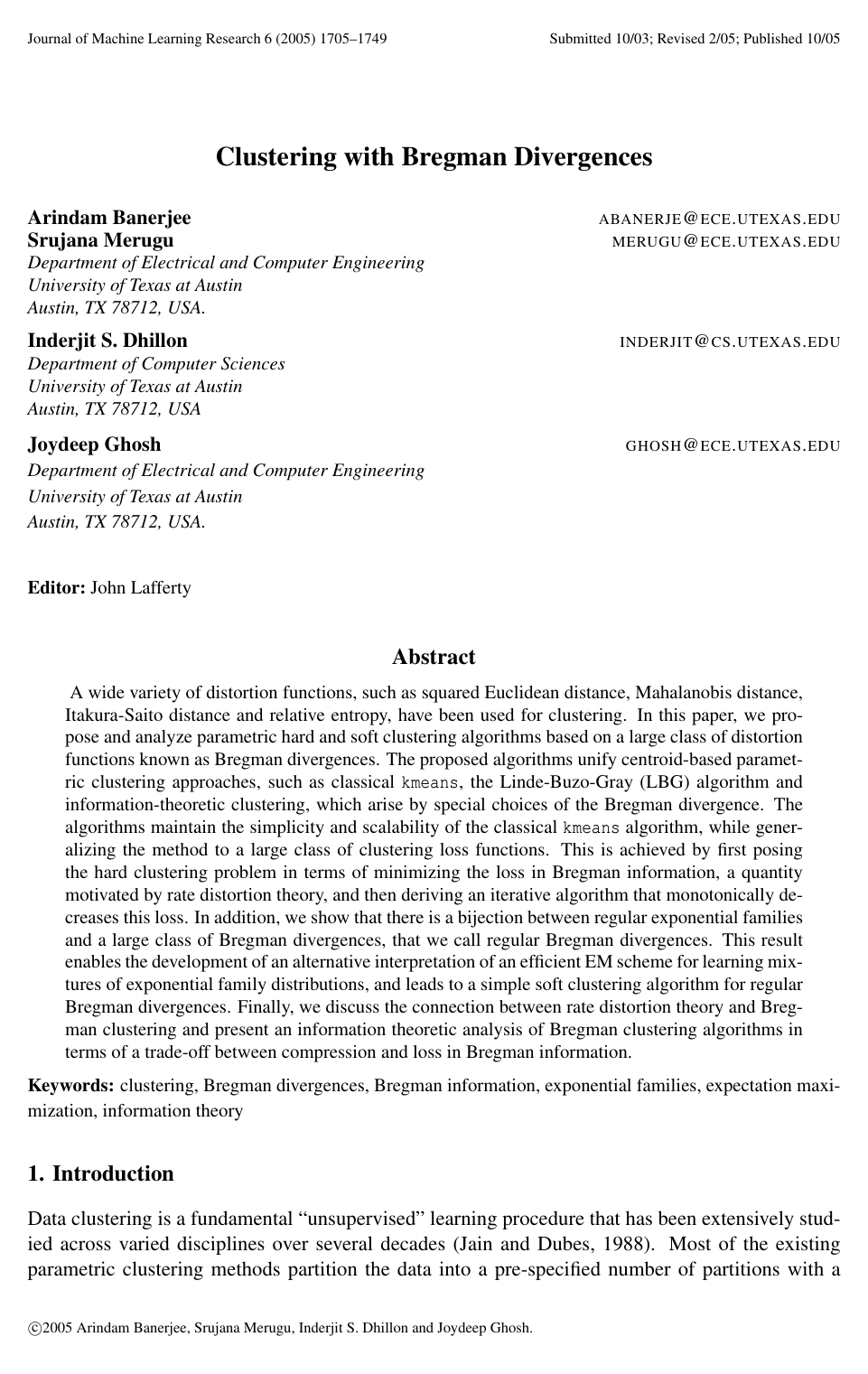
Clustering with Bregman Divergences
Arindam Banerjee, Srujana Merugu, Inderjit S. Dhillon, Joydeep Ghosh
Why you should read this
Unifies centroid-based hard and soft clustering methods across arbitrary Bregman divergences by establishing a fundamental bijection with regular exponential families and formulating clustering as an optimal quantization problem that minimizes information loss.
A wide variety of distortion functions, such as squared Euclidean distance, Mahalanobis distance, Itakura-Saito distance and relative entropy, have been used for clustering. In this paper, we propose and analyze parametric hard and soft clustering algorithms based on a large class of distortion functions known as Bregman divergences. The proposed algorithms unify centroid-based parametric clustering approaches, such as classical kmeans, the Linde-Buzo-Gray (LBG) algorithm and information-theoretic clustering, which arise by special choices of the Bregman divergence. The algorithms maintain the simplicity and scalability of the classical kmeans algorithm, while generalizing the method to a large class of clustering loss functions. This is achieved by first posing the hard clustering problem in terms of minimizing the loss in Bregman information, a quantity motivated by rate distortion theory, and then deriving an iterative algorithm that monotonically decreases this loss. In addition, we show that there is a bijection between regular exponential families and a large class of Bregman divergences, that we call regular Bregman divergences. This result enables the development of an alternative interpretation of an efficient EM scheme for learning mixtures of exponential family distributions, and leads to a simple soft clustering algorithm for regular Bregman divergences. Finally, we discuss the connection between rate distortion theory and Bregman clustering and present an information theoretic analysis of Bregman clustering algorithms in terms of a trade-off between compression and loss in Bregman information.
Added
2026-09-18
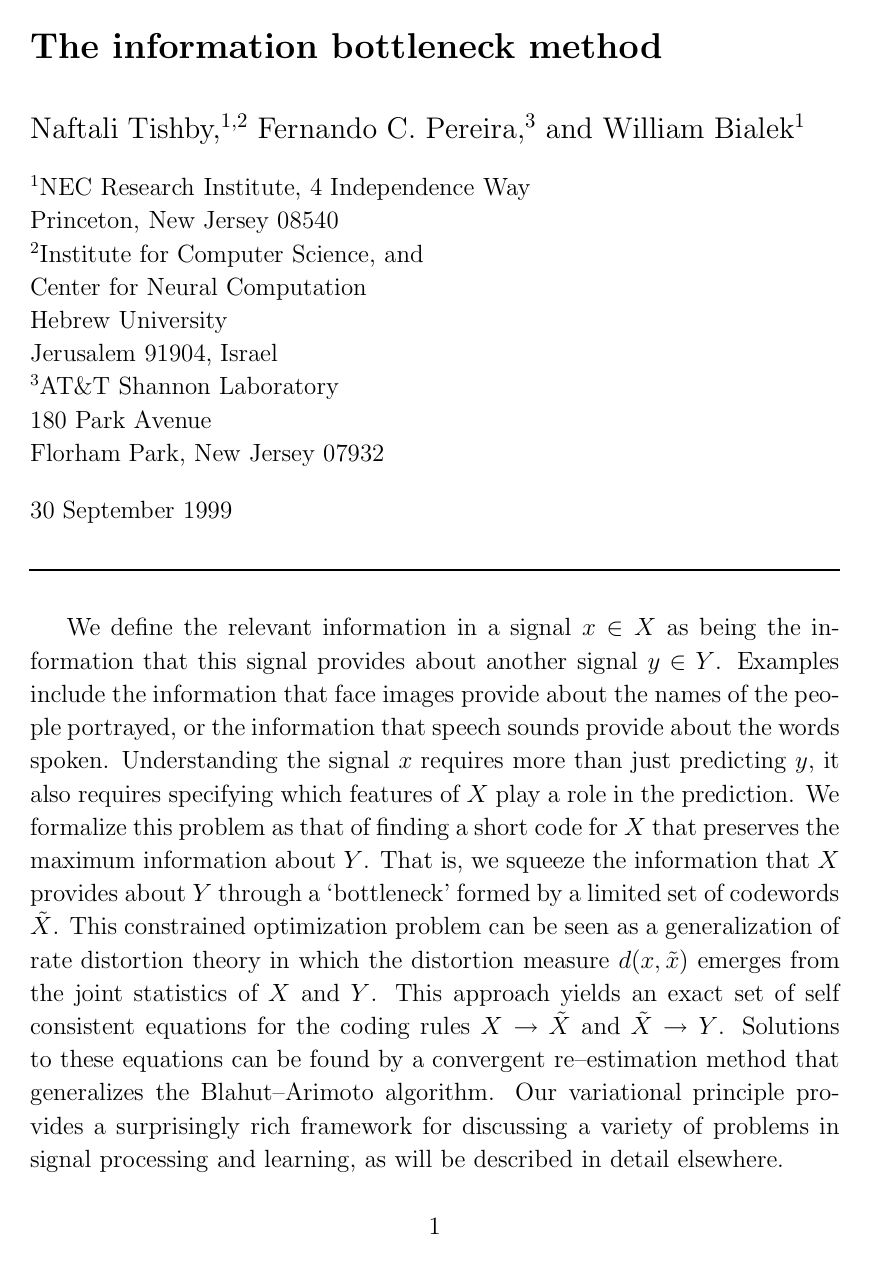
The information bottleneck method
Naftali Tishby, Fernando C. Pereira, William Bialek
Why you should read this
Proposes a fundamental information-theoretic framework and algorithm to compress input signals while preserving maximal information about a target variable, generalizing rate-distortion theory without requiring predefined distortion measures.
We define the relevant information in a signal as being the information that this signal provides about another signal . Examples include the information that face images provide about the names of the people portrayed, or the information that speech sounds provide about the words spoken. Understanding the signal requires more than just predicting , it also requires specifying which features of play a role in the prediction. We formalize this problem as that of finding a short code for that preserves the maximum information about . That is, we squeeze the information that provides about through a `bottleneck' formed by a limited set of codewords . This constrained optimization problem can be seen as a generalization of rate distortion theory in which the distortion measure emerges from the joint statistics of and . This approach yields an exact set of self consistent equations for the coding rules and . Solutions to these equations can be found by a convergent re-estimation method that generalizes the Blahut-Arimoto algorithm. Our variational principle provides a surprisingly rich framework for discussing a variety of problems in signal processing and learning, as will be described in detail elsewhere.
Added
2026-09-10