
keyword
inductive learning
Inductive learning is a machine learning paradigm where an algorithm learns a generalizable rule or mapping function from specific training examples to make predictions on completely new, previously unseen data. In this framework, the model extracts underlying patterns and parameterizes decision boundaries during training so that it can independently evaluate future inputs during inference. This distinguishes inductive learning from transductive learning, which requires the features or structural relationships of test instances to be present during training and restricts predictions to that predetermined dataset. By abstracting general principles from observed samples, inductive learning enables models to generalize effectively to new instances, texts, or entirely unseen graph structures in evolving environments without requiring retraining.
6 items
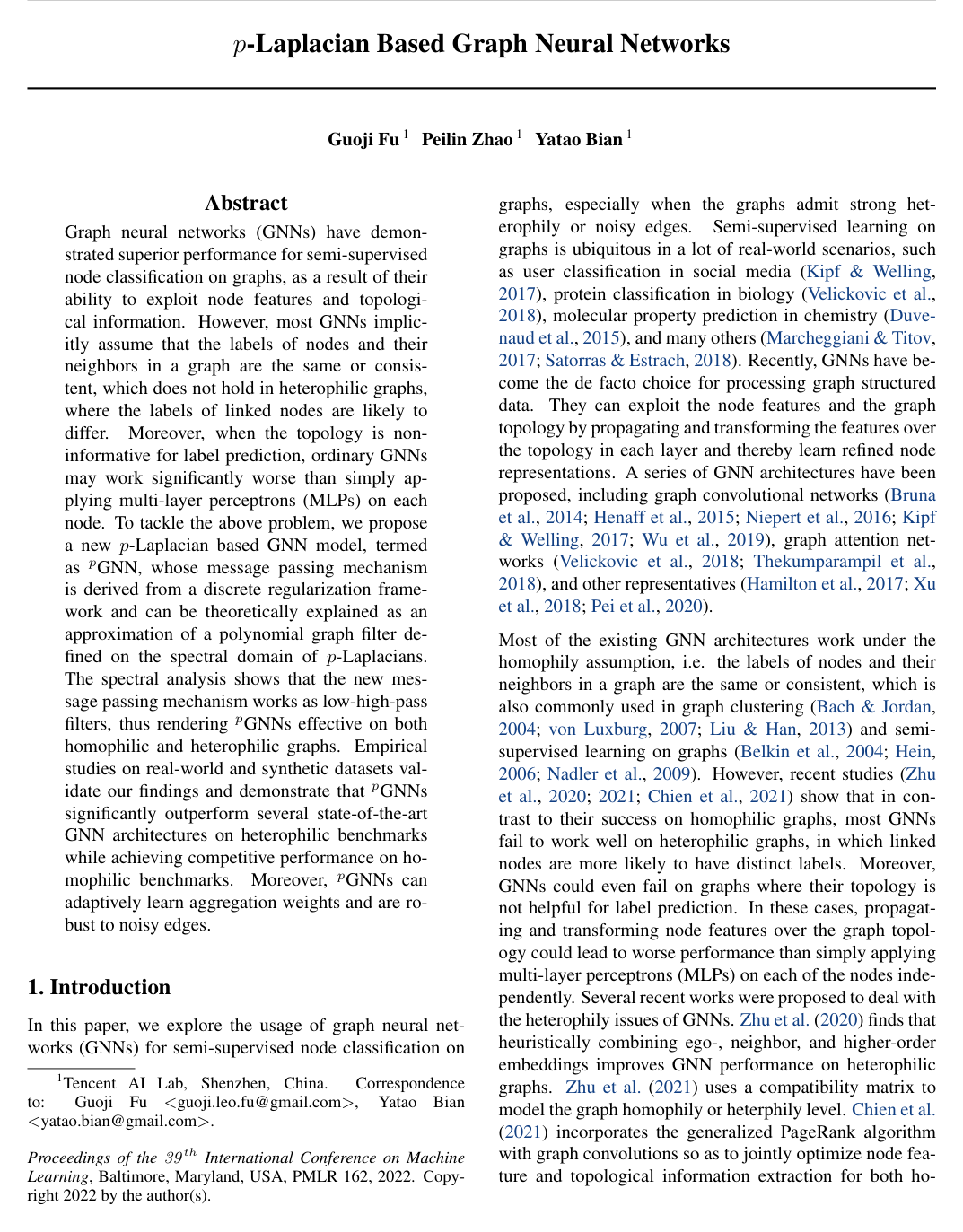
p-Laplacian Based Graph Neural Networks
Guoji Fu, Peilin Zhao, Yatao Bian
Why you should read this
Develops a discrete regularization framework based on the -Laplacian to create graph neural networks that act as adaptive low-high-pass spectral filters, effectively handling heterophilic graphs and noisy topology where standard architectures fail.
Graph neural networks (GNNs) have demonstrated superior performance for semi-supervised node classification on graphs, as a result of their ability to exploit node features and topological information. However, most GNNs implicitly assume that the labels of nodes and their neighbors in a graph are the same or consistent, which does not hold in heterophilic graphs, where the labels of linked nodes are likely to differ. Moreover, when the topology is non-informative for label prediction, ordinary GNNs may work significantly worse than simply applying multi-layer perceptrons (MLPs) on each node. To tackle the above problem, we propose a new p-Laplacian based GNN model, termed as pGNN, whose message passing mechanism is derived from a discrete regularization framework and can be theoretically explained as an approximation of a polynomial graph filter defined on the spectral domain of p-Laplacians. The spectral analysis shows that the new message passing mechanism works as low-high-pass filters, thus rendering pGNNs effective on both homophilic and heterophilic graphs. Empirical studies on real-world and synthetic datasets validate our findings and demonstrate that pGNNs significantly outperform several state-of-the-art GNN architectures on heterophilic benchmarks while achieving competitive performance on homophilic benchmarks. Moreover, pGNNs can adaptively learn aggregation weights and are robust to noisy edges.
Added
2026-10-03
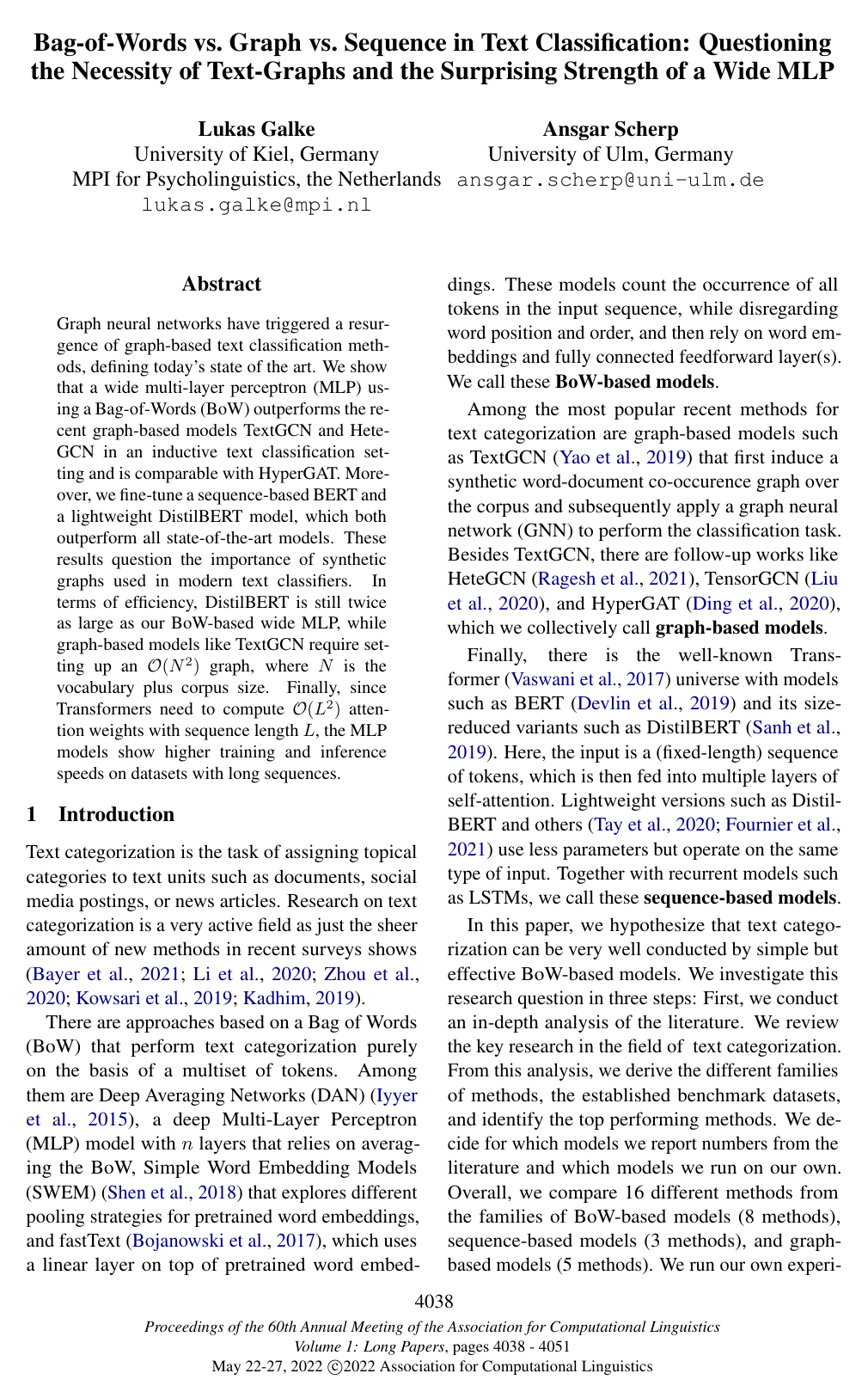
Bag-of-Words vs. Graph vs. Sequence in Text Classification: Questioning the Necessity of Text-Graphs and the Surprising Strength of a Wide MLP
Lukas Galke, Ansgar Scherp
Why you should read this
Demonstrates that a simple, wide bag-of-words multi-layer perceptron outperforms complex graph neural networks like TextGCN in inductive text classification while offering significantly faster training and inference than Transformer models on long sequences.
Graph neural networks have triggered a resurgence of graph-based text classification methods, defining today’s state of the art. We show that a wide multi-layer perceptron (MLP) using a Bag-of-Words (BoW) outperforms the recent graph-based models TextGCN and HeteGCN in an inductive text classification setting and is comparable with HyperGAT. Moreover, we fine-tune a sequence-based BERT and a lightweight DistilBERT model, which both outperform all state-of-the-art models. These results question the importance of synthetic graphs used in modern text classifiers. In terms of efficiency, DistilBERT is still twice as large as our BoW-based wide MLP, while graph-based models like TextGCN require setting up an O(N²) graph, where N is the vocabulary plus corpus size. Finally, since Transformers need to compute O(L²) attention weights with sequence length L, the MLP models show higher training and inference speeds on datasets with long sequences.
Added
2026-10-03
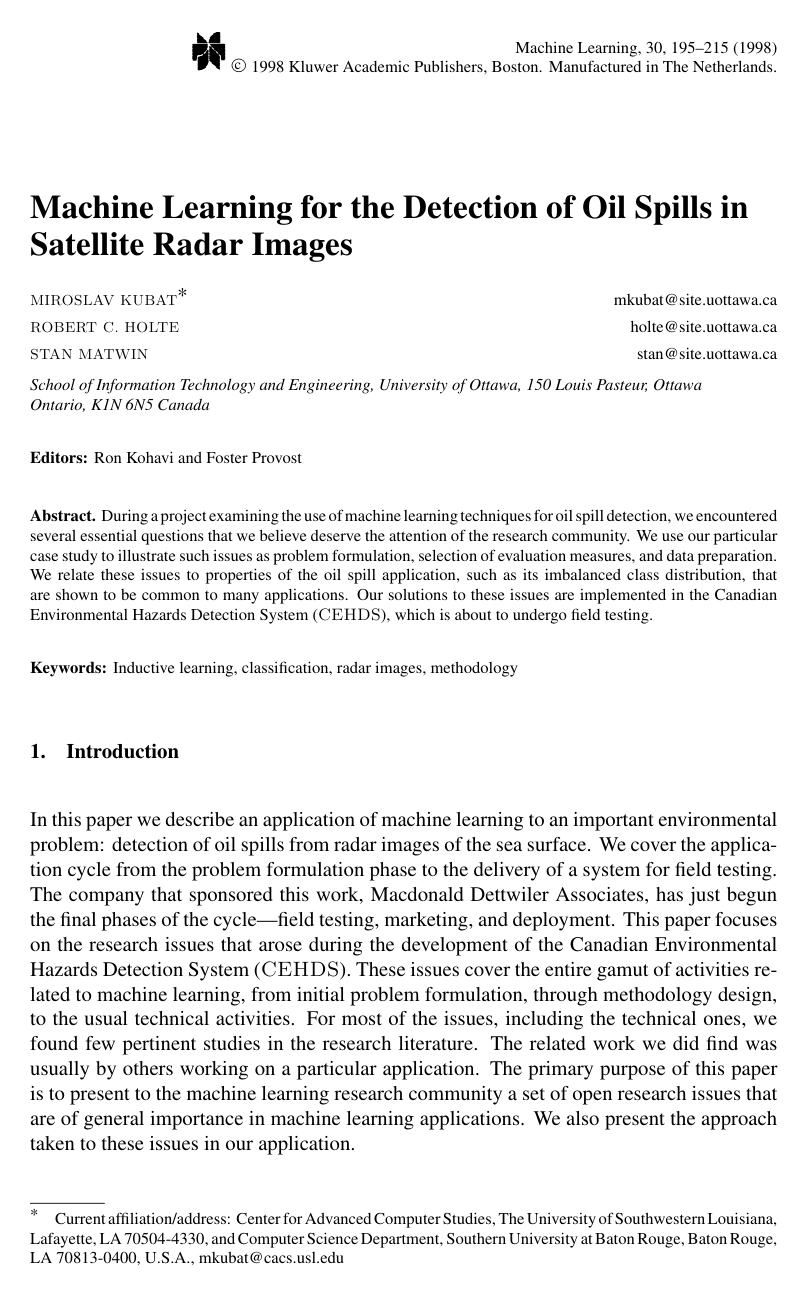
Machine Learning for the Detection of Oil Spills in Satellite Radar Images
MIROSLAV KUBAT, ROBERT C. HOLTE, STAN MATWIN
Why you should read this
Presents practical machine learning solutions for detecting oil spills in satellite radar imagery while addressing real-world challenges such as extreme class imbalance, data preparation, and appropriate evaluation metrics.
During a project examining the use of machine learning techniques for oil spill detection, we encountered several essential questions that we believe deserve the attention of the research community. We use our particular case study to illustrate such issues as problem formulation, selection of evaluation measures, and data preparation. We relate these issues to properties of the oil spill application, such as its imbalanced class distribution, that are shown to be common to many applications. Our solutions to these issues are implemented in the Canadian Environmental Hazards Detection System (CEHDS), which is about to undergo field testing.
Added
2026-09-25
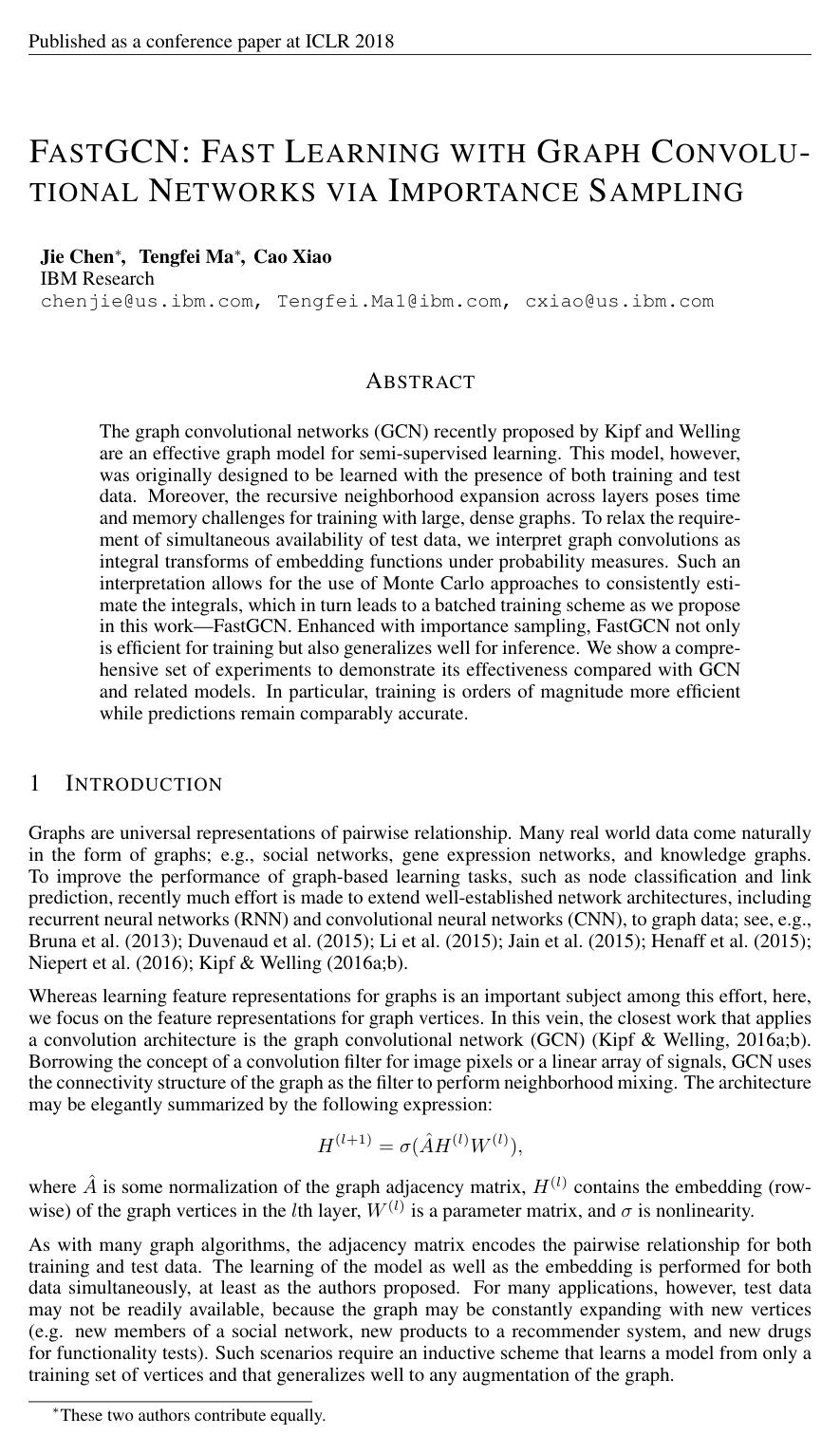
FastGCN: Fast Learning with Graph Convolutional Networks via Importance Sampling
Jie Chen, Tengfei Ma, Cao Xiao
Why you should read this
Develops FastGCN, an importance sampling framework that recasts graph convolutions as integral transforms to eliminate recursive neighborhood expansion, achieving orders-of-magnitude faster training on large graphs without sacrificing predictive accuracy.
The graph convolutional networks (GCN) recently proposed by Kipf and Welling are an effective graph model for semi-supervised learning. This model, however, was originally designed to be learned with the presence of both training and test data. Moreover, the recursive neighborhood expansion across layers poses time and memory challenges for training with large, dense graphs. To relax the requirement of simultaneous availability of test data, we interpret graph convolutions as integral transforms of embedding functions under probability measures. Such an interpretation allows for the use of Monte Carlo approaches to consistently estimate the integrals, which in turn leads to a batched training scheme as we propose in this work---FastGCN. Enhanced with importance sampling, FastGCN not only is efficient for training but also generalizes well for inference. We show a comprehensive set of experiments to demonstrate its effectiveness compared with GCN and related models. In particular, training is orders of magnitude more efficient while predictions remain comparably accurate.
Added
2026-09-24
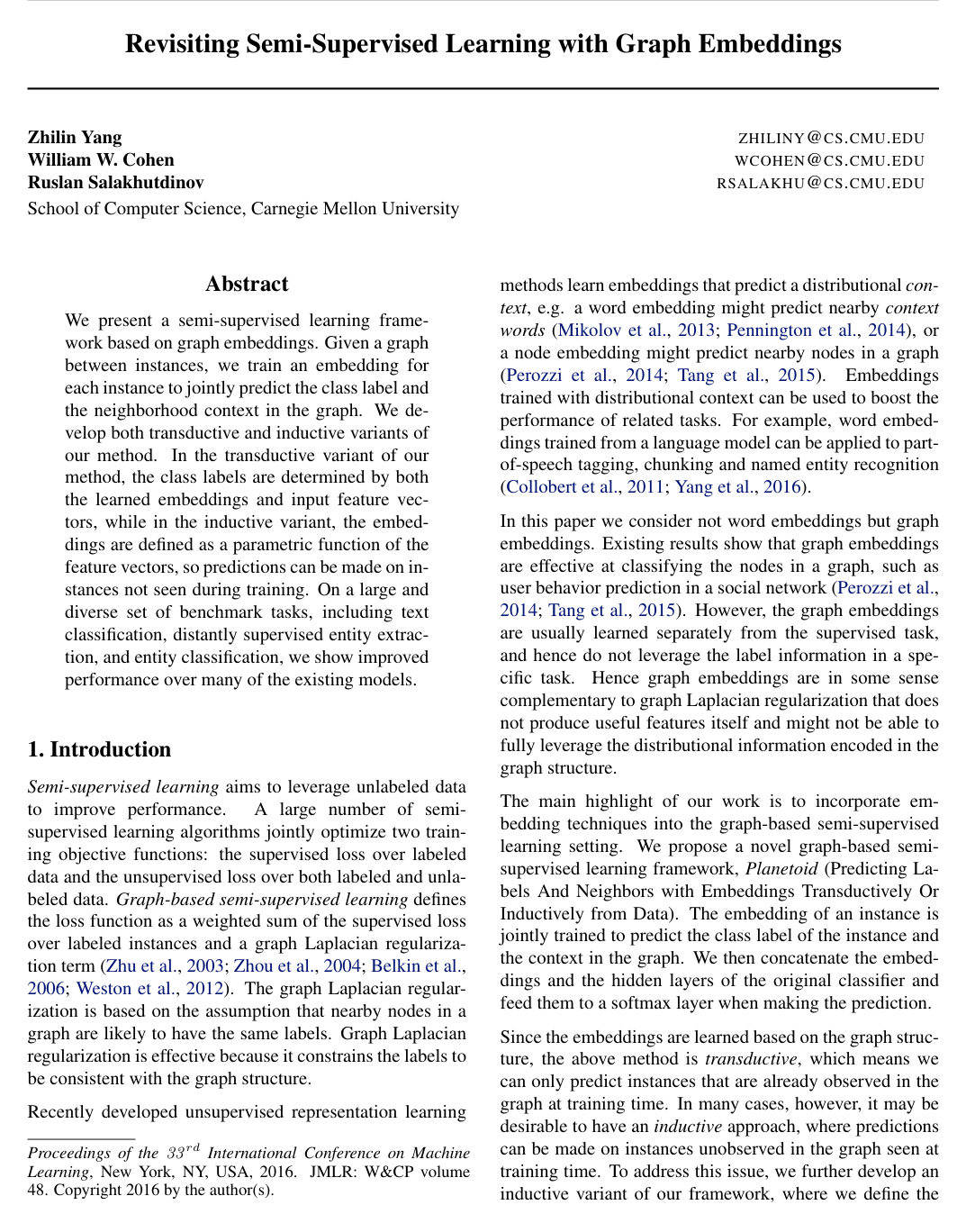
Revisiting Semi-Supervised Learning with Graph Embeddings
Zhilin Yang, William W. Cohen, Ruslan Salakhutdinov
Why you should read this
Proposes a graph embedding framework for semi-supervised learning that jointly predicts class labels and neighborhood context across both transductive and inductive settings, outperforming standard methods on text and entity classification benchmarks.
We present a semi-supervised learning framework based on graph embeddings. Given a graph between instances, we train an embedding for each instance to jointly predict the class label and the neighborhood context in the graph. We develop both transductive and inductive variants of our method. In the transductive variant of our method, the class labels are determined by both the learned embeddings and input feature vectors, while in the inductive variant, the embeddings are defined as a parametric function of the feature vectors, so predictions can be made on instances not seen during training. On a large and diverse set of benchmark tasks, including text classification, distantly supervised entity extraction, and entity classification, we show improved performance over many of the existing models.
Added
2026-09-14
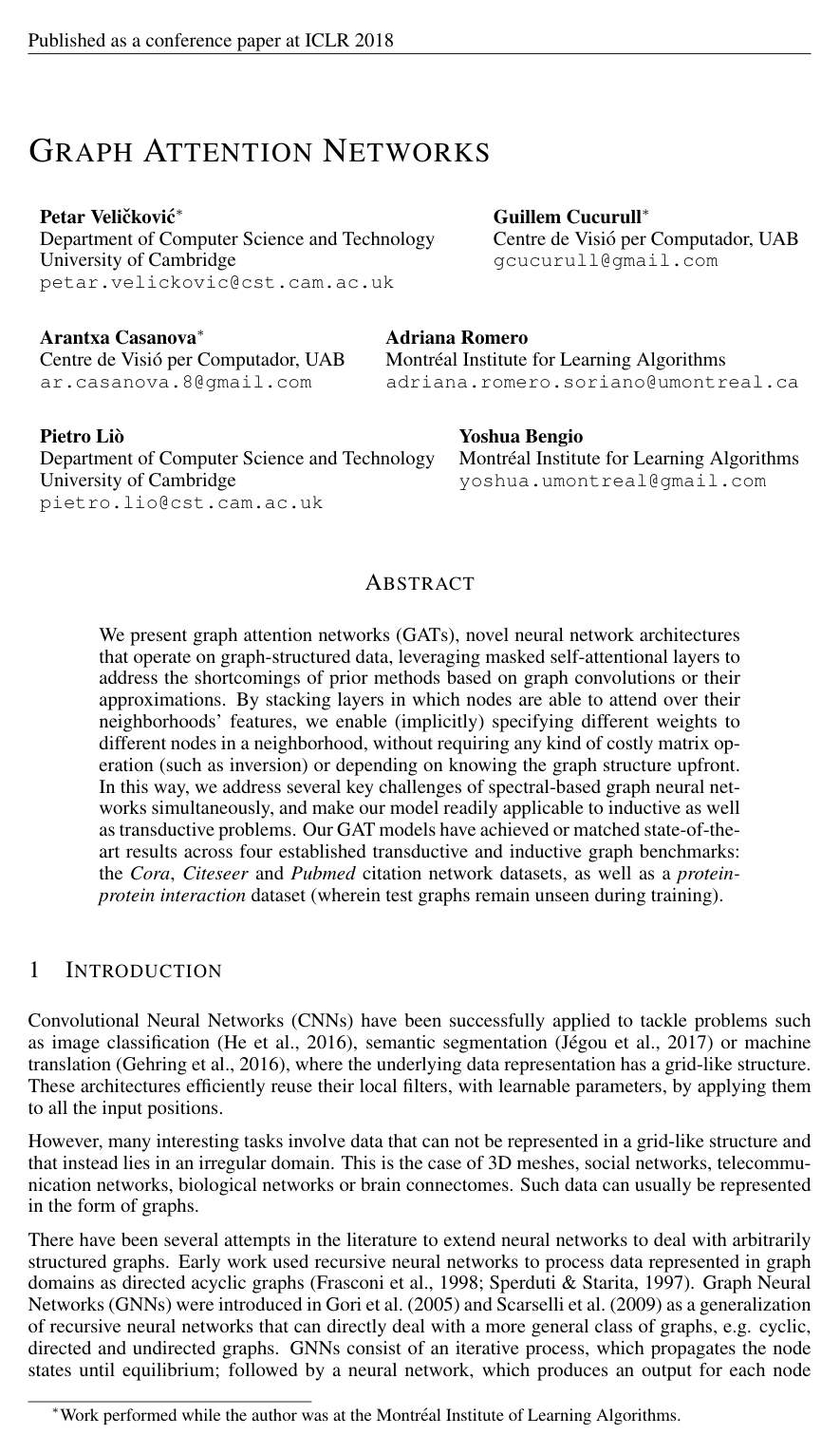
Graph Attention Networks
Petar Veličković, Guillem Cucurull, Arantxa Casanova, Adriana Romero, Pietro Liò, Yoshua Bengio
Why you should read this
Introduces Graph Attention Networks (GATs) which revolutionize graph-structured data processing by using self-attentional layers to dynamically weigh neighboring nodes, overcoming limitations of prior methods and achieving state-of-the-art results on both inductive and transductive problems.
We present graph attention networks (GATs), novel neural network architectures that operate on graph-structured data, leveraging masked self-attentional layers to address the shortcomings of prior methods based on graph convolutions or their approximations. By stacking layers in which nodes are able to attend over their neighborhoods' features, we enable (implicitly) specifying different weights to different nodes in a neighborhood, without requiring any kind of costly matrix operation (such as inversion) or depending on knowing the graph structure upfront. In this way, we address several key challenges of spectral-based graph neural networks simultaneously, and make our model readily applicable to inductive as well as transductive problems. Our GAT models have achieved or matched state-of-the-art results across four established transductive and inductive graph benchmarks: the Cora, Citeseer and Pubmed citation network datasets, as well as a protein-protein interaction dataset (wherein test graphs remain unseen during training).
Added
2026-02-12
License
Published with permission