
keyword
index structure
An index structure is a specialized data organization and access method designed to optimize the retrieval of records from a database or storage system without scanning the entire dataset. By organizing data attributes, keys, or feature coordinates into structured formats—such as hierarchical trees, spatial partitions, or hash-based directories—an index structure accelerates search operations for exact matches, range queries, and similarity or nearest-neighbor lookups. It acts as an auxiliary guide that maps search criteria directly to physical storage locations, significantly reducing input-output operations and computational overhead while balancing the trade-offs of additional storage consumption and maintenance costs during data insertions, updates, and deletions.
3 items
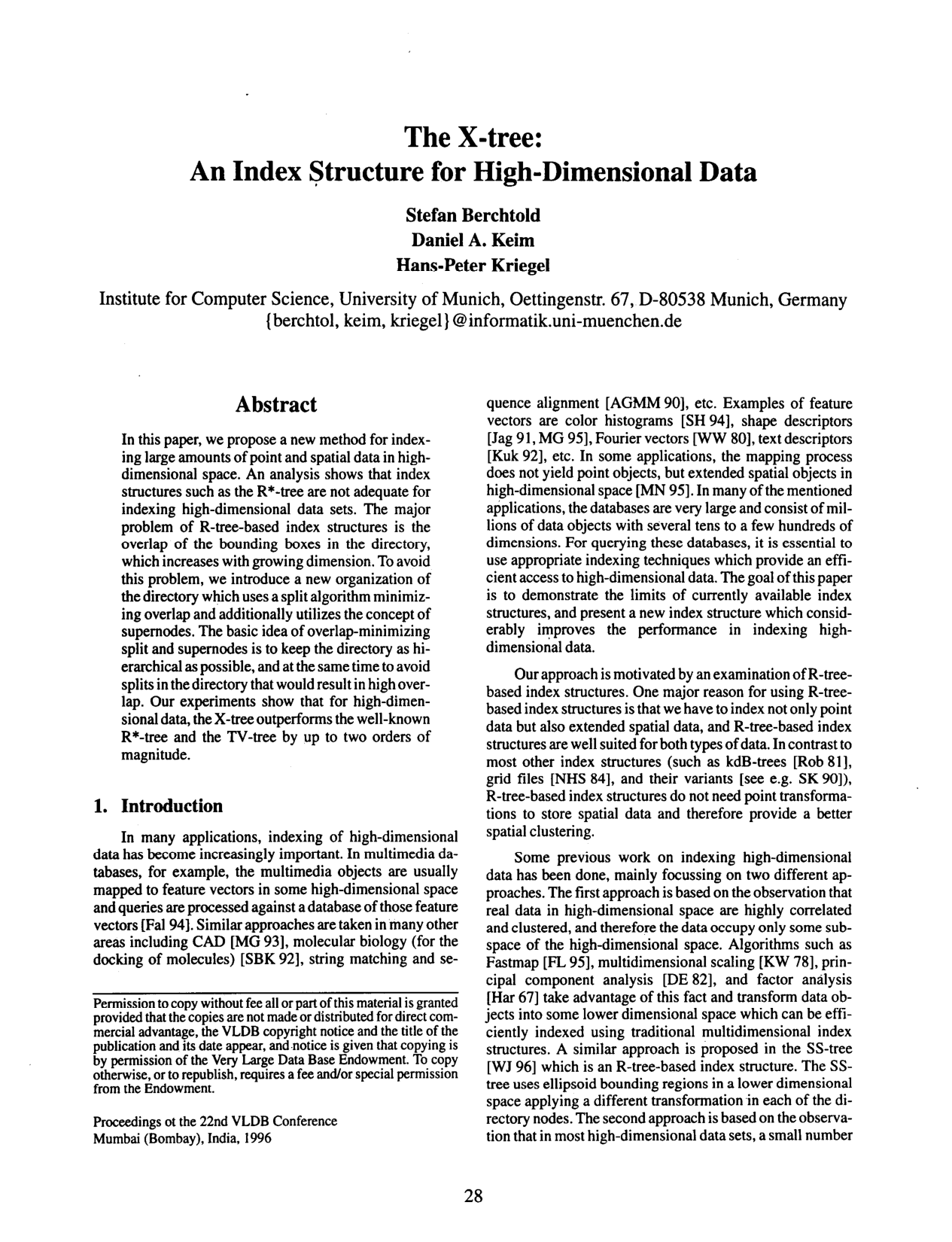
The X-tree : An Index Structure for High-Dimensional Data
S. Berchtold, D. Keim, H. Kriegel
Why you should read this
Introduces the X-tree, an efficient high-dimensional indexing structure that avoids bounding-box overlap by combining an overlap-minimizing split algorithm with variable-sized supernodes to outperform standard R*-trees and TV-trees by orders of magnitude.
In this paper, we propose a new method for indexing large amounts of point and spatial data in high-dimensional space. An analysis shows that index structures such as the R*-tree are not adequate for indexing high-dimensional data sets. The major problem of R-tree-based index structures is the overlap of the bounding boxes in the directory, which increases with growing dimension. To avoid this problem, we introduce a new organization of the directory which uses a split algorithm minimizing overlap and additionally utilizes the concept of supernodes. The basic idea of overlap-minimizing split and supernodes is to keep the directory as hierarchical as possible, and at the same time to avoid splits in the directory that would result in high overlap. Our experiments show that for high-dimensional data, the X-tree outperforms the well-known R*-tree and the TV-tree by up to two orders of magnitude.
Added
2026-09-24
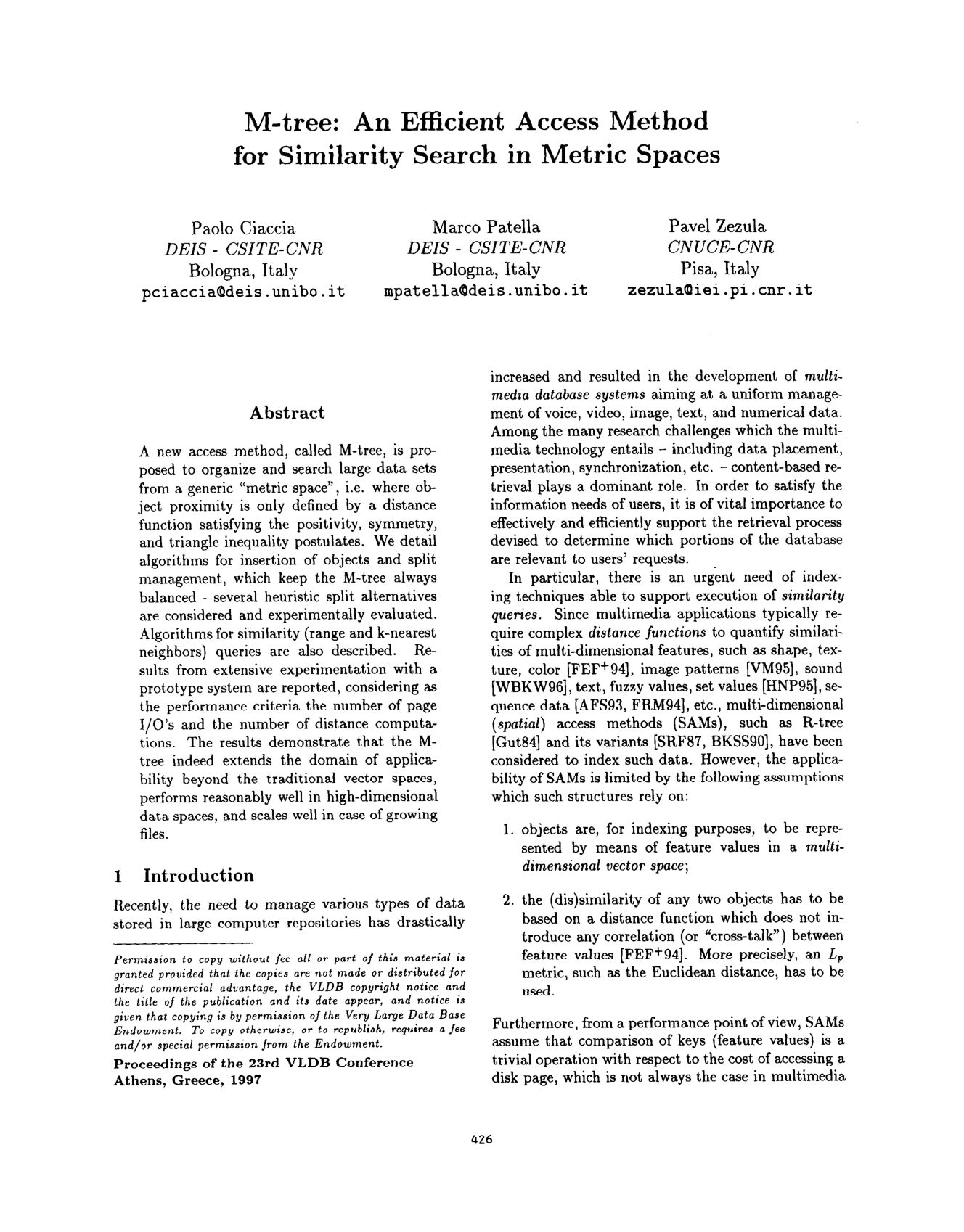
M-tree: An Efficient Access Method for Similarity Search in Metric Spaces
Paolo Ciaccia, Marco Patella, Pavel Zezula
Why you should read this
Presents the M-tree, a dynamic and balanced indexing structure designed for metric spaces that optimizes both disk I/O and distance computations during range and k-nearest neighbor similarity searches.
A new access method, called M-tree, is proposed to organize and search large data sets from a generic "metric space", i.e. where object proximity is only defined by a distance function satisfying the positivity, symmetry, and triangle inequality postulates. We detail algorithms for insertion of objects and split management, which keep the M-tree always balanced - several heuristic split alternatives are considered and experimentally evaluated. Algorithms for similarity (range and k-nearest neighbors) queries are also described. Results from extensive experimentation with a prototype system are reported, considering as the performance criteria the number of page I/O's and the number of distance computations. The results demonstrate that the M-tree indeed extends the domain of applicability beyond the traditional vector spaces, performs reasonably well in high-dimensional data spaces, and scales well in case of growing files.
Added
2026-09-18
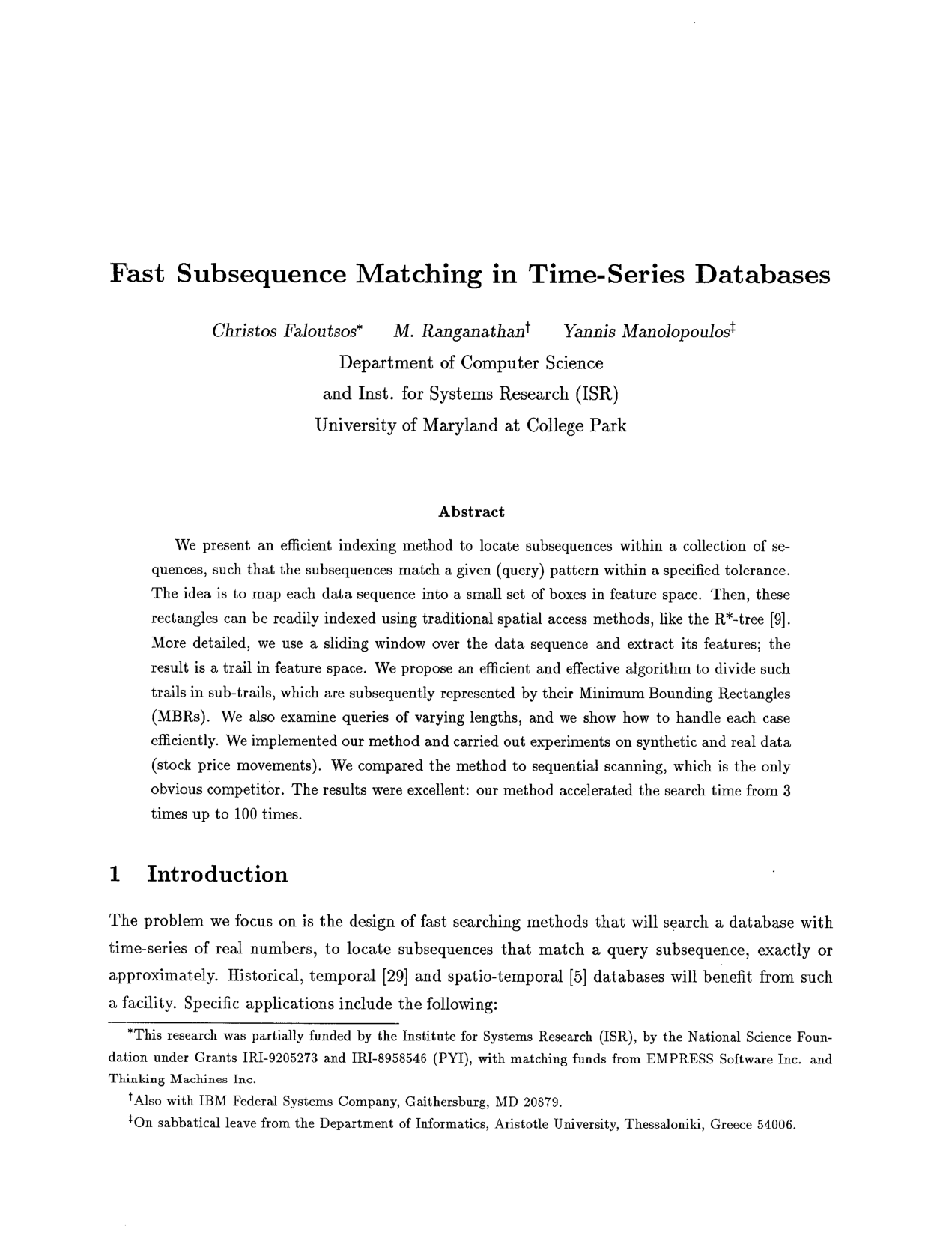
Fast subsequence matching in time-series databases
Christos Faloutsos, M. Ranganathan, Yannis Manolopoulos
We present an efficient indexing method to locate subsequences within a collection of sequences, such that the subsequences match a given (query) pattern within a specified tolerance. The idea is to map each data sequence into a small set of boxes in feature space. Then, these rectangles can be readily indexed using traditional spatial access methods, like the R*-tree [9]. More detailed, we use a sliding window over the data sequence and extract its features; the result is a trail in feature space. We propose an efficient and effective algorithm to divide such trails in sub-trails, which are subsequently represented by their Minimum Bounding Rectangles (MBRs). We also examine queries of varying lengths, and we show how to handle each case efficiently. We implemented our method and carried out experiments on synthetic and real data (stock price movements). We compared the method to sequential scanning, which is the only obvious competitor. The results were excellent: our method accelerated the search time from 3 times up to 100 times.
Added
2026-09-16