
keyword
in-context learning
In-context learning is a machine learning paradigm in which a pretrained model learns to perform a target task at inference time by conditioning on a prompt that contains task demonstrations or input-output examples alongside a query, without requiring any updates to the model weights. Unlike conventional training or fine-tuning approaches that modify network parameters via gradient descent, in-context learning executes entirely within a forward pass over the provided input context window. This capability, prominent in transformer-based sequence models and large language models, enables the system to recognize patterns, infer mapping rules, and generalize to new queries dynamically across diverse domains such as classification, text generation, and algorithmic reasoning.
45 items
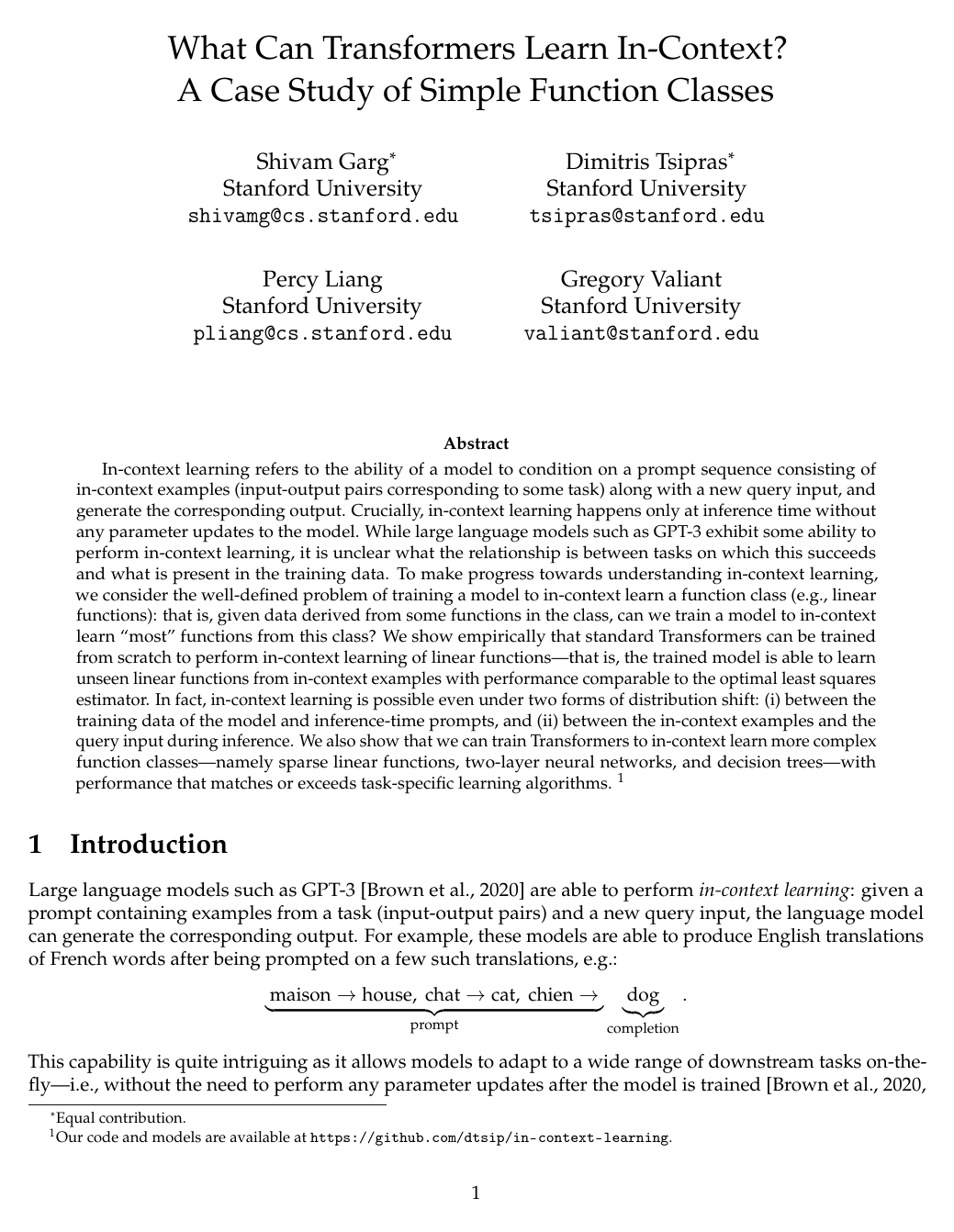
What Can Transformers Learn In-Context? A Case Study of Simple Function Classes
Shivam Garg, Dimitris Tsipras, Percy Liang, Gregory Valiant
Why you should read this
Demonstrates that standard Transformers can be trained from scratch to in-context learn fundamental function classes such as linear models, two-layer neural networks, and decision trees, matching or exceeding the performance of classical task-specific learning algorithms even under distribution shifts.
In-context learning refers to the ability of a model to condition on a prompt sequence consisting of in-context examples (input-output pairs corresponding to some task) along with a new query input, and generate the corresponding output. Crucially, in-context learning happens only at inference time without any parameter updates to the model. While large language models such as GPT-3 exhibit some ability to perform in-context learning, it is unclear what the relationship is between tasks on which this succeeds and what is present in the training data. To make progress towards understanding in-context learning, we consider the well-defined problem of training a model to in-context learn a function class (e.g., linear functions): that is, given data derived from some functions in the class, can we train a model to in-context learn "most" functions from this class? We show empirically that standard Transformers can be trained from scratch to perform in-context learning of linear functions -- that is, the trained model is able to learn unseen linear functions from in-context examples with performance comparable to the optimal least squares estimator. In fact, in-context learning is possible even under two forms of distribution shift: (i) between the training data of the model and inference-time prompts, and (ii) between the in-context examples and the query input during inference. We also show that we can train Transformers to in-context learn more complex function classes -- namely sparse linear functions, two-layer neural networks, and decision trees -- with performance that matches or exceeds task-specific learning algorithms. Our code and models are available at this https URL .
Added
2026-10-05
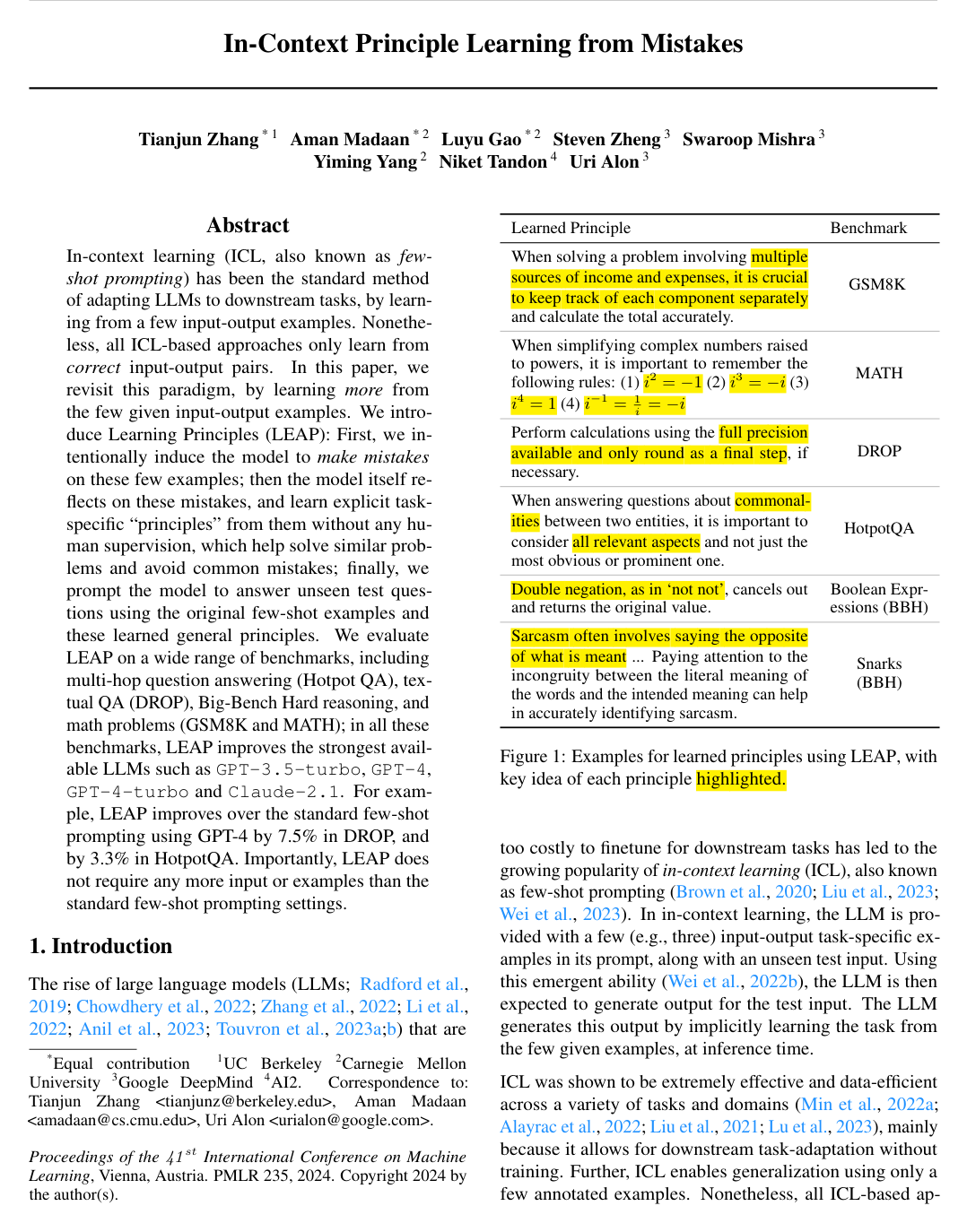
In-Context Principle Learning from Mistakes
Tianjun Zhang, Aman Madaan, Luyu Gao, Steven Zheng, Swaroop Mishra, Yiming Yang, Niket Tandon, Uri Alon
Why you should read this
Proposes LEAP, an unsupervised prompting framework that boosts large language model reasoning across diverse benchmarks by intentionally generating mistakes on few-shot examples, extracting explicit principles from those errors, and conditioning downstream inference on the learned guidance without requiring additional training data.
In-context learning (ICL, also known as few-shot prompting) has been the standard method of adapting LLMs to downstream tasks, by learning from a few input-output examples. Nonetheless, all ICL-based approaches only learn from correct input-output pairs. In this paper, we revisit this paradigm, by learning more from the few given input-output examples. We introduce Learning Principles (LEAP): First, we intentionally induce the model to make mistakes on these few examples; then the model itself reflects on these mistakes, and learn explicit task-specific “principles” from them without any human supervision, which help solve similar problems and avoid common mistakes; finally, we prompt the model to answer unseen test questions using the original few-shot examples and these learned general principles. We evaluate LEAP on a wide range of benchmarks, including multi-hop question answering (Hotpot QA), textual QA (DROP), Big-Bench Hard reasoning, and math problems (GSM8K and MATH); in all these benchmarks, LEAP improves the strongest available LLMs such as GPT-3.5-turbo, GPT-4, GPT-4-turbo and Claude-2.1. For example, LEAP improves over the standard few-shot prompting using GPT4 by 7.5% in DROP, and by 3.3% in HotpotQA. Importantly, LEAP does not require any more input or examples than the standard few-shot prompting settings.
Added
2026-10-05
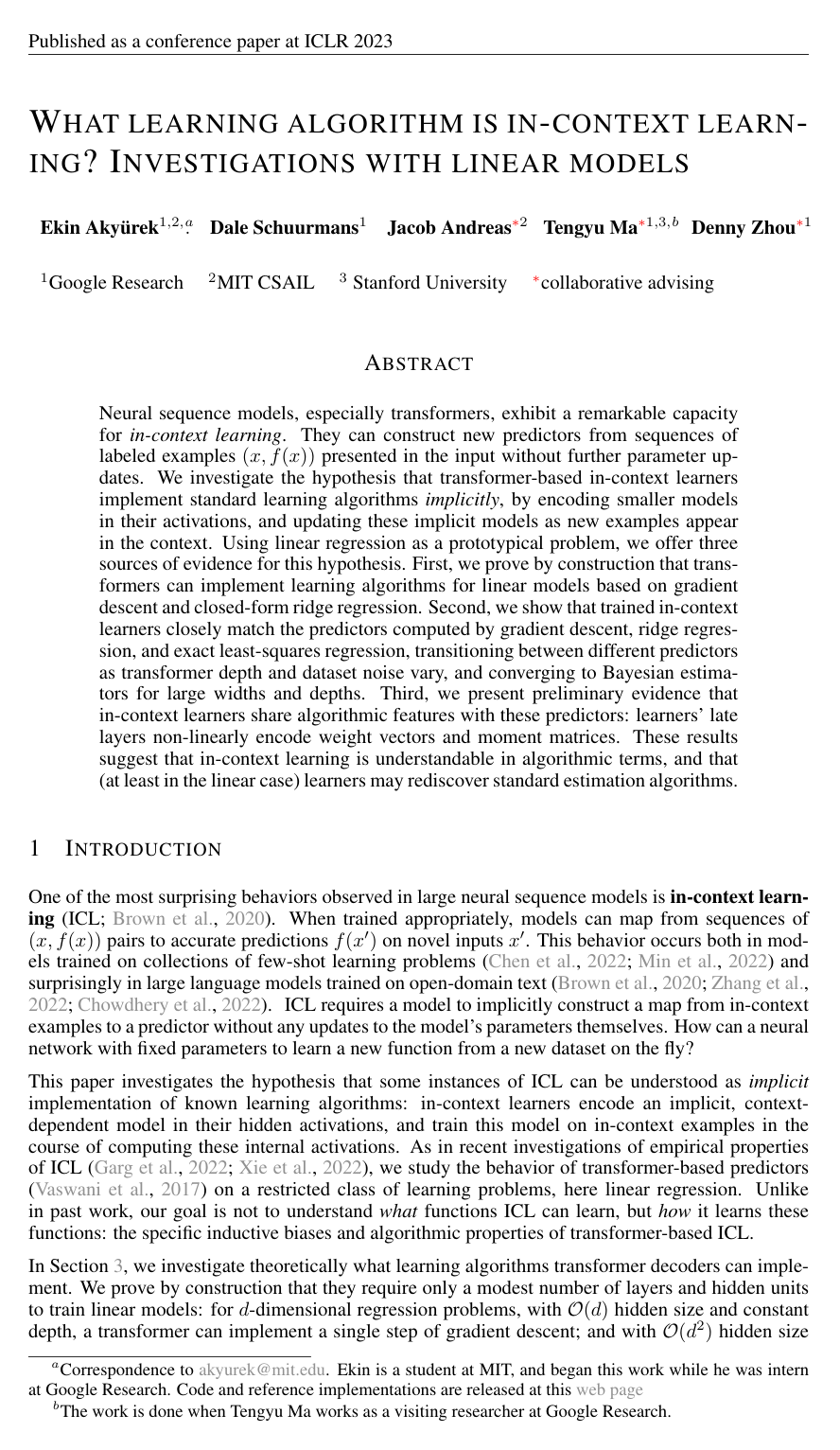
What learning algorithm is in-context learning? Investigations with linear models
Ekin Akyürek, Dale Schuurmans, Jacob Andreas, Tengyu Ma, Denny Zhou
Why you should read this
Demonstrates through constructive proofs and empirical analysis that transformers perform in-context learning by implicitly executing standard algorithms, such as gradient descent and ridge regression, directly within their internal activations.
Neural sequence models, especially transformers, exhibit a remarkable capacity for in-context learning. They can construct new predictors from sequences of labeled examples presented in the input without further parameter updates. We investigate the hypothesis that transformer-based in-context learners implement standard learning algorithms implicitly, by encoding smaller models in their activations, and updating these implicit models as new examples appear in the context. Using linear regression as a prototypical problem, we offer three sources of evidence for this hypothesis. First, we prove by construction that transformers can implement learning algorithms for linear models based on gradient descent and closed-form ridge regression. Second, we show that trained in-context learners closely match the predictors computed by gradient descent, ridge regression, and exact least-squares regression, transitioning between different predictors as transformer depth and dataset noise vary, and converging to Bayesian estimators for large widths and depths. Third, we present preliminary evidence that in-context learners share algorithmic features with these predictors: learners' late layers non-linearly encode weight vectors and moment matrices. These results suggest that in-context learning is understandable in algorithmic terms, and that (at least in the linear case) learners may rediscover standard estimation algorithms. Code and reference implementations are released at this https URL.
Added
2026-10-05
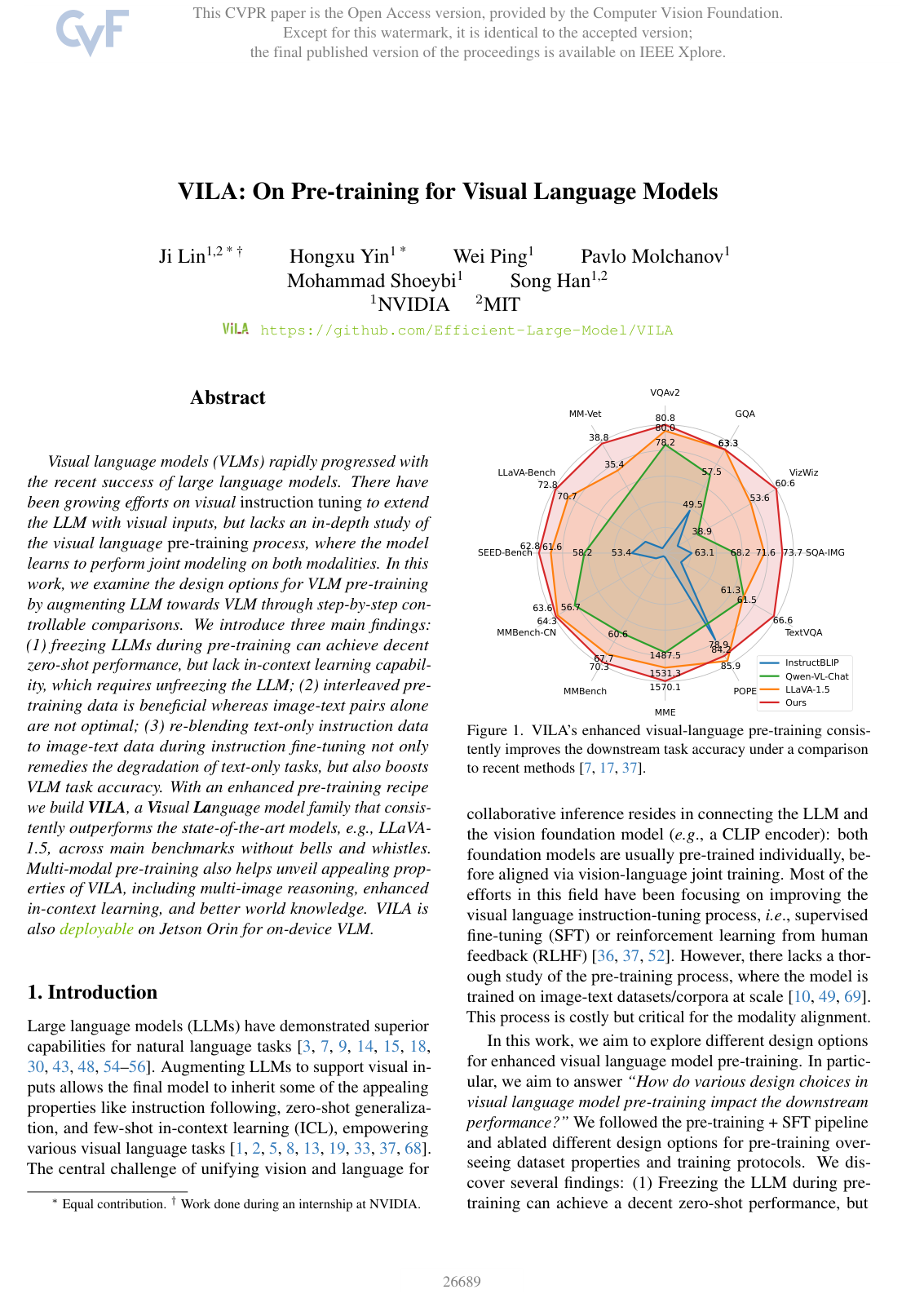
VILA: On Pre-training for Visual Language Models
Ji Lin, Hongxu Yin, Wei Ping, Pavlo Molchanov, Mohammad Shoeybi, Song Han
Why you should read this
Presents an effective pre-training recipe for vision-language models that unfreezes the base language model on interleaved multi-modal data, producing models that outperform LLaVA-1.5 in multi-image reasoning and in-context learning.
Visual language models (VLMs) rapidly progressed with the recent success of large language models. There have been growing efforts on visual instruction tuning to extend the LLM with visual inputs, but lacks an in-depth study of the visual language pre-training process, where the model learns to perform joint modeling on both modalities. In this work, we examine the design options for VLM pre-training by augmenting LLM towards VLM through step-by-step controllable comparisons. We introduce three main findings: (1) freezing LLMs during pre-training can achieve decent zero-shot performance, but lack in-context learning capability, which requires unfreezing the LLM; (2) interleaved pre-training data is beneficial whereas image-text pairs alone are not optimal; (3) re-blending text-only instruction data to image-text data during instruction fine-tuning not only remedies the degradation of text-only tasks, but also boosts VLM task accuracy. With an enhanced pre-training recipe we build VILA, a Visual Language model family that consistently outperforms the state-of-the-art models, e.g., LLaVA-1.5, across main benchmarks without bells and whistles. Multi-modal pre-training also helps unveil appealing properties of VILA, including multi-image reasoning, enhanced in-context learning, and better world knowledge. VILA is also deployable on Jetson Orin for on-device VLM.
Added
2026-10-05
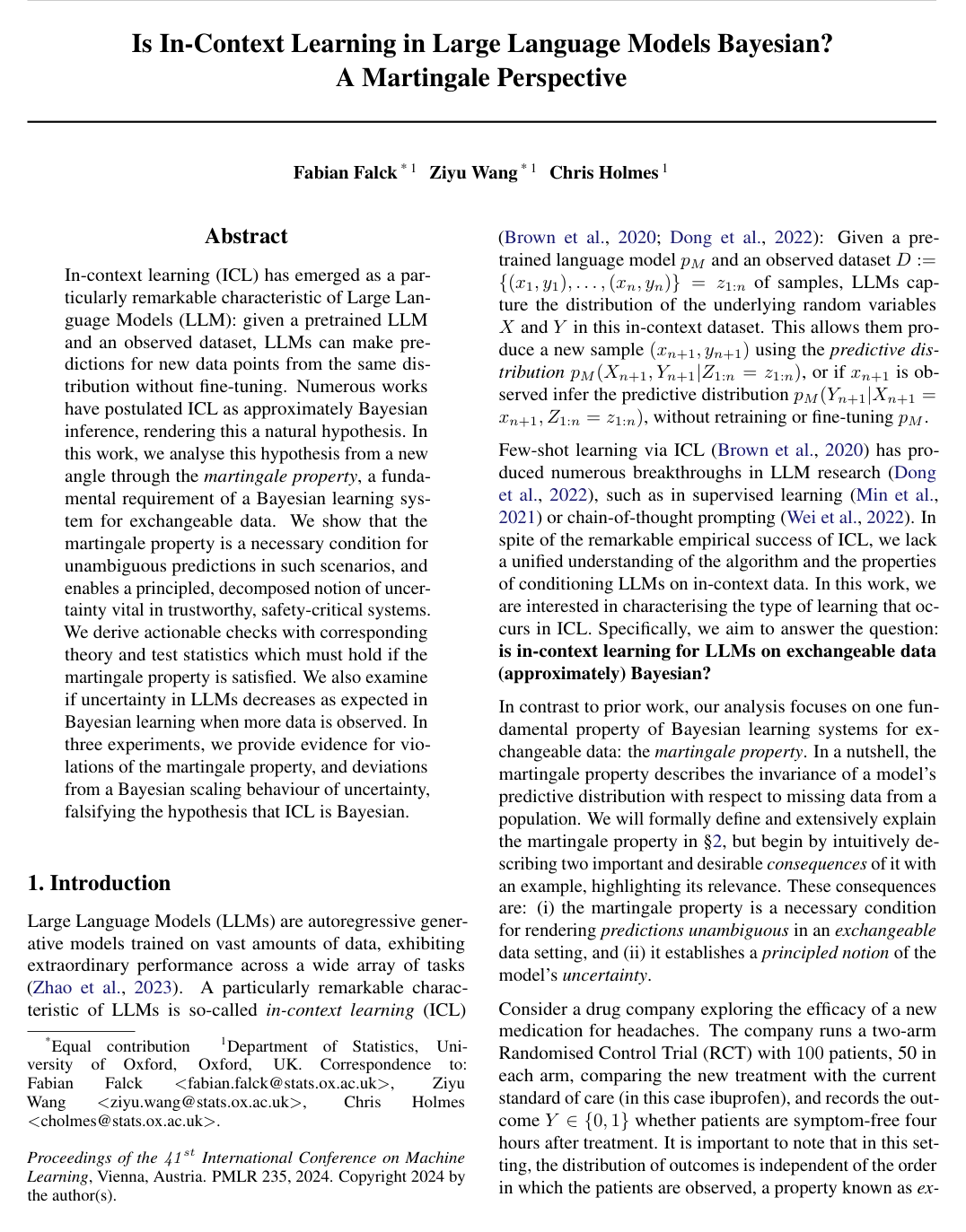
Is In-Context Learning in Large Language Models Bayesian? A Martingale Perspective
Fabian Falck, Ziyu Wang, Christopher C. Holmes
Why you should read this
Falsifies the widely held belief that in-context learning is Bayesian by deriving martingale-based diagnostic tests and showing that large language models violate the fundamental predictive invariance and uncertainty scaling expected of exchangeable Bayesian systems.
In-context learning (ICL) has emerged as a particularly remarkable characteristic of Large Language Models (LLM): given a pretrained LLM and an observed dataset, LLMs can make predictions for new data points from the same distribution without fine-tuning. Numerous works have postulated ICL as approximately Bayesian inference, rendering this a natural hypothesis. In this work, we analyse this hypothesis from a new angle through the martingale property, a fundamental requirement of a Bayesian learning system for exchangeable data. We show that the martingale property is a necessary condition for unambiguous predictions in such scenarios, and enables a principled, decomposed notion of uncertainty vital in trustworthy, safety-critical systems. We derive actionable checks with corresponding theory and test statistics which must hold if the martingale property is satisfied. We also examine if uncertainty in LLMs decreases as expected in Bayesian learning when more data is observed. In three experiments, we provide evidence for violations of the martingale property, and deviations from a Bayesian scaling behaviour of uncertainty, falsifying the hypothesis that ICL is Bayesian.
Added
2026-10-05
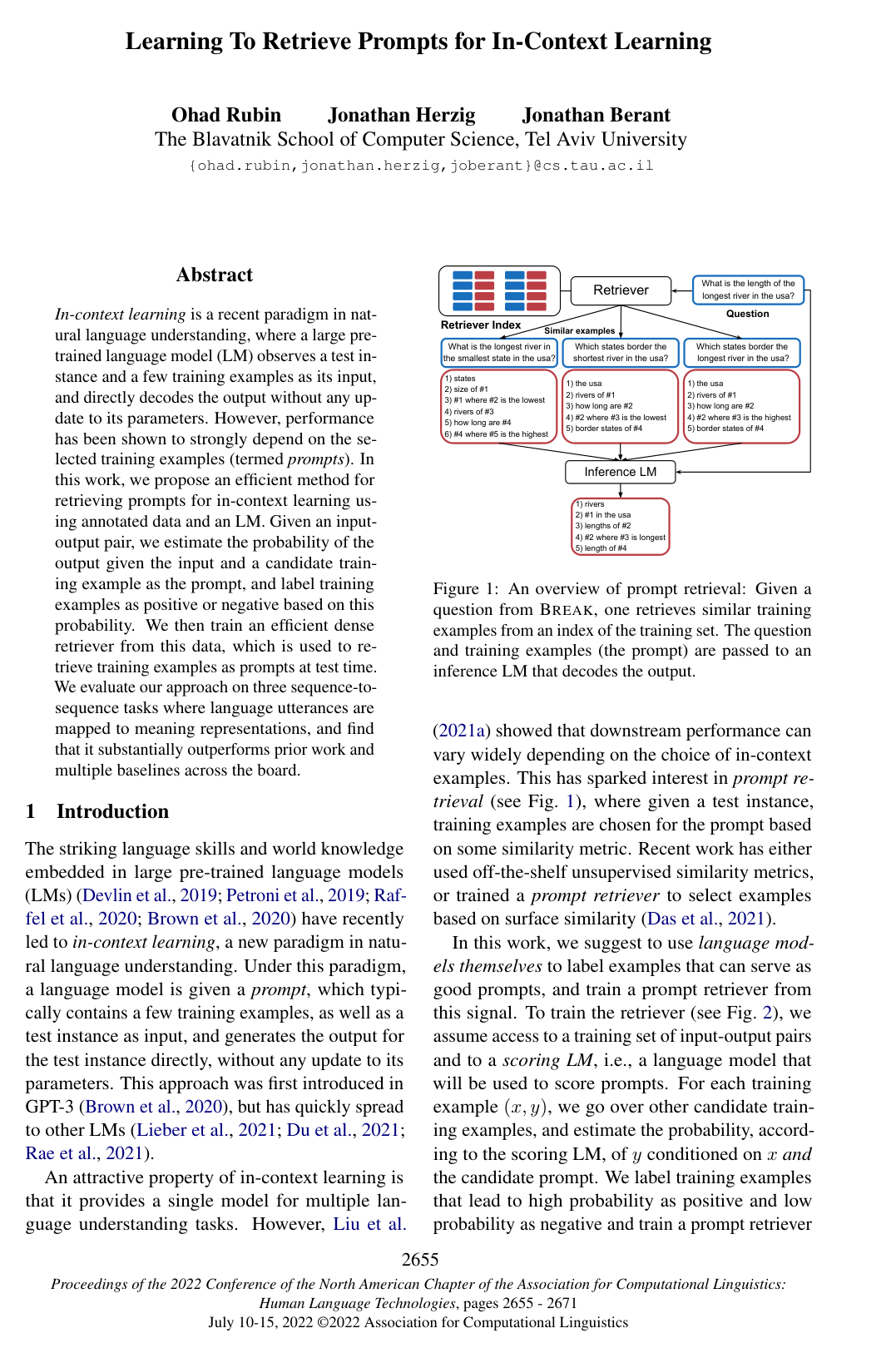
Learning To Retrieve Prompts for In-Context Learning
Ohad Rubin, Jonathan Herzig, Jonathan Berant
Why you should read this
Proposes an efficient method for training dense retrievers by using language models to score and label candidate in-context examples, significantly boosting downstream few-shot semantic parsing performance without updating model parameters.
In-context learning is a recent paradigm in natural language understanding, where a large pre-trained language model (LM) observes a test instance and a few training examples as its input, and directly decodes the output without any update to its parameters. However, performance has been shown to strongly depend on the selected training examples (termed prompts). In this work, we propose an efficient method for retrieving prompts for in-context learning using annotated data and an LM. Given an input-output pair, we estimate the probability of the output given the input and a candidate training example as the prompt, and label training examples as positive or negative based on this probability. We then train an efficient dense retriever from this data, which is used to retrieve training examples as prompts at test time. We evaluate our approach on three sequence-to-sequence tasks where language utterances are mapped to meaning representations, and find that it substantially outperforms prior work and multiple baselines across the board.
Added
2026-10-05
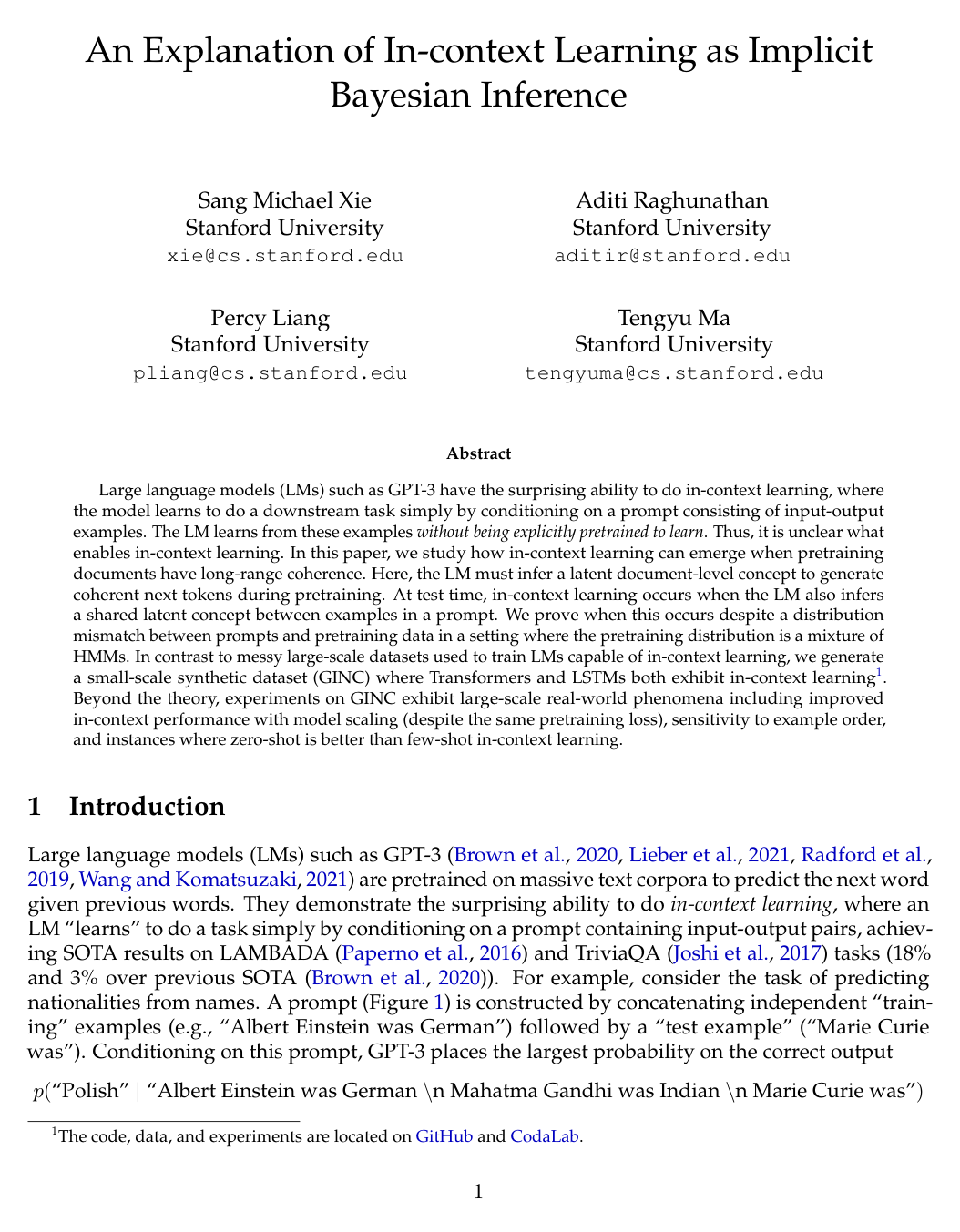
An Explanation of In-context Learning as Implicit Bayesian Inference
Sang Michael Xie, Aditi Raghunathan, Percy Liang, Tengyu Ma
Why you should read this
Explains in-context learning in language models as implicit Bayesian inference over latent concepts, proving how coherent pretraining distributions enable prompt-based task adaptation and reproducing key empirical phenomena on a synthetic dataset.
Large language models (LMs) such as GPT-3 have the surprising ability to do in-context learning, where the model learns to do a downstream task simply by conditioning on a prompt consisting of input-output examples. The LM learns from these examples without being explicitly pretrained to learn. Thus, it is unclear what enables in-context learning. In this paper, we study how in-context learning can emerge when pretraining documents have long-range coherence. Here, the LM must infer a latent document-level concept to generate coherent next tokens during pretraining. At test time, in-context learning occurs when the LM also infers a shared latent concept between examples in a prompt. We prove when this occurs despite a distribution mismatch between prompts and pretraining data in a setting where the pretraining distribution is a mixture of HMMs. In contrast to messy large-scale datasets used to train LMs capable of in-context learning, we generate a small-scale synthetic dataset (GINC) where Transformers and LSTMs both exhibit in-context learning. Beyond the theory, experiments on GINC exhibit large-scale real-world phenomena including improved in-context performance with model scaling (despite the same pretraining loss), sensitivity to example order, and instances where zero-shot is better than few-shot in-context learning.
Added
2026-10-04
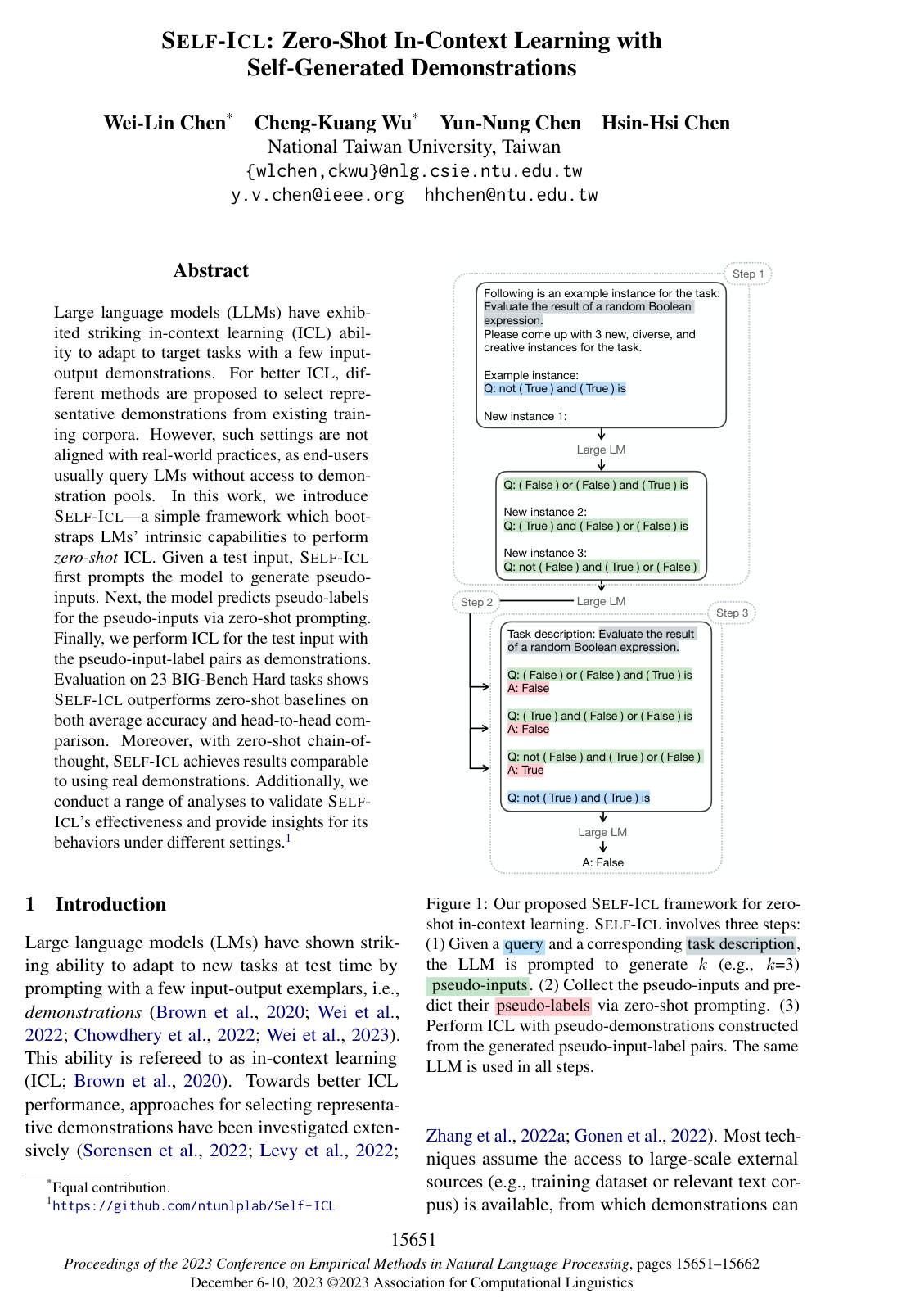
Self-ICL: Zero-Shot In-Context Learning with Self-Generated Demonstrations
Wei-Lin Chen, Cheng-Kuang Wu, Yun-Nung Chen, Hsin-Hsi Chen
Why you should read this
Proposes a framework that enables large language models to generate their own input-output demonstrations on the fly, matching the performance of real few-shot examples across challenging reasoning benchmarks without requiring external datasets.
Large language models (LLMs) have exhibited striking in-context learning (ICL) ability to adapt to target tasks with a few input-output demonstrations. For better ICL, different methods are proposed to select representative demonstrations from existing training corpora. However, such settings are not aligned with real-world practices, as end-users usually query LMs without access to demonstration pools. In this work, we introduce Self-ICL—a simple framework which bootstraps LMs’ intrinsic capabilities to perform zero-shot ICL. Given a test input, Self-ICL first prompts the model to generate pseudo-inputs. Next, the model predicts pseudo-labels for the pseudo-inputs via zero-shot prompting. Finally, we perform ICL for the test input with the pseudo-input-label pairs as demonstrations. Evaluation on 23 BIG-Bench Hard tasks shows Self-ICL outperforms zero-shot baselines on both average accuracy and head-to-head comparison. Moreover, with zero-shot chain-of-thought, Self-ICL achieves results comparable to using real demonstrations. Additionally, we conduct a range of analyses to validate Self-ICL’s effectiveness and provide insights for its behaviors under different settings.
Added
2026-10-04
Dual Operating Modes of In-Context Learning
Ziqian Lin, Kangwook Lee
Why you should read this
Establishes a generalized probabilistic framework to mathematically explain how large language models transition between retrieving pretrained skills and learning new ones, providing theoretical foundations for puzzling empirical behaviors like the initial risk increase and the bounded efficacy of biased demonstrations.
In-context learning (ICL) exhibits dual operating modes: task learning, i.e. acquiring a new skill from in-context samples, and task retrieval, i.e., locating and activating a relevant pretrained skill. Recent theoretical work proposes various mathematical models to analyze ICL, but they cannot fully explain the duality. In this work, we analyze a generalized probabilistic model for pretraining data, obtaining a quantitative understanding of the two operating modes of ICL. Leveraging our analysis, we provide the first explanation of an unexplained phenomenon observed with real-world large language models (LLMs). Under some settings, the ICL risk initially increases and then decreases with more in-context examples. Our analysis offers a plausible explanation for this “early ascent” phenomenon: a limited number of in-context samples may lead to the retrieval of an incorrect skill, thereby increasing the risk, which will eventually diminish as task learning takes effect with more in-context samples. We also analyze ICL with biased labels, e.g., zero-shot ICL, where in-context examples are assigned random labels, and predict the bounded efficacy of such approaches. We corroborate our analysis and predictions with extensive experiments with Transformers and LLMs. The code is available at: https://github.com/UW-Madison-Lee-Lab/Dual_Operating_Modes_of_ICL.
Added
2026-10-03
Uncertainty Quantification for In-Context Learning of Large Language Models
Chen Ling, Xujiang Zhao, Xuchao Zhang, Wei Cheng, Yanchi Liu, Yiyou Sun, Mika Oishi, Takao Osaki, Katsushi Matsuda, Jie Ji, Guangji Bai, Liang Zhao, Haifeng Chen
Why you should read this
Presents a Bayesian framework that decomposes predictive uncertainty in large language model in-context learning into prompt-induced aleatoric and model-induced epistemic components, enabling unsupervised diagnostic evaluation of output reliability across both white-box and black-box settings.
In-context learning has emerged as a ground-breaking ability of Large Language Models (LLMs) and revolutionized various fields by providing a few task-relevant demonstrations in the prompt. However, trustworthy issues with LLM’s response, such as hallucination, have also been actively discussed. Existing works have been devoted to quantifying the uncertainty in LLM’s response, but they often overlook the complex nature of LLMs and the uniqueness of in-context learning. In this work, we delve into the predictive uncertainty of LLMs associated with in-context learning, highlighting that such uncertainties may stem from both the provided demonstrations (aleatoric uncertainty) and ambiguities tied to the model’s configurations (epistemic uncertainty). We propose a novel formulation and corresponding estimation method to quantify both types of uncertainties. The proposed method offers an unsupervised way to understand the prediction of in-context learning in a plug-and-play fashion. Extensive experiments are conducted to demonstrate the effectiveness of the decomposition. The code and data are available at: https://github.com/lingchen0331/UQ_ICL.
Added
2026-10-03
GPS: Genetic Prompt Search for Efficient Few-Shot Learning
Hanwei Xu, Yujun Chen, Yulun Du, Nan Shao, Yanggang Wang, Haiyu Li, Zhilin Yang
Why you should read this
Proposes a gradient-free genetic algorithm that automatically discovers high-performing, fluent natural language prompts using only a tiny validation set, outperforming both manual prompt engineering and parameter-efficient tuning methods.
Prompt-based techniques have demonstrated great potential for improving the few-shot generalization of pretrained language models. However, their performance heavily relies on the manual design of prompts and thus requires a lot of human efforts. In this paper, we introduce Genetic Prompt Search (GPS) to improve few-shot learning with prompts, which utilizes a genetic algorithm to automatically search for high-performing prompts. GPS is gradient-free and requires no update of model parameters but only a small validation set. Experiments on diverse datasets proved the effectiveness of GPS, which outperforms manual prompts by a large margin of 2.6 points. Our method is also better than other parameter-efficient tuning methods such as prompt tuning.
Added
2026-10-03
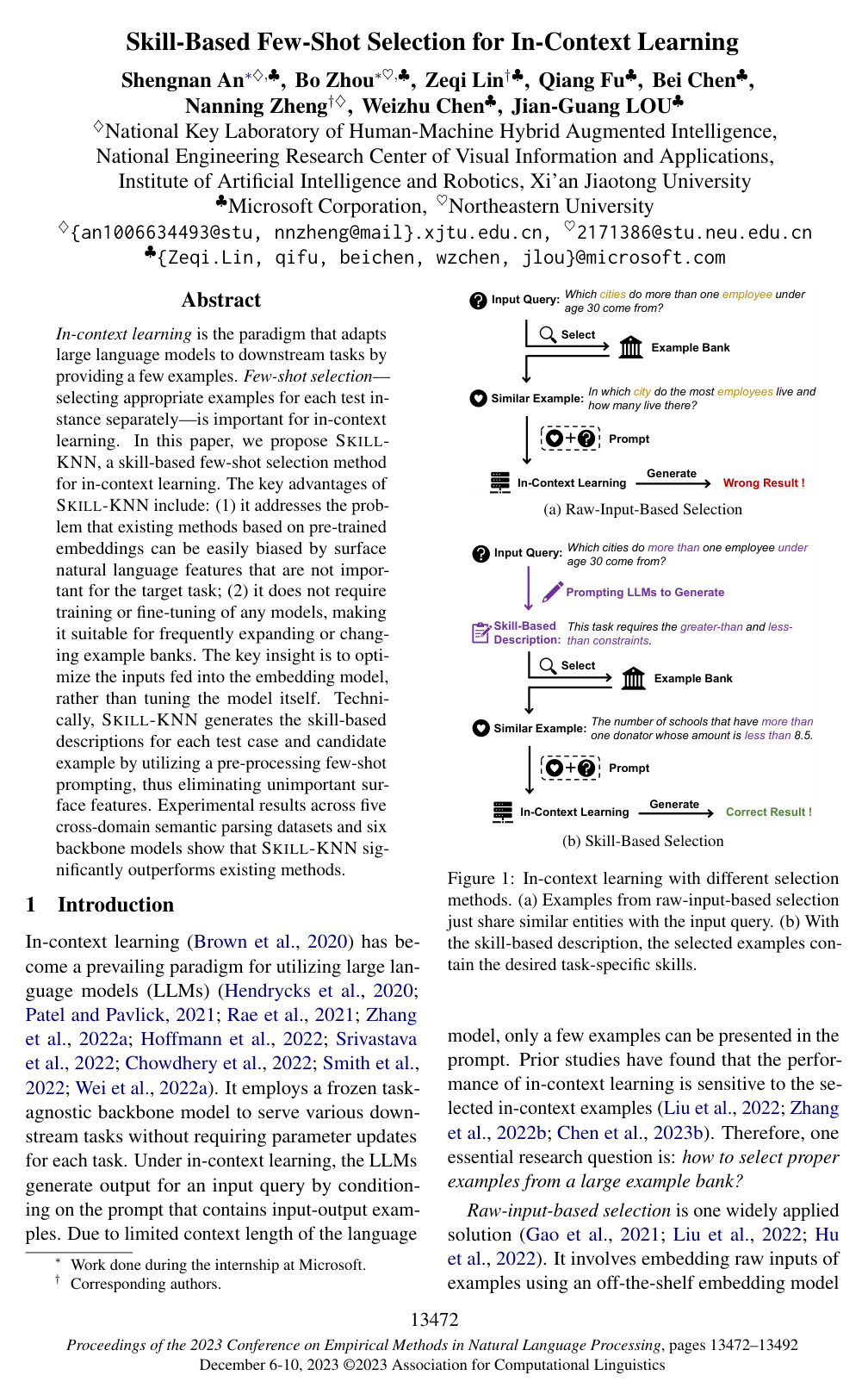
Skill-Based Few-Shot Selection for In-Context Learning
Shengnan An, Bo Zhou, Zeqi Lin, Qiang Fu, Bei Chen, Nanning Zheng, Weizhu Chen, Jian-Guang Lou
Why you should read this
Proposes SKILL-KNN, a training-free few-shot selection method that prompts large language models to convert inputs into skill-based descriptions before retrieval, preventing embedding models from being misled by irrelevant surface features and improving semantic parsing performance.
In-context learning is the paradigm that adapts large language models to downstream tasks by providing a few examples. Few-shot selection—selecting appropriate examples for each test instance separately—is important for in-context learning. In this paper, we propose Skill-KNN, a skill-based few-shot selection method for in-context learning. The key advantages of Skill-KNN include: (1) it addresses the problem that existing methods based on pre-trained embeddings can be easily biased by surface natural language features that are not important for the target task; (2) it does not require training or fine-tuning of any models, making it suitable for frequently expanding or changing example banks. The key insight is to optimize the inputs fed into the embedding model, rather than tuning the model itself. Technically, Skill-KNN generates the skill-based descriptions for each test case and candidate example by utilizing a pre-processing few-shot prompting, thus eliminating unimportant surface features. Experimental results across five cross-domain semantic parsing datasets and six backbone models show that Skill-KNN significantly outperforms existing methods.
Added
2026-10-03
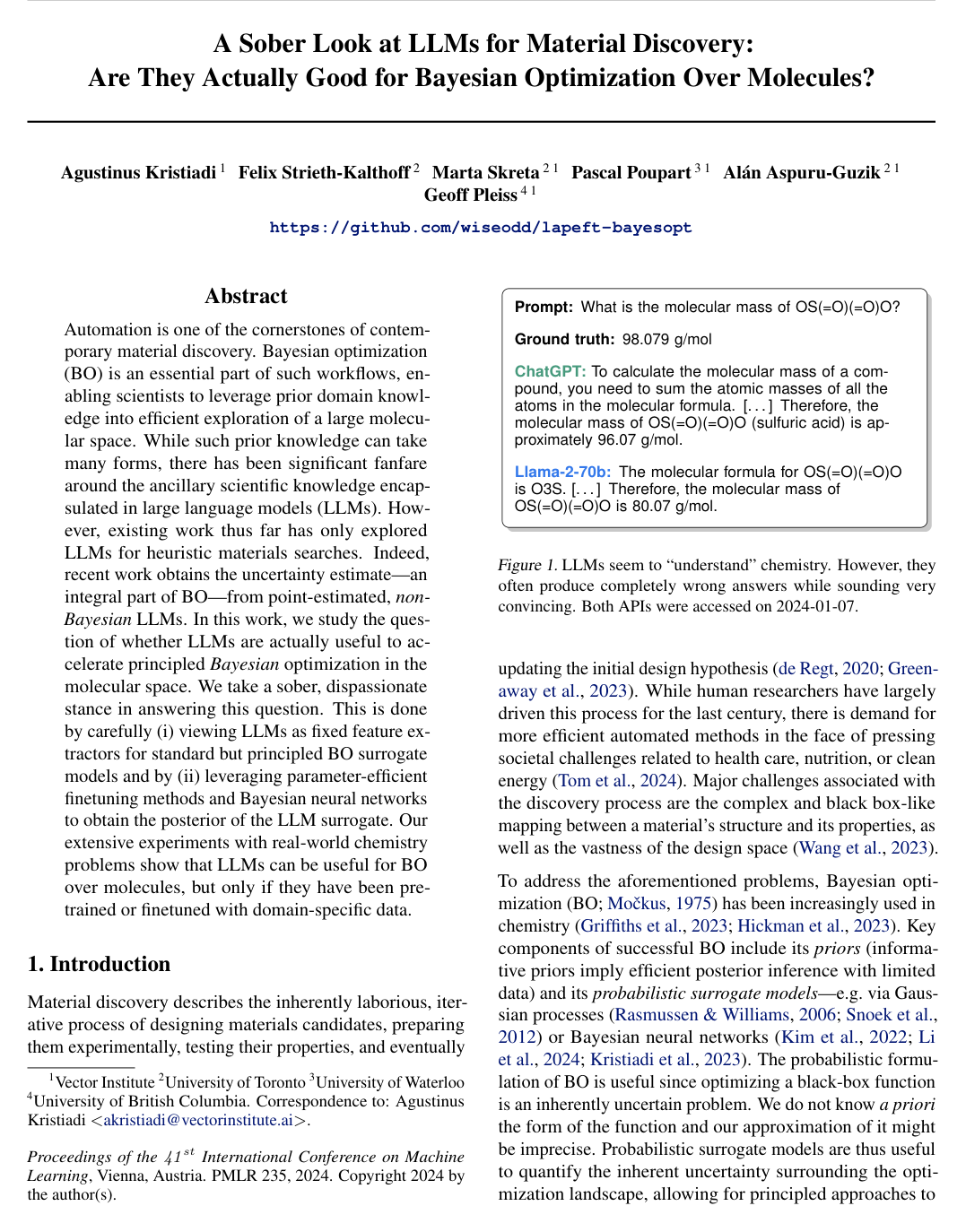
A Sober Look at LLMs for Material Discovery: Are They Actually Good for Bayesian Optimization Over Molecules?
Agustinus Kristiadi, Felix Strieth-Kalthoff, Marta Skreta, Pascal Poupart, Alán Aspuru-Guzik, Geoff Pleiss
Why you should read this
Demonstrates that large language models improve principled Bayesian optimization for molecular material discovery only when pretrained or finetuned on domain-specific chemistry data rather than applied out-of-the-box.
Automation is one of the cornerstones of contemporary material discovery. Bayesian optimization (BO) is an essential part of such workflows, enabling scientists to leverage prior domain knowledge into efficient exploration of a large molecular space. While such prior knowledge can take many forms, there has been significant fanfare around the ancillary scientific knowledge encapsulated in large language models (LLMs). However, existing work thus far has only explored LLMs for heuristic materials searches. Indeed, recent work obtains the uncertainty estimate—an integral part of BO—from point-estimated, non-Bayesian LLMs. In this work, we study the question of whether LLMs are actually useful to accelerate principled Bayesian optimization in the molecular space. We take a sober, dispassionate stance in answering this question. This is done by carefully (i) viewing LLMs as fixed feature extractors for standard but principled BO surrogate models and by (ii) leveraging parameter-efficient finetuning methods and Bayesian neural networks to obtain the posterior of the LLM surrogate. Our extensive experiments with real-world chemistry problems show that LLMs can be useful for BO over molecules, but only if they have been pretrained or finetuned with domain-specific data.
Added
2026-10-03
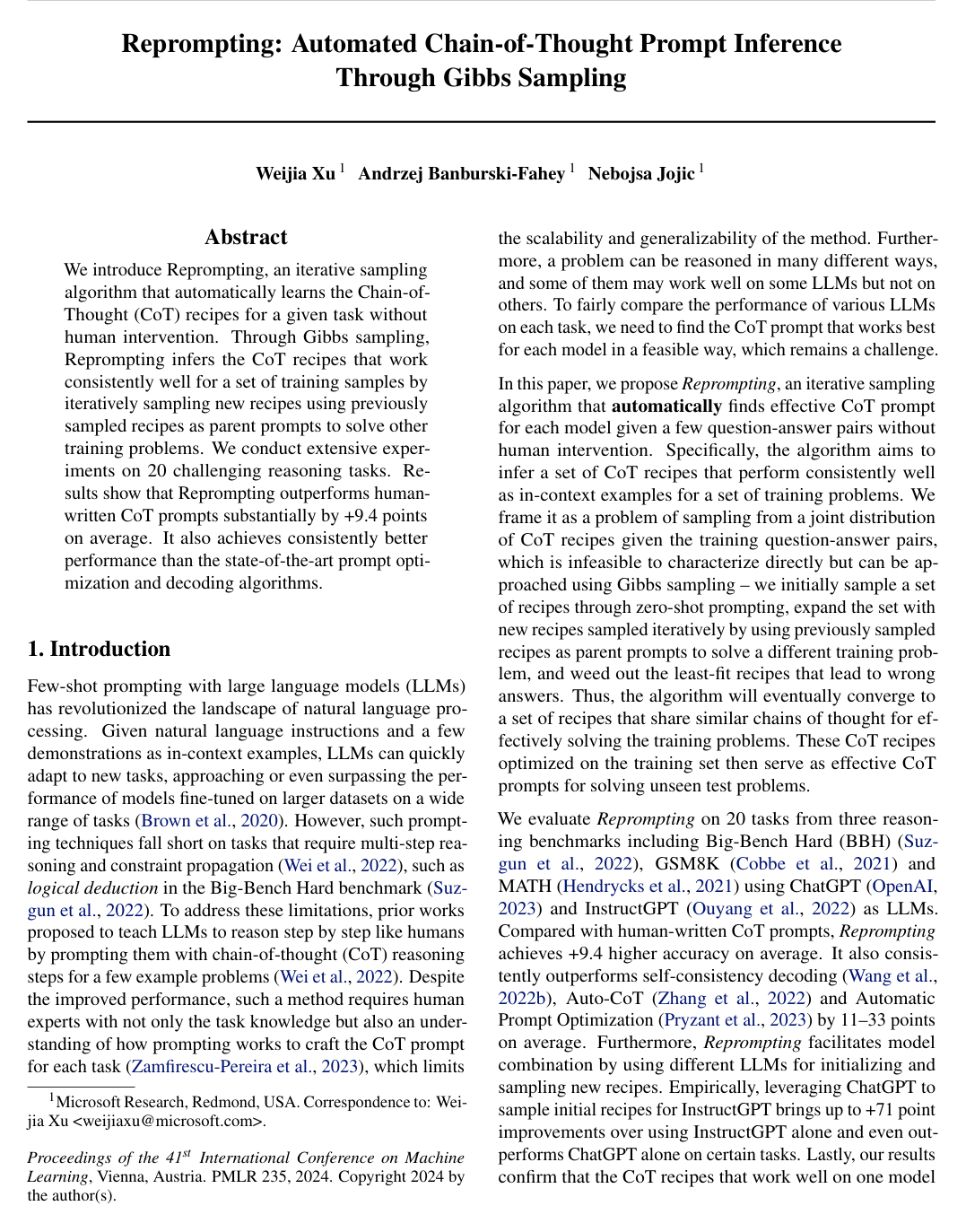
Reprompting: Automated Chain-of-Thought Prompt Inference Through Gibbs Sampling
Weijia Xu, Andrzej Banburski, Nebojsa Jojic
Why you should read this
Proposes an automated method that uses Gibbs sampling to infer effective chain-of-thought prompts without human intervention, outperforming human-written prompts and existing prompt optimization techniques across twenty complex reasoning benchmarks.
We introduce Reprompting, an iterative sampling algorithm that automatically learns the Chain-of-Thought (CoT) recipes for a given task without human intervention. Through Gibbs sampling, Reprompting infers the CoT recipes that work consistently well for a set of training samples by iteratively sampling new recipes using previously sampled recipes as parent prompts to solve other training problems. We conduct extensive experiments on 20 challenging reasoning tasks. Results show that Reprompting outperforms human-written CoT prompts substantially by +9.4 points on average. It also achieves consistently better performance than the state-of-the-art prompt optimization and decoding algorithms.
Added
2026-10-03
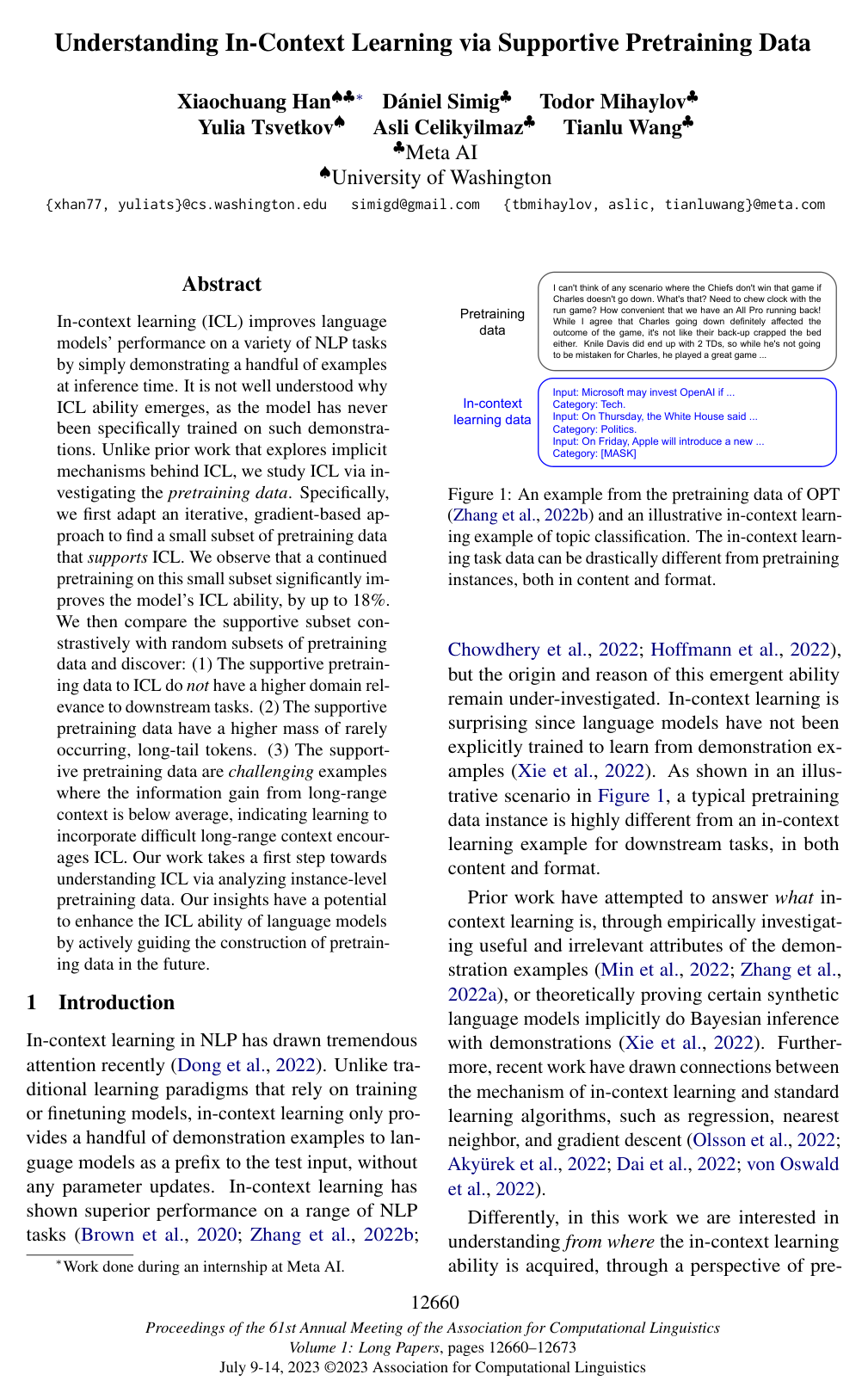
Understanding In-Context Learning via Supportive Pretraining Data
Xiaochuang Han, Daniel Simig, Todor Mihaylov, Yulia Tsvetkov, Asli Celikyilmaz, Tianlu Wang
Why you should read this
Reveals that in-context learning in large language models is driven by specific, challenging pretraining instances rich in long-tail tokens and difficult long-range contexts rather than domain-relevant text, providing actionable criteria to guide future pretraining data selection.
In-context learning (ICL) improves language models’ performance on a variety of NLP tasks by simply demonstrating a handful of examples at inference time. It is not well understood why ICL ability emerges, as the model has never been specifically trained on such demonstrations. Unlike prior work that explores implicit mechanisms behind ICL, we study ICL via investigating the pretraining data. Specifically, we first adapt an iterative, gradient-based approach to find a small subset of pretraining data that supports ICL. We observe that a continued pretraining on this small subset significantly improves the model’s ICL ability, by up to 18%. We then compare the supportive subset contrastively with random subsets of pretraining data and discover: (1) The supportive pretraining data to ICL do not have a higher domain relevance to downstream tasks. (2) The supportive pretraining data have a higher mass of rarely occurring, long-tail tokens. (3) The supportive pretraining data are challenging examples where the information gain from long-range context is below average, indicating learning to incorporate difficult long-range context encourages ICL. Our work takes a first step towards understanding ICL via analyzing instance-level pretraining data. Our insights have a potential to enhance the ICL ability of language models by actively guiding the construction of pretraining data in the future.
Added
2026-10-03
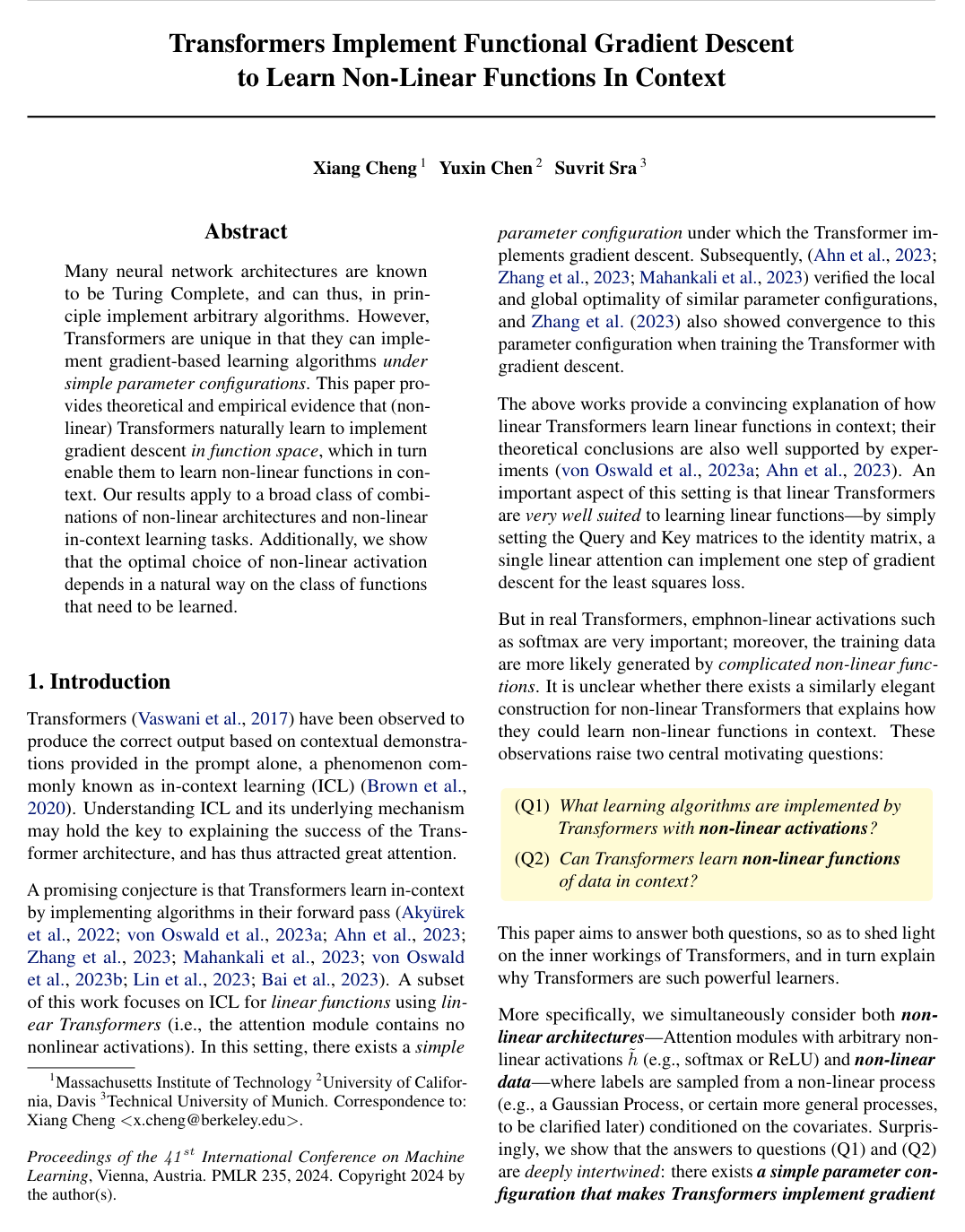
Transformers Implement Functional Gradient Descent to Learn Non-Linear Functions In Context
Xiang Cheng, Yuxin Chen, Suvrit Sra
Why you should read this
Proves both theoretically and empirically that non-linear Transformers learn to execute functional gradient descent during in-context learning, converging to Bayes-optimal predictors when their attention activations match the underlying data distribution.
Many neural network architectures are known to be Turing Complete, and can thus, in principle implement arbitrary algorithms. However, Transformers are unique in that they can implement gradient-based learning algorithms under simple parameter configurations. This paper provides theoretical and empirical evidence that (non-linear) Transformers naturally learn to implement gradient descent in function space, which in turn enable them to learn non-linear functions in context. Our results apply to a broad class of combinations of non-linear architectures and non-linear in-context learning tasks. Additionally, we show that the optimal choice of non-linear activation depends in a natural way on the class of functions that need to be learned.
Added
2026-10-02
Rethinking the Role of Scale for In-Context Learning: An Interpretability-based Case Study at 66 Billion Scale
Hritik Bansal, Karthik Gopalakrishnan, Saket Dingliwal, Sravan Bodapati, Katrin Kirchhoff, Dan Roth
Why you should read this
Reveals that up to 70% of attention heads and 20% of feedforward networks in a 66-billion-parameter language model can be pruned without sacrificing in-context learning performance, demonstrating that in-context capabilities are concentrated in a small, shared subset of task-agnostic induction heads.
Language models have been shown to perform better with an increase in scale on a wide variety of tasks via the in-context learning paradigm. In this paper, we investigate the hypothesis that the ability of a large language model to in-context learn-perform a task is not uniformly spread across all of its underlying components. Using a 66 billion parameter language model (OPT-66B) across a diverse set of 14 downstream tasks, we find this is indeed the case: ~70% of the attention heads and ~20% of the feed forward networks can be removed with minimal decline in task performance. We find substantial overlap in the set of attention heads (un)important for in-context learning across tasks and number of in-context examples. We also address our hypothesis through a task-agnostic lens, finding that a small set of attention heads in OPT-66B score highly on their ability to perform primitive induction operations associated with in-context learning, namely, prefix matching and copying. These induction heads overlap with task-specific important heads, reinforcing arguments by Olsson et al. (2022) regarding induction head generality to more sophisticated behaviors associated with in-context learning. Overall, our study provides several insights that indicate large language models may be under-trained for in-context learning and opens up questions on how to pre-train language models to more effectively perform in-context learning.
Added
2026-10-02
Data Curation Alone Can Stabilize In-context Learning
Ting-Yun Chang, Robin Jia
Why you should read this
Demonstrates that selecting high-value training subsets through individual example scoring significantly reduces performance variance and increases accuracy in in-context learning without requiring dynamic prompt retrieval or model calibration.
In-context learning (ICL) enables large language models (LLMs) to perform new tasks by prompting them with a sequence of training examples. However, it is known that ICL is very sensitive to the choice of training examples: randomly sampling examples from a training set leads to high variance in performance. In this paper, we show that carefully curating a subset of training data greatly stabilizes ICL performance without any other changes to the ICL algorithm (e.g., prompt retrieval or calibration). We introduce two methods to choose training subsets—both score training examples individually, then select the highest-scoring ones. CONDACC scores a training example by its average dev-set ICL accuracy when combined with random training examples, while DATAMODELS learns linear regressors that estimate how the presence of each training example influences LLM outputs. Across five tasks and two LLMs, sampling from stable subsets selected by CONDACC and DATAMODELS improves average accuracy over sampling from the entire training set by 7.7% and 6.3%, respectively. Surprisingly, the stable subset examples are not especially diverse in content or low in perplexity, in contrast with other work suggesting that diversity and perplexity are important when prompting LLMs.
Added
2026-10-02
Symbol tuning improves in-context learning in language models
Jerry W. Wei, Le Hou, Andrew K. Lampinen, Xiangning Chen, Da Huang, Yi Tay, Xinyun Chen, Yifeng Lu, Denny Zhou, Tengyu Ma, Quoc V. Le
Why you should read this
Demonstrates that finetuning language models on input-label pairs with arbitrary symbols forces them to genuinely reason over in-context mappings, leading to substantial gains on algorithmic tasks, underspecified prompts, and counterfactual examples where models must override prior knowledge.
We present symbol tuning—finetuning language models on in-context input–label pairs where natural language labels (e.g., “positive/negative sentiment”) are replaced with arbitrary symbols (e.g., “foo/bar”). Symbol tuning leverages the intuition that when a model cannot use instructions or natural language labels to figure out a task, it must instead do so by learning the input–label mappings. We experiment with symbol tuning across PaLM models up to 540B parameters and observe benefits across various settings. First, symbol tuning boosts performance on unseen in-context learning tasks and is much more robust to underspecified prompts, such as those without instructions or without natural language labels. Second, symbol-tuned models are much stronger at algorithmic reasoning tasks, with up to 18.2% better performance on the List Functions benchmark and up to 15.3% better performance on the Simple Turing Concepts benchmark. Finally, symbol-tuned models show large improvements in following flipped-labels presented in-context, meaning that they are more capable of using in-context information to override prior knowledge.
Added
2026-10-01
Mitigating Label Biases for In-context Learning
Yu Fei, Yifan Hou, Zeming Chen, Antoine Bosselut
Why you should read this
Proposes a domain-context calibration method that estimates and removes pre-existing task corpus biases from language models, improving in-context text classification performance by up to 37% Macro-F1.
Various design settings for in-context learning (ICL), such as the choice and order of the in-context examples, can bias the model’s predictions. While many studies discuss these design choices, there have been few systematic investigations into categorizing them and mitigating their impact. In this work, we define a typology for three types of label biases in ICL for text classification: vanilla-label bias, context-label bias, and domain-label bias (which we conceptualize and detect for the first time). Our analysis demonstrates that prior label bias calibration methods fall short of addressing all three types of biases. Specifically, domain-label bias restricts LLMs to random-level performance on many tasks regardless of the choice of in-context examples. To mitigate the effect of these biases, we propose a simple bias calibration method that estimates a language model’s label bias using random in-domain words from the task corpus. After controlling for this estimated bias when making predictions, our novel domain-context calibration significantly improves the ICL performance of GPT-J and GPT-3 on a wide range of tasks. The gain is substantial on tasks with large domain-label bias (up to 37% in Macro-F1). Furthermore, our results generalize to models with different scales, pretraining methods, and manually-designed task instructions, showing the prevalence of label biases in ICL.
Added
2026-10-01