
keyword
importance sampling
Importance sampling is a Monte Carlo technique used to estimate properties, such as expected values or integrals, of a target probability distribution while generating samples from a different distribution known as a proposal distribution. To correct for the discrepancy between the two distributions, each sampled point is assigned an importance weight calculated from the ratio of the target probability density to the proposal probability density evaluated at that point. By weighting the samples accordingly, the method produces unbiased or consistent estimates without requiring direct sampling from the target distribution, which is particularly useful when the target distribution is intractable or only known up to a normalizing constant. Beyond facilitating inference in complex models, choosing an effective proposal distribution that concentrates samples in the most influential regions can substantially reduce estimator variance, making importance sampling a foundational tool across probabilistic modeling, particle filtering, and off-policy evaluation in reinforcement learning.
27 items
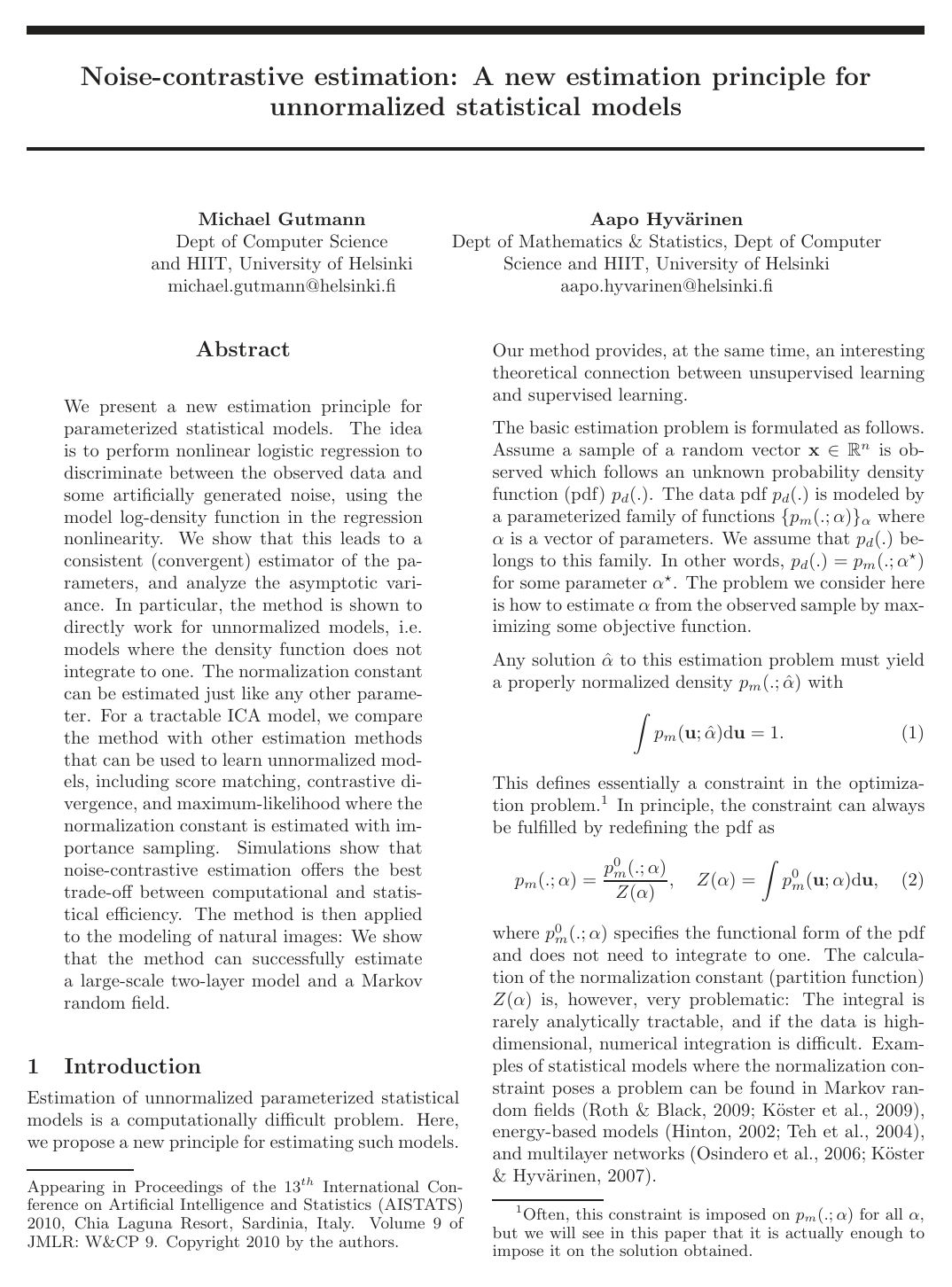
Noise-contrastive estimation: A new estimation principle for unnormalized statistical models
Michael Gutmann, Aapo Hyvönen
Why you should read this
Introduces a novel estimation principle for unnormalized statistical models that avoids complex integration by treating parameter estimation as a classification task between data and artificial noise.
We present a new estimation principle for parameterized statistical models. The idea is to perform nonlinear logistic regression to discriminate between the observed data and some artificially generated noise, using the model log-density function in the regression nonlinearity. We show that this leads to a consistent (convergent) estimator of the parameters, and analyze the asymptotic variance. In particular, the method is shown to directly work for unnormalized models, i.e. models where the density function does not integrate to one. The normalization constant can be estimated just like any other parameter. For a tractable ICA model, we compare the method with other estimation methods that can be used to learn unnormalized models, including score matching, contrastive divergence, and maximum-likelihood where the normalization constant is estimated with importance sampling. Simulations show that noise-contrastive estimation offers the best trade-off between computational and statistical efficiency. The method is then applied to the modeling of natural images: We show that the method can successfully estimate a large-scale two-layer model and a Markov random field.
Added
2026-10-04
License
Published with permission
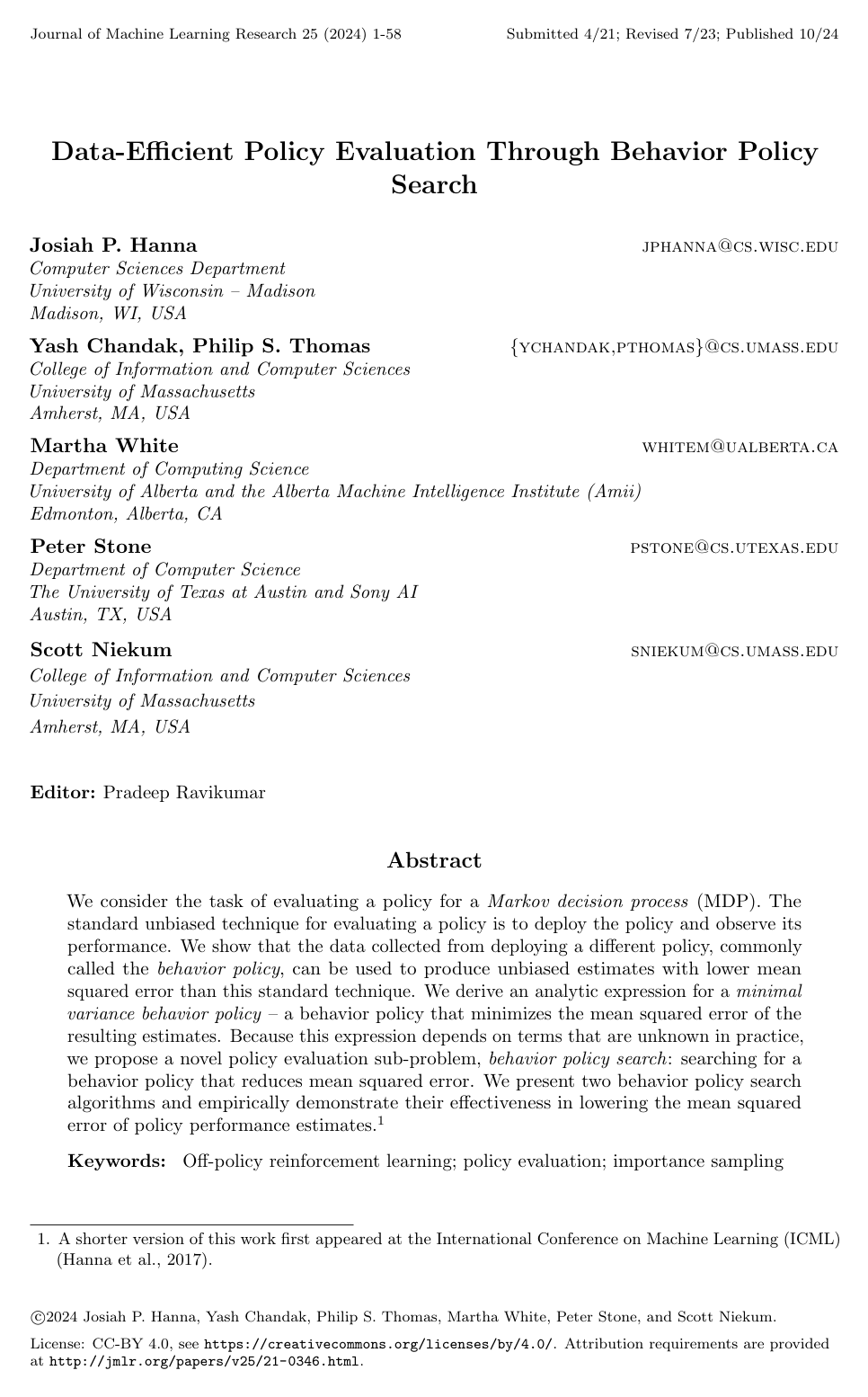
Data-Efficient Policy Evaluation Through Behavior Policy Search
Josiah P. Hanna, Yash Chandak, Philip S. Thomas, Martha White, Peter Stone, Scott Niekum
Why you should read this
Develops algorithms that search for an optimal data-collection behavior policy to evaluate reinforcement learning policies with lower variance and mean squared error than standard on-policy rollouts.
We consider the task of evaluating a policy for a Markov decision process (MDP). The standard unbiased technique for evaluating a policy is to deploy the policy and observe its performance. We show that the data collected from deploying a different policy, commonly called the behavior policy, can be used to produce unbiased estimates with lower mean squared error than this standard technique. We derive an analytic expression for a minimal variance behavior policy – a behavior policy that minimizes the mean squared error of the resulting estimates. Because this expression depends on terms that are unknown in practice, we propose a novel policy evaluation sub-problem, behavior policy search: searching for a behavior policy that reduces mean squared error. We present two behavior policy search algorithms and empirically demonstrate their effectiveness in lowering the mean squared error of policy performance estimates.1
Added
2026-10-03
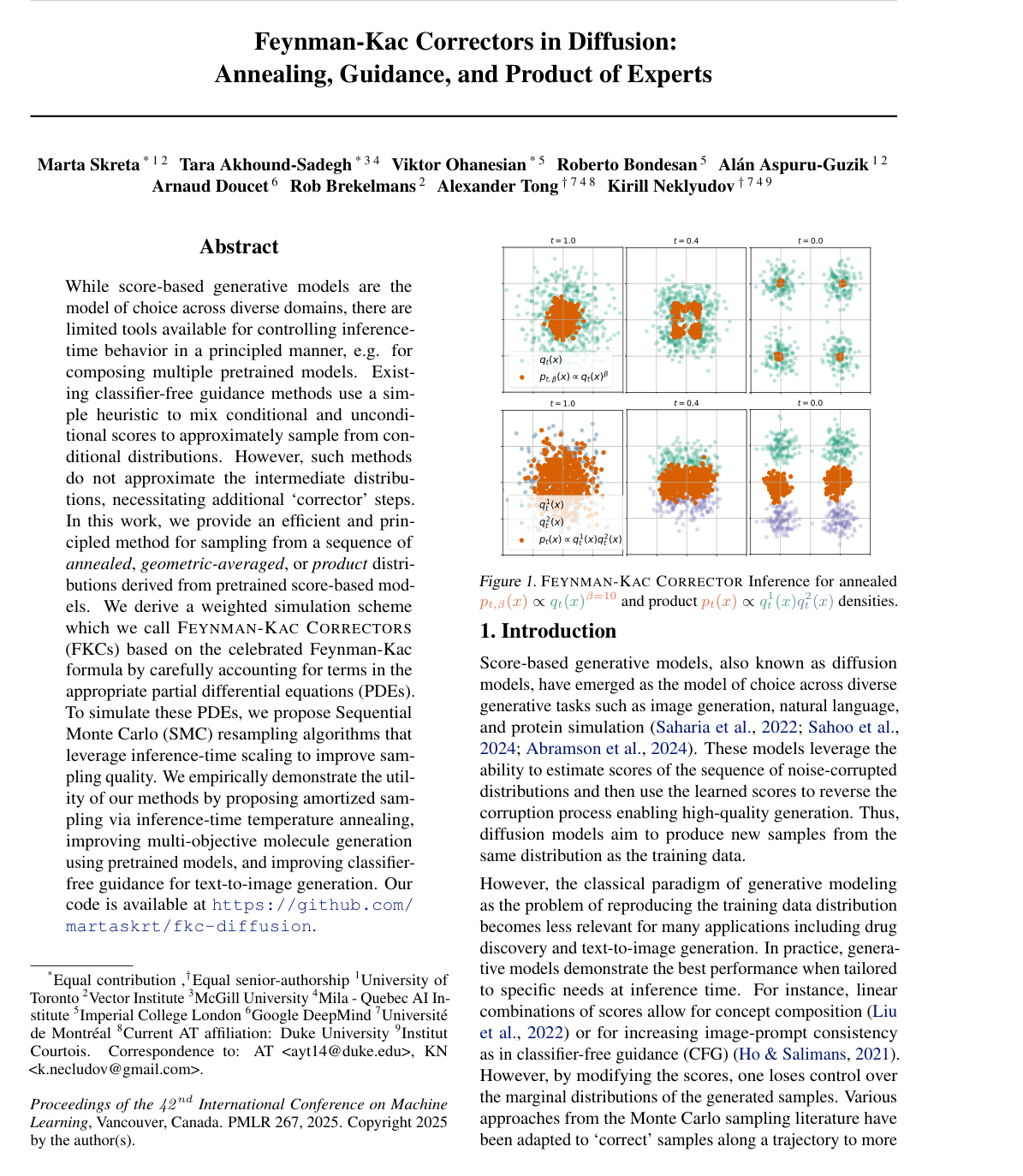
Feynman-Kac Correctors in Diffusion: Annealing, Guidance, and Product of Experts
Marta Skreta, Tara Akhound-Sadegh, Viktor Ohanesian, Roberto Bondesan, Aln Aspuru-Guzik, Arnaud Doucet, Rob Brekelmans, Alexander Tong, Kirill Neklyudov
Why you should read this
Develops Feynman-Kac Correctors and Sequential Monte Carlo resampling schemes to rigorously sample from compositions, temperings, and guidance mixtures of pretrained diffusion models without requiring retraining or expensive corrector iterations.
While score-based generative models are the model of choice across diverse domains, there are limited tools available for controlling inference-time behavior in a principled manner, e.g. for composing multiple pretrained models. Existing classifier-free guidance methods use a simple heuristic to mix conditional and unconditional scores to approximately sample from conditional distributions. However, such methods do not approximate the intermediate distributions, necessitating additional ‘corrector’ steps. In this work, we provide an efficient and principled method for sampling from a sequence of annealed, geometric-averaged, or product distributions derived from pretrained score-based models. We derive a weighted simulation scheme which we call Feynman-Kac Correctors (FKCs) based on the celebrated Feynman-Kac formula by carefully accounting for terms in the appropriate partial differential equations (PDEs). To simulate these PDEs, we propose Sequential Monte Carlo (SMC) resampling algorithms that leverage inference-time scaling to improve sampling quality. We empirically demonstrate the utility of our methods by proposing amortized sampling via inference-time temperature annealing, improving multi-objective molecule generation using pretrained models, and improving classifier-free guidance for text-to-image generation. Our code is available at https://github.com/martaskrt/fkc-diffusion.
Added
2026-10-03
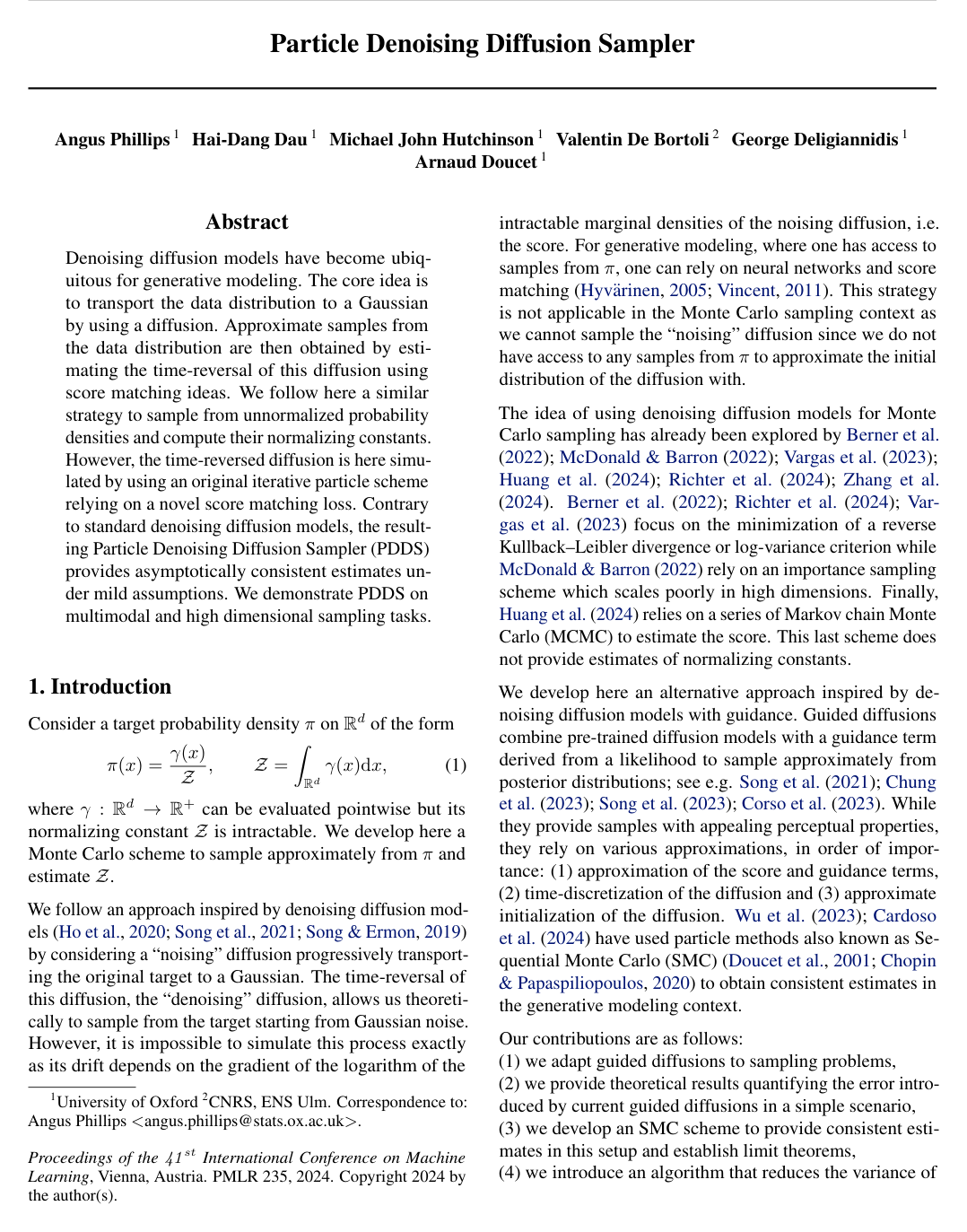
Particle Denoising Diffusion Sampler
Angus Phillips, Hai-Dang Dau, Michael John Hutchinson, Valentin De Bortoli, George Deligiannidis, Arnaud Doucet
Why you should read this
Introduces the Particle Denoising Diffusion Sampler, an iterative particle method combining guided diffusions with a novel score matching loss to achieve asymptotically consistent sampling and normalizing constant estimation for complex, unnormalized target distributions.
Denoising diffusion models have become ubiquitous for generative modeling. The core idea is to transport the data distribution to a Gaussian by using a diffusion. Approximate samples from the data distribution are then obtained by estimating the time-reversal of this diffusion using score matching ideas. We follow here a similar strategy to sample from unnormalized probability densities and compute their normalizing constants. However, the time-reversed diffusion is here simulated by using an original iterative particle scheme relying on a novel score matching loss. Contrary to standard denoising diffusion models, the resulting Particle Denoising Diffusion Sampler (PDDS) provides asymptotically consistent estimates under mild assumptions. We demonstrate PDDS on multimodal and high dimensional sampling tasks.
Added
2026-10-03
Probabilistic Inference in Language Models via Twisted Sequential Monte Carlo
Stephen Zhao, Rob Brekelmans, Alireza Makhzani, Roger Baker Grosse
Why you should read this
Proposes a twisted Sequential Monte Carlo framework using contrastively learned lookahead functions to steer language model generation toward sequence-level targets and establish bidirectional bounds for evaluating inference quality.
Numerous capability and safety techniques of Large Language Models (LLMs), including RLHF, automated red-teaming, prompt engineering, and infilling, can be cast as sampling from an unnormalized target distribution defined by a given reward or potential function over the full sequence. In this work, we leverage the rich toolkit of Sequential Monte Carlo (SMC) for these probabilistic inference problems. In particular, we use learned twist functions to estimate the expected future value of the potential at each timestep, which enables us to focus inference-time computation on promising partial sequences. We propose a novel contrastive method for learning the twist functions, and establish connections with the rich literature of soft reinforcement learning. As a complementary application of our twisted SMC framework, we present methods for evaluating the accuracy of language model inference techniques using novel bidirectional SMC bounds on the log partition function. These bounds can be used to estimate the KL divergence between the inference and target distributions in both directions. We apply our inference evaluation techniques to show that twisted SMC is effective for sampling undesirable outputs from a pretrained model (a useful component of harmlessness training and automated red-teaming), generating reviews with varied sentiment, and performing infilling tasks.
Added
2026-10-03
Iterated Denoising Energy Matching for Sampling from Boltzmann Densities
Tara Akhound-Sadegh, Jarrid Rector-Brooks, Avishek Joey Bose, Sarthak Mittal, Pablo Lemos, Cheng-Hao Liu, Marcin Sendera, Siamak Ravanbakhsh, Gauthier Gidel, Yoshua Bengio, Nikolay Malkin, Alexander Tong
Why you should read this
Proposes an iterative, simulation-free score matching algorithm that trains diffusion samplers directly from unnormalized energy functions without data or MCMC, achieving up to five times faster training and successfully scaling to the challenging 55-particle Lennard-Jones system.
Efficiently generating statistically independent samples from an unnormalized probability distribution, such as equilibrium samples of many-body systems, is a foundational problem in science. In this paper, we propose Iterated Denoising Energy Matching (iDEM), an iterative algorithm that uses a novel stochastic score matching objective leveraging solely the energy function and its gradient—and no data samples—to train a diffusion-based sampler. Specifically, iDEM alternates between (I) sampling regions of high model density from a diffusion-based sampler and (II) using these samples in our stochastic matching objective to further improve the sampler. iDEM is scalable to high dimensions as the inner matching objective, is simulation-free, and requires no MCMC samples. Moreover, by leveraging the fast mode mixing behavior of diffusion, iDEM smooths out the energy landscape enabling efficient exploration and learning of an amortized sampler. We evaluate iDEM on a suite of tasks ranging from standard synthetic energy functions to invariant n-body particle systems. We show that the proposed approach achieves state-of-the-art performance on all metrics and trains 2 − 5× faster, which allows it to be the first method to train using energy on the challenging 55-particle Lennard-Jones system.
Added
2026-10-01
Additive Control Variates Dominate Self-Normalisation in Off-Policy Evaluation
Olivier Jeunen, Shashank Gupta
Why you should read this
Proves that inverse propensity scoring with an optimal additive control variate asymptotically dominates the standard self-normalised estimator in mean squared error, theoretically justifying a shift toward baseline corrections in off-policy evaluation for ranking and recommendation systems.
Off-policy evaluation (OPE) is essential for assessing ranking and recommendation systems without costly online interventions. Self-Normalised Inverse Propensity Scoring (SNIPS) is a standard tool for variance reduction in OPE, leveraging a multiplicative control variate. Recent advances in off-policy learning suggest that additive control variates (baseline corrections) may offer superior performance, yet theoretical guarantees for evaluation are lacking. This paper provides a definitive answer: we prove that -IPS, an estimator with an optimal additive baseline, asymptotically dominates SNIPS in Mean Squared Error. By analytically decomposing the variance gap, we show that SNIPS is asymptotically equivalent to using a specific -- but generally sub-optimal -- additive baseline. Our results theoretically justify shifting from self-normalisation to optimal baseline corrections for both ranking and recommendation.
Added
2026-09-29
A Unifying View of Coverage in Linear Off-Policy Evaluation
Philip Amortila, Audrey Huang, Akshay Krishnamurthy, Nan Jiang
Why you should read this
Establishes a unified theory of data coverage in linear off-policy evaluation by introducing a feature-dynamics coverage parameter that supplies finite-sample error bounds for LSTDQ under minimal realizability assumptions while recovering standard coverage metrics in stronger settings.
Off-policy evaluation (OPE) is a fundamental task in reinforcement learning (RL). In the classic setting of linear OPE, finite-sample guarantees often take the form where is the dimension of the features and is a coverage parameter that characterizes the degree to which the visited features lie in the span of the data distribution. While such guarantees are well-understood for several popular algorithms under stronger assumptions (e.g. Bellman completeness), the understanding is lacking and fragmented in the minimal setting where only the target value function is linearly realizable in the features. Despite recent interest in tight characterizations of the statistical rate in this setting, the right notion of coverage remains unclear, and candidate definitions from prior analyses have undesirable properties and are starkly disconnected from more standard definitions in the literature. We provide a novel finite-sample analysis of a canonical algorithm for this setting, LSTDQ. Inspired by an instrumental-variable view, we develop error bounds that depend on a novel coverage parameter, the feature-dynamics coverage, which can be interpreted as linear coverage in an induced dynamical system for feature evolution. With further assumptions -- such as Bellman-completeness -- our definition successfully recovers the coverage parameters specialized to those settings, finally yielding a unified understanding for coverage in linear OPE.
Added
2026-09-29
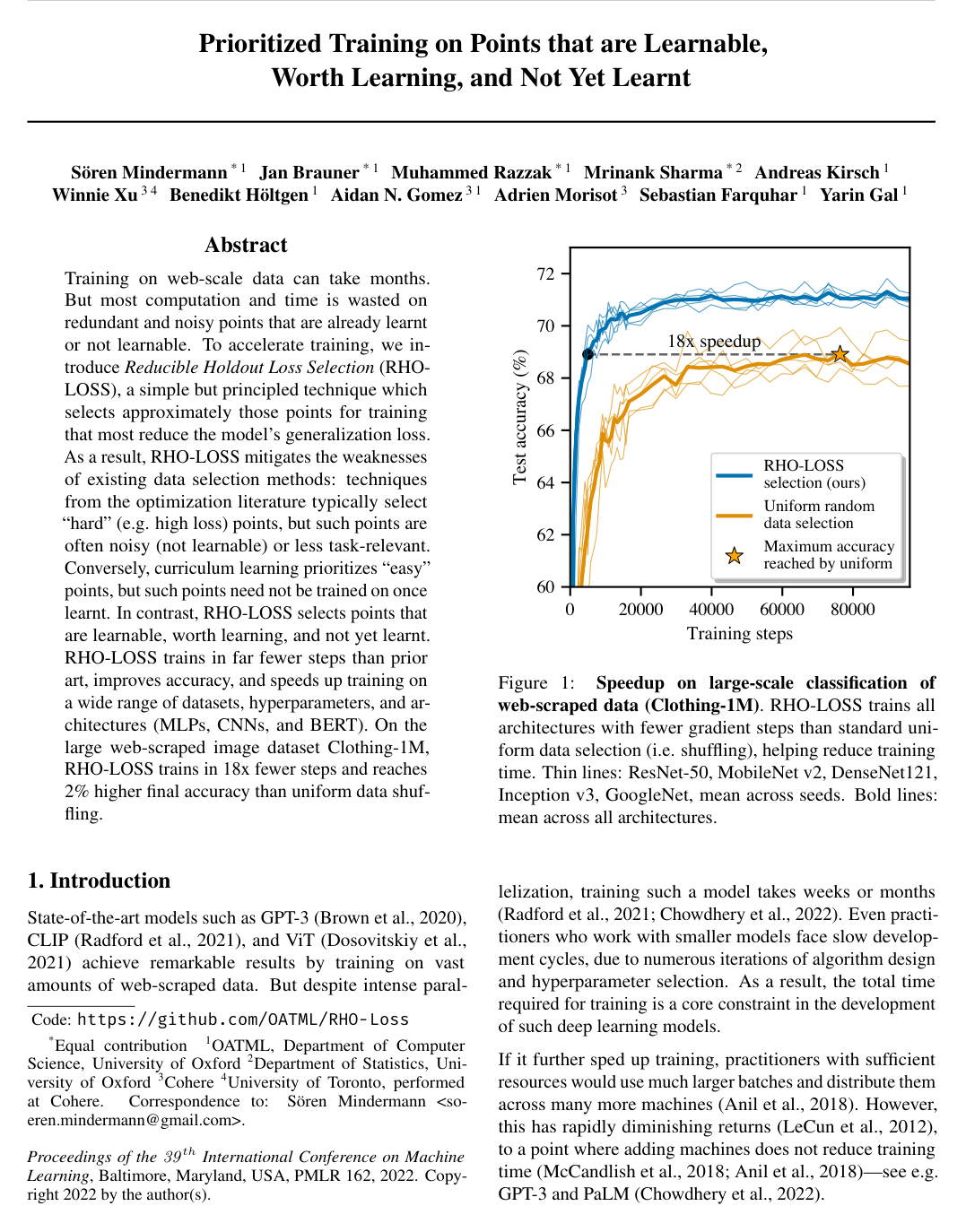
Prioritized Training on Points that are Learnable, Worth Learning, and not yet Learnt
Sören Mindermann, Jan Markus Brauner, Muhammed Razzak, Mrinank Sharma, Andreas Kirsch, Winnie Xu, Benedikt Höltgen, Aidan N. Gomez, Adrien Morisot, Sebastian Farquhar, Yarin Gal
Why you should read this
Proposes Reducible Holdout Loss Selection (RHO-LOSS), an effective data selection technique that accelerates deep model training by prioritizing examples that maximize generalization gains while filtering out noisy, irrelevant, and already learned points.
Training on web-scale data can take months. But most computation and time is wasted on redundant and noisy points that are already learnt or not learnable. To accelerate training, we introduce Reducible Holdout Loss Selection (RHO-LOSS), a simple but principled technique which selects approximately those points for training that most reduce the model's generalization loss. As a result, RHO-LOSS mitigates the weaknesses of existing data selection methods: techniques from the optimization literature typically select 'hard' (e.g. high loss) points, but such points are often noisy (not learnable) or less task-relevant. Conversely, curriculum learning prioritizes 'easy' points, but such points need not be trained on once learned. In contrast, RHO-LOSS selects points that are learnable, worth learning, and not yet learnt. RHO-LOSS trains in far fewer steps than prior art, improves accuracy, and speeds up training on a wide range of datasets, hyperparameters, and architectures (MLPs, CNNs, and BERT). On the large web-scraped image dataset Clothing-1M, RHO-LOSS trains in 18x fewer steps and reaches 2% higher final accuracy than uniform data shuffling.
Added
2026-09-28
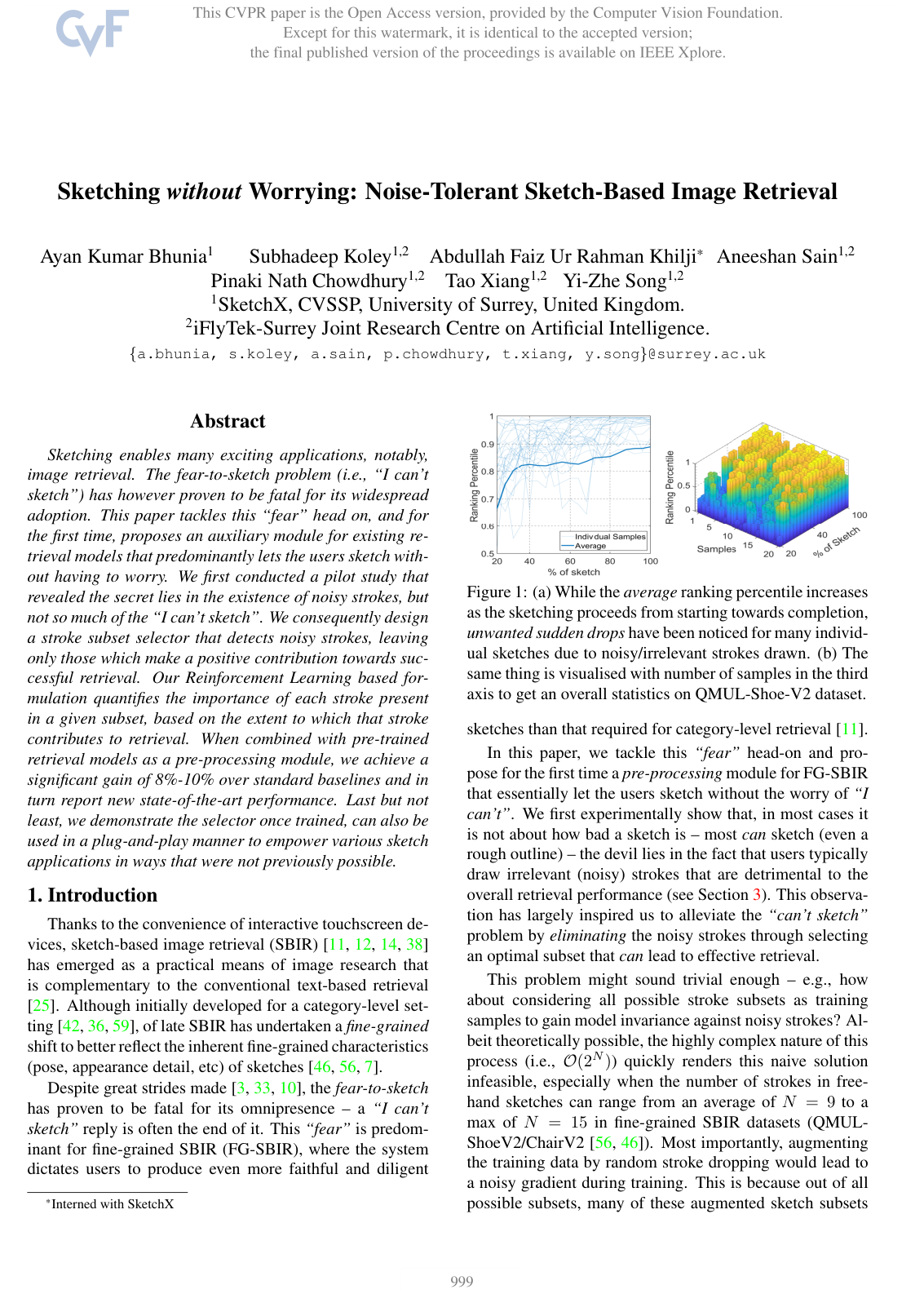
Sketching without Worrying: Noise-Tolerant Sketch-Based Image Retrieval
Ayan Kumar Bhunia, Subhadeep Koley, Abdullah Faiz Ur Rahman Khilji, Aneeshan Sain, Pinaki Nath Chowdhury, Tao Xiang, Yi-Zhe Song
Why you should read this
Proposes a reinforcement learning-based stroke subset selector that filters out noisy or detrimental strokes from amateur drawings to boost fine-grained sketch-based image retrieval accuracy without retraining underlying retrieval models.
Sketching enables many exciting applications, notably, image retrieval. The fear-to-sketch problem (i.e., “I can’t sketch”) has however proven to be fatal for its widespread adoption. This paper tackles this “fear” head on, and for the first time, proposes an auxiliary module for existing retrieval models that predominantly lets the users sketch without having to worry. We first conducted a pilot study that revealed the secret lies in the existence of noisy strokes, but not so much of the “I can’t sketch”. We consequently design a stroke subset selector that detects noisy strokes, leaving only those which make a positive contribution towards successful retrieval. Our Reinforcement Learning based formulation quantifies the importance of each stroke present in a given subset, based on the extent to which that stroke contributes to retrieval. When combined with pre-trained retrieval models as a pre-processing module, we achieve a significant gain of 8%-10% over standard baselines and in turn report new state-of-the-art performance. Last but not least, we demonstrate the selector once trained, can also be used in a plug-and-play manner to empower various sketch applications in ways that were not previously possible.
Added
2026-09-26
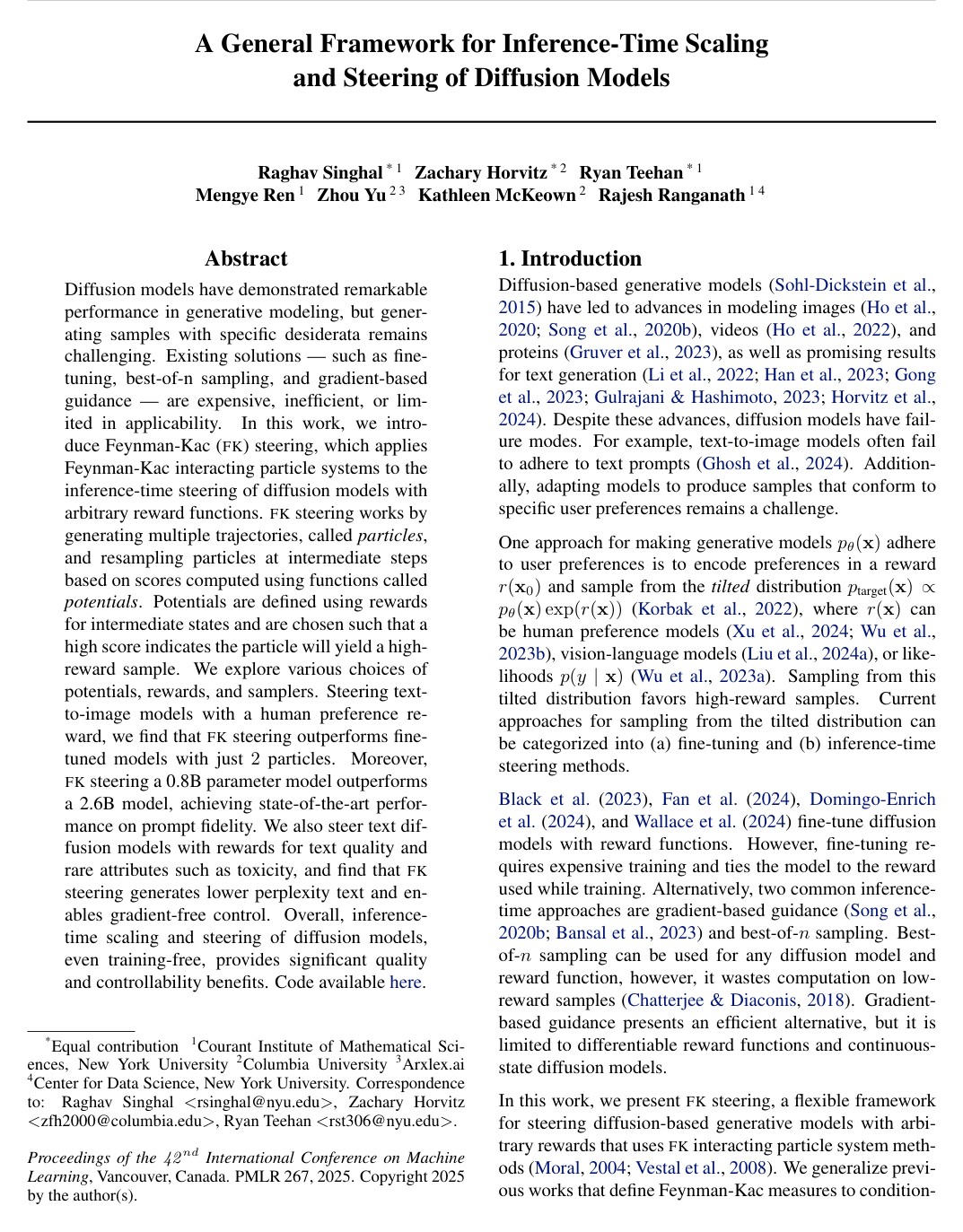
A General Framework for Inference-time Scaling and Steering of Diffusion Models
Raghav Singhal, Zachary Horvitz, Ryan Teehan, Mengye Ren, Zhou Yu, Kathleen McKeown, Rajesh Ranganath
Why you should read this
Presents Feynman-Kac steering, a training-free framework that resamples particle trajectories at intermediate generation steps using arbitrary reward functions, allowing smaller diffusion models to outperform fine-tuned models and larger architectures in sample quality and prompt fidelity.
Diffusion models have demonstrated remarkable performance in generative modeling, but generating samples with specific desiderata remains challenging. Existing solutions — such as fine-tuning, best-of-n sampling, and gradient-based guidance — are expensive, inefficient, or limited in applicability. In this work, we introduce Feynman-Kac (FK) steering, which applies Feynman-Kac interacting particle systems to the inference-time steering of diffusion models with arbitrary reward functions. FK steering works by generating multiple trajectories, called particles, and resampling particles at intermediate steps based on scores computed using functions called potentials. Potentials are defined using rewards for intermediate states and are chosen such that a high score indicates the particle will yield a high-reward sample. We explore various choices of potentials, rewards, and samplers. Steering text-to-image models with a human preference reward, we find that FK steering outperforms fine-tuned models with just 2 particles. Moreover, FK steering a 0.8B parameter model outperforms a 2.6B model, achieving state-of-the-art performance on prompt fidelity. We also steer text diffusion models with rewards for text quality and rare attributes such as toxicity, and find that FK steering generates lower perplexity text and enables gradient-free control. Overall, inference-time scaling and steering of diffusion models, even training-free, provides significant quality and controllability benefits. Code available here.
Added
2026-09-26
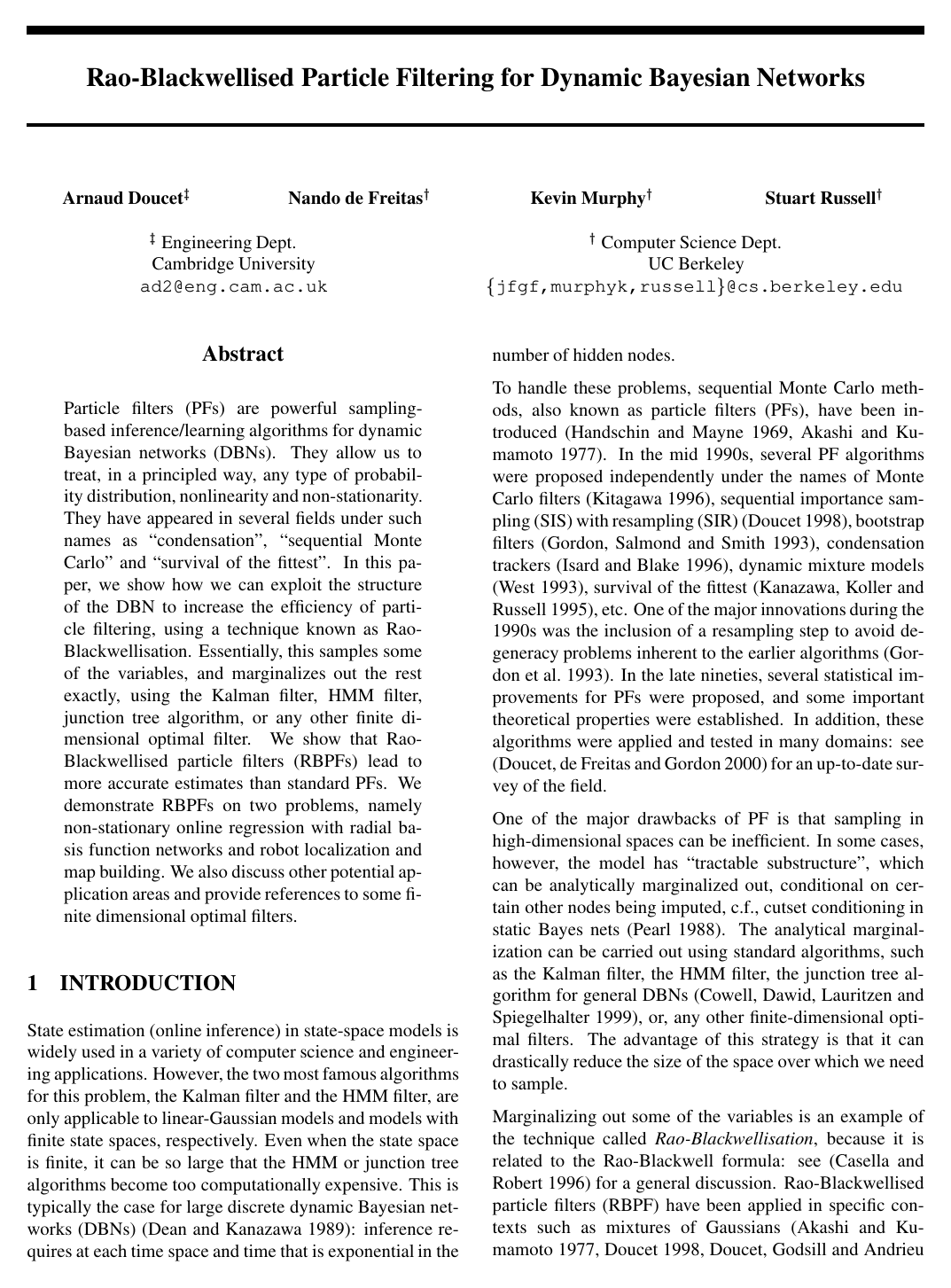
Rao-Blackwellised Particle Filtering for Dynamic Bayesian Networks
Arnaud Doucet, Nando de Freitas, Kevin Murphy, Stuart Russell
Why you should read this
Proposes Rao-Blackwellised particle filtering for dynamic Bayesian networks, showing how to combine sequential Monte Carlo sampling with exact analytical filtering to achieve significantly higher estimation accuracy in complex applications like robot mapping and non-stationary regression.
Particle filters (PFs) are powerful sampling-based inference/learning algorithms for dynamic Bayesian networks (DBNs). They allow us to treat, in a principled way, any type of probability distribution, nonlinearity and non-stationarity. They have appeared in several fields under such names as "condensation", "sequential Monte Carlo" and "survival of the fittest". In this paper, we show how we can exploit the structure of the DBN to increase the efficiency of particle filtering, using a technique known as Rao-Blackwellisation. Essentially, this samples some of the variables, and marginalizes out the rest exactly, using the Kalman filter, HMM filter, junction tree algorithm, or any other finite dimensional optimal filter. We show that Rao-Blackwellised particle filters (RBPFs) lead to more accurate estimates than standard PFs. We demonstrate RBPFs on two problems, namely non-stationary online regression with radial basis function networks and robot localization and map building. We also discuss other potential application areas and provide references to some finite dimensional optimal filters.
Added
2026-09-25
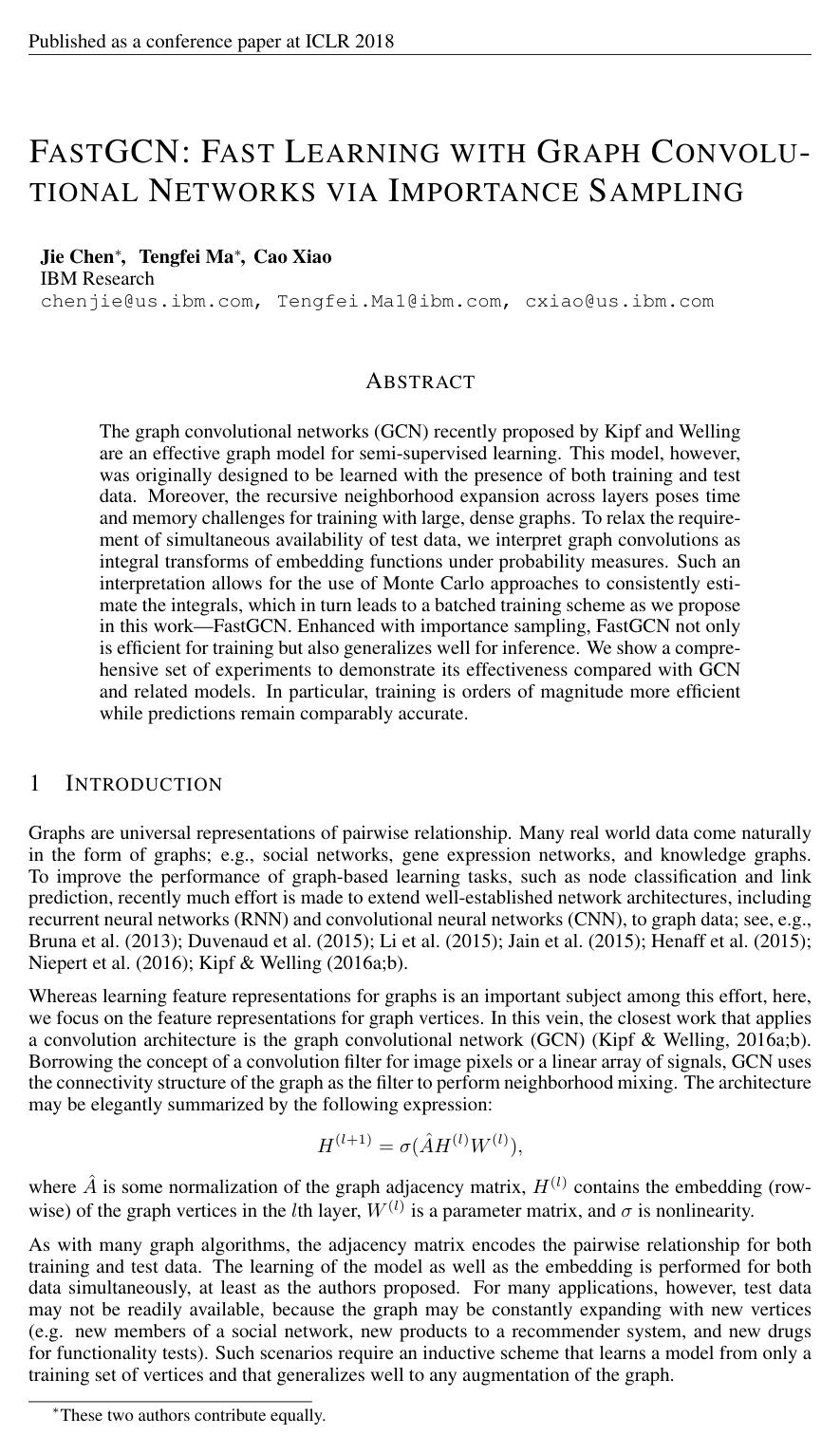
FastGCN: Fast Learning with Graph Convolutional Networks via Importance Sampling
Jie Chen, Tengfei Ma, Cao Xiao
Why you should read this
Develops FastGCN, an importance sampling framework that recasts graph convolutions as integral transforms to eliminate recursive neighborhood expansion, achieving orders-of-magnitude faster training on large graphs without sacrificing predictive accuracy.
The graph convolutional networks (GCN) recently proposed by Kipf and Welling are an effective graph model for semi-supervised learning. This model, however, was originally designed to be learned with the presence of both training and test data. Moreover, the recursive neighborhood expansion across layers poses time and memory challenges for training with large, dense graphs. To relax the requirement of simultaneous availability of test data, we interpret graph convolutions as integral transforms of embedding functions under probability measures. Such an interpretation allows for the use of Monte Carlo approaches to consistently estimate the integrals, which in turn leads to a batched training scheme as we propose in this work---FastGCN. Enhanced with importance sampling, FastGCN not only is efficient for training but also generalizes well for inference. We show a comprehensive set of experiments to demonstrate its effectiveness compared with GCN and related models. In particular, training is orders of magnitude more efficient while predictions remain comparably accurate.
Added
2026-09-24
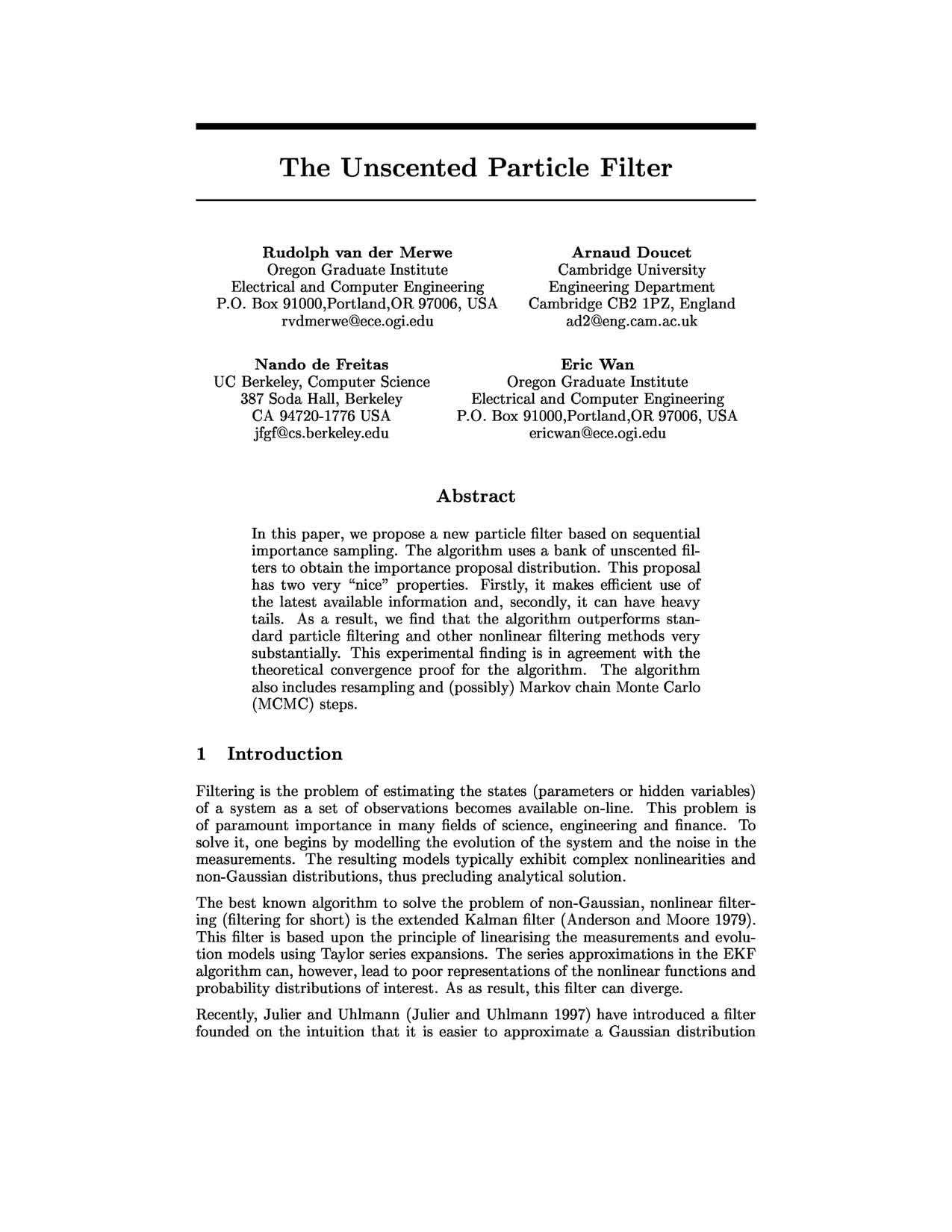
The Unscented Particle Filter
Rudolph van der Merwe, A. Doucet, Nando de Freitas, Eric A. Wan
Why you should read this
Introduces the unscented particle filter, an advanced sequential Monte Carlo method that uses the unscented Kalman filter to generate superior, heavy-tailed proposal distributions for highly accurate state estimation in nonlinear, non-Gaussian systems.
In this paper, we propose a new particle filter based on sequential importance sampling. The algorithm uses a bank of unscented filters to obtain the importance proposal distribution. This proposal has two very “nice” properties. Firstly, it makes efficient use of the latest available information and, secondly, it can have heavy tails. As a result, we find that the algorithm outperforms standard particle filtering and other nonlinear filtering methods very substantially. This experimental finding is in agreement with the theoretical convergence proof for the algorithm. The algorithm also includes resampling and (possibly) Markov chain Monte Carlo (MCMC) steps.
Added
2026-09-24
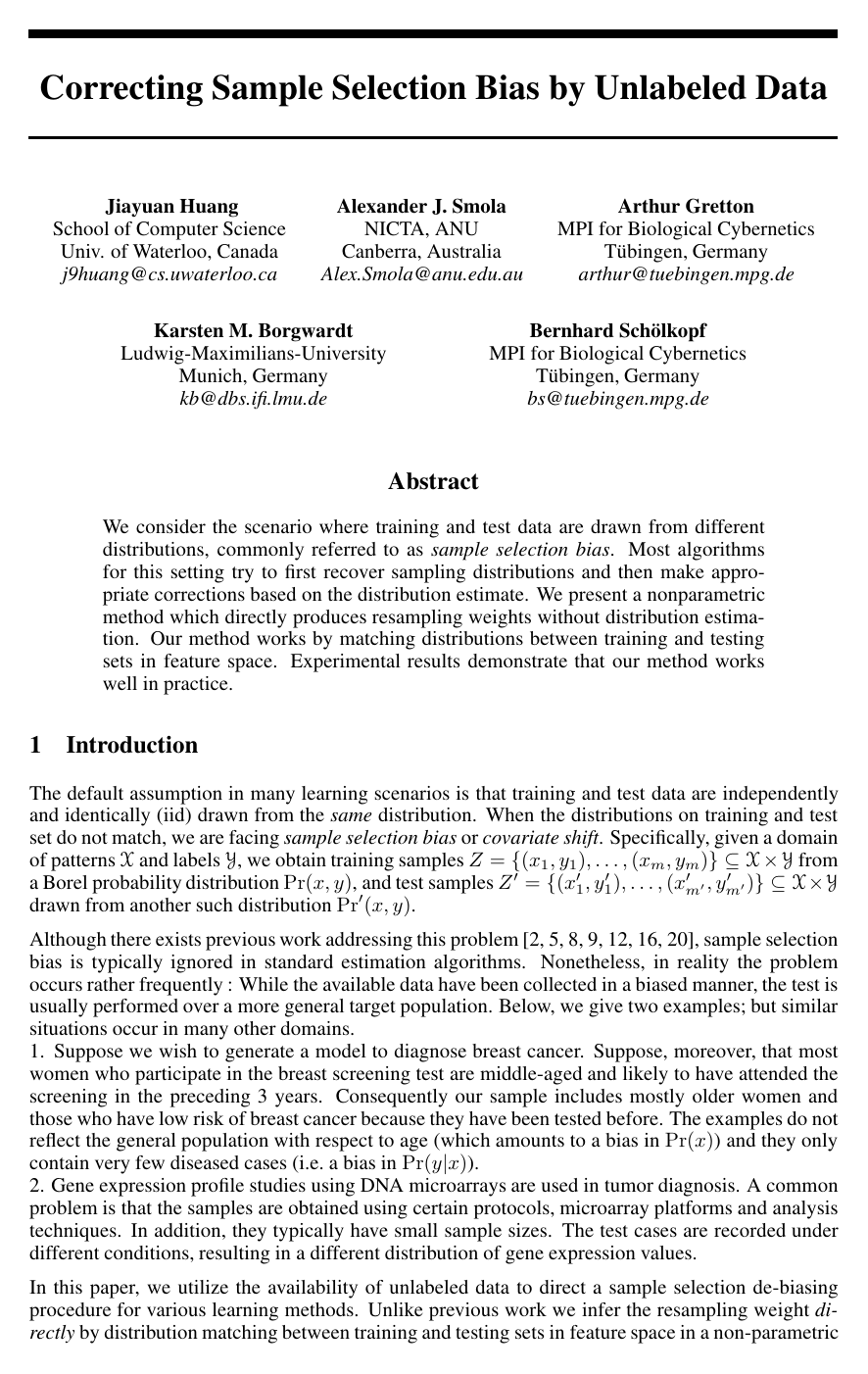
Correcting Sample Selection Bias by Unlabeled Data
Jiayuan Huang, A. Gretton, Karsten M. Borgwardt, B. Schölkopf, Alex Smola
Why you should read this
Introduces Kernel Mean Matching, a nonparametric method that directly corrects sample selection bias by matching training and test feature distributions in reproducing kernel Hilbert spaces without requiring intermediate density estimation.
We consider the scenario where training and test data are drawn from different distributions, commonly referred to as sample selection bias. Most algorithms for this setting try to first recover sampling distributions and then make appropriate corrections based on the distribution estimate. We present a nonparametric method which directly produces resampling weights without distribution estimation. Our method works by matching distributions between training and testing sets in feature space. Experimental results demonstrate that our method works well in practice.
Added
2026-09-18
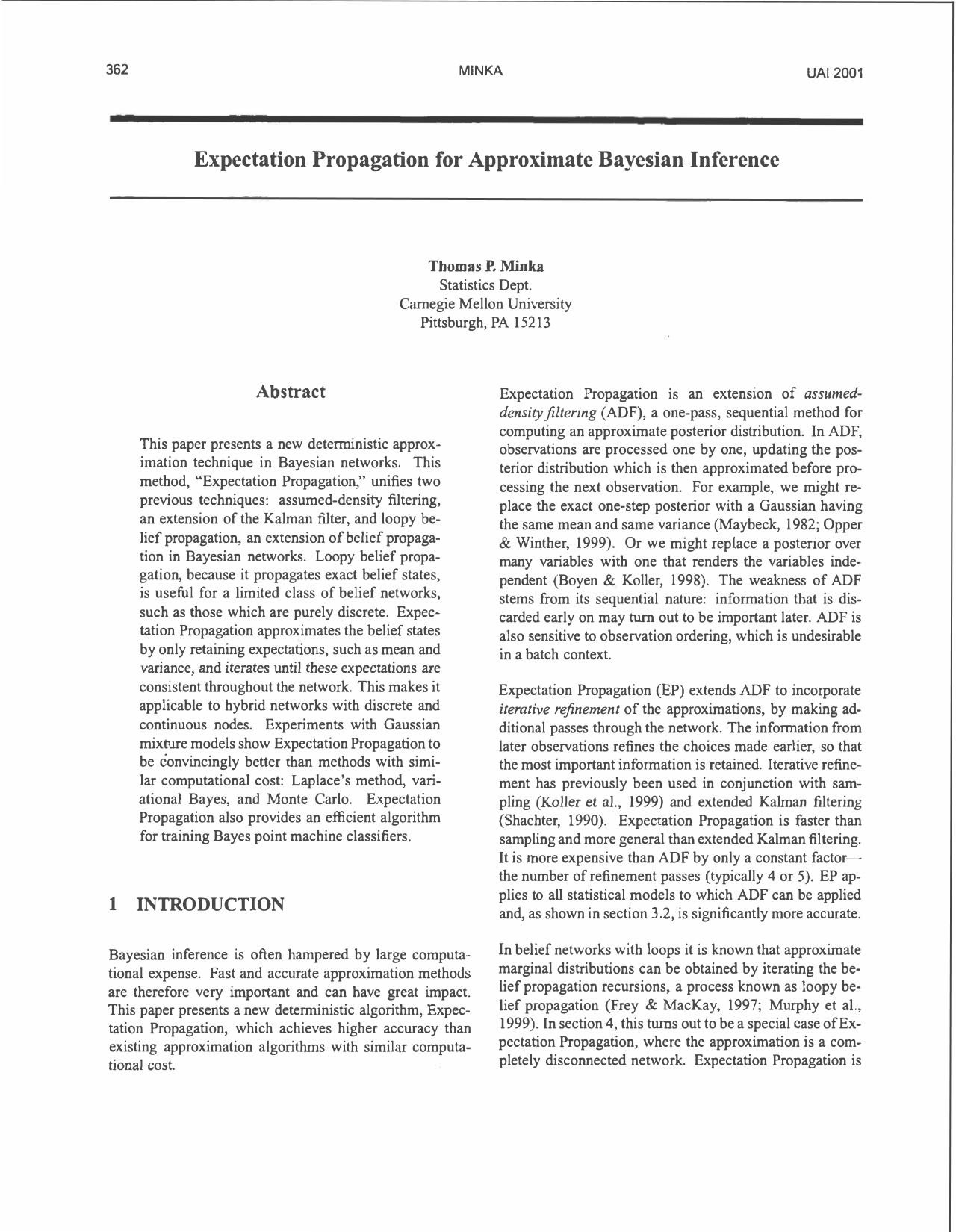
Expectation Propagation for approximate Bayesian inference
Thomas P. Minka
Why you should read this
Introduces Expectation Propagation, a deterministic approximate inference framework that unifies assumed-density filtering and belief propagation to deliver higher accuracy than variational Bayes or Laplace approximations in hybrid networks at comparable computational cost.
This paper presents a new deterministic approximation technique in Bayesian networks. This method, "Expectation Propagation", unifies two previous techniques: assumed-density filtering, an extension of the Kalman filter, and loopy belief propagation, an extension of belief propagation in Bayesian networks. All three algorithms try to recover an approximate distribution which is close in KL divergence to the true distribution. Loopy belief propagation, because it propagates exact belief states, is useful for a limited class of belief networks, such as those which are purely discrete. Expectation Propagation approximates the belief states by only retaining certain expectations, such as mean and variance, and iterates until these expectations are consistent throughout the network. This makes it applicable to hybrid networks with discrete and continuous nodes. Expectation Propagation also extends belief propagation in the opposite direction - it can propagate richer belief states that incorporate correlations between nodes. Experiments with Gaussian mixture models show Expectation Propagation to be convincingly better than methods with similar computational cost: Laplace's method, variational Bayes, and Monte Carlo. Expectation Propagation also provides an efficient algorithm for training Bayes point machine classifiers.
Added
2026-09-17
Deep Boltzmann Machines
Ruslan Salakhutdinov, Geoffrey Hinton
Why you should read this
Introduces a scalable learning and pre-training framework for Deep Boltzmann Machines that combines variational inference with persistent Markov chains to effectively train multi-layer undirected generative models with millions of parameters.
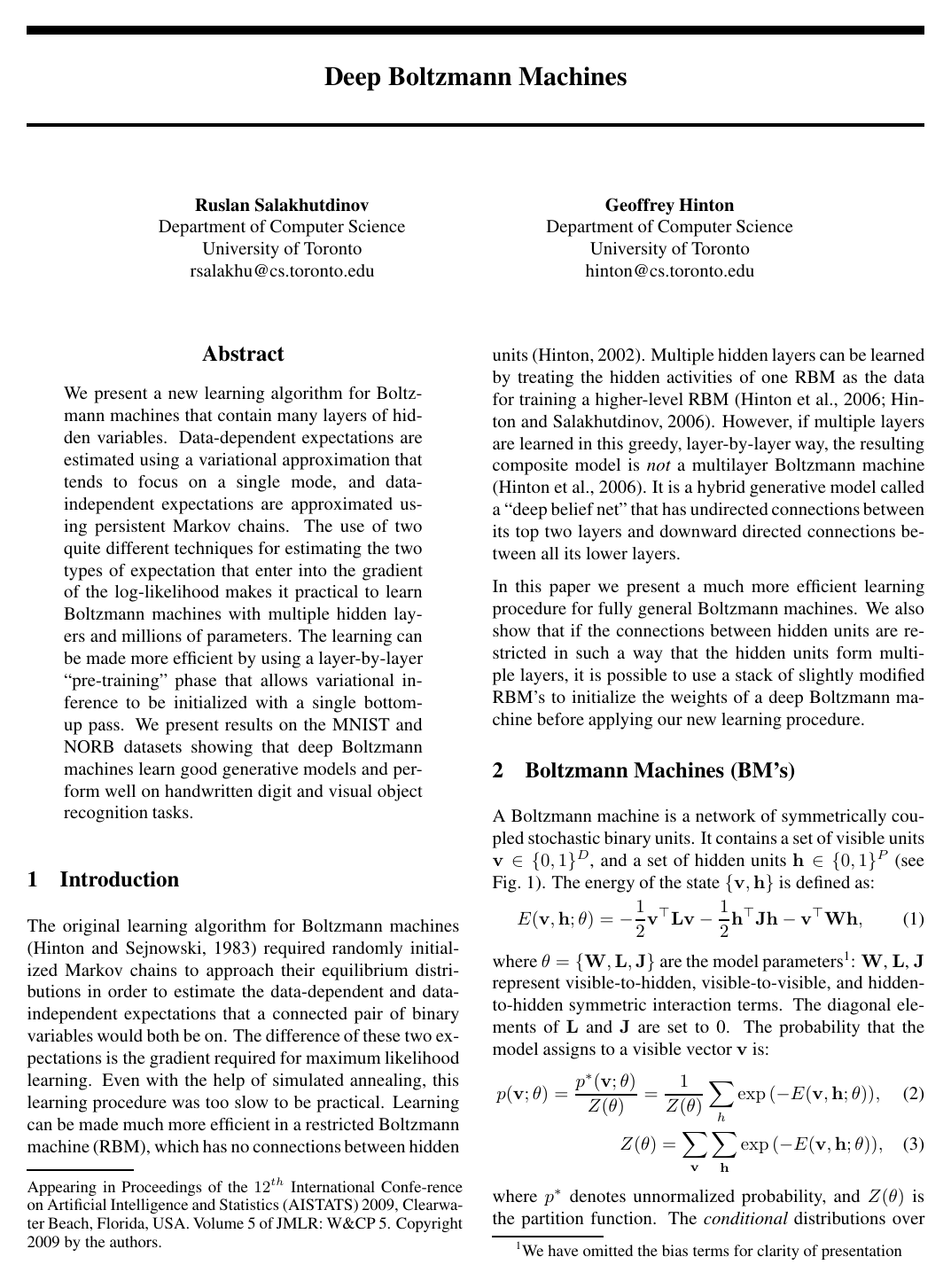
We present a new learning algorithm for Boltzmann machines that contain many layers of hidden variables. Data-dependent expectations are estimated using a variational approximation that tends to focus on a single mode, and data-independent expectations are approximated using persistent Markov chains. The use of two quite different techniques for estimating the two types of expectation that enter into the gradient of the log-likelihood makes it practical to learn Boltzmann machines with multiple hidden layers and millions of parameters. The learning can be made more efficient by using a layer-by-layer “pre-training” phase that allows variational inference to be initialized with a single bottom-up pass. We present results on the MNIST and NORB datasets showing that deep Boltzmann machines learn good generative models and perform well on handwritten digit and visual object recognition tasks.
Added
2026-09-15
License
Published with permission
The rendering equation
James T. Kajiya
Why you should read this
Introduces the foundational integral equation of light transport that unifies ray tracing and radiosity into a single mathematical framework while proposing path tracing to accurately compute complex global illumination effects such as caustics and indirect interreflections.
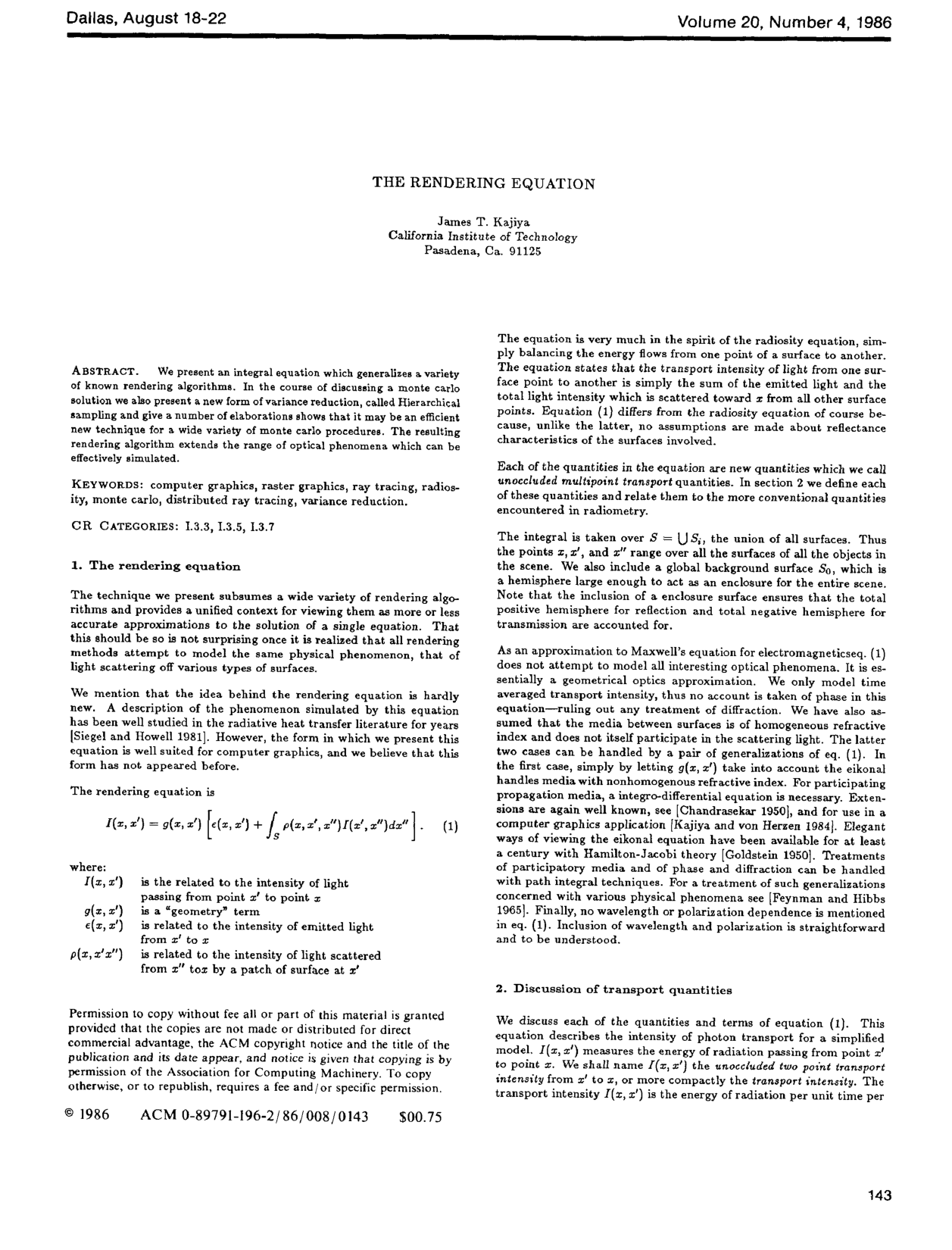
We present an integral equation which generalizes a variety of known rendering algorithms. In the course of discussing a monte carlo solution we also present a new form of variance reduction, called Hierarchical sampling and give a number of elaborations shows that it may be an efficient new technique for a wide variety of monte carlo procedures. The resulting rendering algorithm extends the range of optical phenomena which can be effectively simulated.
Added
2026-09-11
Decision-Making with Auto-Encoding Variational Bayes
Romain Lopez, Pierre Boyeau, N. Yosef, Michael I. Jordan, J. Regier
Why you should read this
Proposes using multiple importance sampling over varied approximate posteriors to correct decision-making biases in auto-encoding variational Bayes, outperforming existing methods on complex single-cell RNA sequencing benchmarks.
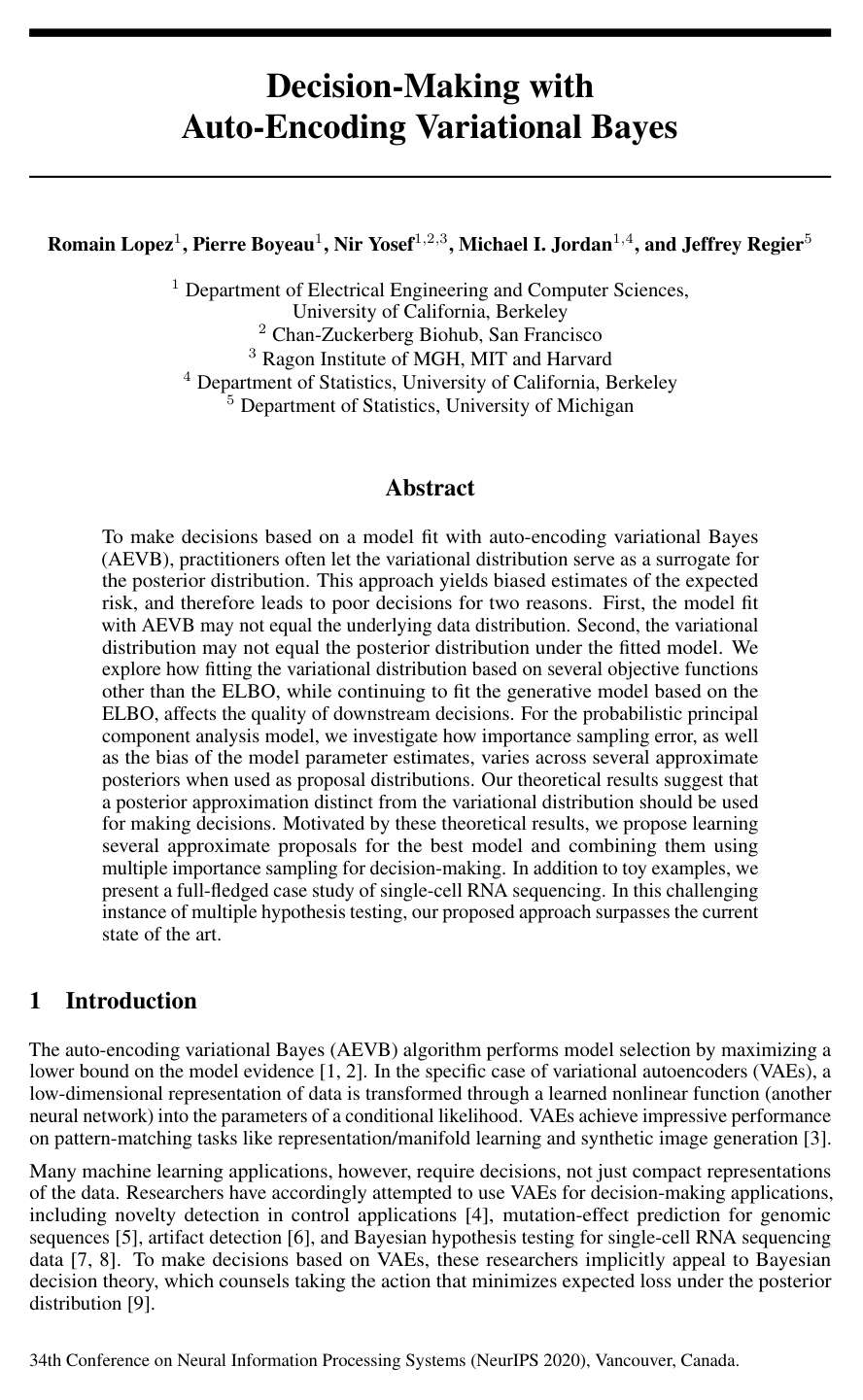
To make decisions based on a model fit with auto-encoding variational Bayes (AEVB), practitioners often let the variational distribution serve as a surrogate for the posterior distribution. This approach yields biased estimates of the expected risk, and therefore leads to poor decisions for two reasons. First, the model fit with AEVB may not equal the underlying data distribution. Second, the variational distribution may not equal the posterior distribution under the fitted model. We explore how fitting the variational distribution based on several objective functions other than the ELBO, while continuing to fit the generative model based on the ELBO, affects the quality of downstream decisions. For the probabilistic principal component analysis model, we investigate how importance sampling error, as well as the bias of the model parameter estimates, varies across several approximate posteriors when used as proposal distributions. Our theoretical results suggest that a posterior approximation distinct from the variational distribution should be used for making decisions. Motivated by these theoretical results, we propose learning several approximate proposals for the best model and combining them using multiple importance sampling for decision-making. In addition to toy examples, we present a full-fledged case study of single-cell RNA sequencing. In this challenging instance of multiple hypothesis testing, our proposed approach surpasses the current state of the art.
Added
2026-09-05

An Introduction to Bayesian and Frequentist Simulation-Based Inference with Machine Learning
Maximilian Dax, Theo Heimel, Gilles Louppe
Why you should read this
Unifies Bayesian and frequentist foundations of neural simulation-based inference, explaining how methods like neural posterior and likelihood estimation solve scientific inverse problems alongside concrete validation strategies.
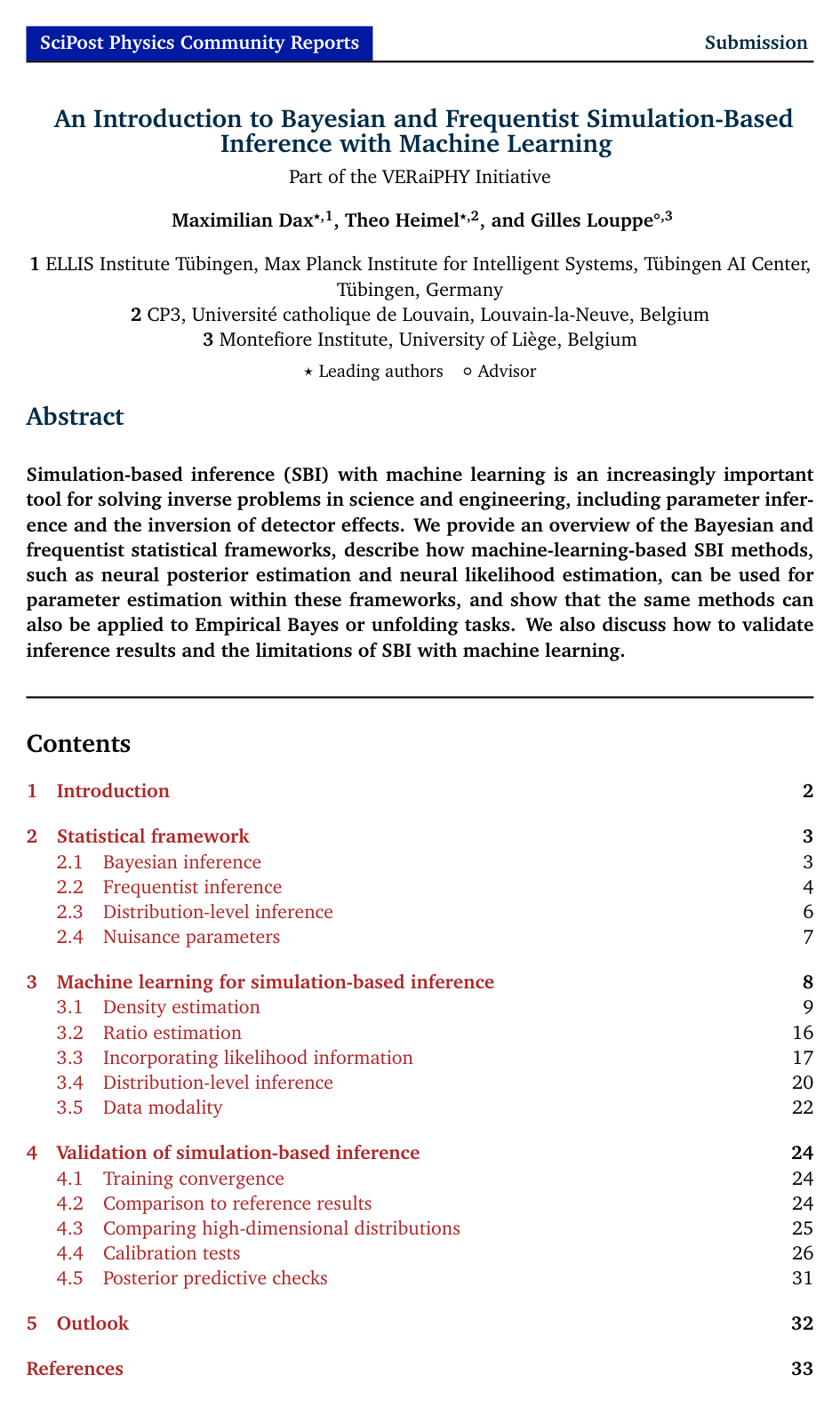
Simulation-based inference (SBI) with machine learning is an increasingly important tool for solving inverse problems in science and engineering, including parameter inference and the inversion of detector effects. We provide an overview of the Bayesian and frequentist statistical frameworks, describe how machine-learning-based SBI methods, such as neural posterior estimation and neural likelihood estimation, can be used for parameter estimation within these frameworks, and show that the same methods can also be applied to Empirical Bayes or unfolding tasks. We also discuss how to validate inference results and the limitations of SBI with machine learning.
Added
2026-08-24