
keyword
ImageNet accuracy
ImageNet accuracy is a standard performance metric in computer vision that measures the percentage of test images correctly classified by a machine learning model on the ImageNet benchmark dataset, most commonly the 1,000-class ImageNet Large Scale Visual Recognition Challenge. It is primarily evaluated as top-1 accuracy, indicating how often the model’s single highest-confidence prediction matches the ground-truth label, or top-5 accuracy, indicating how often the true label is within the model’s top five predicted classes. Beyond serving as a direct measure of visual categorization capability, ImageNet accuracy functions as a foundational yardstick across artificial intelligence research to compare neural network architectures, evaluate computational efficiency under resource constraints, and gauge how effectively learned visual representations transfer to downstream tasks.
5 items
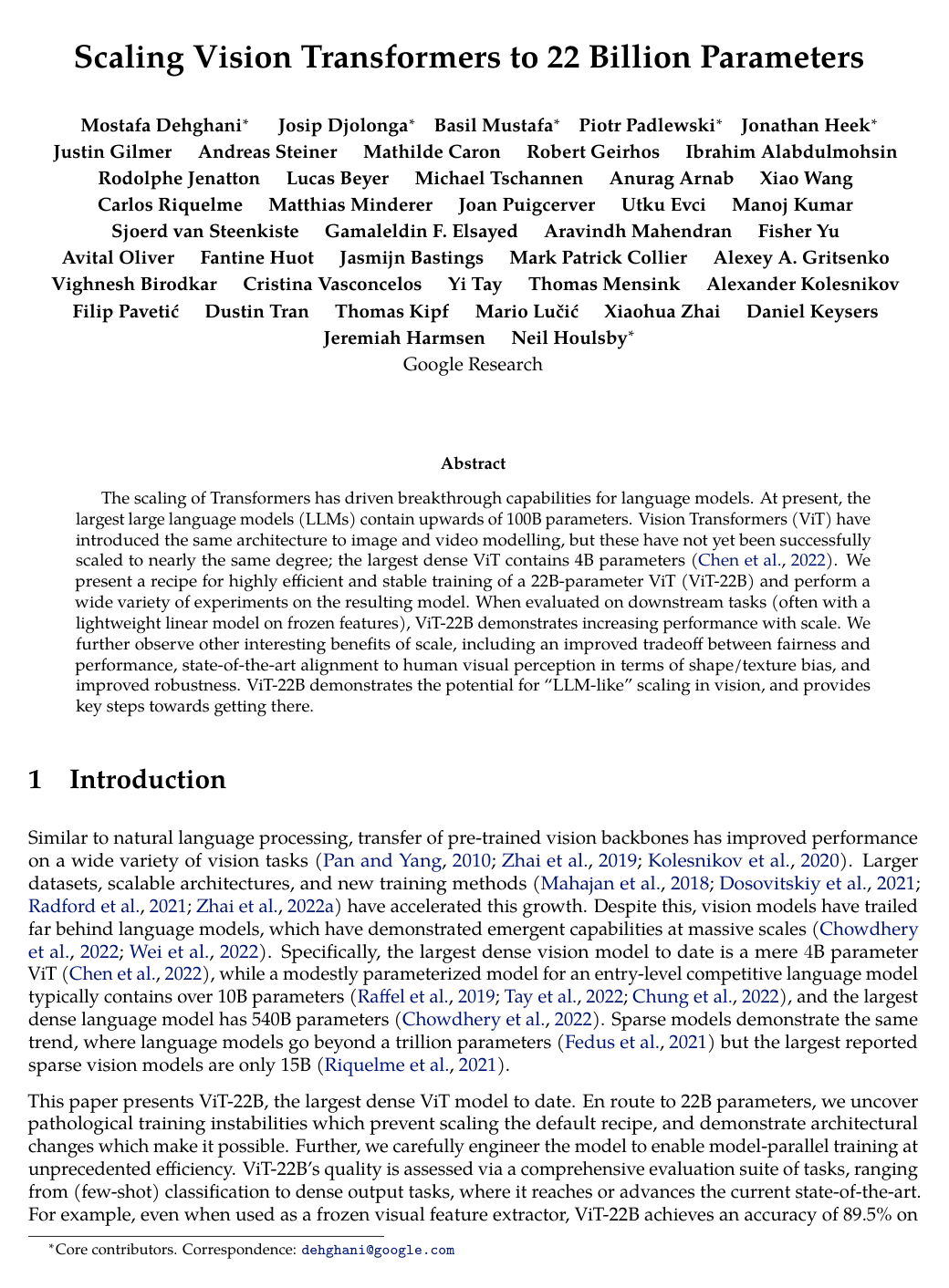
Scaling Vision Transformers to 22 Billion Parameters
Mostafa Dehghani, Josip Djolonga, Basil Mustafa, Piotr Padlewski, Jonathan Heek, Justin Gilmer, Andreas Peter Steiner, Mathilde Caron, Robert Geirhos, Ibrahim Alabdulmohsin, Rodolphe Jenatton, Lucas Beyer, Michael Tschannen, Anurag Arnab, Xiao Wang, Carlos Riquelme Ruiz, Matthias Minderer, Joan Puigcerver, Utku Evci, Manoj Kumar, Sjoerd van Steenkiste, Gamaleldin Fathy Elsayed, Aravindh Mahendran, Fisher Yu, Avital Oliver, Fantine Huot, Jasmijn Bastings, Mark Collier, Alexey A. Gritsenko, Vighnesh Birodkar, Cristina Nader Vasconcelos, Yi Tay, Thomas Mensink, Alexander Kolesnikov, Filip Pavetic, Dustin Tran, Thomas Kipf, Mario Lucic, Xiaohua Zhai, Daniel Keysers, Jeremiah J. Harmsen, Neil Houlsby
Why you should read this
Introduces an efficient training recipe for a 22-billion-parameter Vision Transformer, demonstrating that language-model-scale vision architectures achieve strong downstream performance, improved fairness tradeoffs, and closer alignment with human visual perception.
The scaling of Transformers has driven breakthrough capabilities for language models. At present, the largest large language models (LLMs) contain upwards of 100B parameters. Vision Transformers (ViT) have introduced the same architecture to image and video modelling, but these have not yet been successfully scaled to nearly the same degree; the largest dense ViT contains 4B parameters (Chen et al., 2022). We present a recipe for highly efficient and stable training of a 22B-parameter ViT (ViT-22B) and perform a wide variety of experiments on the resulting model. When evaluated on downstream tasks (often with a lightweight linear model on frozen features), ViT-22B demonstrates increasing performance with scale. We further observe other interesting benefits of scale, including an improved tradeoff between fairness and performance, state-of-the-art alignment to human visual perception in terms of shape/texture bias, and improved robustness. ViT-22B demonstrates the potential for "LLM-like" scaling in vision, and provides key steps towards getting there.
Added
2026-09-28
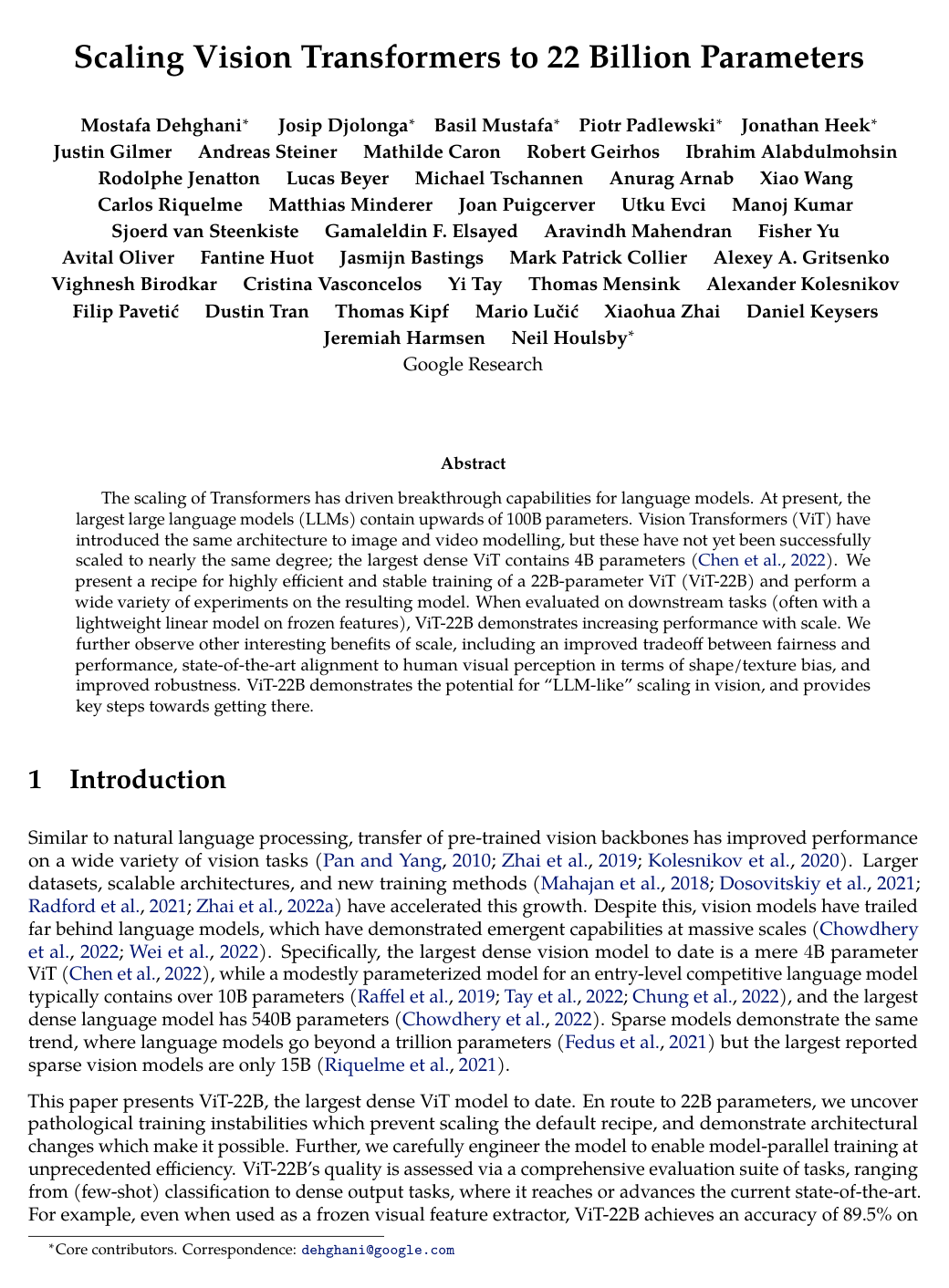
Scaling Vision Transformers
Xiaohua Zhai, Alexander Kolesnikov, Neil Houlsby, Lucas Beyer
Why you should read this
Establishes empirical scaling laws relating compute, data, and model size for Vision Transformers, showing how memory-efficient architecture refinements allow a two-billion-parameter model to achieve 90.45% top-1 accuracy on ImageNet.
Attention-based neural networks such as the Vision Transformer (ViT) have recently attained state-of-the-art results on many computer vision benchmarks. Scale is a primary ingredient in attaining excellent results, therefore, understanding a model's scaling properties is a key to designing future generations effectively. While the laws for scaling Transformer language models have been studied, it is unknown how Vision Transformers scale. To address this, we scale ViT models and data, both up and down, and characterize the relationships between error rate, data, and compute. Along the way, we refine the architecture and training of ViT, reducing memory consumption and increasing accuracy of the resulting models. As a result, we successfully train a ViT model with two billion parameters, which attains a new state-of-the-art on ImageNet of 90.45% top-1 accuracy. The model also performs well for few-shot transfer, for example, reaching 84.86% top-1 accuracy on ImageNet with only 10 examples per class.
Added
2026-09-25
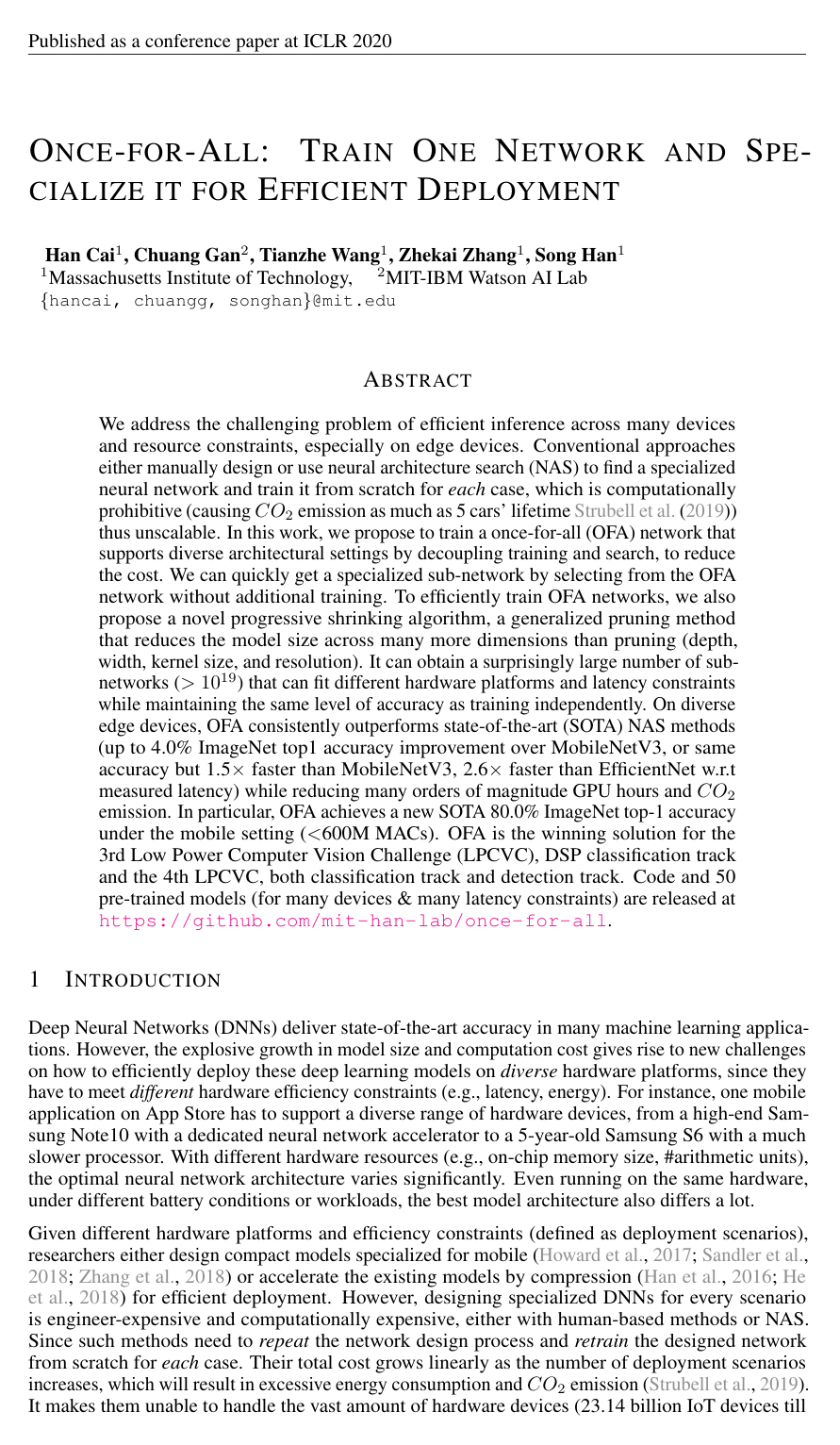
Once for All: Train One Network and Specialize it for Efficient Deployment
Han Cai, Chuang Gan, Song Han
Why you should read this
Proposes a once-for-all network training approach and a progressive shrinking algorithm that decouples model training from architecture search, enabling instant extraction of over accurate, hardware-tailored sub-networks without retraining while cutting carbon emissions and compute costs by orders of magnitude.
We address the challenging problem of efficient inference across many devices and resource constraints, especially on edge devices. Conventional approaches either manually design or use neural architecture search (NAS) to find a specialized neural network and train it from scratch for each case, which is computationally prohibitive (causing emission as much as 5 cars' lifetime) thus unscalable. In this work, we propose to train a once-for-all (OFA) network that supports diverse architectural settings by decoupling training and search, to reduce the cost. We can quickly get a specialized sub-network by selecting from the OFA network without additional training. To efficiently train OFA networks, we also propose a novel progressive shrinking algorithm, a generalized pruning method that reduces the model size across many more dimensions than pruning (depth, width, kernel size, and resolution). It can obtain a surprisingly large number of sub-networks () that can fit different hardware platforms and latency constraints while maintaining the same level of accuracy as training independently. On diverse edge devices, OFA consistently outperforms state-of-the-art (SOTA) NAS methods (up to 4.0% ImageNet top1 accuracy improvement over MobileNetV3, or same accuracy but 1.5x faster than MobileNetV3, 2.6x faster than EfficientNet w.r.t measured latency) while reducing many orders of magnitude GPU hours and emission. In particular, OFA achieves a new SOTA 80.0% ImageNet top-1 accuracy under the mobile setting (600M MACs). OFA is the winning solution for the 3rd Low Power Computer Vision Challenge (LPCVC), DSP classification track and the 4th LPCVC, both classification track and detection track. Code and 50 pre-trained models (for many devices & many latency constraints) are released at this https URL.
Added
2026-09-25

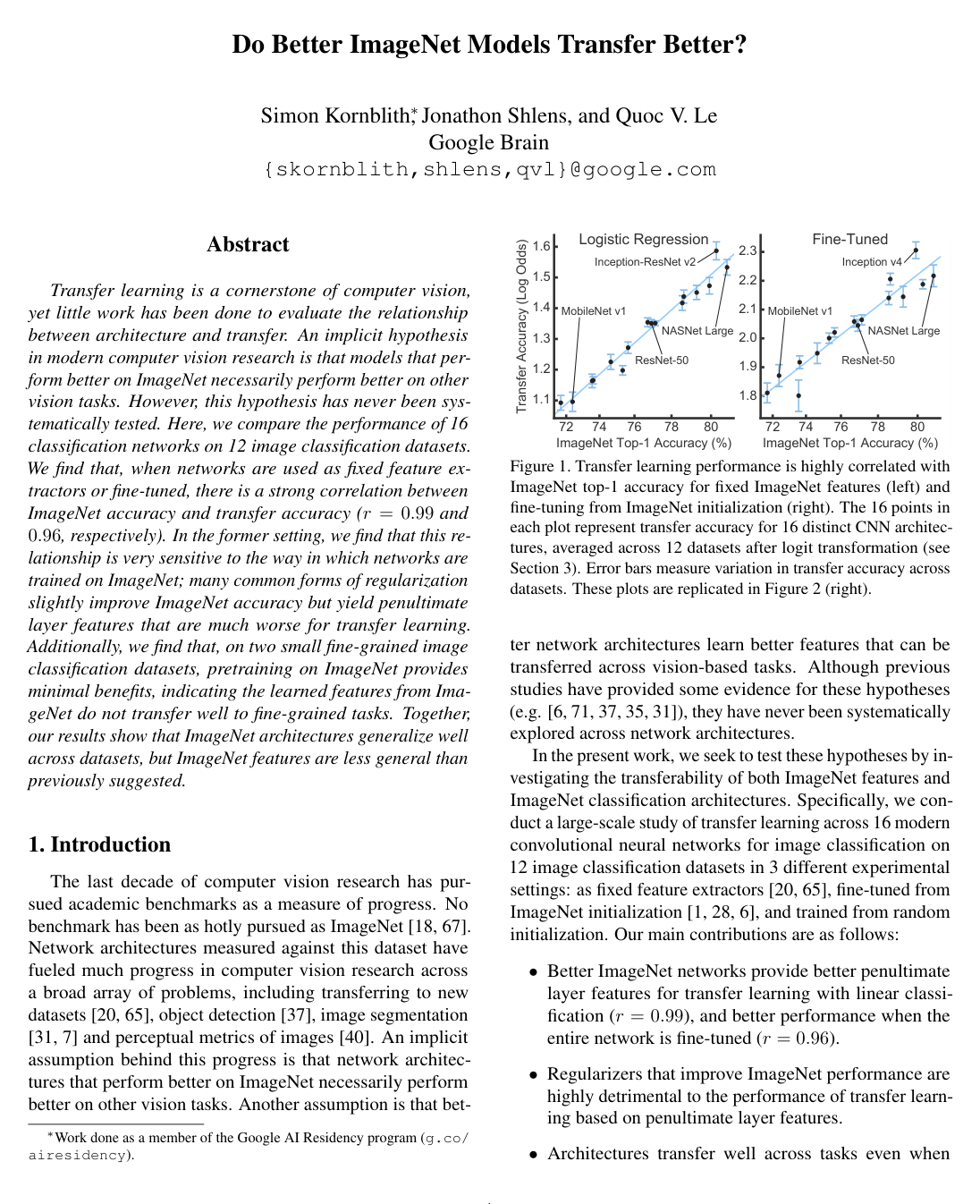
Do Better ImageNet Models Transfer Better?
Simon Kornblith, Jonathon Shlens, Quoc V. Le
Why you should read this
Establishes a strong correlation between ImageNet classification accuracy and downstream transfer performance across sixteen neural architectures, while showing that common regularization techniques can unexpectedly degrade learned feature representations.
Transfer learning is a cornerstone of computer vision, yet little work has been done to evaluate the relationship between architecture and transfer. An implicit hypothesis in modern computer vision research is that models that perform better on ImageNet necessarily perform better on other vision tasks. However, this hypothesis has never been systematically tested. Here, we compare the performance of 16 classification networks on 12 image classification datasets. We find that, when networks are used as fixed feature extractors or fine-tuned, there is a strong correlation between ImageNet accuracy and transfer accuracy ( and , respectively). In the former setting, we find that this relationship is very sensitive to the way in which networks are trained on ImageNet; many common forms of regularization slightly improve ImageNet accuracy but yield penultimate layer features that are much worse for transfer learning. Additionally, we find that, on two small fine-grained image classification datasets, pretraining on ImageNet provides minimal benefits, indicating the learned features from ImageNet do not transfer well to fine-grained tasks. Together, our results show that ImageNet architectures generalize well across datasets, but ImageNet features are less general than previously suggested.
Added
2026-09-24
Searching for MobileNetV3
Andrew Howard, Mark Sandler, Grace Chu, Liang-Chieh Chen, Bo Chen, Mingxing Tan, Weijun Wang, Yukun Zhu, Ruoming Pang, Vijay Vasudevan, Quoc V. Le, Hartwig Adam
Why you should read this
Presents MobileNetV3, a family of efficient neural architectures developed through a combination of hardware-aware automated search and manual design advances to achieve higher accuracy with lower latency on mobile computer vision tasks.
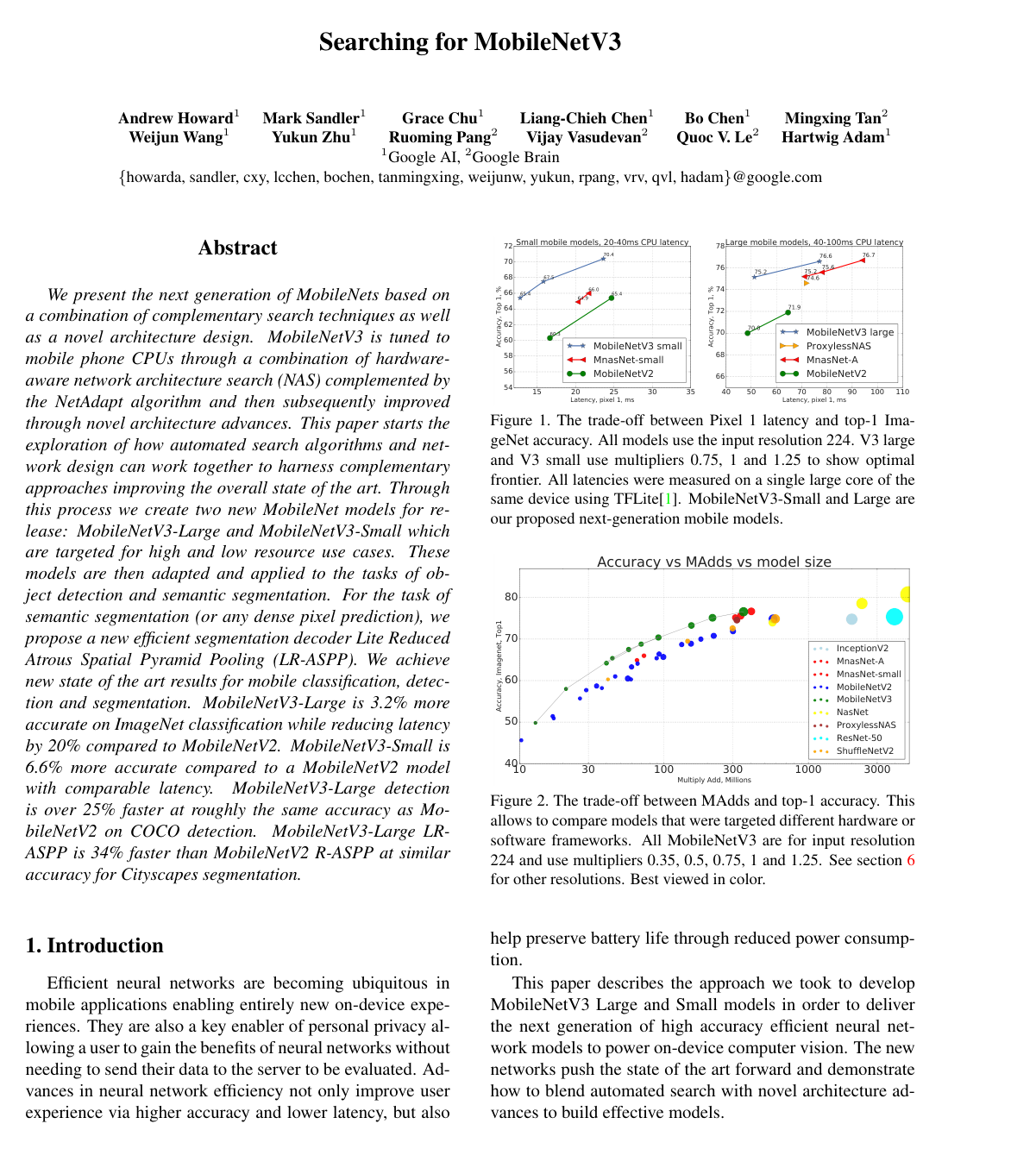
We present the next generation of MobileNets based on a combination of complementary search techniques as well as a novel architecture design. MobileNetV3 is tuned to mobile phone CPUs through a combination of hardware-aware network architecture search (NAS) complemented by the NetAdapt algorithm and then subsequently improved through novel architecture advances. This paper starts the exploration of how automated search algorithms and network design can work together to harness complementary approaches improving the overall state of the art. Through this process we create two new MobileNet models for release: MobileNetV3-Large and MobileNetV3-Small which are targeted for high and low resource use cases. These models are then adapted and applied to the tasks of object detection and semantic segmentation. For the task of semantic segmentation (or any dense pixel prediction), we propose a new efficient segmentation decoder Lite Reduced Atrous Spatial Pyramid Pooling (LR-ASPP). We achieve new state of the art results for mobile classification, detection and segmentation. MobileNetV3-Large is 3.2\% more accurate on ImageNet classification while reducing latency by 15\% compared to MobileNetV2. MobileNetV3-Small is 4.6\% more accurate while reducing latency by 5\% compared to MobileNetV2. MobileNetV3-Large detection is 25\% faster at roughly the same accuracy as MobileNetV2 on COCO detection. MobileNetV3-Large LR-ASPP is 30\% faster than MobileNetV2 R-ASPP at similar accuracy for Cityscapes segmentation.
Added
2026-09-07