
keyword
image transformers
Image transformers are deep learning neural network architectures based on the self-attention mechanism that process visual data by dividing images into sequences of patches or tokens. Originally adapted from transformer models in natural language processing, they replace or augment traditional convolutional neural networks by directly modeling global, long-range spatial dependencies across an entire image without relying heavily on localized inductive biases. These architectures serve as foundational backbones for a wide range of computer vision applications, including image classification, object detection, semantic segmentation, and generative modeling, demonstrating high scalability when trained with large datasets and computational capacity.
3 items
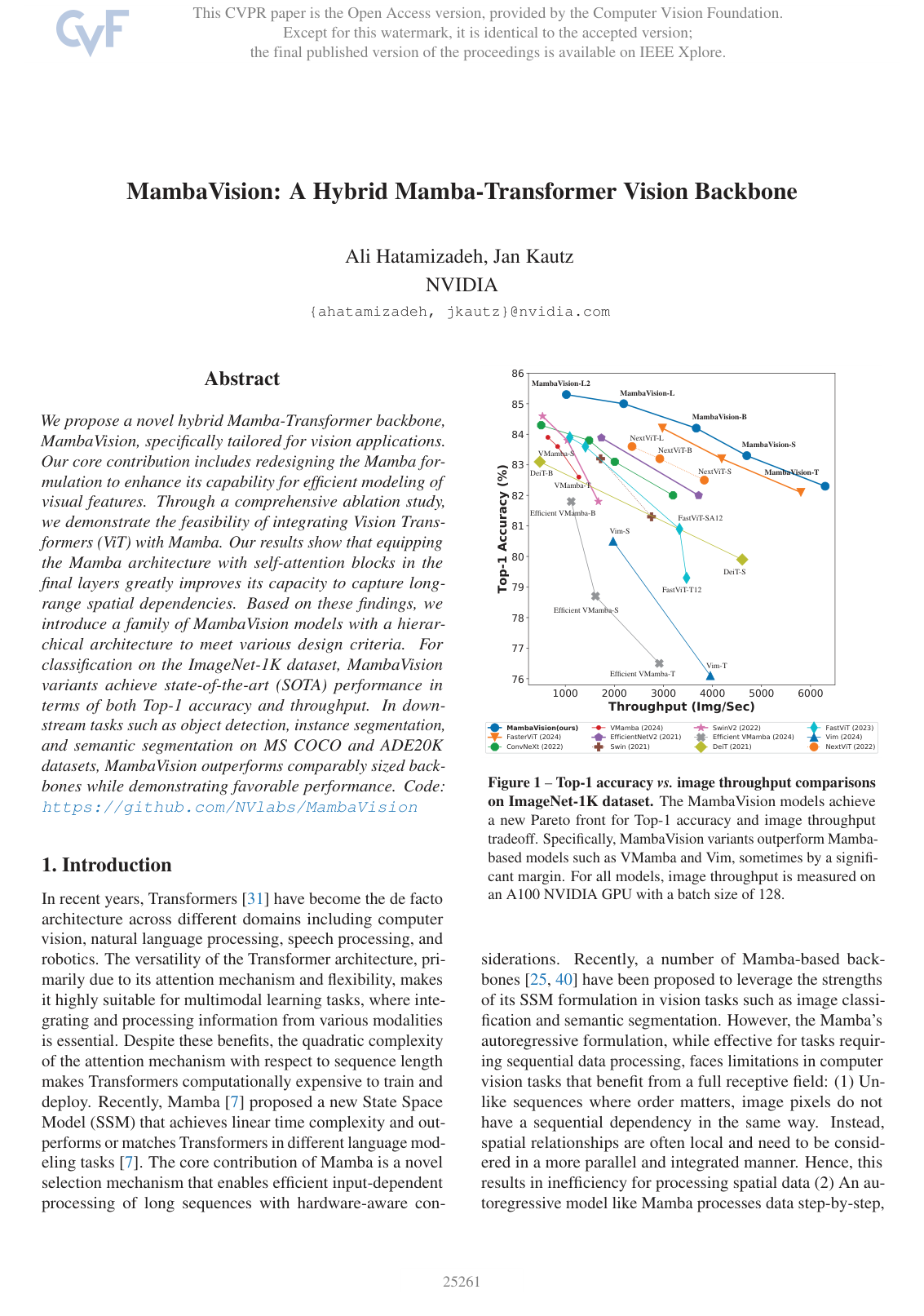
MambaVision: A Hybrid Mamba-Transformer Vision Backbone
Ali Hatamizadeh, Jan Kautz
Why you should read this
Introduces a hybrid vision backbone that strategically places self-attention layers after redesigned Mamba blocks, establishing a new Pareto frontier for the trade-off between ImageNet-1K accuracy and image throughput.
We propose a novel hybrid Mamba-Transformer backbone, MambaVision, specifically tailored for vision applications. Our core contribution includes redesigning the Mamba formulation to enhance its capability for efficient modeling of visual features. Through a comprehensive ablation study, we demonstrate the feasibility of integrating Vision Transformers (ViT) with Mamba. Our results show that equipping the Mamba architecture with self-attention blocks in the final layers greatly improves its capacity to capture long-range spatial dependencies. Based on these findings, we introduce a family of MambaVision models with a hierarchical architecture to meet various design criteria. For classification on the ImageNet-1K dataset, MambaVision variants achieve state-of-the-art (SOTA) performance in terms of both Top-1 accuracy and throughput. In downstream tasks such as object detection, instance segmentation, and semantic segmentation on MS COCO and ADE20K datasets, MambaVision outperforms comparably sized backbones while demonstrating favorable performance. Code: https://github.com/NVlabs/MambaVision
Added
2026-09-26
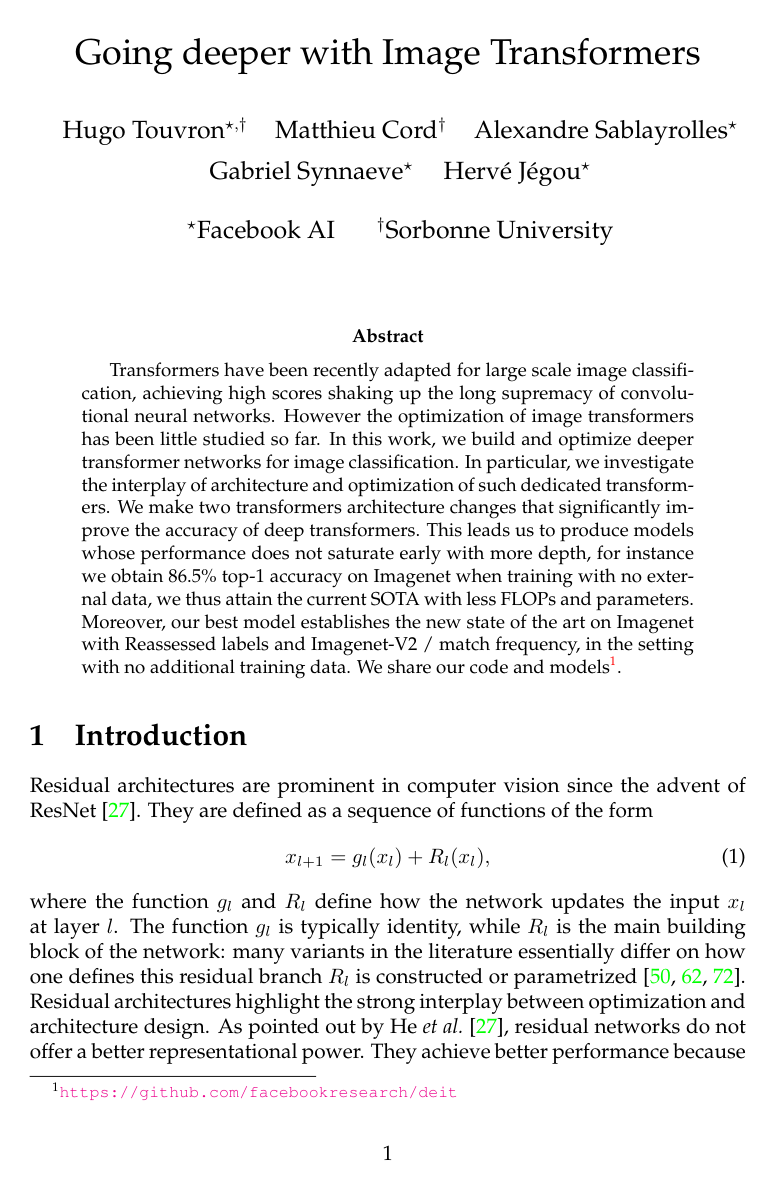
Going deeper with Image Transformers
Hugo Touvron, Matthieu Cord, Alexandre Sablayrolles, Gabriel Synnaeve, Hervé Jégou
Why you should read this
Develops architectural modifications that prevent performance saturation in deep vision transformers, achieving state-of-the-art ImageNet accuracy with fewer parameters and no external training data.
Transformers have been recently adapted for large scale image classification, achieving high scores shaking up the long supremacy of convolutional neural networks. However the optimization of image transformers has been little studied so far. In this work, we build and optimize deeper transformer networks for image classification. In particular, we investigate the interplay of architecture and optimization of such dedicated transformers. We make two transformers architecture changes that significantly improve the accuracy of deep transformers. This leads us to produce models whose performance does not saturate early with more depth, for instance we obtain 86.5% top-1 accuracy on Imagenet when training with no external data, we thus attain the current SOTA with less FLOPs and parameters. Moreover, our best model establishes the new state of the art on Imagenet with Reassessed labels and Imagenet-V2 / match frequency, in the setting with no additional training data. We share our code and models.
Added
2026-09-25
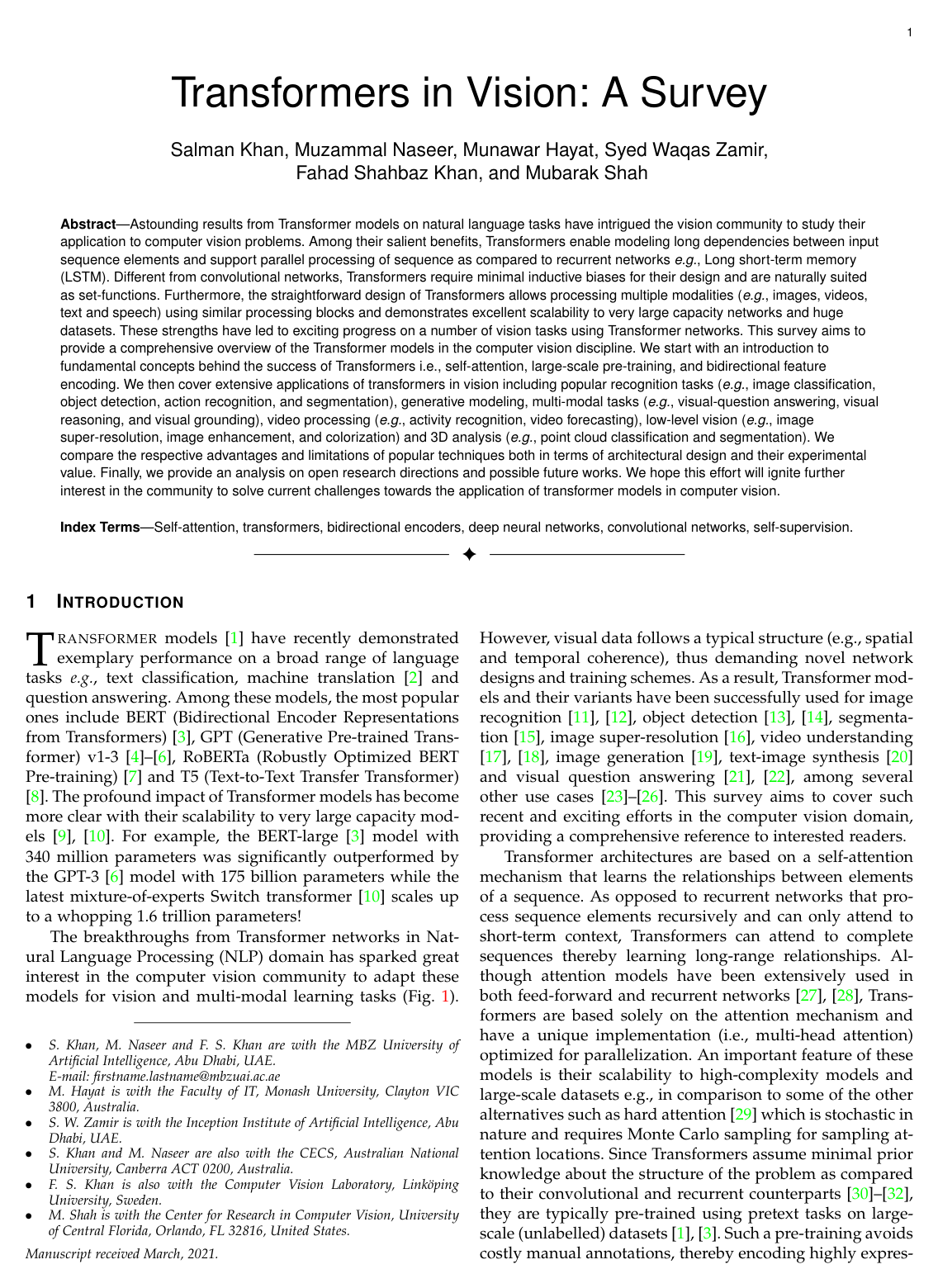
Transformers in Vision: A Survey
Salman Khan, Muzammal Naseer, Munawar Hayat, Syed Waqas Zamir, Fahad Shahbaz Khan, Mubarak Shah
Why you should read this
Provides a systematic taxonomy of vision transformer architectures across recognition, generative, multi-modal, and 3D vision tasks, comparing their foundational mechanisms, performance trade-offs, and open challenges.
Astounding results from Transformer models on natural language tasks have intrigued the vision community to study their application to computer vision problems. Among their salient benefits, Transformers enable modeling long dependencies between input sequence elements and support parallel processing of sequence as compared to recurrent networks e.g., Long short-term memory (LSTM). Different from convolutional networks, Transformers require minimal inductive biases for their design and are naturally suited as set-functions. Furthermore, the straightforward design of Transformers allows processing multiple modalities (e.g., images, videos, text and speech) using similar processing blocks and demonstrates excellent scalability to very large capacity networks and huge datasets. These strengths have led to exciting progress on a number of vision tasks using Transformer networks. This survey aims to provide a comprehensive overview of the Transformer models in the computer vision discipline. We start with an introduction to fundamental concepts behind the success of Transformers i.e., self-attention, large-scale pre-training, and bidirectional encoding. We then cover extensive applications of transformers in vision including popular recognition tasks (e.g., image classification, object detection, action recognition, and segmentation), generative modeling, multi-modal tasks (e.g., visual-question answering, visual reasoning, and visual grounding), video processing (e.g., activity recognition, video forecasting), low-level vision (e.g., image super-resolution, image enhancement, and colorization) and 3D analysis (e.g., point cloud classification and segmentation). We compare the respective advantages and limitations of popular techniques both in terms of architectural design and their experimental value. Finally, we provide an analysis on open research directions and possible future works.
Added
2026-09-14