
keyword
image deraining
Image deraining is a computer vision and digital image restoration process focused on removing rain-induced degradations, such as rain streaks, rain accumulation, and raindrops, from photographs captured in rainy conditions. The goal is to recover a clear, high-quality background scene while preserving the underlying structural details, textures, and color information that were obscured or blurred by precipitation. Addressed through techniques ranging from traditional filtering and optimization frameworks to modern deep learning models, image deraining serves as a fundamental low-level enhancement step that improves human visual perception and boosts the accuracy of downstream vision tasks, including autonomous driving systems, outdoor surveillance, and object detection.
4 items
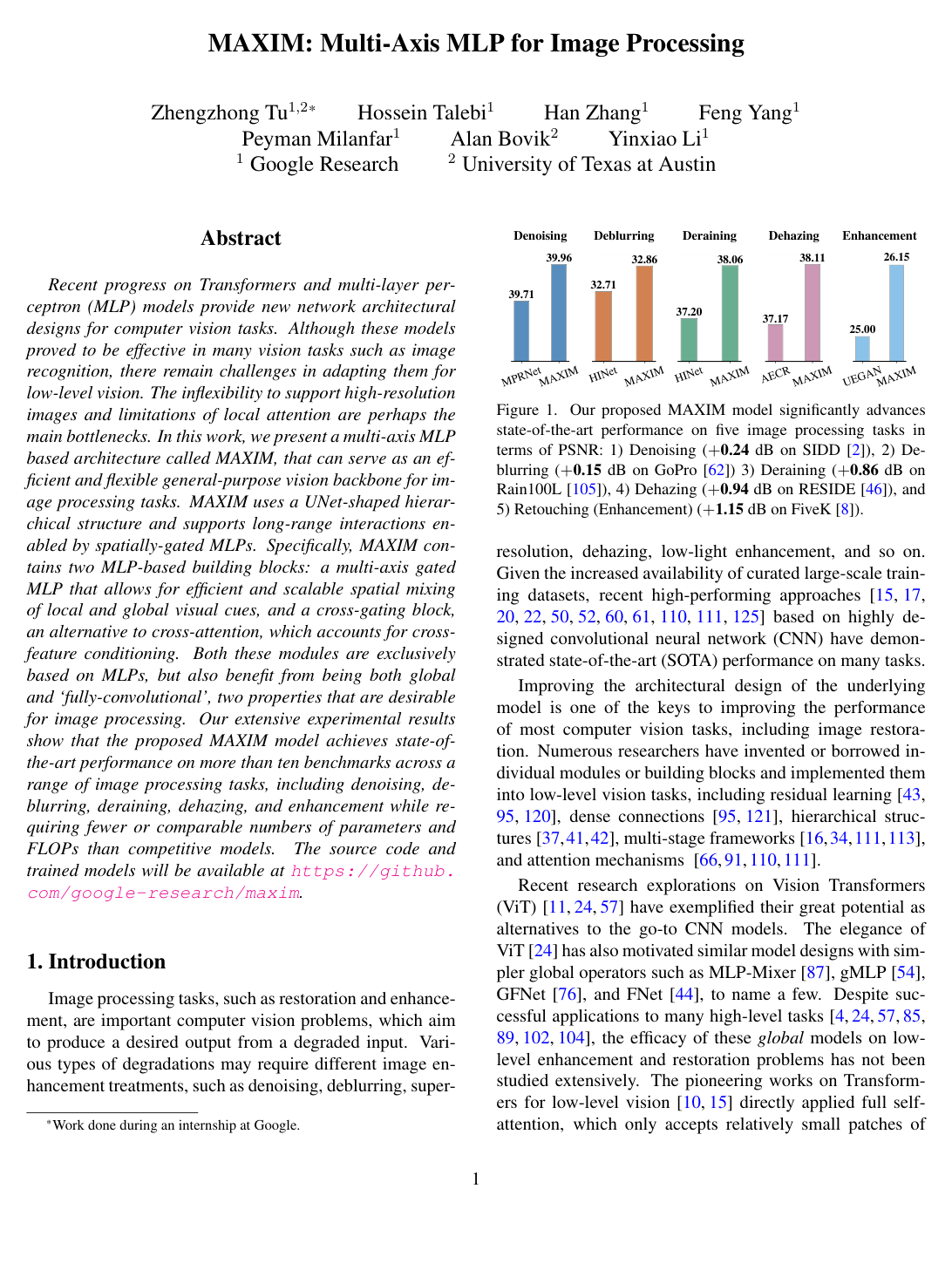
MAXIM: Multi-Axis MLP for Image Processing
Zhengzhong Tu, Hossein Talebi, Han Zhang, Feng Yang, Peyman Milanfar, Alan C. Bovik, Yinxiao Li
Why you should read this
Introduces MAXIM, a multi-axis MLP architecture that delivers state-of-the-art performance across more than ten image processing benchmarks—including denoising, deblurring, and deraining—by enabling efficient global spatial mixing within a UNet-shaped hierarchy.
Recent progress on Transformers and multi-layer perceptron (MLP) models provide new network architectural designs for computer vision tasks. Although these models proved to be effective in many vision tasks such as image recognition, there remain challenges in adapting them for low-level vision. The inflexibility to support high-resolution images and limitations of local attention are perhaps the main bottlenecks. In this work, we present a multi-axis MLP based architecture called MAXIM, that can serve as an efficient and flexible general-purpose vision backbone for image processing tasks. MAXIM uses a UNet-shaped hierarchical structure and supports long-range interactions enabled by spatially-gated MLPs. Specifically, MAXIM contains two MLP-based building blocks: a multi-axis gated MLP that allows for efficient and scalable spatial mixing of local and global visual cues, and a cross-gating block, an alternative to cross-attention, which accounts for cross-feature conditioning. Both these modules are exclusively based on MLPs, but also benefit from being both global and `fully-convolutional', two properties that are desirable for image processing. Our extensive experimental results show that the proposed MAXIM model achieves state-of-the-art performance on more than ten benchmarks across a range of image processing tasks, including denoising, deblurring, deraining, dehazing, and enhancement while requiring fewer or comparable numbers of parameters and FLOPs than competitive models. The source code and trained models will be available at \url{this https URL}.
Added
2026-10-05
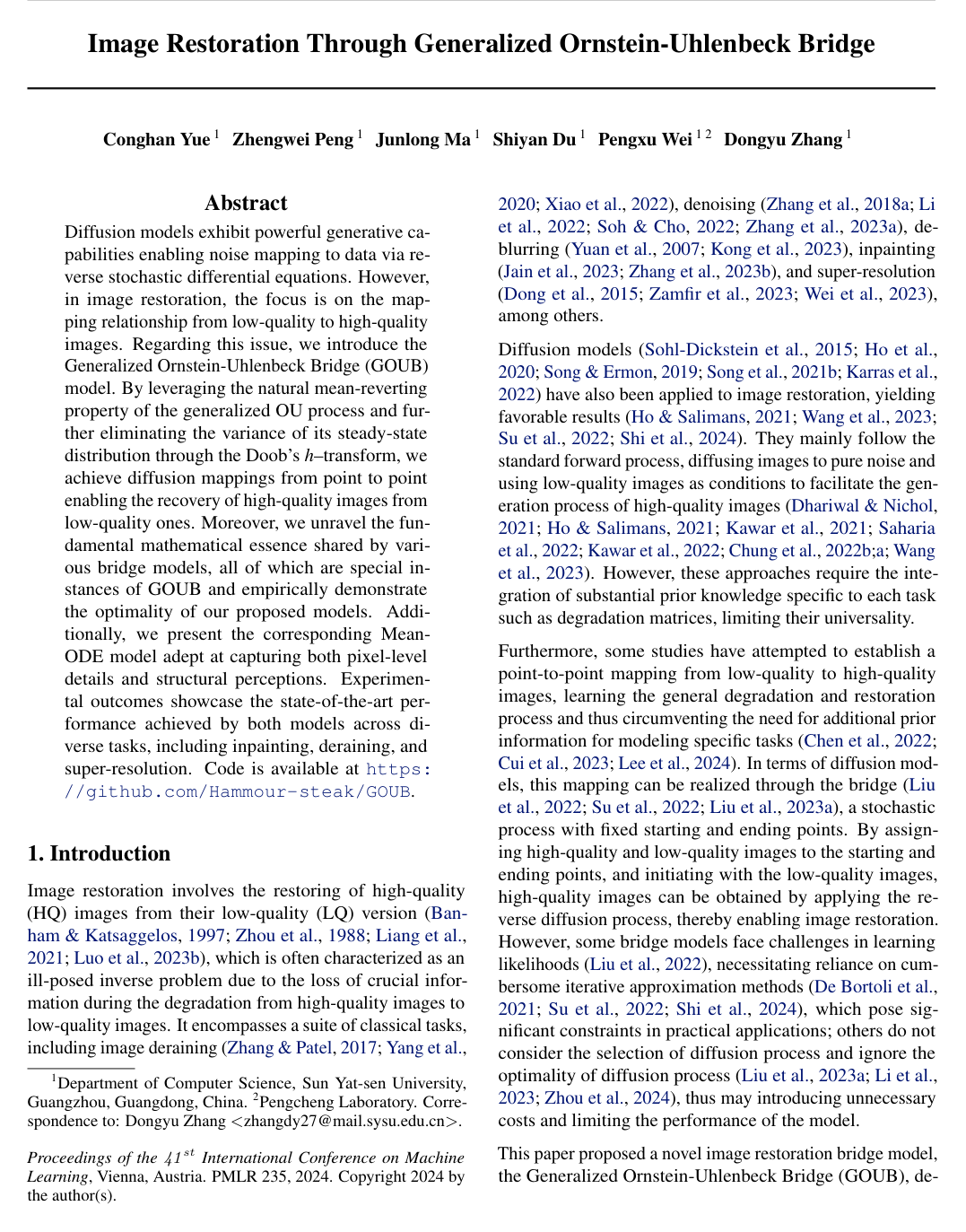
Image Restoration Through Generalized Ornstein-Uhlenbeck Bridge
Conghan Yue, Zhengwei Peng, Junlong Ma, Shiyan Du, Pengxu Wei, Dongyu Zhang
Why you should read this
Proposes a Generalized Ornstein-Uhlenbeck Bridge framework that applies Doob's h-transform to establish direct point-to-point diffusion mappings between low- and high-quality images, unifying existing bridge methods and achieving state-of-the-art performance across inpainting, deraining, and super-resolution.
Diffusion models exhibit powerful generative capabilities enabling noise mapping to data via reverse stochastic differential equations. However, in image restoration, the focus is on the mapping relationship from low-quality to high-quality images. Regarding this issue, we introduce the Generalized Ornstein-Uhlenbeck Bridge (GOUB) model. By leveraging the natural mean-reverting property of the generalized OU process and further eliminating the variance of its steady-state distribution through the Doob's h-transform, we achieve diffusion mappings from point to point enabling the recovery of high-quality images from low-quality ones. Moreover, we unravel the fundamental mathematical essence shared by various bridge models, all of which are special instances of GOUB and empirically demonstrate the optimality of our proposed models. Additionally, we present the corresponding Mean-ODE model adept at capturing both pixel-level details and structural perceptions. Experimental outcomes showcase the state-of-the-art performance achieved by both models across diverse tasks, including inpainting, deraining, and super-resolution. Code is available at https://github.com/Hammour-steak/GOUB.
Added
2026-10-05
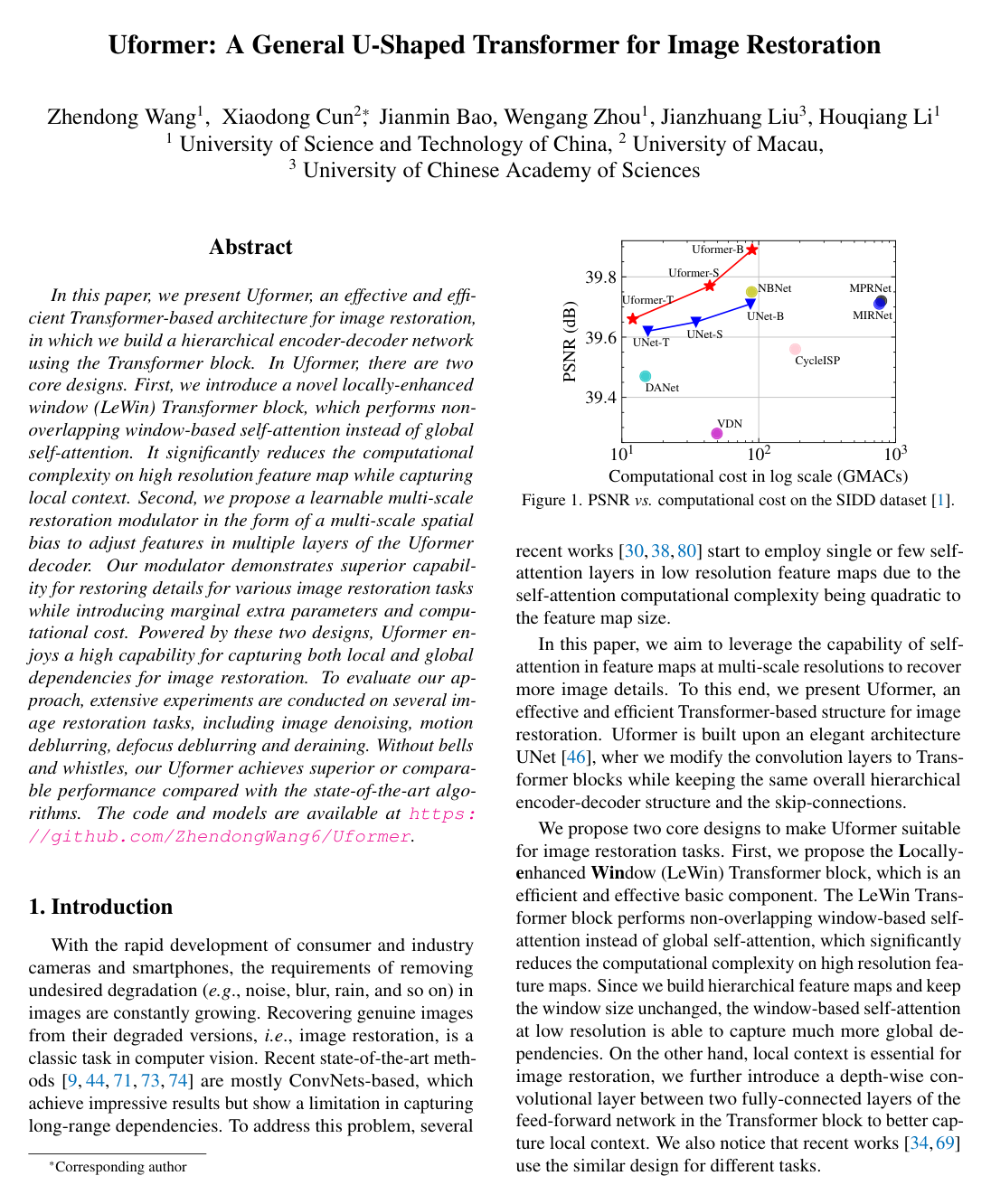
Uformer: A General U-Shaped Transformer for Image Restoration
Zhendong Wang, Xiaodong Cun, Jianmin Bao, Jianzhuang Liu
Why you should read this
Proposes a hierarchical U-shaped Transformer architecture that pairs window-based local self-attention with multi-scale feature modulation to efficiently capture both local and global dependencies across diverse image restoration tasks including denoising, deblurring, and deraining.
In this paper, we present Uformer, an effective and efficient Transformer-based architecture for image restoration, in which we build a hierarchical encoder-decoder network using the Transformer block. In Uformer, there are two core designs. First, we introduce a novel locally-enhanced window (LeWin) Transformer block, which performs nonoverlapping window-based self-attention instead of global self-attention. It significantly reduces the computational complexity on high resolution feature map while capturing local context. Second, we propose a learnable multi-scale restoration modulator in the form of a multi-scale spatial bias to adjust features in multiple layers of the Uformer decoder. Our modulator demonstrates superior capability for restoring details for various image restoration tasks while introducing marginal extra parameters and computational cost. Powered by these two designs, Uformer enjoys a high capability for capturing both local and global dependencies for image restoration. To evaluate our approach, extensive experiments are conducted on several image restoration tasks, including image denoising, motion deblurring, defocus deblurring and deraining. Without bells and whistles, our Uformer achieves superior or comparable performance compared with the state-of-the-art algorithms. The code and models are available at this https URL.
Added
2026-09-16
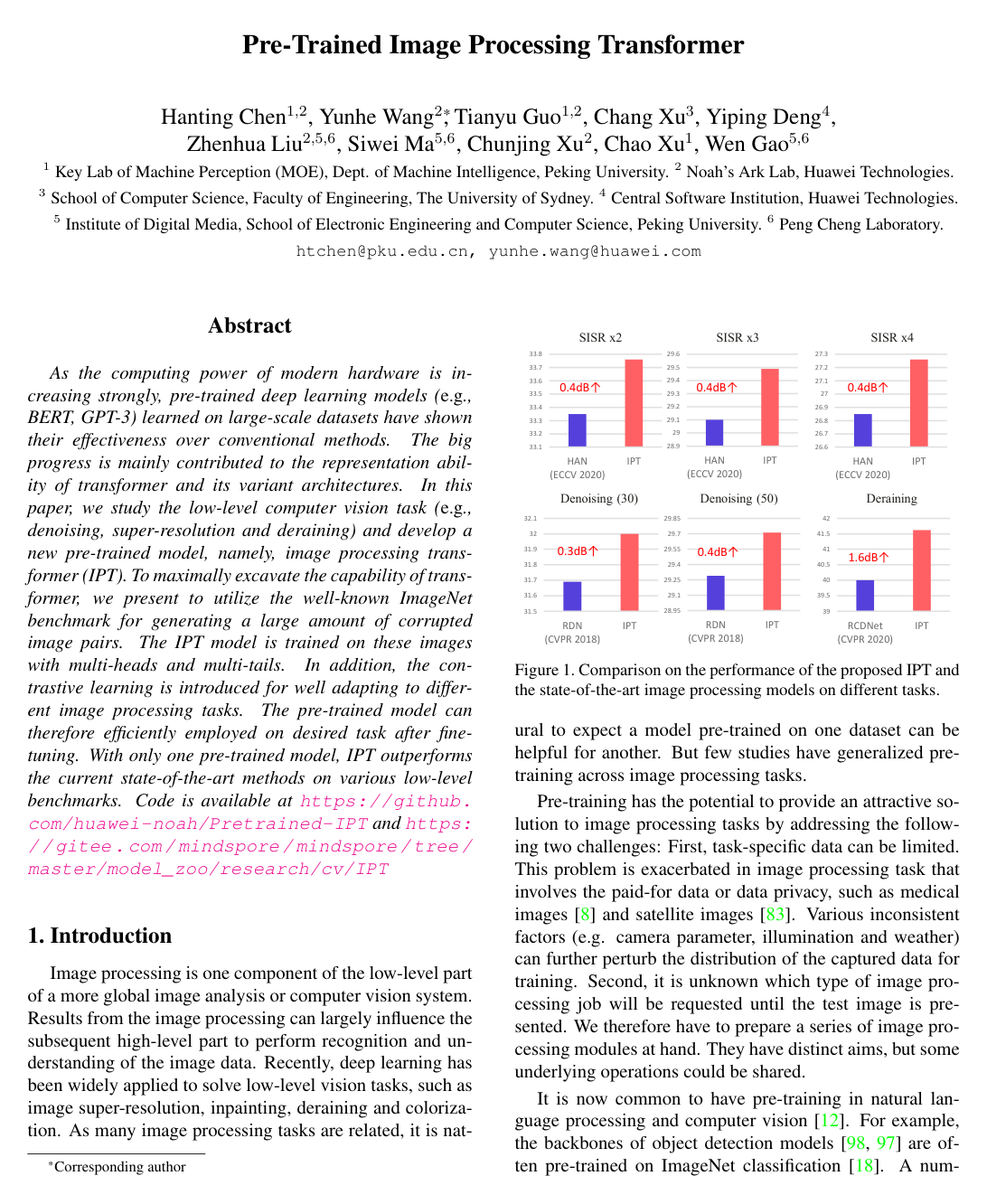
Pre-Trained Image Processing Transformer
Hanting Chen, Yunhe Wang, Tianyu Guo, Chang Xu, Yiping Deng, Zhenhua Liu, Siwei Ma, Chunjing Xu, Chao Xu, Wen Gao
Why you should read this
Introduces the Image Processing Transformer (IPT), a unified pre-trained architecture trained on large-scale corrupted datasets with contrastive learning to outperform specialized models across multiple low-level vision tasks such as super-resolution, denoising, and deraining.
As the computing power of modern hardware is increasing strongly, pre-trained deep learning models (e.g., BERT, GPT-3) learned on large-scale datasets have shown their effectiveness over conventional methods. The big progress is mainly contributed to the representation ability of transformer and its variant architectures. In this paper, we study the low-level computer vision task (e.g., denoising, super-resolution and deraining) and develop a new pre-trained model, namely, image processing transformer (IPT). To maximally excavate the capability of transformer, we present to utilize the well-known ImageNet benchmark for generating a large amount of corrupted image pairs. The IPT model is trained on these images with multi-heads and multi-tails. In addition, the contrastive learning is introduced for well adapting to different image processing tasks. The pre-trained model can therefore efficiently employed on desired task after fine-tuning. With only one pre-trained model, IPT outperforms the current state-of-the-art methods on various low-level benchmarks. Code is available at this https URL and this https URL
Added
2026-09-15