
keyword
image captioning
Image captioning is a multimodal artificial intelligence task at the intersection of computer vision and natural language processing that involves automatically generating descriptive natural language text for a given visual image. The process requires a computational system to recognize key visual elements—such as objects, actions, scene attributes, and spatial relationships—and synthesize them into coherent, grammatically correct sentences. Modern captioning frameworks commonly employ deep neural networks, including encoder-decoder architectures, visual attention mechanisms, and large vision-language models, to align visual feature representations with sequential text generation. This capability plays a critical role in practical applications such as assistive technologies for visually impaired individuals, content-based image retrieval, and automated digital media indexing.
32 items
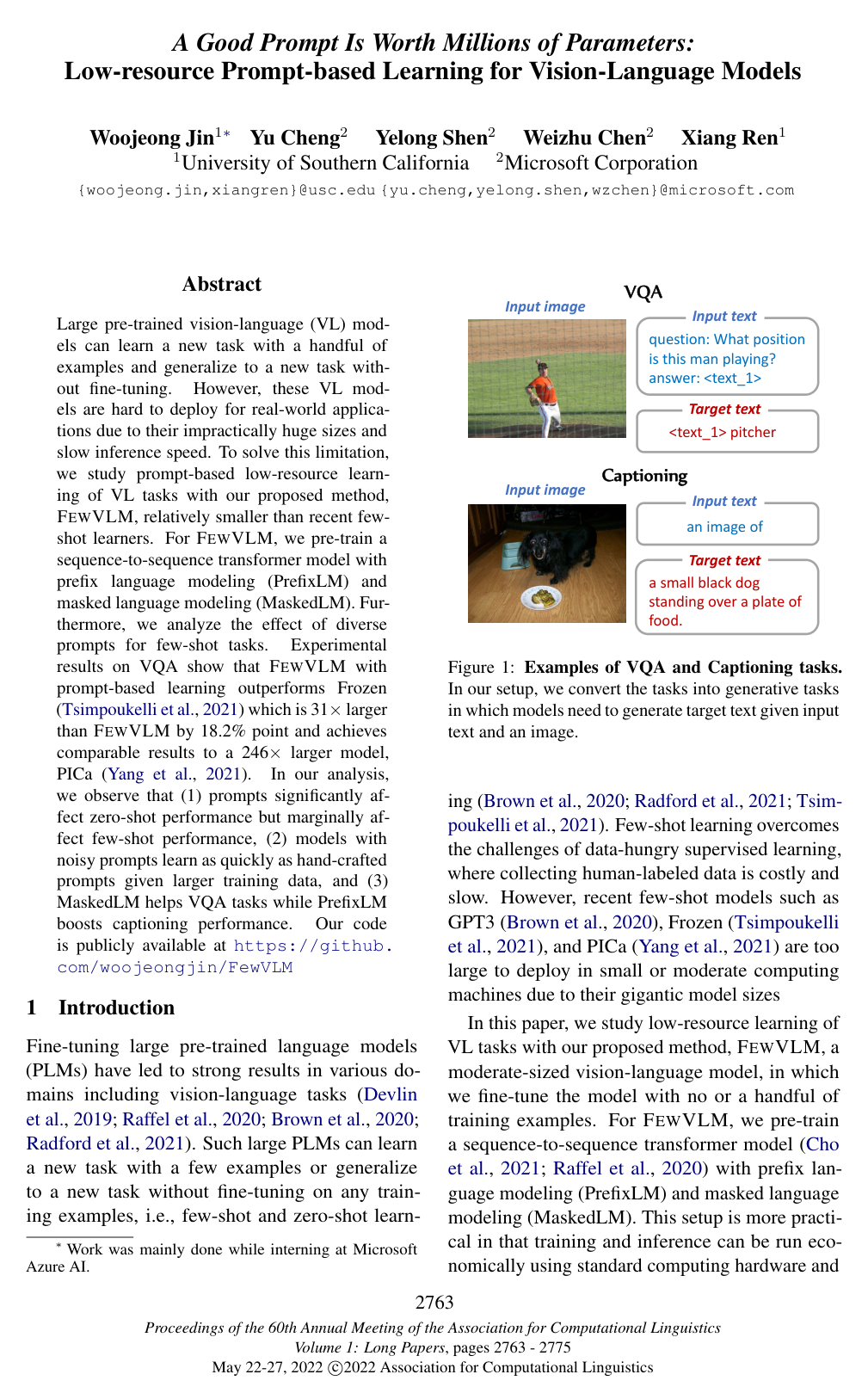
A Good Prompt Is Worth Millions of Parameters: Low-resource Prompt-based Learning for Vision-Language Models
Woojeong Jin, Yu Cheng, Yelong Shen, Weizhu Chen, Xiang Ren
Why you should read this
Proposes FewVLM, a sequence-to-sequence framework demonstrating that prompt-based learning enables compact vision-language models to match or exceed the zero-shot and few-shot performance of systems hundreds of times larger.
Added
2026-10-05
BLIVA: A Simple Multimodal LLM for Better Handling of Text-Rich Visual Questions
Wenbo Hu, Yifan Xu, Yi Li, Weiyue Li, Zeyuan Chen, Zhuowen Tu
Why you should read this
Proposes BLIVA, a multimodal architecture that combines learned query embeddings with directly projected visual patch embeddings to overcome token-bottleneck limitations and improve performance on text-rich visual question answering tasks.
Vision Language Models (VLMs), which extend Large Language Models (LLM) by incorporating visual understanding capability, have demonstrated significant advancements in addressing open-ended visual question-answering (VQA) tasks. However, these models cannot accurately interpret images infused with text, a common occurrence in real-world scenarios. Standard procedures for extracting information from images often involve learning a fixed set of query embeddings. These embeddings are designed to encapsulate image contexts and are later used as soft prompt inputs in LLMs. Yet, this process is limited to the token count, potentially curtailing the recognition of scenes with text-rich context. To improve upon them, the present study introduces BLIVA: an augmented version of InstructBLIP with Visual Assistant. BLIVA incorporates the query embeddings from InstructBLIP and also directly projects encoded patch embeddings into the LLM, a technique inspired by LLaVA. This approach assists the model to capture intricate details potentially missed during the query decoding process. Empirical evidence demonstrates that our model, BLIVA, significantly enhances performance in processing text-rich VQA benchmarks (up to 17.76% in OCR-VQA benchmark) and in understanding general (not particularly text-rich) VQA benchmarks (up to 7.9% in Visual Spatial Reasoning benchmark), and achieved 17.72% overall improvement in a comprehensive multimodal LLM benchmark (MME), comparing to our baseline InstructBLIP. BLIVA demonstrates significant capability in decoding real-world images, irrespective of text presence. To demonstrate the broad industry applications enabled by BLIVA, we evaluate the model using a new dataset comprising YouTube thumbnails paired with question-answer sets across 11 diverse categories. For researchers interested in further exploration, our code and models are freely accessible at https://github.com/mlpc-ucsd/BLIVA.
Added
2026-10-05
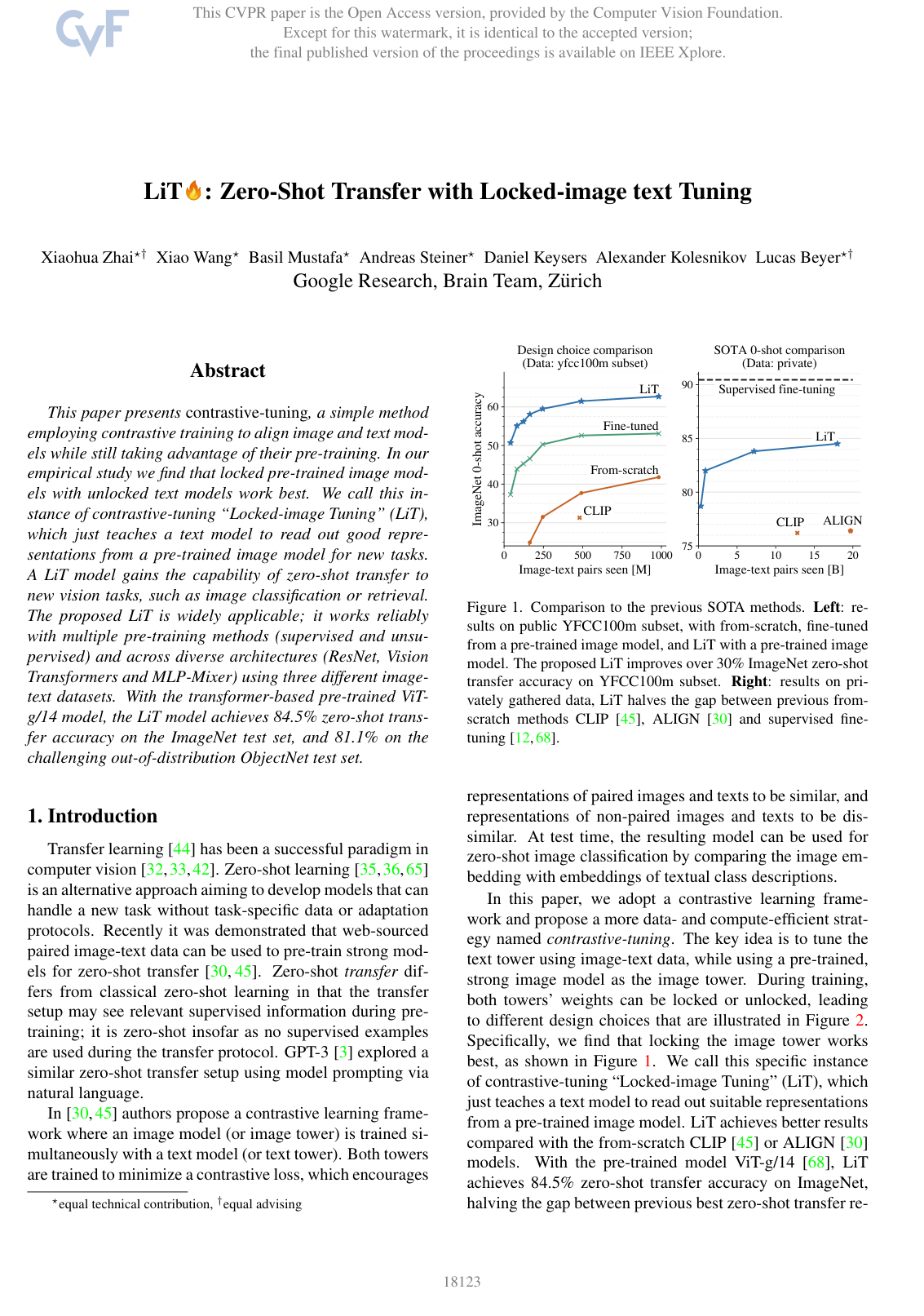
LiT: Zero-Shot Transfer with Locked-image text Tuning
Xiaohua Zhai, Xiao Wang, Basil Mustafa, Andreas Steiner, Daniel Keysers, Alexander Kolesnikov, Lucas Beyer
Why you should read this
Demonstrates that training a text model to align with a frozen, pre-trained image encoder significantly improves data and compute efficiency in zero-shot vision-language tasks, outperforming from-scratch contrastive learning baselines while achieving 84.5% top-1 accuracy on ImageNet.
This paper presents contrastive-tuning, a simple method employing contrastive training to align image and text models while still taking advantage of their pre-training. In our empirical study we find that locked pre-trained image models with unlocked text models work best. We call this instance of contrastive-tuning “Locked-image Tuning” (LiT), which just teaches a text model to read out good representations from a pre-trained image model for new tasks. A LiT model gains the capability of zero-shot transfer to new vision tasks, such as image classification or retrieval. The proposed LiT is widely applicable; it works reliably with multiple pre-training methods (supervised and unsupervised) and across diverse architectures (ResNet, Vision Transformers and MLP-Mixer) using three different image-text datasets. With the transformer-based pre-trained ViT-g/14 model, the LiT model achieves 84.5% zero-shot transfer accuracy on the ImageNet test set, and 81.1% on the challenging out-of-distribution ObjectNet test set.
Added
2026-10-05
ImageInWords: Unlocking Hyper-Detailed Image Descriptions
Roopal Garg, Andrea Burns, Burcu Karagol Ayan, Yonatan Bitton, Ceslee Montgomery, Yasumasa Onoe, Andrew Bunner, Ranjay Krishna, Jason Baldridge, Radu Soricut
Why you should read this
Presents a human-in-the-loop framework and dataset for producing hyper-detailed image descriptions that substantially outperform existing models and benchmarks in text-to-image generation and compositional reasoning tasks.
Despite the longstanding adage “an image is worth a thousand words,” generating accurate hyper-detailed image descriptions remains unsolved. Trained on short web-scraped image-text, vision-language models often generate incomplete descriptions with visual inconsistencies. We address this via a novel data-centric approach with ImageInWords (IIW), a carefully designed human-in-the-loop framework for curating hyper-detailed image descriptions. Human evaluations on IIW data show major gains compared to recent datasets (+66%) and GPT-4V (+48%) across comprehensiveness, specificity, hallucinations, and more. We also show that fine-tuning with IIW data improves these metrics by +31% against models trained with prior work, even with only 9k samples. Lastly, we evaluate IIW models with text-to-image generation and vision-language reasoning tasks. Our generated descriptions result in the highest fidelity images, and boost compositional reasoning by up to 6% on ARO, SVO-Probes, and Winoground datasets. We release the IIW-Eval benchmark with human judgement labels, object and image-level annotations from our framework, and existing image caption datasets enriched via IIW-model.
Added
2026-10-03
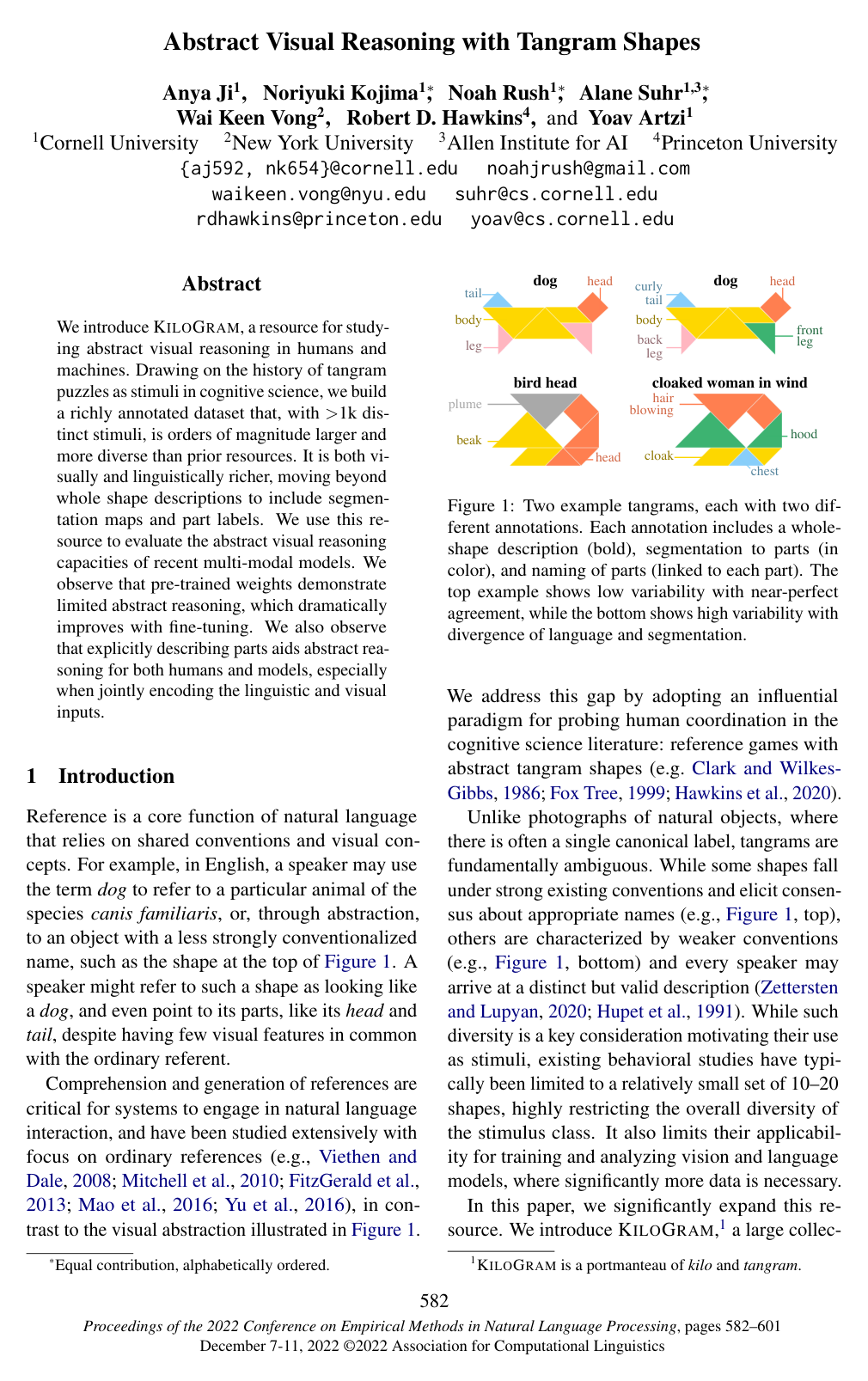
Abstract Visual Reasoning with Tangram Shapes
Anya Ji, Noriyuki Kojima, Noah Rush, Alane Suhr, Wai Keen Vong, Robert D. Hawkins, Yoav Artzi
Why you should read this
Introduces KILOGRAM, a large-scale dataset of tangram shapes paired with part-level segmentations and natural language descriptions to benchmark and improve abstract visual reasoning in multimodal models.
We introduce KILOGRAM, a resource for studying abstract visual reasoning in humans and machines. Drawing on the history of tangram puzzles as stimuli in cognitive science, we build a richly annotated dataset that, with >1k distinct stimuli, is orders of magnitude larger and more diverse than prior resources. It is both visually and linguistically richer, moving beyond whole shape descriptions to include segmentation maps and part labels. We use this resource to evaluate the abstract visual reasoning capacities of recent multi-modal models. We observe that pre-trained weights demonstrate limited abstract reasoning, which dramatically improves with fine-tuning. We also observe that explicitly describing parts aids abstract reasoning for both humans and models, especially when jointly encoding the linguistic and visual inputs.
Added
2026-10-03
Image Captioning as an Assistive Technology: Lessons Learned from VizWiz 2020 Challenge
Pierre L. Dognin, Igor Melnyk, Youssef Mroueh, Inkit Padhi, Mattia Rigotti, Jarret Ross, Yair Schiff, Richard A. Young, Brian Belgodere
Why you should read this
Presents the winning multimodal framework from the VizWiz 2020 Challenge, integrating rotation-invariant optical character recognition, object detection, and a copy-mechanism transformer to generate task-oriented captions from real-world photos taken by visually impaired users.
Image captioning has recently demonstrated impressive progress largely owing to the introduction of neural network algorithms trained on curated dataset like MS-COCO. Often work in this field is motivated by the promise of deployment of captioning systems in practical applications. However, the scarcity of data and contexts in many competition datasets renders the utility of systems trained on these datasets limited as an assistive technology in real-world settings, such as helping visually impaired people navigate and accomplish everyday tasks. This gap motivated the introduction of the novel VizWiz dataset, which consists of images taken by the visually impaired and captions that have useful, task-oriented information. In an attempt to help the machine learning computer vision field realize its promise of producing technologies that have positive social impact, the curators of the VizWiz dataset host several competitions, including one for image captioning. This work details the theory and engineering from our winning submission to the 2020 captioning competition. Our work provides a step towards improved assistive image captioning systems.
Added
2026-10-03
On Vision Features in Multimodal Machine Translation
Bei Li, Chuanhao Lv, Zefan Zhou, Tao Zhou, Tong Xiao, Anxiang Ma, Jingbo Zhu
Why you should read this
Reveals that stronger Transformer-based vision models improve multimodal machine translation on targeted probing tasks, while introducing a patch-level selective attention mechanism that directly correlates visual regions with words.
Previous work on multimodal machine translation (MMT) has focused on the way of incorporating vision features into translation but little attention is on the quality of vision models. In this work, we investigate the impact of vision models on MMT. Given the fact that Transformer is becoming popular in computer vision, we experiment with various strong models (such as Vision Transformer) and enhanced features (such as object-detection and image captioning). We develop a selective attention model to study the patch-level contribution of an image in MMT. On detailed probing tasks, we find that stronger vision models are helpful for learning translation from the visual modality. Our results also suggest the need of carefully examining MMT models, especially when current benchmarks are small-scale and biased. Our code could be found at https://github.com/libeineu/fairseq_mmt.
Added
2026-10-02
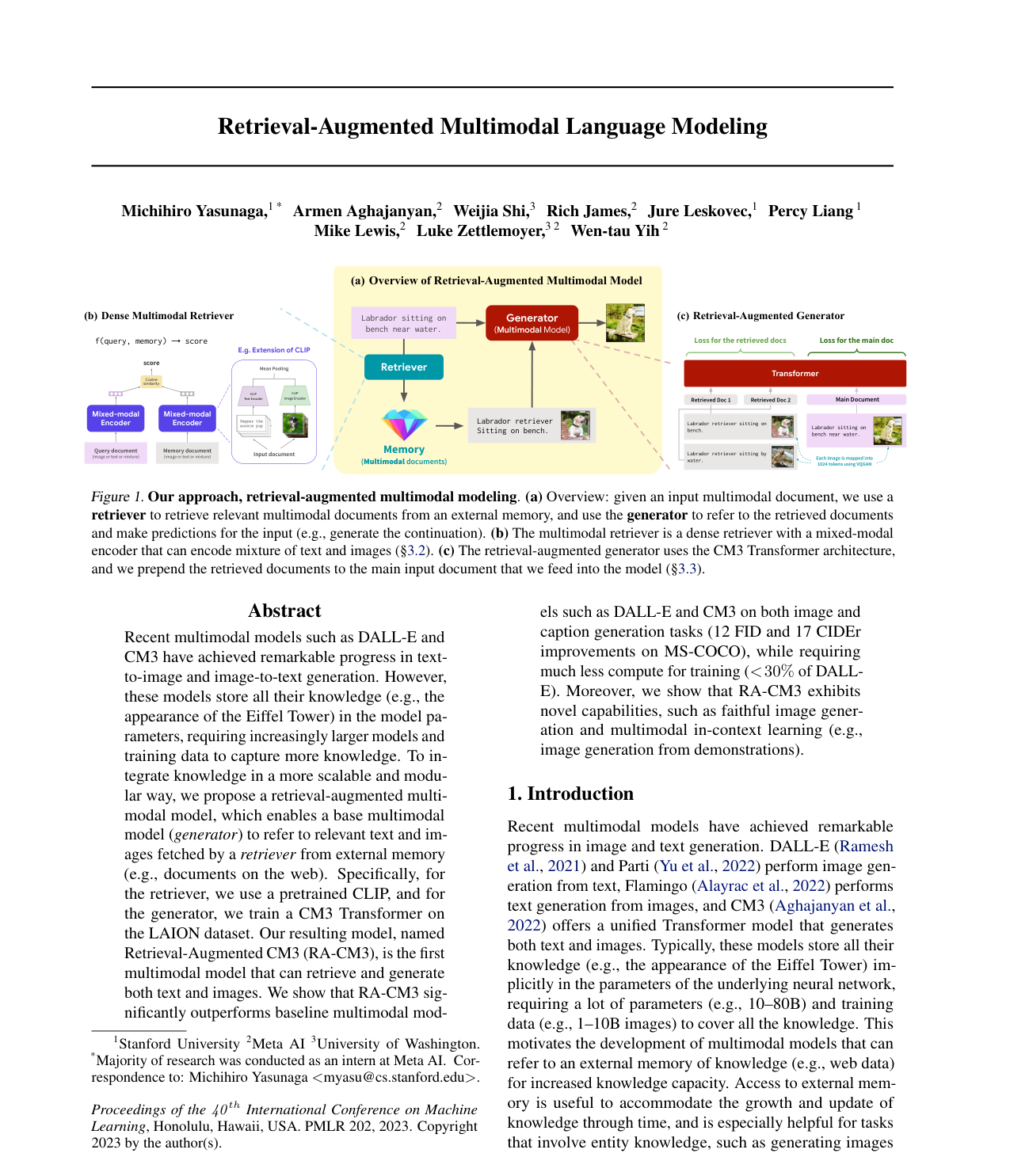
Retrieval-Augmented Multimodal Language Modeling
Michihiro Yasunaga, Armen Aghajanyan, Weijia Shi, Richard James, Jure Leskovec, Percy Liang, Mike Lewis, Luke Zettlemoyer, Wen-Tau Yih
Why you should read this
Proposes RA-CM3, a retrieval-augmented multimodal architecture that fetches relevant text-image documents to generate both modalities, significantly cutting training compute while outperforming models like DALL-E and enabling multimodal in-context learning.
Recent multimodal models such as DALL-E and CM3 have achieved remarkable progress in text-to-image and image-to-text generation. However, these models store all their knowledge (e.g., the appearance of the Eiffel Tower) in the model parameters, requiring increasingly larger models and training data to capture more knowledge. To integrate knowledge in a more scalable and modular way, we propose a retrieval-augmented multimodal model, which enables a base multimodal model (generator) to refer to relevant text and images fetched by a retriever from external memory (e.g., documents on the web). Specifically, for the retriever, we use a pretrained CLIP, and for the generator, we train a CM3 Transformer on the LAION dataset. Our resulting model, named Retrieval-Augmented CM3 (RA-CM3), is the first multimodal model that can retrieve and generate both text and images. We show that RA-CM3 significantly outperforms baseline multimodal models such as DALL-E and CM3 on both image and caption generation tasks (12 FID and 17 CIDEr improvements on MS-COCO), while requiring much less compute for training (<30% of DALL-E). Moreover, we show that RA-CM3 exhibits novel capabilities, such as faithful image generation and multimodal in-context learning (e.g., image generation from demonstrations).
Added
2026-10-01
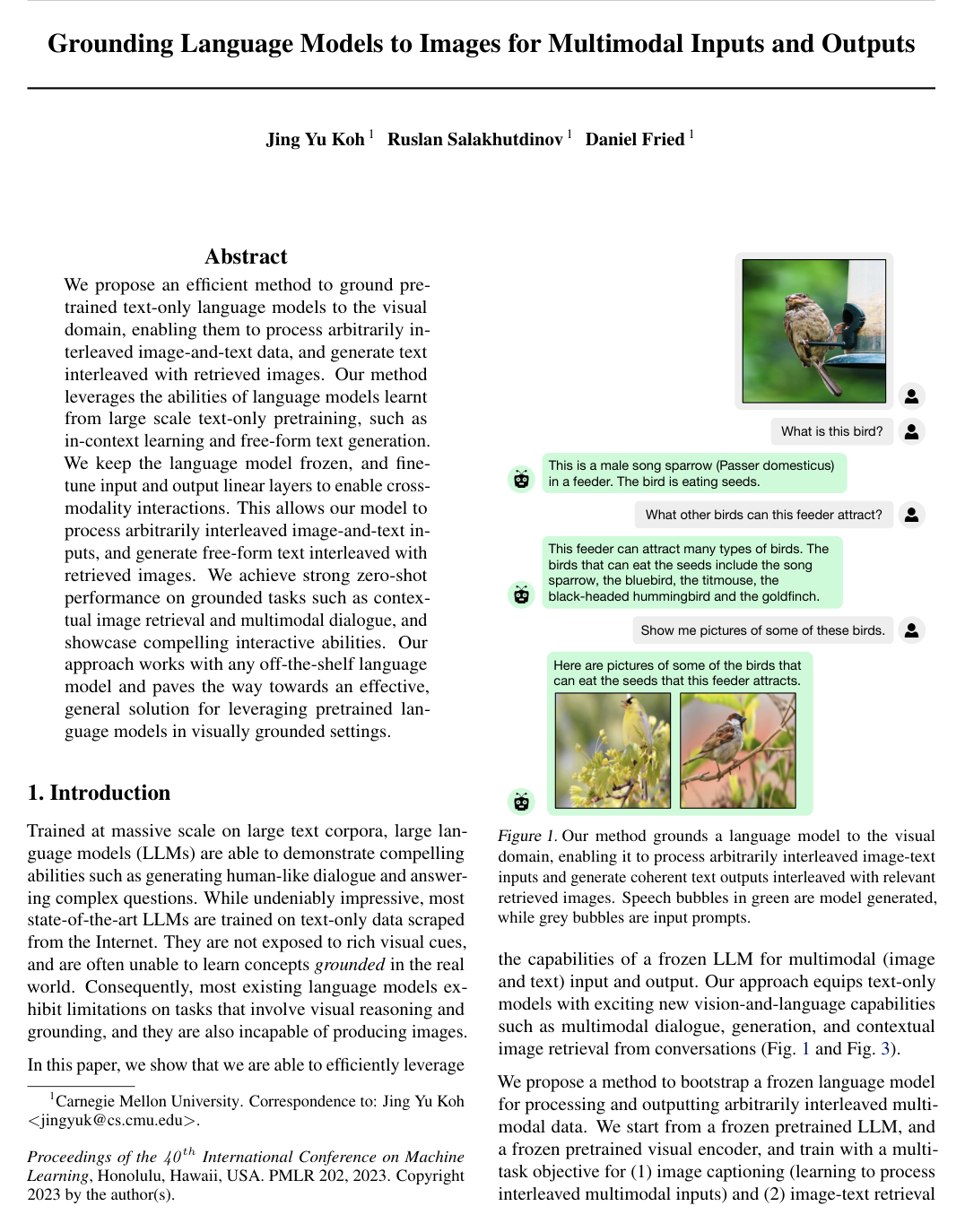
Grounding Language Models to Images for Multimodal Inputs and Outputs
Jing Yu Koh, Ruslan Salakhutdinov, Daniel Fried
Why you should read this
Presents FROMAGe, an efficient approach that equips frozen text-only language models to process arbitrarily interleaved image-text inputs and generate text interspersed with retrieved images by training only lightweight linear translation layers.
We propose an efficient method to ground pre-trained text-only language models to the visual domain, enabling them to process arbitrarily interleaved image-and-text data, and generate text interleaved with retrieved images. Our method leverages the abilities of language models learnt from large scale text-only pretraining, such as in-context learning and free-form text generation. We keep the language model frozen, and fine-tune input and output linear layers to enable cross-modality interactions. This allows our model to process arbitrarily interleaved image-and-text inputs, and generate free-form text interleaved with retrieved images. We achieve strong zero-shot performance on grounded tasks such as contextual image retrieval and multimodal dialogue, and showcase compelling interactive abilities. Our approach works with any off-the-shelf language model and paves the way towards an effective, general solution for leveraging pretrained language models in visually grounded settings.
Added
2026-09-30
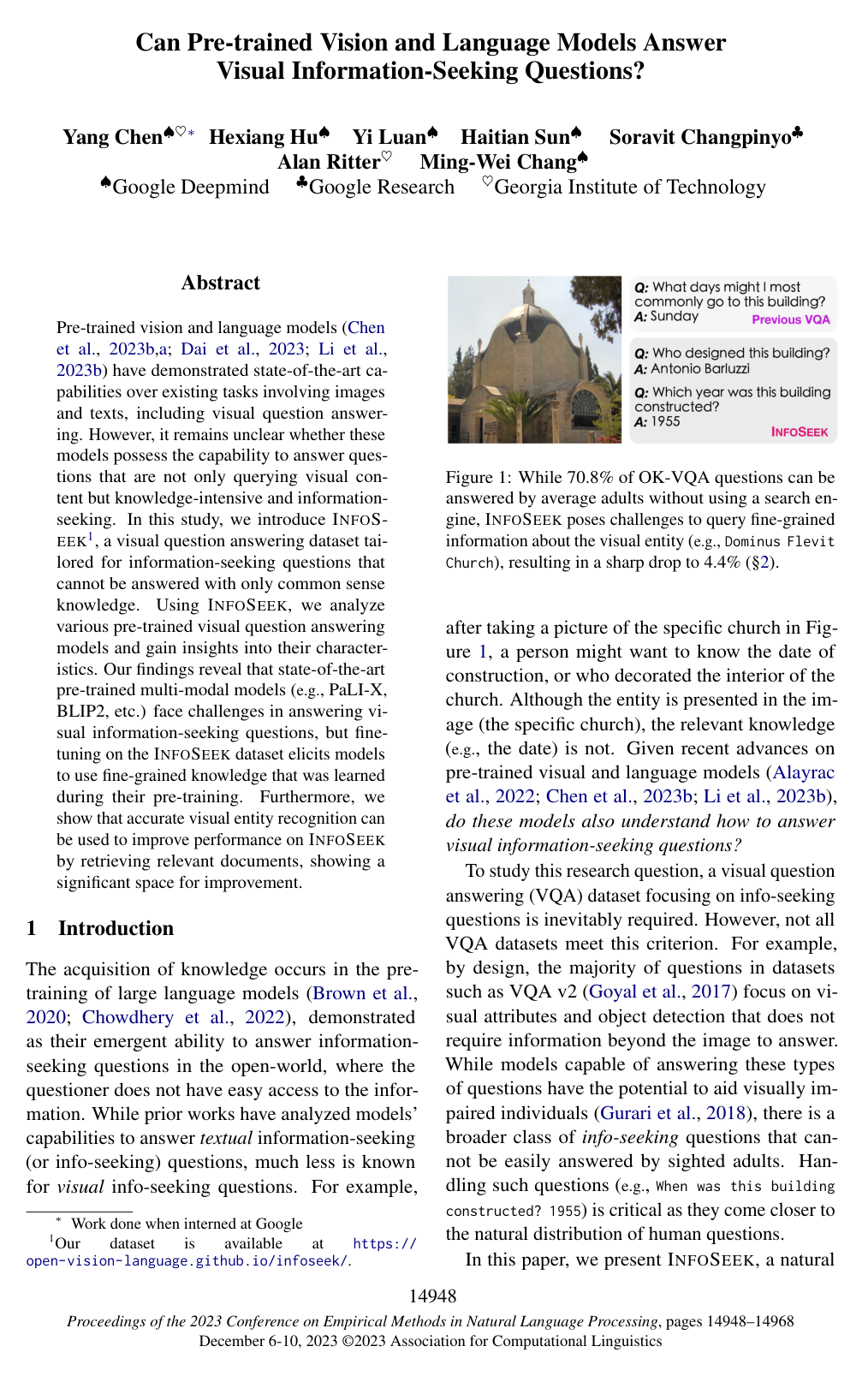
Can Pre-trained Vision and Language Models Answer Visual Information-Seeking Questions?
Yang Chen, Hexiang Hu, Yi Luan, Haitian Sun, Soravit Changpinyo, Alan Ritter, Ming-Wei Chang
Pre-trained vision and language models (Chen et al., 2023b,a; Dai et al., 2023; Li et al., 2023b) have demonstrated state-of-the-art capabilities over existing tasks involving images and texts, including visual question answering. However, it remains unclear whether these models possess the capability to answer questions that are not only querying visual content but knowledge-intensive and information-seeking. In this study, we introduce INFOSEEK^1, a visual question answering dataset tailored for information-seeking questions that cannot be answered with only common sense knowledge. Using INFOSEEK, we analyze various pre-trained visual question answering models and gain insights into their characteristics. Our findings reveal that state-of-the-art pre-trained multi-modal models (e.g., PaLI-X, BLIP2, etc.) face challenges in answering visual information-seeking questions, but fine-tuning on the INFOSEEK dataset elicits models to use fine-grained knowledge that was learned during their pre-training. Furthermore, we show that accurate visual entity recognition can be used to improve performance on INFOSEEK by retrieving relevant documents, showing a significant space for improvement.
Added
2026-09-28
Inducing High Energy-Latency of Large Vision-Language Models with Verbose Images
Kuofeng Gao, Yang Bai, Jindong Gu, Shu-Tao Xia, Philip Torr, Zhifeng Li, Wei Liu
Why you should read this
Demonstrates a severe availability vulnerability in vision-language models by generating imperceptible image perturbations that delay termination tokens to multiply output lengths more than eightfold and exhaust computational resources.
Large vision-language models (VLMs) such as GPT-4 have achieved exceptional performance across various multi-modal tasks. However, the deployment of VLMs necessitates substantial energy consumption and computational resources. Once attackers maliciously induce high energy consumption and latency time (energy-latency cost) during inference of VLMs, it will exhaust computational resources. In this paper, we explore this attack surface about availability of VLMs and aim to induce high energy-latency cost during inference of VLMs. We find that high energy-latency cost during inference of VLMs can be manipulated by maximizing the length of generated sequences. To this end, we propose verbose images, with the goal of crafting an imperceptible perturbation to induce VLMs to generate long sentences during inference. Concretely, we design three loss objectives. First, a loss is proposed to delay the occurrence of end-of-sequence (EOS) token, where EOS token is a signal for VLMs to stop generating further tokens. Moreover, an uncertainty loss and a token diversity loss are proposed to increase the uncertainty over each generated token and the diversity among all tokens of the whole generated sequence, respectively, which can break output dependency at token-level and sequence-level. Furthermore, a temporal weight adjustment algorithm is proposed, which can effectively balance these losses. Extensive experiments demonstrate that our verbose images can increase the length of generated sequences by 7.87 times and 8.56 times compared to original images on MS-COCO and ImageNet datasets, which presents potential challenges for various applications. Our code is available at this https URL.
Added
2026-09-26
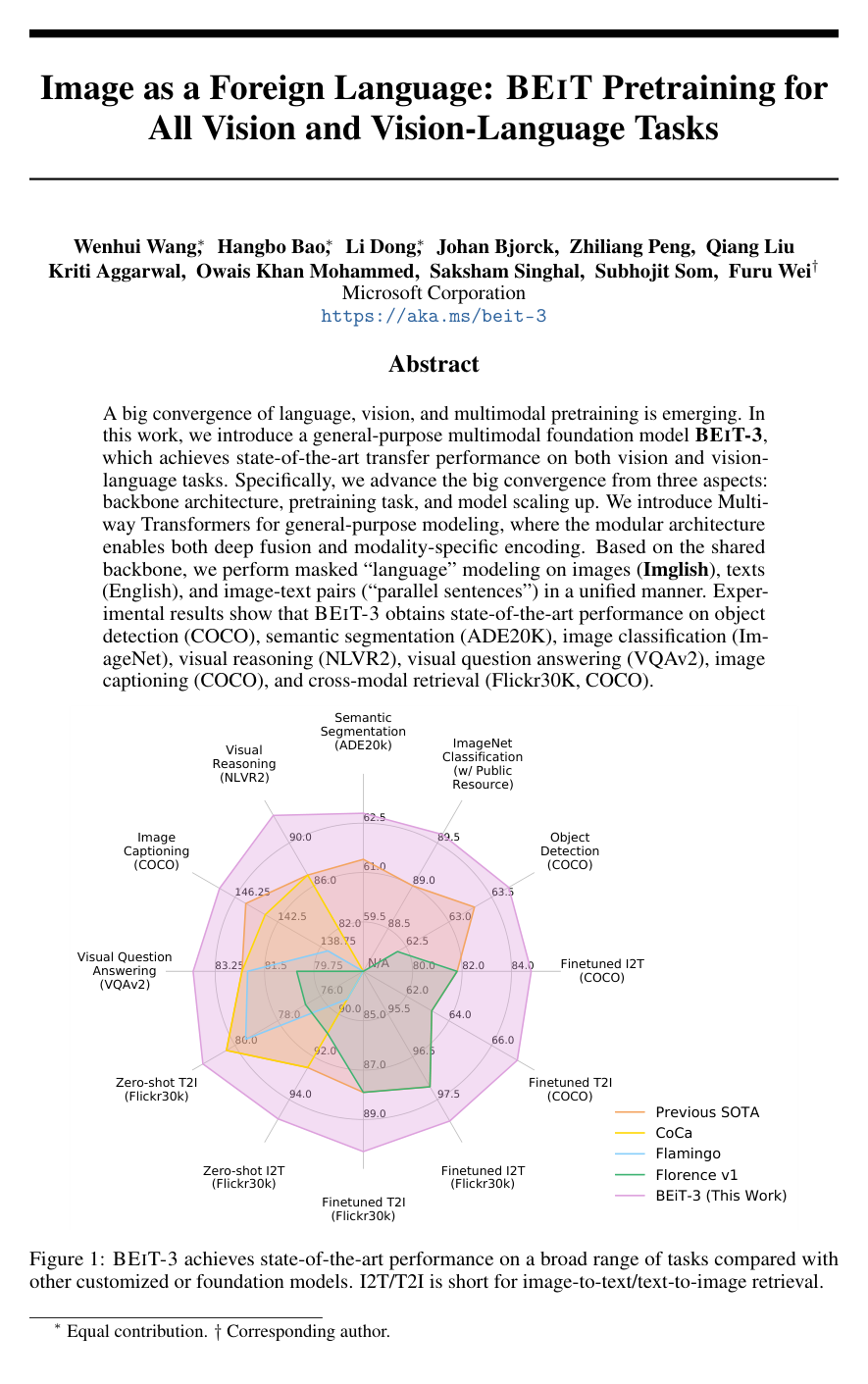
Image as a Foreign Language: BEIT Pretraining for Vision and Vision-Language Tasks
Wenhui Wang, Hangbo Bao, Li Dong, Johan Bjorck, Zhiliang Peng, Qiang Liu, Kriti Aggarwal, Owais Khan Mohammed, Saksham Singhal, Subhojit Som, Furu Wei
Why you should read this
Introduces BEiT-3, a unified multimodal foundation model that treats images as a foreign language and pretrains a Multiway Transformer via masked data modeling to achieve state-of-the-art transfer performance across major vision and vision-language benchmarks.
A big convergence of language, vision, and multimodal pretraining is emerging. In this work, we introduce a general-purpose multimodal foundation model BEiT-3, which achieves state-of-the-art transfer performance on both vision and vision-language tasks. Specifically, we advance the big convergence from three aspects: backbone architecture, pretraining task, and model scaling up. We introduce Multiway Transformers for general-purpose modeling, where the modular architecture enables both deep fusion and modality-specific encoding. Based on the shared backbone, we perform masked "language" modeling on images (Imglish), texts (English), and image-text pairs ("parallel sentences") in a unified manner. Experimental results show that BEiT-3 obtains state-of-the-art performance on object detection (COCO), semantic segmentation (ADE20K), image classification (ImageNet), visual reasoning (NLVR2), visual question answering (VQAv2), image captioning (COCO), and cross-modal retrieval (Flickr30K, COCO).
Added
2026-09-26
VisualGPT: Data-efficient Adaptation of Pretrained Language Models for Image Captioning
Jun Chen, Han Guo, Kai Yi, Boyang Li, Mohamed Elhoseiny
Why you should read this
Proposes a data-efficient adaptation framework for image captioning that balances pretrained language model knowledge with visual features via a self-resurrecting activation unit, outperforming baselines under extreme low-data regimes.
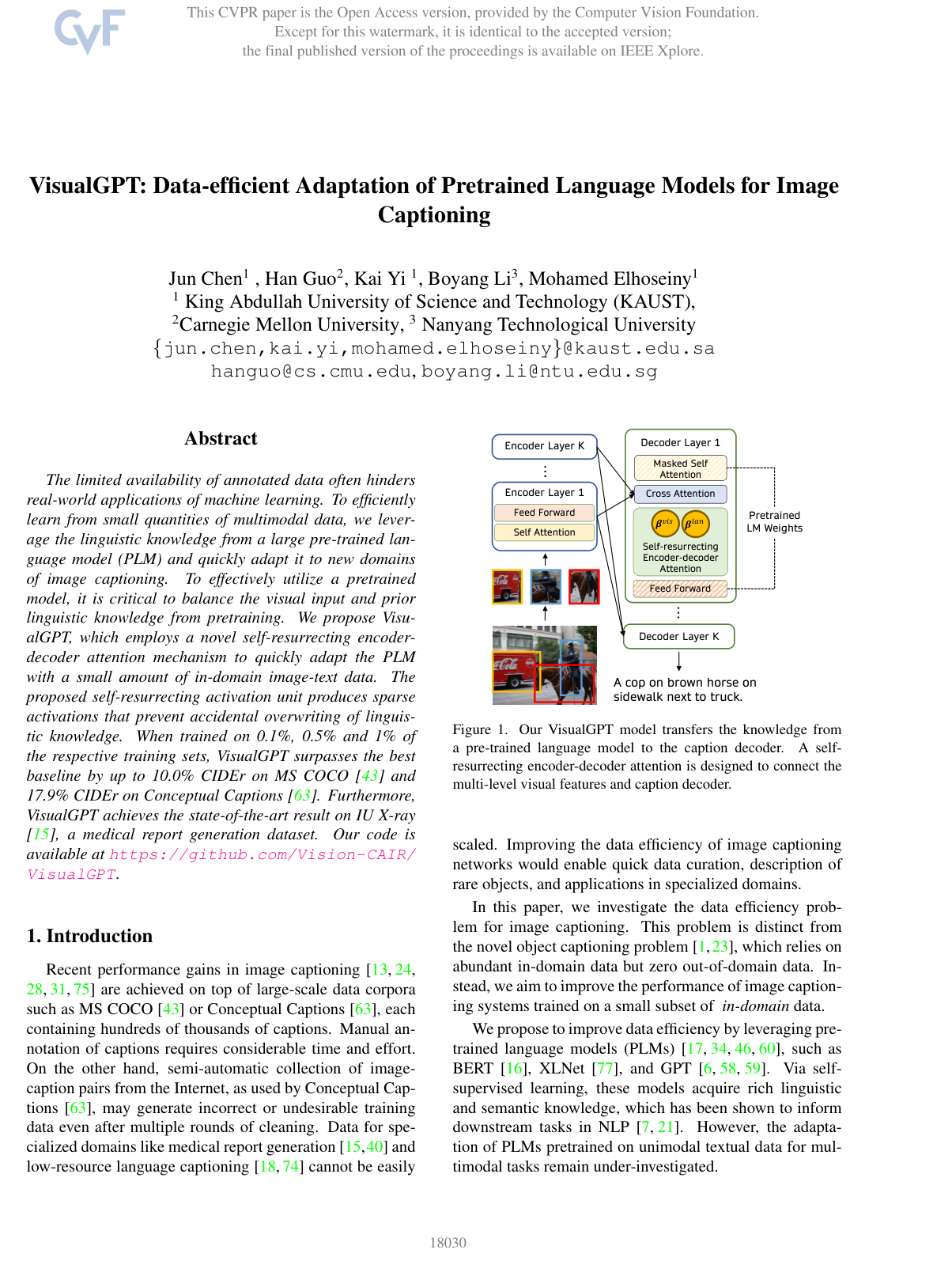
The limited availability of annotated data often hinders real-world applications of machine learning. To efficiently learn from small quantities of multimodal data, we leverage the linguistic knowledge from a large pre-trained language model (PLM) and quickly adapt it to new domains of image captioning. To effectively utilize a pretrained model, it is critical to balance the visual input and prior linguistic knowledge from pretraining. We propose VisualGPT, which employs a novel self-resurrecting encoder-decoder attention mechanism to quickly adapt the PLM with a small amount of in-domain image-text data. The proposed self-resurrecting activation unit produces sparse activations that prevent accidental overwriting of linguistic knowledge. When trained on 0.1%, 0.5% and 1% of the respective training sets, VisualGPT surpasses the best baseline by up to 10.0% CIDEr on MS COCO [43] and 17.9% CIDEr on Conceptual Captions [63]. Furthermore, VisualGPT achieves the state-of-the-art result on IU X-ray [15], a medical report generation dataset. Our code is available at https://github.com/Vision-CAIR/VisualGPT.
Added
2026-09-26
Tuning Computer Vision Models With Task Rewards
André Susano Pinto, Alexander Kolesnikov, Yuge Shi, Lucas Beyer, Xiaohua Zhai
Why you should read this
Demonstrates that fine-tuning pretrained vision models with REINFORCE using task-specific rewards directly optimizes non-differentiable evaluation metrics across diverse tasks including object detection, panoptic segmentation, and image colorization without task-specific architectural modifications.
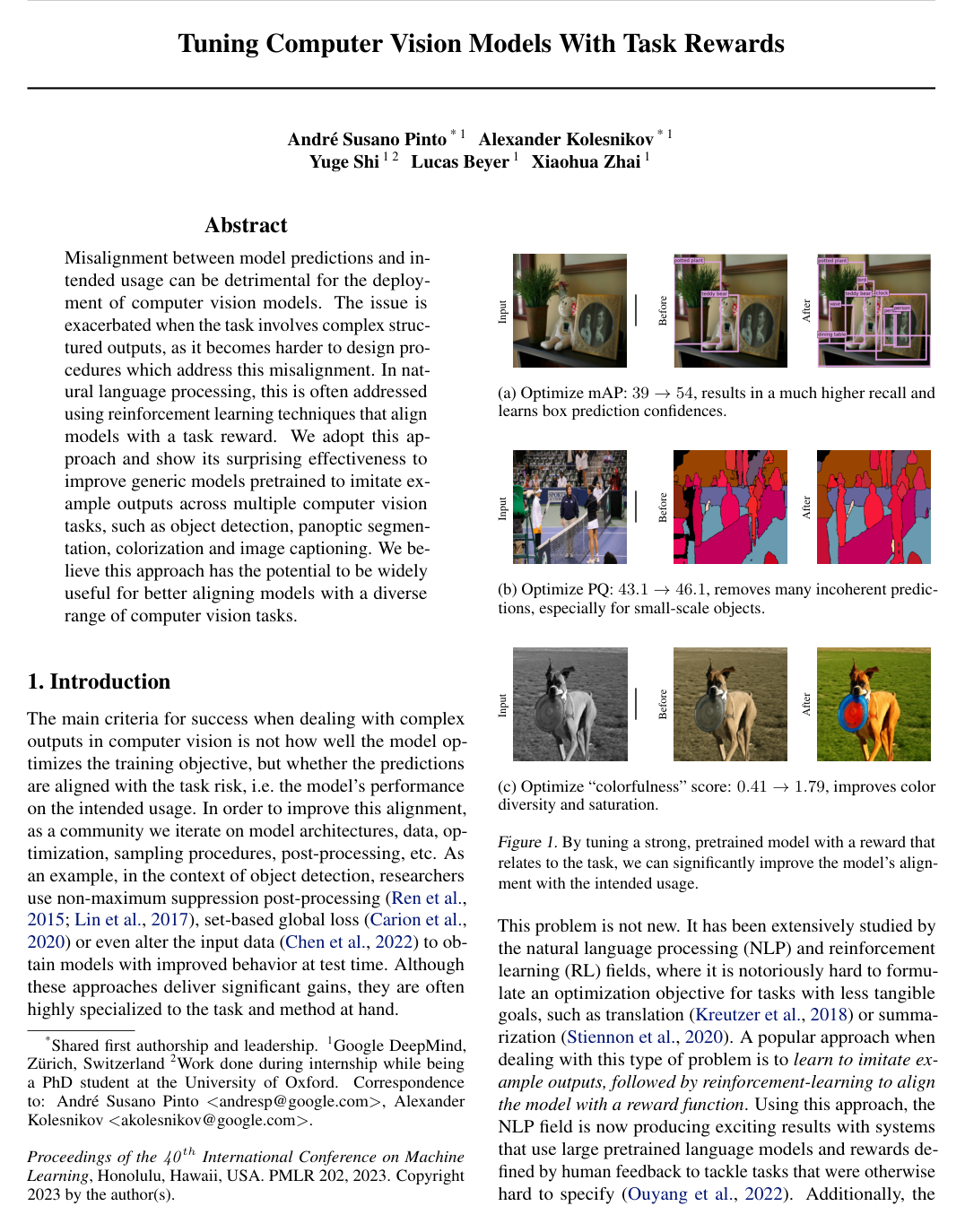
Misalignment between model predictions and intended usage can be detrimental for the deployment of computer vision models. The issue is exacerbated when the task involves complex structured outputs, as it becomes harder to design procedures which address this misalignment. In natural language processing, this is often addressed using reinforcement learning techniques that align models with a task reward. We adopt this approach and show its surprising effectiveness to improve generic models pretrained to imitate example outputs across multiple computer vision tasks, such as object detection, panoptic segmentation, colorization and image captioning. We believe this approach has the potential to be widely useful for better aligning models with a diverse range of computer vision tasks.
Added
2026-09-26
Taxonomizing and Measuring Representational Harms: A Look at Image Tagging
Jared Katzman, Angelina Wang, Morgan Klaus Scheuerman, Su Lin Blodgett, Kristen Laird, Hanna M. Wallach, Solon Barocas
Why you should read this
Categorizes computational fairness metrics and representational harms in image tagging systems to demonstrate that standard measurement approaches fail to uniquely map to specific harms and that mitigating one harm can inadvertently worsen another.
In this paper, we examine computational approaches for measuring the “fairness” of image tagging systems, finding that they cluster into five distinct categories, each with its own analytic foundation. We also identify a range of normative concerns that are often collapsed under the terms “unfairness,” “bias,” or even “discrimination” when discussing problematic cases of image tagging. Specifically, we identify four types of representational harms that can be caused by image tagging systems, providing concrete examples of each. We then consider how different computational measurement approaches map to each of these types, demonstrating that there is not a one-to-one mapping. Our findings emphasize that no single measurement approach will be definitive and that it is not possible to infer from the use of a particular measurement approach which type of harm was intended to be measured. Lastly, equipped with this more granular understanding of the types of representational harms that can be caused by image tagging systems, we show that attempts to mitigate some of these types of harms may be in tension with one another.
Added
2026-09-26
Kosmos-2: Grounding Multimodal Large Language Models to the World
Zhiliang Peng, Wenhui Wang, Li Dong, Yaru Hao, Shaohan Huang, Shuming Ma, Furu Wei
Why you should read this
Introduces Kosmos-2, a multimodal large language model that links text spans directly to visual bounding boxes via location tokens, enabling integrated visual grounding, referring, and vision-language generation.
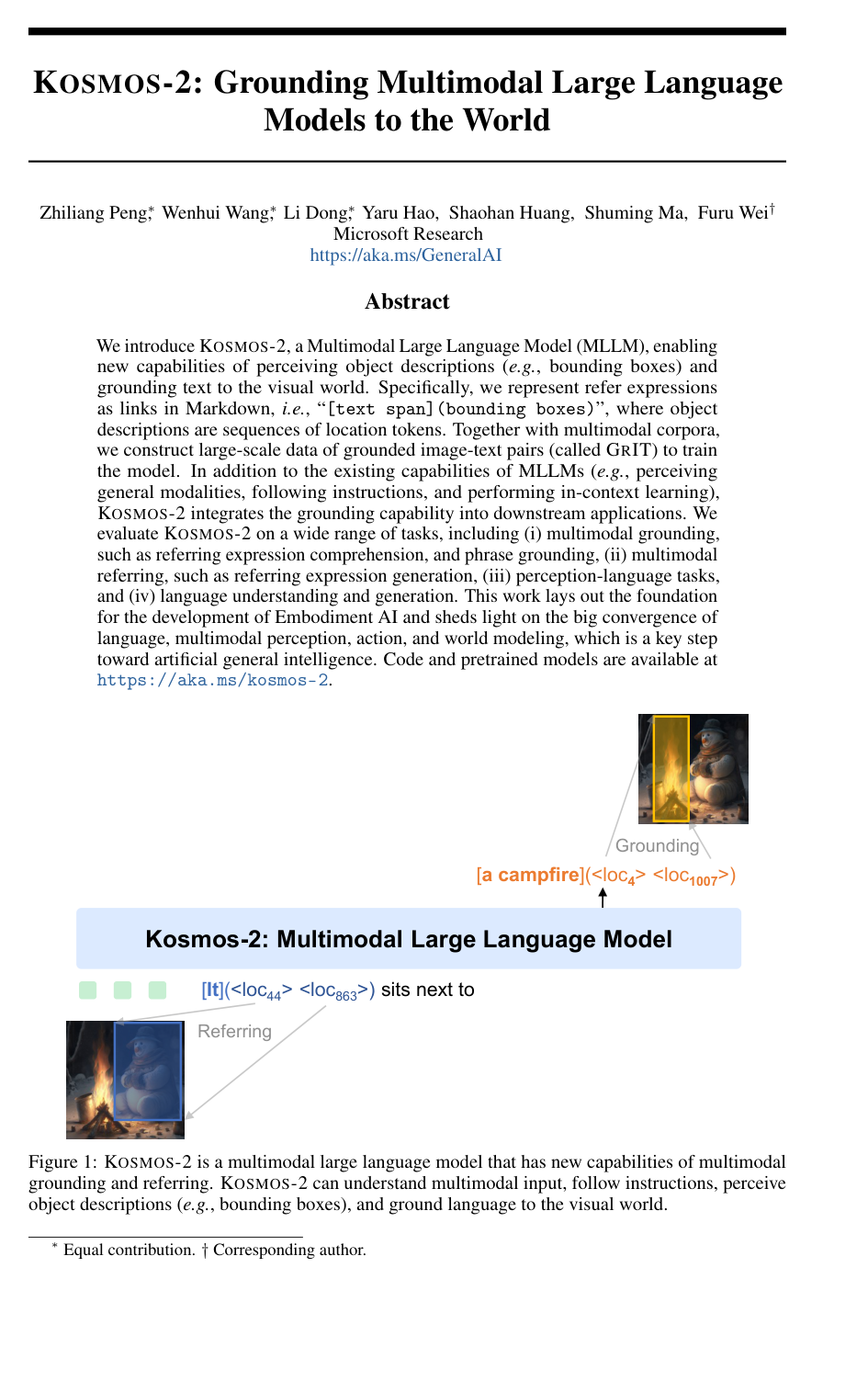
We introduce Kosmos-2, a Multimodal Large Language Model (MLLM), enabling new capabilities of perceiving object descriptions (e.g., bounding boxes) and grounding text to the visual world. Specifically, we represent refer expressions as links in Markdown, i.e., ``[text span](bounding boxes)'', where object descriptions are sequences of location tokens. Together with multimodal corpora, we construct large-scale data of grounded image-text pairs (called GrIT) to train the model. In addition to the existing capabilities of MLLMs (e.g., perceiving general modalities, following instructions, and performing in-context learning), Kosmos-2 integrates the grounding capability into downstream applications. We evaluate Kosmos-2 on a wide range of tasks, including (i) multimodal grounding, such as referring expression comprehension, and phrase grounding, (ii) multimodal referring, such as referring expression generation, (iii) perception-language tasks, and (iv) language understanding and generation. This work lays out the foundation for the development of Embodiment AI and sheds light on the big convergence of language, multimodal perception, action, and world modeling, which is a key step toward artificial general intelligence. Code and pretrained models are available at this https URL.
Added
2026-09-25
Stacked Cross Attention for Image-Text Matching
Kuang-Huei Lee, Xi Chen, Gang Hua, Houdong Hu, Xiaodong He
Why you should read this
Proposes a stacked cross-attention network that aligns visual regions with corresponding sentence words, achieving significant gains in bidirectional image-text retrieval accuracy on MS-COCO and Flickr30K.
In this paper, we study the problem of image-text matching. Inferring the latent semantic alignment between objects or other salient stuff (e.g. snow, sky, lawn) and the corresponding words in sentences allows to capture fine-grained interplay between vision and language, and makes image-text matching more interpretable. Prior work either simply aggregates the similarity of all possible pairs of regions and words without attending differentially to more and less important words or regions, or uses a multi-step attentional process to capture limited number of semantic alignments which is less interpretable. In this paper, we present Stacked Cross Attention to discover the full latent alignments using both image regions and words in a sentence as context and infer image-text similarity. Our approach achieves the state-of-the-art results on the MS-COCO and Flickr30K datasets. On Flickr30K, our approach outperforms the current best methods by 22.1% relatively in text retrieval from image query, and 18.2% relatively in image retrieval with text query (based on Recall@1). On MS-COCO, our approach improves sentence retrieval by 17.8% relatively and image retrieval by 16.6% relatively (based on Recall@1 using the 5K test set). Code has been made available at: this https URL.
Added
2026-09-25
Conceptual 12M: Pushing Web-Scale Image-Text Pre-Training To Recognize Long-Tail Visual Concepts
Soravit Changpinyo, Piyush Sharma, Nan Ding, Radu Soricut
Why you should read this
Introduces Conceptual 12M, a relaxed web-scale dataset of twelve million image-text pairs that substantially improves vision-and-language pre-training performance on long-tail visual concepts and out-of-domain captioning benchmarks.
The availability of large-scale image captioning and visual question answering datasets has contributed significantly to recent successes in vision-and-language pre-training. However, these datasets are often collected with overrestrictive requirements inherited from their original target tasks (e.g., image caption generation), which limit the resulting dataset scale and diversity. We take a step further in pushing the limits of vision-and-language pre-training data by relaxing the data collection pipeline used in Conceptual Captions 3M (CC3M) [Sharma et al. 2018] and introduce the Conceptual 12M (CC12M), a dataset with 12 million image-text pairs specifically meant to be used for vision-and-language pre-training. We perform an analysis of this dataset and benchmark its effectiveness against CC3M on multiple downstream tasks with an emphasis on long-tail visual recognition. Our results clearly illustrate the benefit of scaling up pre-training data for vision-and-language tasks, as indicated by the new state-of-the-art results on both the nocaps and Conceptual Captions benchmarks.
Added
2026-09-24
Knowing When to Look: Adaptive Attention via a Visual Sentinel for Image Captioning
Jiasen Lu, Caiming Xiong, Devi Parikh, Richard Socher
Why you should read this
Introduces an adaptive attention mechanism with a visual sentinel that allows image captioning models to dynamically decide when to attend to visual features versus relying on linguistic context, substantially improving caption generation accuracy on standard benchmarks.
Attention-based neural encoder-decoder frameworks have been widely adopted for image captioning. Most methods force visual attention to be active for every generated word. However, the decoder likely requires little to no visual information from the image to predict non-visual words such as "the" and "of". Other words that may seem visual can often be predicted reliably just from the language model e.g., "sign" after "behind a red stop" or "phone" following "talking on a cell". In this paper, we propose a novel adaptive attention model with a visual sentinel. At each time step, our model decides whether to attend to the image (and if so, to which regions) or to the visual sentinel. The model decides whether to attend to the image and where, in order to extract meaningful information for sequential word generation. We test our method on the COCO image captioning 2015 challenge dataset and Flickr30K. Our approach sets the new state-of-the-art by a significant margin.
Added
2026-09-24
A survey on multimodal large language models
Shukang Yin, Chaoyou Fu, Sirui Zhao, Ke Li, Xing Sun, Tong Xu, Enhong Chen
Why you should read this
Synthesizes the rapid progress in Multimodal Large Language Models by structuring their core architectures, training strategies, and evaluation protocols while detailing critical advanced topics such as multimodal hallucination, chain-of-thought reasoning, and cross-modal extensions.
Recently, Multimodal Large Language Model (MLLM) represented by GPT-4V has been a new rising research hotspot, which uses powerful Large Language Models (LLMs) as a brain to perform multimodal tasks. The surprising emergent capabilities of MLLM, such as writing stories based on images and OCR-free math reasoning, are rare in traditional multimodal methods, suggesting a potential path to artificial general intelligence. To this end, both academia and industry have endeavored to develop MLLMs that can compete with or even better than GPT-4V, pushing the limit of research at a surprising speed. In this paper, we aim to trace and summarize the recent progress of MLLMs. First of all, we present the basic formulation of MLLM and delineate its related concepts, including architecture, training strategy and data, as well as evaluation. Then, we introduce research topics about how MLLMs can be extended to support more granularity, modalities, languages, and scenarios. We continue with multimodal hallucination and extended techniques, including Multimodal ICL (M-ICL), Multimodal CoT (M-CoT), and LLM-Aided Visual Reasoning (LAVR). To conclude the paper, we discuss existing challenges and point out promising research directions. In light of the fact that the era of MLLM has only just begun, we will keep updating this survey and hope it can inspire more research. An associated GitHub link collecting the latest papers is available at this https URL.
Added
2026-09-24