
Built independently by an author, for readers. Read the story and support ChapterPal

keyword

human visual preferences

Human visual preferences refer to the individual or collective aesthetic inclinations, evaluations, and judgments people form about objects, scenes, or items based on their visual appearance. These preferences govern how individuals perceive relationships between visual elements, determining which items are considered visually compatible or complementary, such as matching clothing pieces, as well as which items serve as acceptable stylistic alternatives or substitutes. Driven by personal taste, cultural norms, and principles of visual harmony, human visual preferences guide everyday consumer choices and aesthetic decisions, and they are widely modeled in visual computing and recommendation systems to predict compatibility, style affinity, and user choices.

1 item
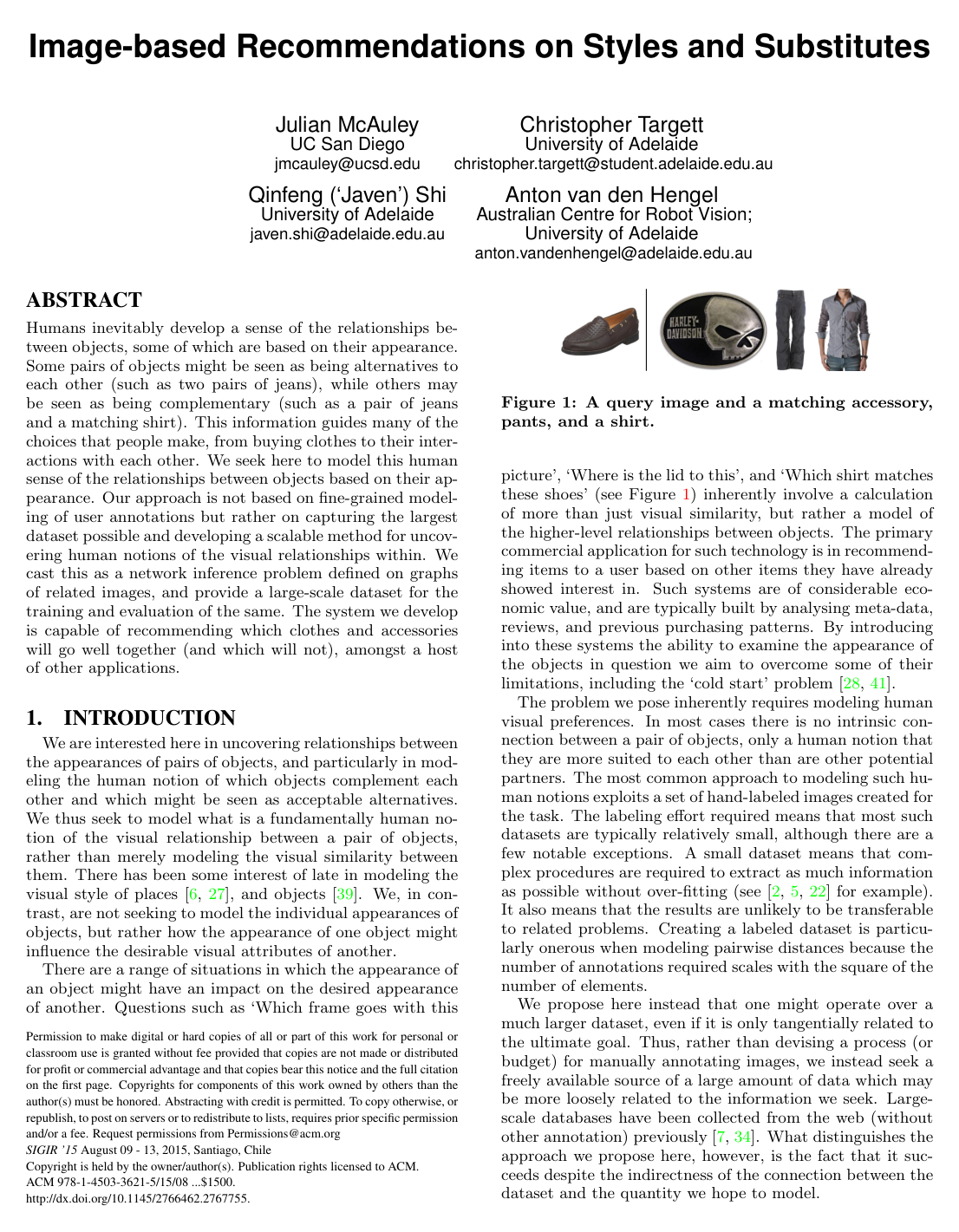
Image-Based Recommendations on Styles and Substitutes

Image-Based Recommendations on Styles and Substitutes

Julian McAuley, Christopher Targett, Qinfeng Shi, Anton van den Hengel

OrganizationsAustralian Centre for Robotic VisionUniversity of AdelaideUniversity of California, San Diego

Why you should read this

Develops a scalable graph-based network inference method and dataset to learn visual relationships between items, enabling systems to automatically identify substitute products and recommend complementary styles directly from images.

Humans inevitably develop a sense of the relationships between objects, some of which are based on their appearance. Some pairs of objects might be seen as being alternatives to each other (such as two pairs of jeans), while others may be seen as being complementary (such as a pair of jeans and a matching shirt). This information guides many of the choices that people make, from buying clothes to their interactions with each other. We seek here to model this human sense of the relationships between objects based on their appearance. Our approach is not based on fine-grained modeling of user annotations but rather on capturing the largest dataset possible and developing a scalable method for uncovering human notions of the visual relationships within. We cast this as a network inference problem defined on graphs of related images, and provide a large-scale dataset for the training and evaluation of the same. The system we develop is capable of recommending which clothes and accessories will go well together (and which will not), amongst a host of other applications.

Added

2026-09-14