
keyword
human validation
Human validation is the process of using human evaluation, judgment, or manually verified reference data to assess the accuracy, quality, and reliability of outputs produced by automated systems or artificial intelligence models. In computational tasks and data annotation, it serves as an essential benchmark by comparing machine-generated predictions, classifications, or decisions against human-generated ground-truth standards. This review mechanism ensures that automated processes align with real-world human reasoning and domain expertise, allowing practitioners to measure performance discrepancies, detect subtle errors or biases, and establish rigorous quality control before models or automated labels are deployed at scale.
2 items
Keeping Humans in the Loop: Human-Centered Automated Annotation with Generative AI
Nick Pangakis, Sam Wolken
Why you should read this
Demonstrates through twenty-seven private social science tasks that large language model annotations vary unpredictably and diverge from human judgment, proving that human validation remains essential for automated research workflows.
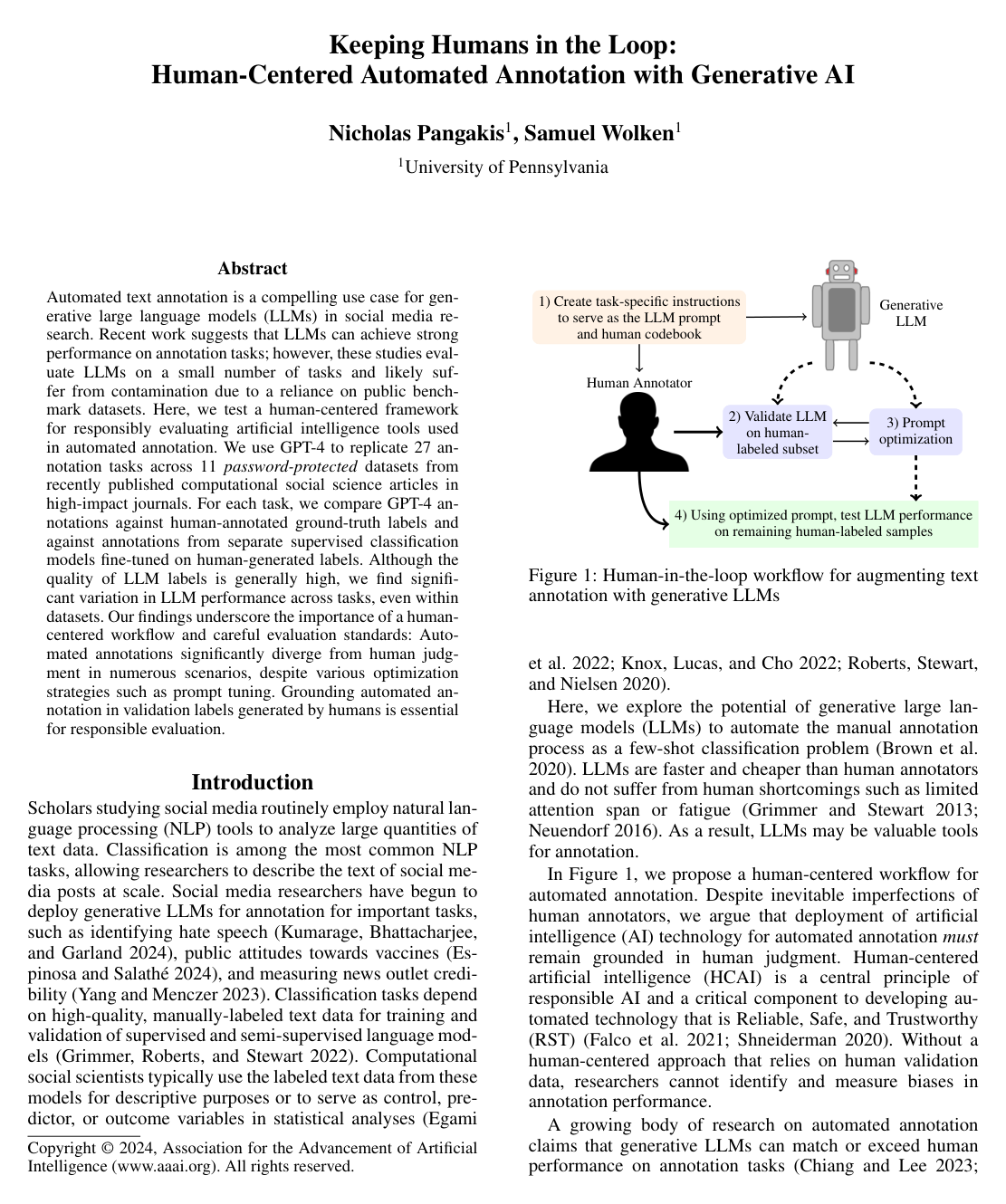
Automated text annotation is a compelling use case for generative large language models (LLMs) in social media research. Recent work suggests that LLMs can achieve strong performance on annotation tasks; however, these studies evaluate LLMs on a small number of tasks and likely suffer from contamination due to a reliance on public benchmark datasets. Here, we test a human-centered framework for responsibly evaluating artificial intelligence tools used in automated annotation. We use GPT-4 to replicate 27 annotation tasks across 11 password-protected datasets from recently published computational social science articles in high-impact journals. For each task, we compare GPT-4 annotations against human-annotated ground-truth labels and against annotations from separate supervised classification models fine-tuned on human-generated labels. Although the quality of LLM labels is generally high, we find significant variation in LLM performance across tasks, even within datasets. Our findings underscore the importance of a human-centered workflow and careful evaluation standards: Automated annotations significantly diverge from human judgment in numerous scenarios, despite various optimization strategies such as prompt tuning. Grounding automated annotation in validation labels generated by humans is essential for responsible evaluation.
Added
2026-09-29
HellaSwag: Can a Machine Really Finish Your Sentence?
Rowan Zellers, Ari Holtzman, Yonatan Bisk, Ali Farhadi, Yejin Choi
Why you should read this
Introduces HellaSwag, a commonsense reasoning benchmark constructed through adversarial filtering that exposes how state-of-the-art language models fail on sentence completion tasks that remain trivial for humans.
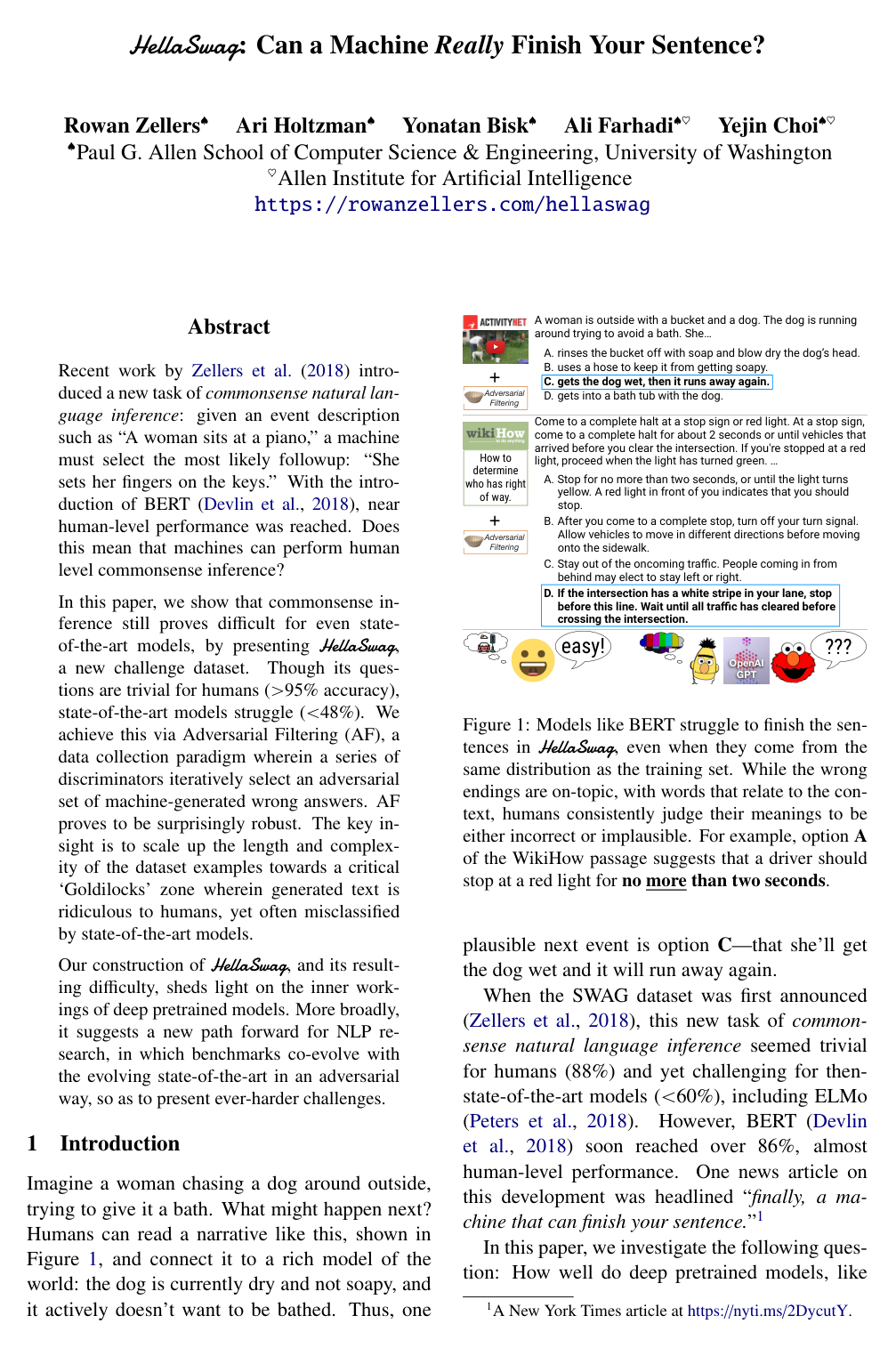
Recent work by Zellers et al. (2018) introduced a new task of commonsense natural language inference: given an event description such as "A woman sits at a piano," a machine must select the most likely followup: "She sets her fingers on the keys." With the introduction of BERT, near human-level performance was reached. Does this mean that machines can perform human level commonsense inference? In this paper, we show that commonsense inference still proves difficult for even state-of-the-art models, by presenting HellaSwag, a new challenge dataset. Though its questions are trivial for humans (>95% accuracy), state-of-the-art models struggle (<48%). We achieve this via Adversarial Filtering (AF), a data collection paradigm wherein a series of discriminators iteratively select an adversarial set of machine-generated wrong answers. AF proves to be surprisingly robust. The key insight is to scale up the length and complexity of the dataset examples towards a critical 'Goldilocks' zone wherein generated text is ridiculous to humans, yet often misclassified by state-of-the-art models. Our construction of HellaSwag, and its resulting difficulty, sheds light on the inner workings of deep pretrained models. More broadly, it suggests a new path forward for NLP research, in which benchmarks co-evolve with the evolving state-of-the-art in an adversarial way, so as to present ever-harder challenges.
Added
2026-09-10
