
keyword
human-object interaction
Human-object interaction refers to the physical or semantic relationship and dynamic engagement between a person and an entity in their environment, typically characterized by direct contact, intentional manipulation, or functional use such as holding, operating, or altering an item. In fields such as computer vision, robotics, and artificial intelligence, the concept centers on modeling, detecting, and reconstructing the spatial and temporal relationships between human body parts, notably hands, and manipulated objects. This involves analyzing both human body pose and motion alongside object trajectories, dynamic contact points, and physical state changes to enable machine comprehension of complex daily activities, egocentric video reasoning, and embodied robotic execution.
7 items
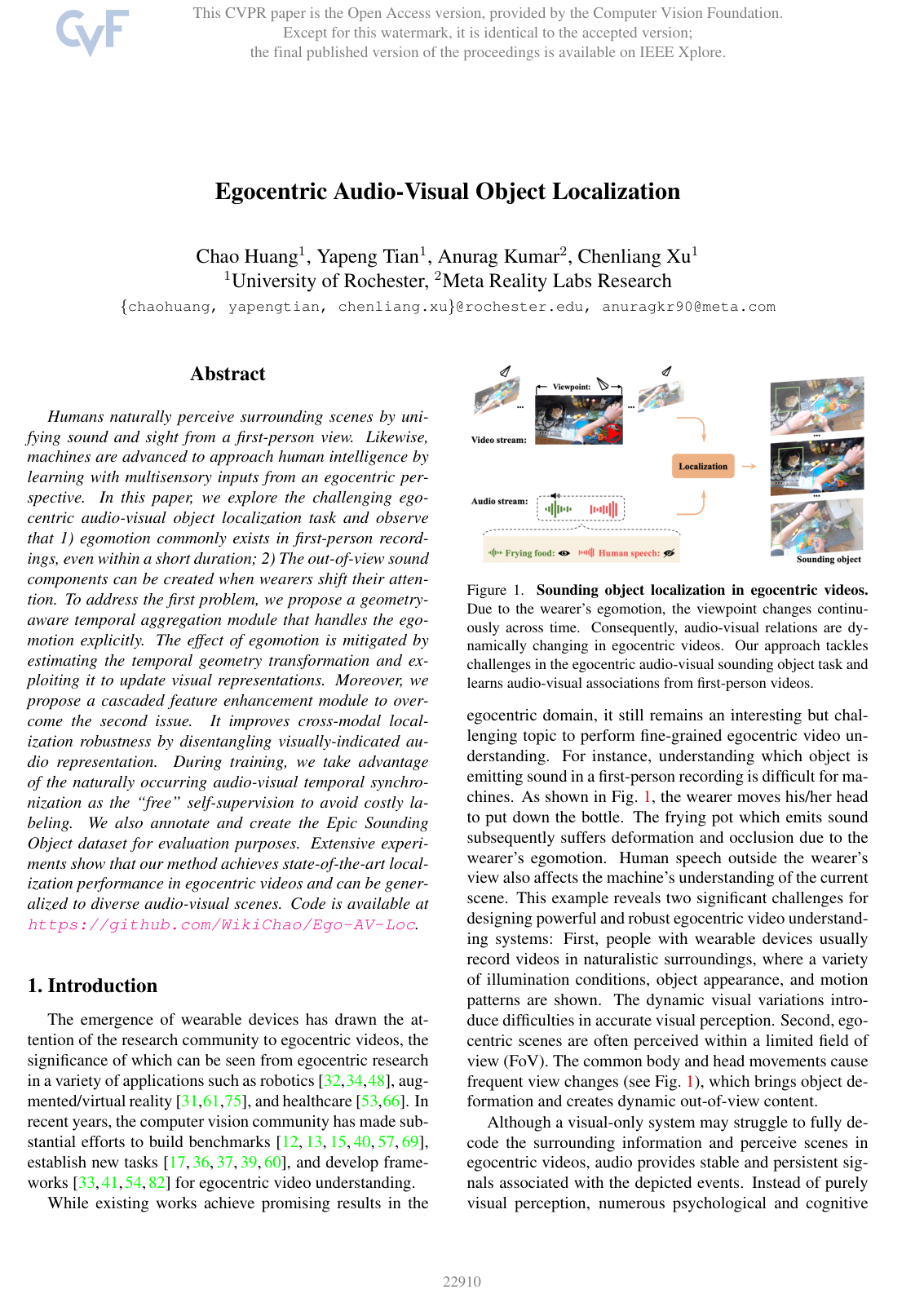
Egocentric Audio-Visual Object Localization
Chao Huang, Yapeng Tian, Anurag Kumar, Chenliang Xu
Why you should read this
Introduces a self-supervised framework for egocentric audio-visual object localization that explicitly accounts for camera motion via geometry-aware temporal aggregation and separates out-of-view audio distractors to accurately pinpoint sounding objects in first-person video.
Humans naturally perceive surrounding scenes by unifying sound and sight from a first-person view. Likewise, machines are advanced to approach human intelligence by learning with multisensory inputs from an egocentric perspective. In this paper, we explore the challenging egocentric audio-visual object localization task and observe that 1) egomotion commonly exists in first-person recordings, even within a short duration; 2) The out-of-view sound components can be created when wearers shift their attention. To address the first problem, we propose a geometry-aware temporal aggregation module that handles the egomotion explicitly. The effect of egomotion is mitigated by estimating the temporal geometry transformation and exploiting it to update visual representations. Moreover, we propose a cascaded feature enhancement module to overcome the second issue. It improves cross-modal localization robustness by disentangling visually-indicated audio representation. During training, we take advantage of the naturally occurring audio-visual temporal synchronization as the “free” self-supervision to avoid costly labeling. We also annotate and create the Epic Sounding Object dataset for evaluation purposes. Extensive experiments show that our method achieves state-of-the-art localization performance in egocentric videos and can be generalized to diverse audio-visual scenes. Code is available at https://github.com/WikiChao/Ego-AV-Loc.
Added
2026-09-26
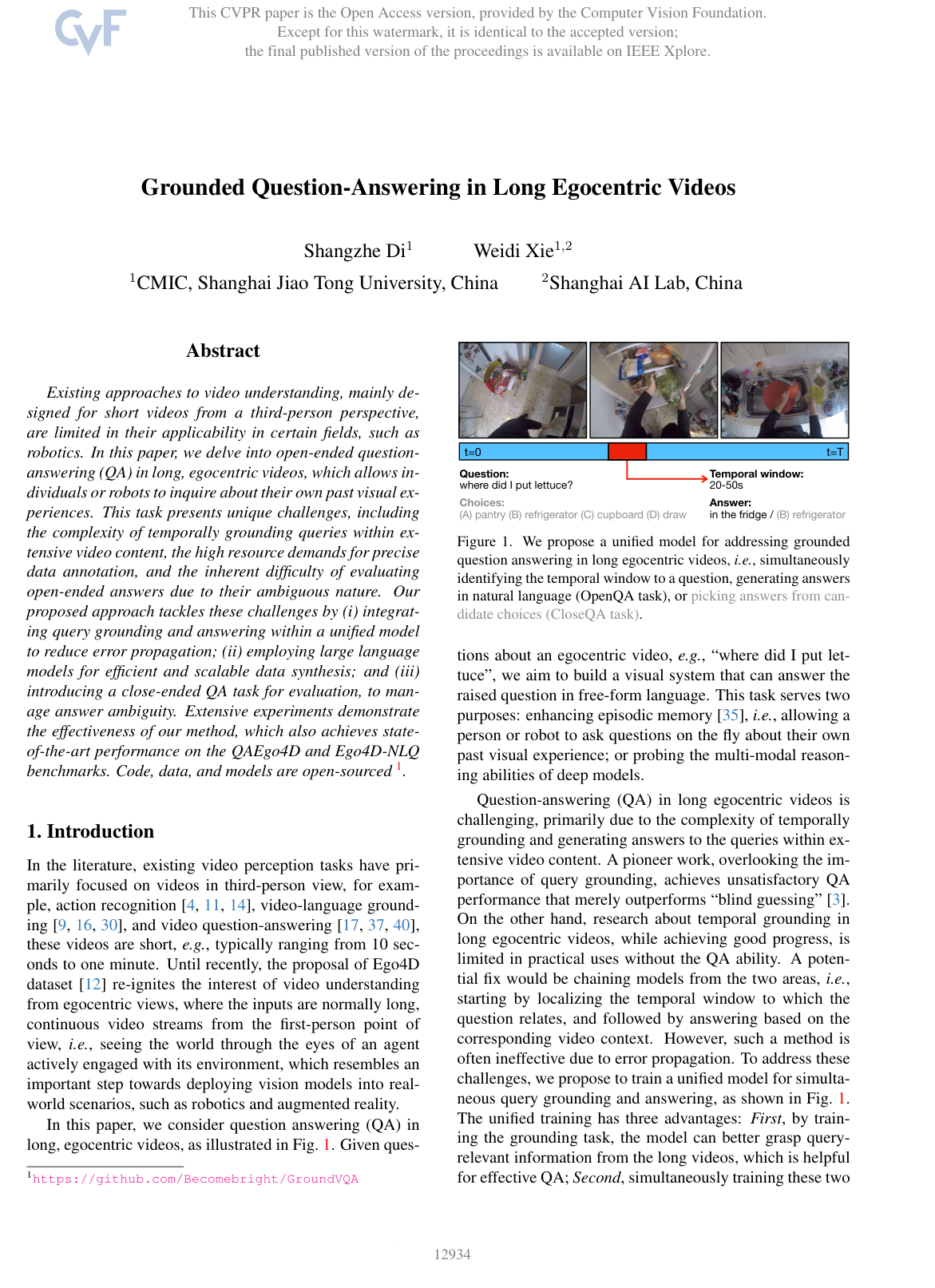
Grounded Question-Answering in Long Egocentric Videos
Shangzhe Di, Weidi Xie
Why you should read this
Proposes GroundVQA, a unified multimodal framework that simultaneously localizes relevant temporal windows and generates answers for questions in long egocentric videos, supported by an LLM-driven data generation pipeline that scales training triplets to achieve state-of-the-art performance on Ego4D benchmarks.
Existing approaches to video understanding, mainly designed for short videos from a third-person perspective, are limited in their applicability in certain fields, such as robotics. In this paper, we delve into open-ended question-answering (QA) in long, egocentric videos, which allows individuals or robots to inquire about their own past visual experiences. This task presents unique challenges, including the complexity of temporally grounding queries within extensive video content, the high resource demands for precise data annotation, and the inherent difficulty of evaluating open-ended answers due to their ambiguous nature. Our proposed approach tackles these challenges by (i) integrating query grounding and answering within a unified model to reduce error propagation; (ii) employing large language models for efficient and scalable data synthesis; and (iii) introducing a closed-ended QA task for evaluation, to manage answer ambiguity. Extensive experiments demonstrate the effectiveness of our method, which also achieves state-of-the-art performance on the QAEgo4D and Ego4D-NLQ benchmarks. Code, data, and models are open-sourced^1.
Added
2026-09-26
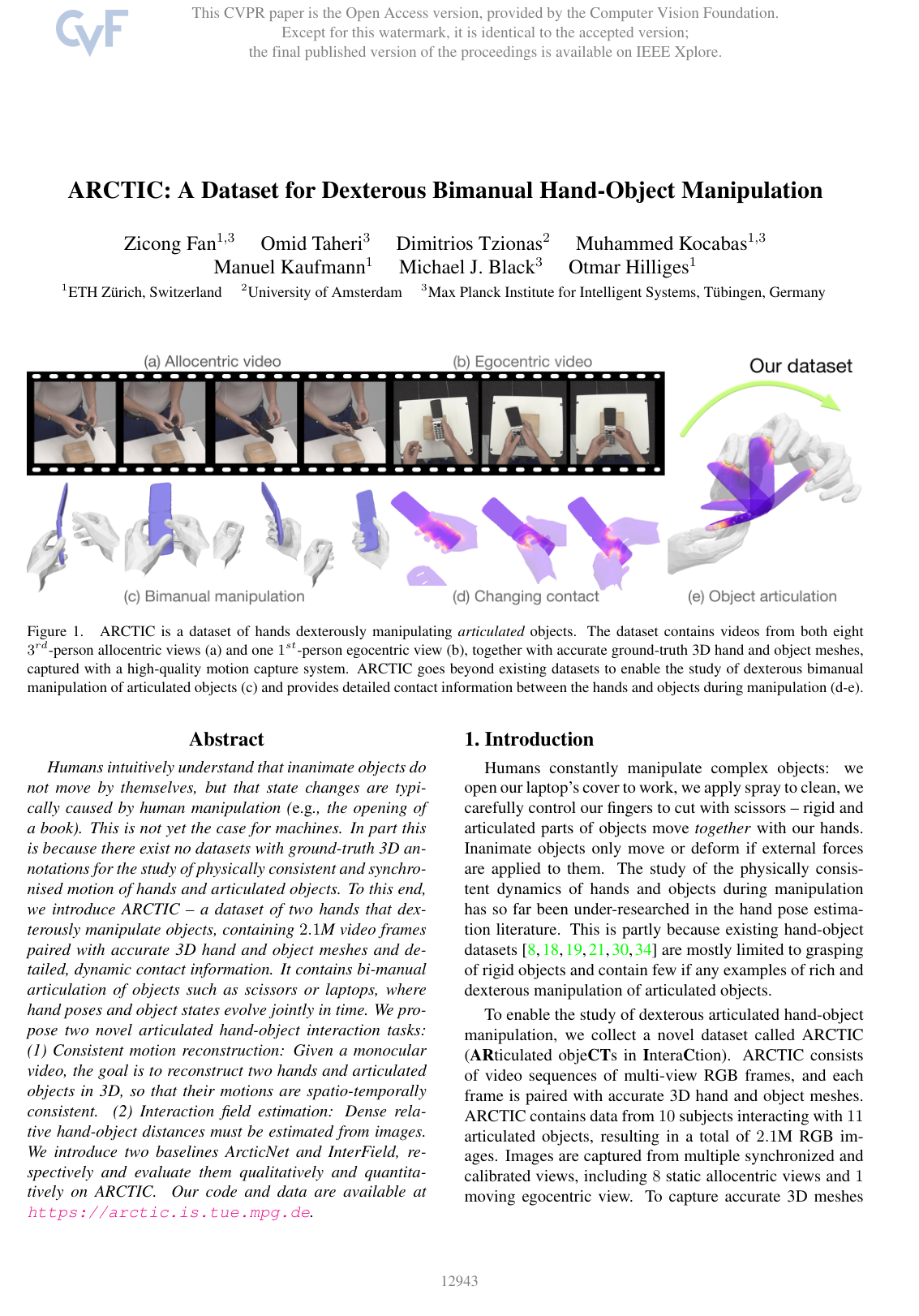
ARCTIC: A Dataset for Dexterous Bimanual Hand-Object Manipulation
Zicong Fan, Omid Taheri, Dimitrios Tzionas, Muhammed Kocabas, Manuel Kaufmann, Michael J. Black, Otmar Hilliges
Why you should read this
Presents the first large-scale multi-view dataset featuring accurate 3D meshes and dynamic contact annotations for bimanual manipulation of articulated objects, establishing new benchmarks and baselines for spatio-temporally consistent 3D motion reconstruction and interaction field estimation.
Humans intuitively understand that inanimate objects do not move by themselves, but that state changes are typically caused by human manipulation (e.g., the opening of a book). This is not yet the case for machines. In part this is because there exist no datasets with ground-truth 3D annotations for the study of physically consistent and synchronised motion of hands and articulated objects. To this end, we introduce ARCTIC – a dataset of two hands that dexterously manipulate objects, containing 2.1M video frames paired with accurate 3D hand and object meshes and detailed, dynamic contact information. It contains bi-manual articulation of objects such as scissors or laptops, where hand poses and object states evolve jointly in time. We propose two novel articulated hand-object interaction tasks: (1) Consistent motion reconstruction: Given a monocular video, the goal is to reconstruct two hands and articulated objects in 3D, so that their motions are spatio-temporally consistent. (2) Interaction field estimation: Dense relative hand-object distances must be estimated from images. We introduce two baselines ArcticNet and InterField, respectively and evaluate them qualitatively and quantitatively on ARCTIC. Our code and data are available at https://arctic.is.tue.mpg.de.
Added
2026-09-26
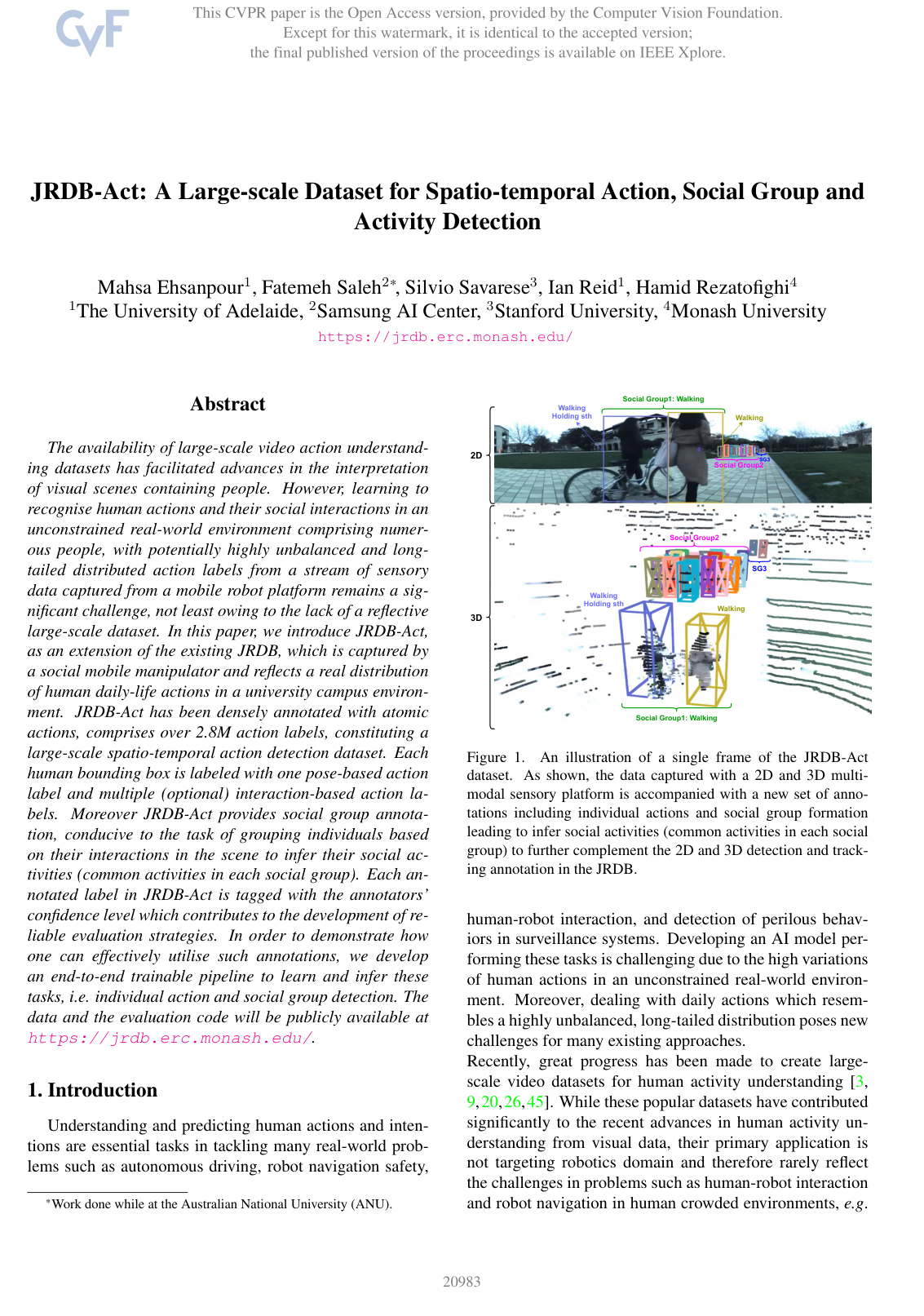
JRDB-Act: A Large-scale Dataset for Spatio-temporal Action, Social Group and Activity Detection
Mahsa Ehsanpour, Fatemeh Sadat Saleh, Silvio Savarese, Ian D. Reid, Hamid Rezatofighi
Why you should read this
Presents JRDB-Act, a large-scale multimodal benchmark featuring over 2.8 million action labels alongside social group annotations and confidence ratings captured from a mobile robot, establishing an end-to-end framework for joint individual action and group activity detection in crowded real-world environments.
The availability of large-scale video action understanding datasets has facilitated advances in the interpretation of visual scenes containing people. However, learning to recognise human actions and their social interactions in an unconstrained real-world environment comprising numerous people, with potentially highly unbalanced and long-tailed distributed action labels from a stream of sensory data captured from a mobile robot platform remains a significant challenge, not least owing to the lack of a reflective large-scale dataset. In this paper, we introduce JRDB-Act, as an extension of the existing JRDB, which is captured by a social mobile manipulator and reflects a real distribution of human daily-life actions in a university campus environment. JRDB-Act has been densely annotated with atomic actions, comprises over 2.8M action labels, constituting a large-scale spatio-temporal action detection dataset. Each human bounding box is labeled with one pose-based action label and multiple (optional) interaction-based action labels. Moreover JRDB-Act provides social group annotation, conducive to the task of grouping individuals based on their interactions in the scene to infer their social activities (common activities in each social group). Each annotated label in JRDB-Act is tagged with the annotators’ confidence level which contributes to the development of reliable evaluation strategies. In order to demonstrate how one can effectively utilise such annotations, we develop an end-to-end trainable pipeline to learn and infer these tasks, i.e. individual action and social group detection. The data and the evaluation code will be publicly available at https://jrdb.erc.monash.edu/.
Added
2026-09-26
EmbodiedGPT: Vision-Language Pre-Training via Embodied Chain of Thought
Yao Mu, Qinglong Zhang, Mengkang Hu, Wenhai Wang, Mingyu Ding, Jun Jin, Bin Wang, Jifeng Dai, Yu Qiao, Ping Luo
Why you should read this
Presents EmbodiedGPT, a vision-language foundation model that connects high-level chain-of-thought task planning to low-level robot control to substantially increase manipulation success rates across benchmarks like Franka Kitchen and Meta-World.
Embodied AI is a crucial frontier in robotics, capable of planning and executing action sequences for robots to accomplish long-horizon tasks in physical environments. In this work, we introduce EmbodiedGPT, an end-to-end multi-modal foundation model for embodied AI, empowering embodied agents with multi-modal understanding and execution capabilities. To achieve this, we have made the following efforts: (i) We craft a large-scale embodied planning dataset, termed EgoCOT. The dataset consists of carefully selected videos from the Ego4D dataset, along with corresponding high-quality language instructions. Specifically, we generate a sequence of sub-goals with the "Chain of Thoughts" mode for effective embodied planning. (ii) We introduce an efficient training approach to EmbodiedGPT for high-quality plan generation, by adapting a 7B large language model (LLM) to the EgoCOT dataset via prefix tuning. (iii) We introduce a paradigm for extracting task-related features from LLM-generated planning queries to form a closed loop between high-level planning and low-level control. Extensive experiments show the effectiveness of EmbodiedGPT on embodied tasks, including embodied planning, embodied control, visual captioning, and visual question answering. Notably, EmbodiedGPT significantly enhances the success rate of the embodied control task by extracting more effective features. It has achieved a remarkable 1.6 times increase in success rate on the Franka Kitchen benchmark and a 1.3 times increase on the Meta-World benchmark, compared to the BLIP-2 baseline fine-tuned with the Ego4D dataset.
Added
2026-09-26
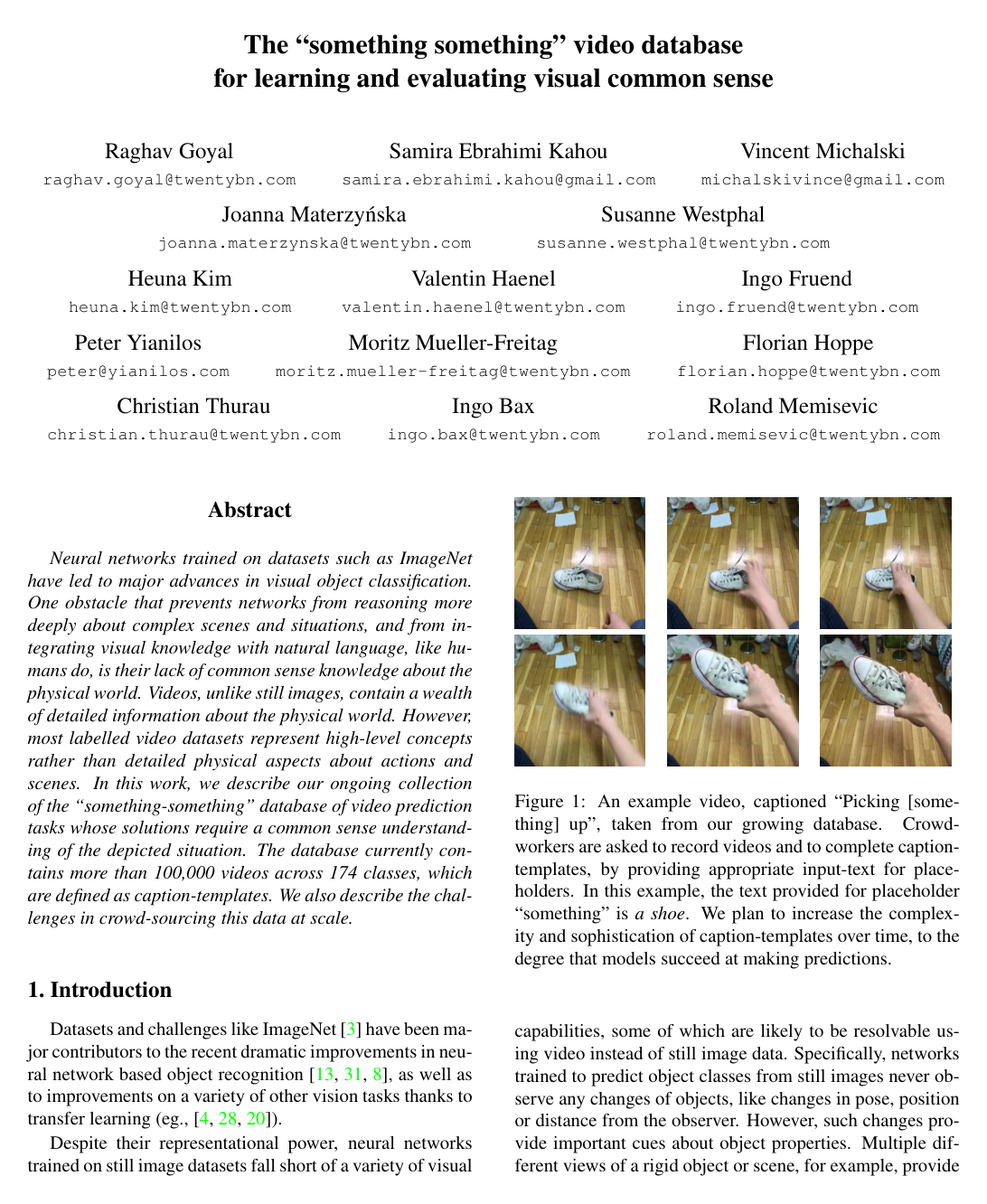
The “Something Something” Video Database for Learning and Evaluating Visual Common Sense
Raghav Goyal, Samira Ebrahimi Kahou, Vincent Michalski, Joanna Materzyńska, Susanne Westphal, Heuna Kim, Valentin Haenel, Ingo Fruend, Peter Yianilos, Moritz Mueller-Freitag, Florian Hoppe, Christian Thurau, Ingo Bax, Roland Memisevic
Why you should read this
Introduces the Something-Something video dataset containing over 100,000 crowd-sourced clips designed to benchmark and train neural networks on physical reasoning and visual common sense rather than superficial object recognition.
Neural networks trained on datasets such as ImageNet have led to major advances in visual object classification. One obstacle that prevents networks from reasoning more deeply about complex scenes and situations, and from integrating visual knowledge with natural language, like humans do, is their lack of common sense knowledge about the physical world. Videos, unlike still images, contain a wealth of detailed information about the physical world. However, most labelled video datasets represent high-level concepts rather than detailed physical aspects about actions and scenes. In this work, we describe our ongoing collection of the "something-something" database of video prediction tasks whose solutions require a common sense understanding of the depicted situation. The database currently contains more than 100,000 videos across 174 classes, which are defined as caption-templates. We also describe the challenges in crowd-sourcing this data at scale.
Added
2026-09-17
UCF101: A Dataset of 101 Human Actions Classes From Videos in The Wild
Khurram Soomro, Amir Roshan Zamir, Mubarak Shah
Why you should read this
Introduces UCF101, a benchmark dataset comprising over 13,000 unconstrained video clips across 101 distinct classes to advance realistic human action recognition in computer vision.
We introduce UCF101 which is currently the largest dataset of human actions. It consists of 101 action classes, over 13k clips and 27 hours of video data. The database consists of realistic user uploaded videos containing camera motion and cluttered background. Additionally, we provide baseline action recognition results on this new dataset using standard bag of words approach with overall performance of 44.5%. To the best of our knowledge, UCF101 is currently the most challenging dataset of actions due to its large number of classes, large number of clips and also unconstrained nature of such clips.
Added
2026-09-08