
keyword
human-interpretable concepts
Human-interpretable concepts are high-level, semantically meaningful units of information that correspond directly to categories, visual attributes, topics, or real-world ideas that people naturally understand. In artificial intelligence and machine learning interpretability, these concepts represent distinct semantic components extracted or disentangled from a model internal, high-dimensional representations. By translating dense mathematical vectors and activations into recognizable elements such as objects, textures, or thematic word associations, human-interpretable concepts allow practitioners to evaluate how models form predictions, identify and mitigate reliance on spurious correlations, and inspect or steer internal computational processes with greater transparency.
3 items
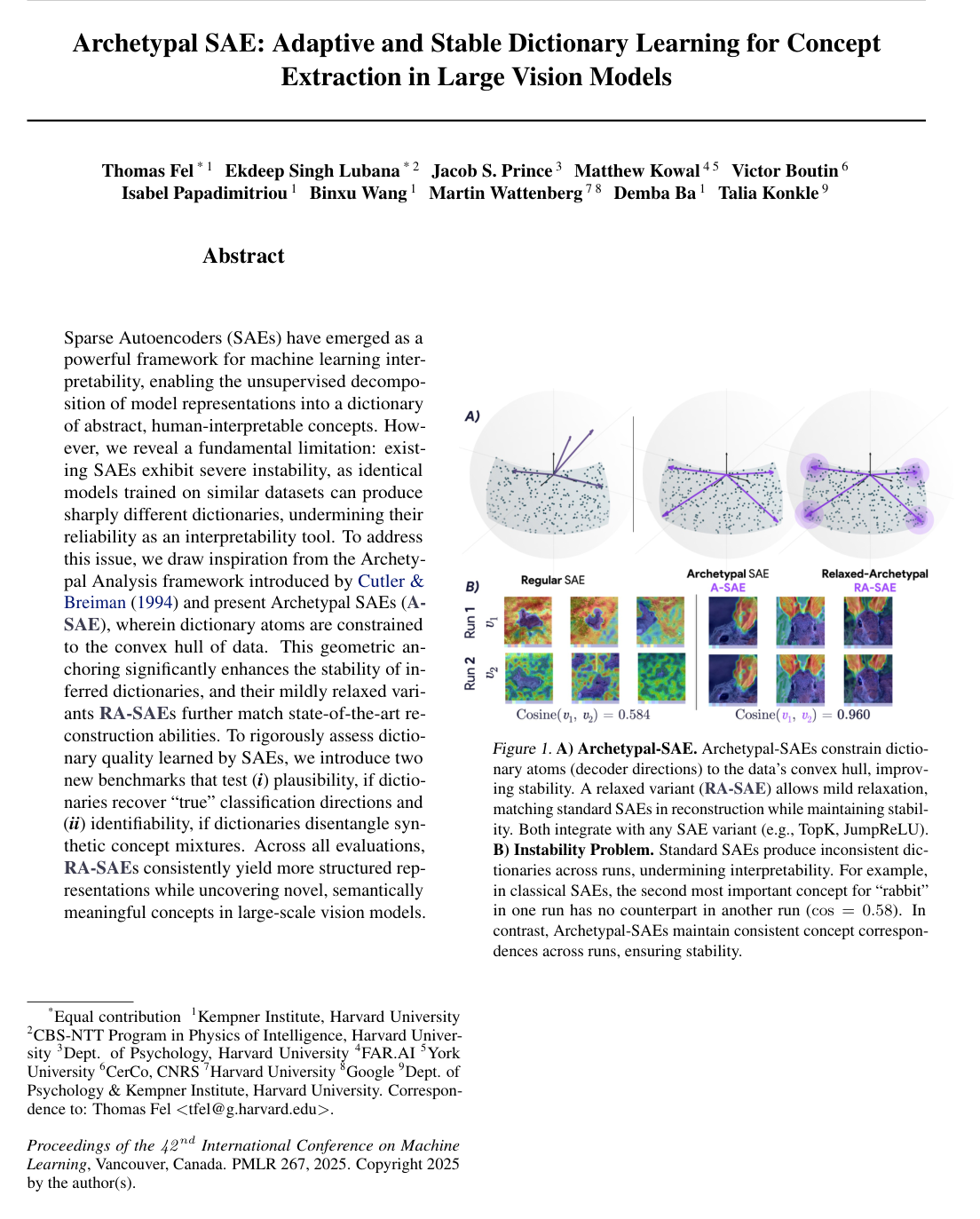
Archetypal SAE: Adaptive and Stable Dictionary Learning for Concept Extraction in Large Vision Models
Thomas Fel, Ekdeep Singh Lubana, Jacob S. Prince, Matthew Kowal, Victor Boutin, Isabel Papadimitriou, Binxu Wang, Martin Wattenberg, Demba E. Ba, Talia Konkle
Why you should read this
Proposes Archetypal Sparse Autoencoders to solve the instability of concept extraction across training runs by geometrically constraining dictionary atoms to the data's convex hull.
Sparse Autoencoders (SAEs) have emerged as a powerful framework for machine learning interpretability, enabling the unsupervised decomposition of model representations into a dictionary of abstract, human-interpretable concepts. However, we reveal a fundamental limitation: existing SAEs exhibit severe instability, as identical models trained on similar datasets can produce sharply different dictionaries, undermining their reliability as an interpretability tool. To address this issue, we draw inspiration from the Archetypal Analysis framework introduced by Cutler & Breiman (1994) and present Archetypal SAEs (A-SAE), wherein dictionary atoms are constrained to the convex hull of data. This geometric anchoring significantly enhances the stability of inferred dictionaries, and their mildly relaxed variants RA-SAEs further match state-of-the-art reconstruction abilities. To rigorously assess dictionary quality learned by SAEs, we introduce two new benchmarks that test (i) plausibility, if dictionaries recover “true” classification directions and (ii) identifiability, if dictionaries disentangle synthetic concept mixtures. Across all evaluations, RA-SAEs consistently yield more structured representations while uncovering novel, semantically meaningful concepts in large-scale vision models.
Added
2026-10-05
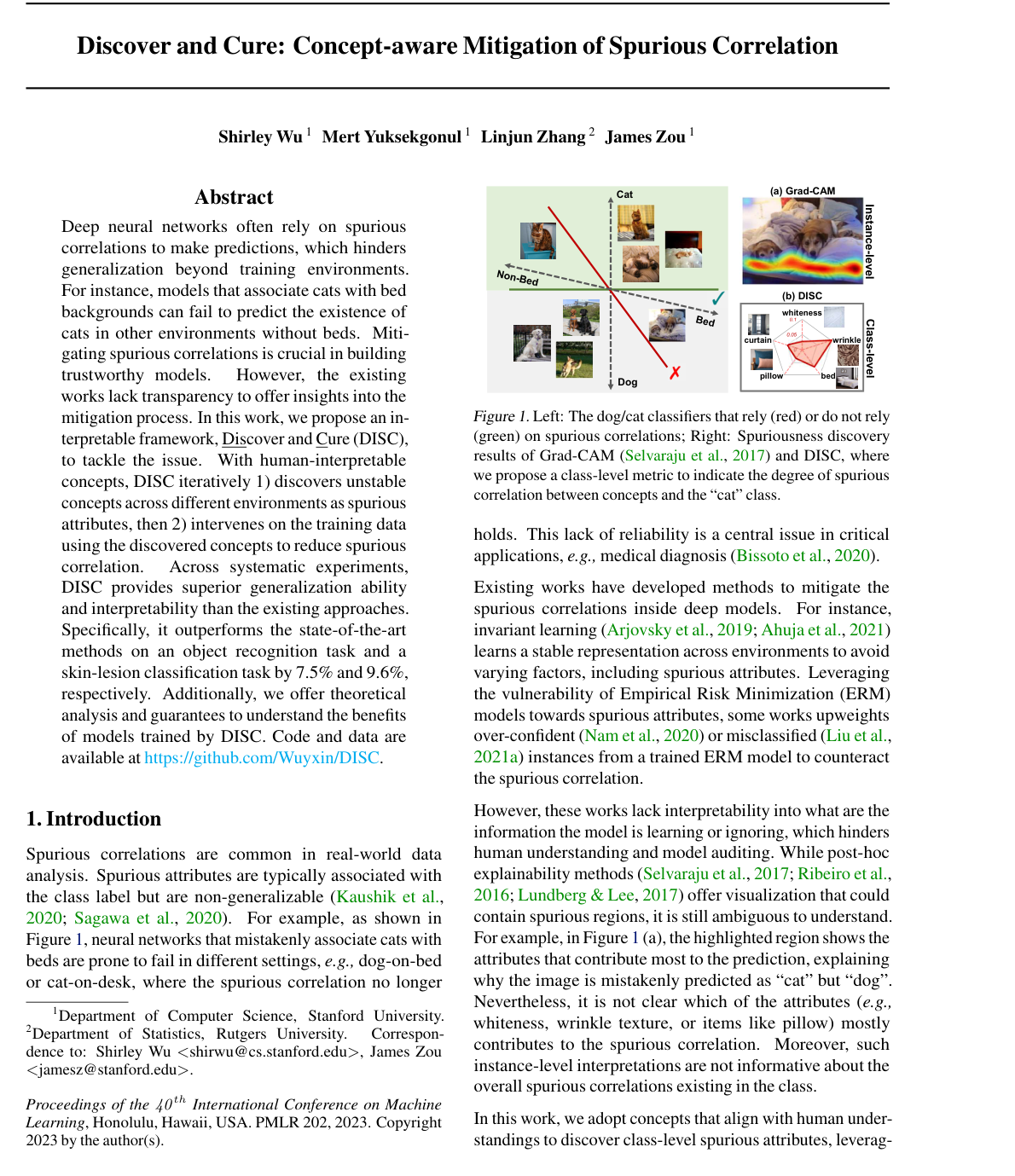
Discover and Cure: Concept-aware Mitigation of Spurious Correlation
Shirley Wu, Mert Yüksekgönül, Linjun Zhang, James Zou
Why you should read this
Proposes DISC, an interpretable framework that discovers unstable concepts across environments and performs targeted concept-level data interventions to prevent deep neural networks from relying on spurious correlations.
Deep neural networks often rely on spurious correlations to make predictions, which hinders generalization beyond training environments. For instance, models that associate cats with bed backgrounds can fail to predict the existence of cats in other environments without beds. Mitigating spurious correlations is crucial in building trustworthy models. However, the existing works lack transparency to offer insights into the mitigation process. In this work, we propose an interpretable framework, Discover and Cure (DISC), to tackle the issue. With human-interpretable concepts, DISC iteratively 1) discovers unstable concepts across different environments as spurious attributes, then 2) intervenes on the training data using the discovered concepts to reduce spurious correlation. Across systematic experiments, DISC provides superior generalization ability and interpretability than the existing approaches. Specifically, it outperforms the state-of-the-art methods on an object recognition task and a skin-lesion classification task by 7.5% and 9.6%, respectively. Additionally, we offer theoretical analysis and guarantees to understand the benefits of models trained by DISC. Code and data are available at https://github.com/Wuyxin/DISC.
Added
2026-10-02
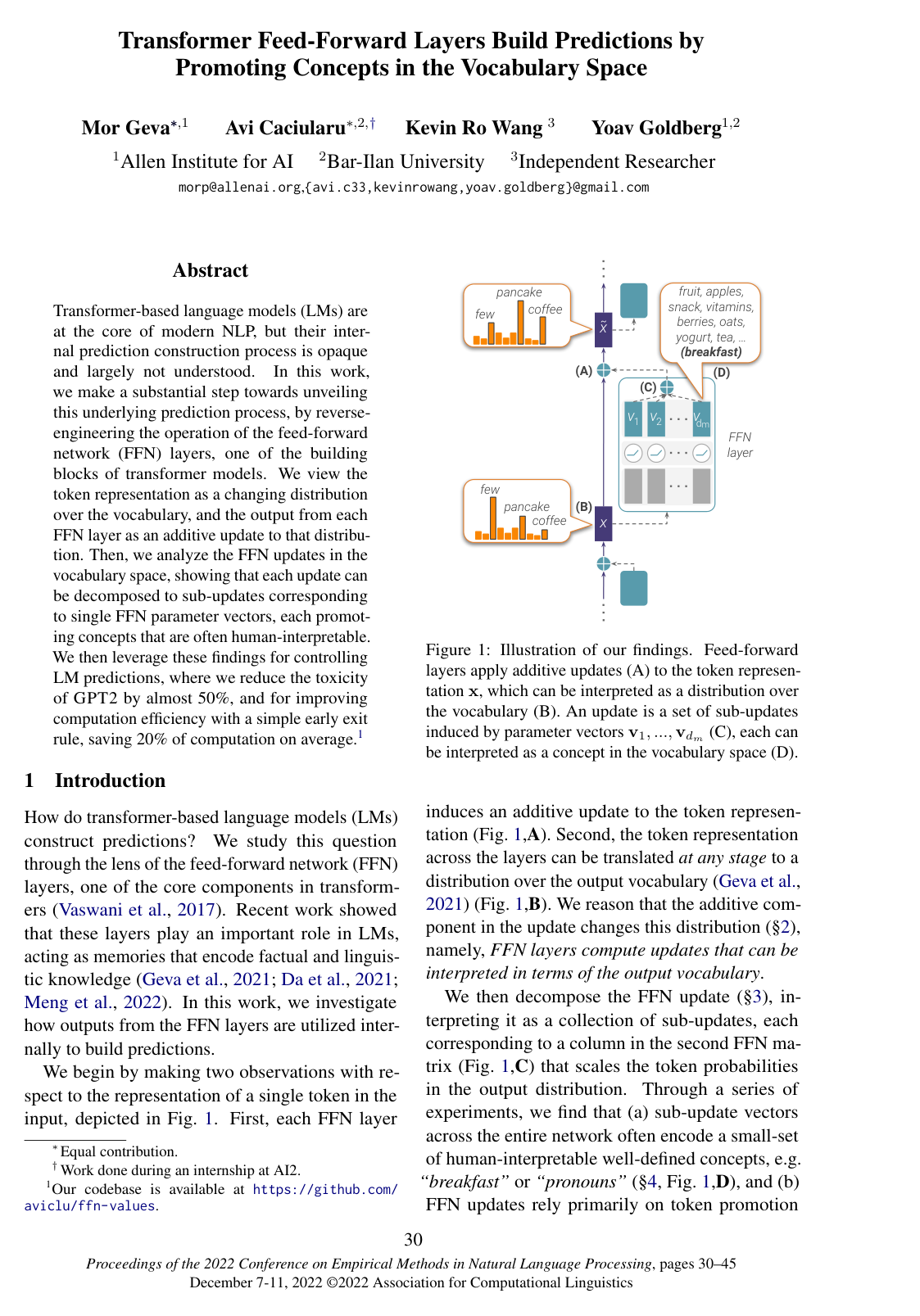
Transformer Feed-Forward Layers Build Predictions by Promoting Concepts in the Vocabulary Space
Mor Geva, Avi Caciularu, Kevin Ro Wang, Yoav Goldberg
Why you should read this
Reveals how transformer feed-forward layers construct predictions by promoting human-interpretable concepts directly in the vocabulary space, enabling practical techniques to cut GPT-2 toxicity by half and save twenty percent of inference computation through early exiting.
Transformer-based language models (LMs) are at the core of modern NLP, but their internal prediction construction process is opaque and largely not understood. In this work, we make a substantial step towards unveiling this underlying prediction process, by reverse-engineering the operation of the feed-forward network (FFN) layers, one of the building blocks of transformer models. We view the token representation as a changing distribution over the vocabulary, and the output from each FFN layer as an additive update to that distribution. Then, we analyze the FFN updates in the vocabulary space, showing that each update can be decomposed to sub-updates corresponding to single FFN parameter vectors, each promoting concepts that are often human-interpretable. We then leverage these findings for controlling LM predictions, where we reduce the toxicity of GPT2 by almost 50%, and for improving computation efficiency with a simple early exit rule, saving 20% of computation on average.
Added
2026-09-29