
keyword
human-in-the-loop
Human-in-the-loop is an artificial intelligence framework that integrates human oversight, judgment, or feedback directly into an automated system's training, evaluation, or decision-making process. Rather than relying entirely on autonomous machine learning algorithms, this approach incorporates human expertise to generate reliable reference data, validate model-generated outputs, correct algorithmic errors, and navigate complex or ambiguous edge cases. By combining computational speed and scalability with human contextual understanding and critical reasoning, human-in-the-loop workflows improve the overall accuracy, safety, and reliability of artificial intelligence systems.
2 items
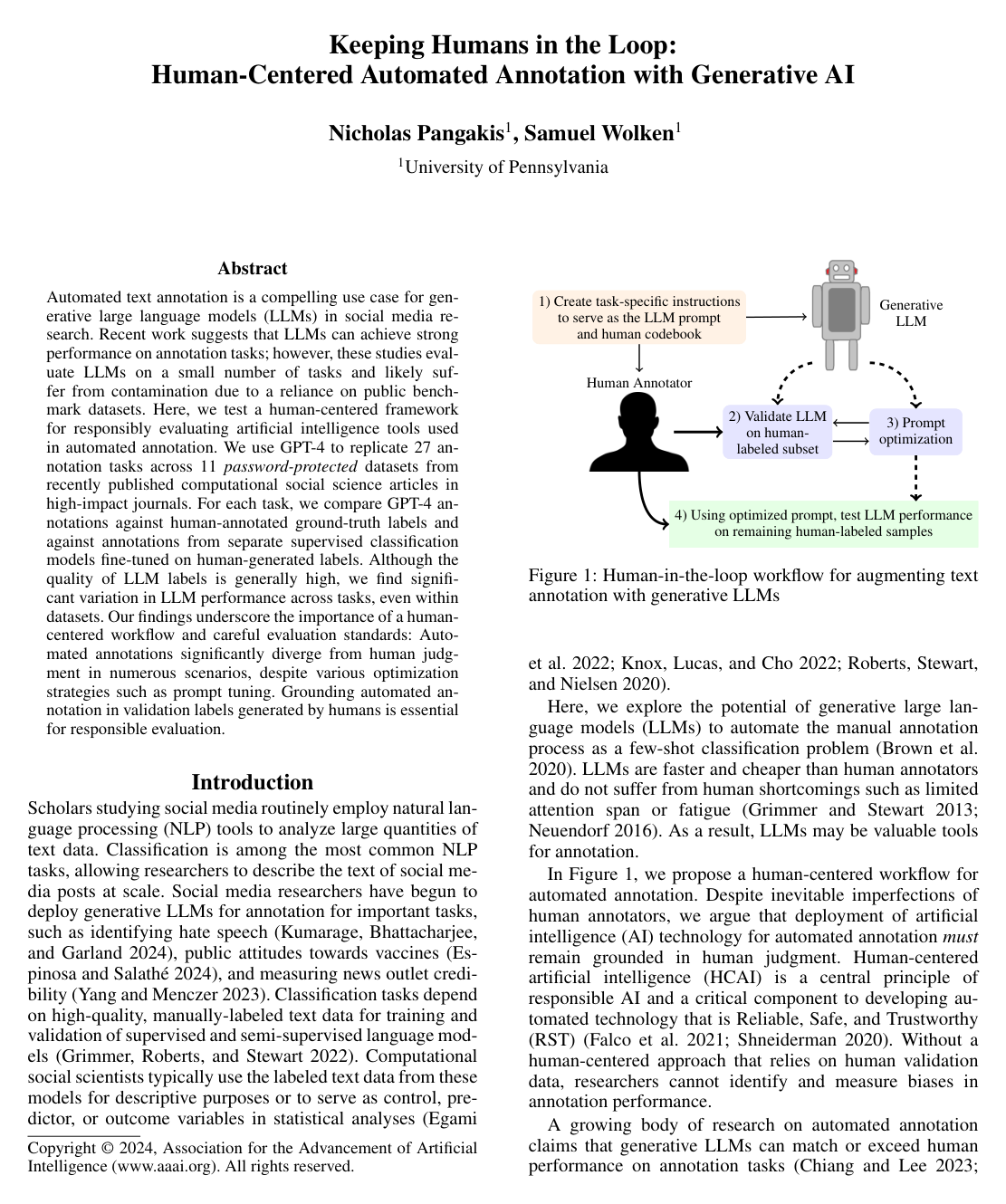
Keeping Humans in the Loop: Human-Centered Automated Annotation with Generative AI
Nick Pangakis, Sam Wolken
Why you should read this
Demonstrates through twenty-seven private social science tasks that large language model annotations vary unpredictably and diverge from human judgment, proving that human validation remains essential for automated research workflows.
Automated text annotation is a compelling use case for generative large language models (LLMs) in social media research. Recent work suggests that LLMs can achieve strong performance on annotation tasks; however, these studies evaluate LLMs on a small number of tasks and likely suffer from contamination due to a reliance on public benchmark datasets. Here, we test a human-centered framework for responsibly evaluating artificial intelligence tools used in automated annotation. We use GPT-4 to replicate 27 annotation tasks across 11 password-protected datasets from recently published computational social science articles in high-impact journals. For each task, we compare GPT-4 annotations against human-annotated ground-truth labels and against annotations from separate supervised classification models fine-tuned on human-generated labels. Although the quality of LLM labels is generally high, we find significant variation in LLM performance across tasks, even within datasets. Our findings underscore the importance of a human-centered workflow and careful evaluation standards: Automated annotations significantly diverge from human judgment in numerous scenarios, despite various optimization strategies such as prompt tuning. Grounding automated annotation in validation labels generated by humans is essential for responsible evaluation.
Added
2026-09-29
Human-in-the-loop or AI-in-the-loop? Automate or Collaborate?
Sriraam Natarajan, Saurabh Mathur, Sahil Sidheekh, Wolfgang Stammer, Kristian Kersting
Why you should read this
Distinguishes human-in-the-loop systems, where algorithms control decision-making using human feedback, from AI-in-the-loop paradigms, where humans retain ultimate authority while AI provides assistance, to define appropriate evaluation and trust frameworks for collaborative machine learning.
Human-in-the-loop (HIL) systems have emerged as a promising approach for combining the strengths of data-driven machine learning models with the contextual understanding of human experts. However, a deeper look into several of these systems reveals that calling them HIL would be a misnomer, as they are quite the opposite, namely AI-in-the-loop (AI²L) systems: the human is in control of the system, while the AI is there to support the human. We argue that existing evaluation methods often overemphasize the machine (learning) component's performance, neglecting the human expert's critical role. Consequently, we propose an AI²L perspective, which recognizes that the human expert is an active participant in the system, significantly influencing its overall performance. By adopting an AI²L approach, we can develop more comprehensive systems that faithfully model the intricate interplay between the human and machine components, leading to more effective and robust AI systems.
Added
2026-09-26