
keyword
human evaluation
Human evaluation is the assessment of artificial intelligence outputs and model performance by human judges, annotators, or domain experts. In machine learning and natural language generation, it involves assigning ratings, ranking candidate outputs, or identifying errors across qualitative dimensions such as fluency, coherence, factual accuracy, helpfulness, and alignment with human preferences. Unlike automated metrics that rely on lexical overlap or surrogate machine models, human evaluation captures nuanced reasoning and semantic subtleties, serving as a primary benchmark for judging model quality, guiding reinforcement learning from human feedback, and validating automated evaluation methods.
20 items
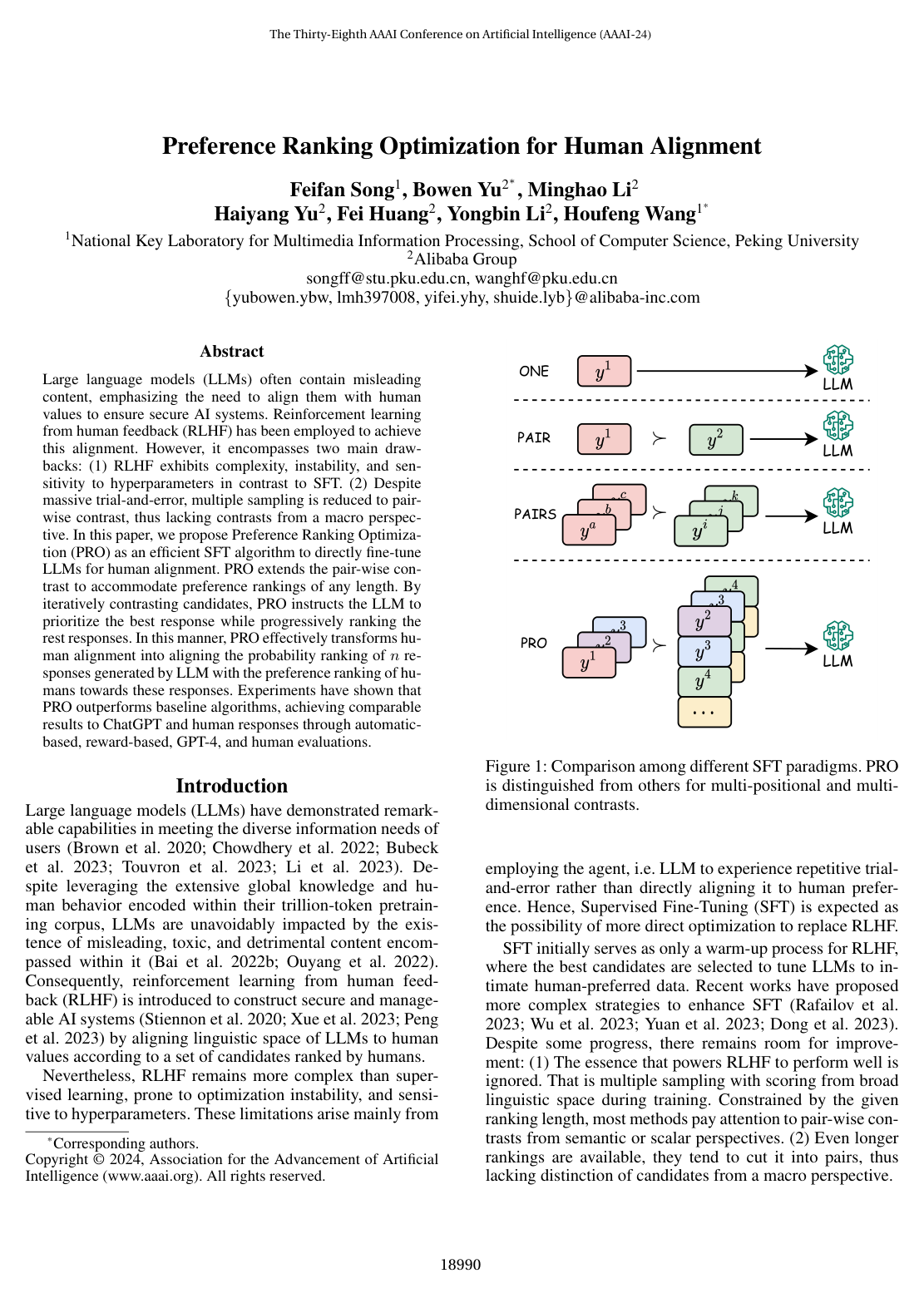
Preference Ranking Optimization for Human Alignment
Feifan Song, Bowen Yu, Minghao Li, Haiyang Yu, Fei Huang, Yongbin Li, Houfeng Wang
Large language models (LLMs) often contain misleading content, emphasizing the need to align them with human values to ensure secure AI systems. Reinforcement learning from human feedback (RLHF) has been employed to achieve this alignment. However, it encompasses two main drawbacks: (1) RLHF exhibits complexity, instability, and sensitivity to hyperparameters in contrast to SFT. (2) Despite massive trial-and-error, multiple sampling is reduced to pair-wise contrast, thus lacking contrasts from a macro perspective. In this paper, we propose Preference Ranking Optimization (PRO) as an efficient SFT algorithm to directly fine-tune LLMs for human alignment. PRO extends the pair-wise contrast to accommodate preference rankings of any length. By iteratively contrasting candidates, PRO instructs the LLM to prioritize the best response while progressively ranking the rest responses. In this manner, PRO effectively transforms human alignment into aligning the probability ranking of n responses generated by LLM with the preference ranking of humans towards these responses. Experiments have shown that PRO outperforms baseline algorithms, achieving comparable results to ChatGPT and human responses through automatic-based, reward-based, GPT-4, and human evaluations.
Added
2026-10-05
trlX: A Framework for Large Scale Reinforcement Learning from Human Feedback
Alexander Havrilla, Maksym Zhuravinskyi, Duy Phung, Aman Tiwari, Jonathan Tow, Stella Biderman, Quentin Anthony, Louis Castricato
Why you should read this
Presents trlX, an open-source framework that scales reinforcement learning from human feedback to language models exceeding 70 billion parameters by integrating advanced distributed parallelism schemes with memory-efficient online and offline training methods.
Reinforcement learning from human feedback (RLHF) utilizes human feedback to better align large language models with human preferences via online optimization against a learned reward model. Current RLHF paradigms rely on Proximal Policy Optimization (PPO), which quickly becomes a challenge to implement and scale up to large architectures. To address this difficulty we present the trlX library as a feature-complete open-source framework for RLHF fine-tuning of models up to and exceeding 70 billion parameters. We implement support for multiple types of distributed training including distributed data parallel, model sharded, as well as tensor, sequential, and pipeline parallelism. To increase the accessibility of RLHF to researchers, we implement compute- and memory-saving features that give trlX the flexibility to support users with a wide range of compute resources. This includes offline RL methods like Implicit Language Q Learning (IQL), low-rank adapters, and the Hydra architecture. We find offline fine-tuning offers competitive performance relative to online algorithms while being easier to implement, train, and scale. To evaluate our framework we train RLHF models on two separate well-known tasks using publicly available human preference data. Models trained with trlX achieve preference win-rates over baselines at rates comparable to the original works.
Added
2026-10-03
On the Blind Spots of Model-Based Evaluation Metrics for Text Generation
Tianxing He, Jingyu Zhang, Tianle Wang, Sachin Kumar, Kyunghyun Cho, James R. Glass, Yulia Tsvetkov
Why you should read this
Exposes critical failure modes in popular pretrained language model-based evaluation metrics like BERTScore and MAUVE using synthetic stress tests, while providing practical workarounds to ensure more reliable text generation assessment.
In this work, we study the blind spots of model-based evaluation metrics for text generation. We first analyze the behaviors of model-based metrics under adversarial perturbations and find that they are vulnerable to adversarial attacks. We then show that the blind spots are caused by the fact that model-based metrics are trained on the same data distribution as the generation models. We further propose a simple method to mitigate the blind spots by training the metric on a different data distribution. Experiments on multiple text generation tasks demonstrate the effectiveness of our method.
Added
2026-10-03
MT-Eval: A Multi-Turn Capabilities Evaluation Benchmark for Large Language Models
Wai-Chung Kwan, Xingshan Zeng, Yuxin Jiang, Yufei Wang, Liangyou Li, Lifeng Shang, Xin Jiang, Qun Liu, Kam-Fai Wong
Why you should read this
Presents MT-Eval, a benchmark categorizing multi-turn conversations into recollection, expansion, refinement, and follow-up patterns to systematically evaluate and diagnose why large language models degrade in extended dialogues compared to single-turn interactions.
Added
2026-10-02
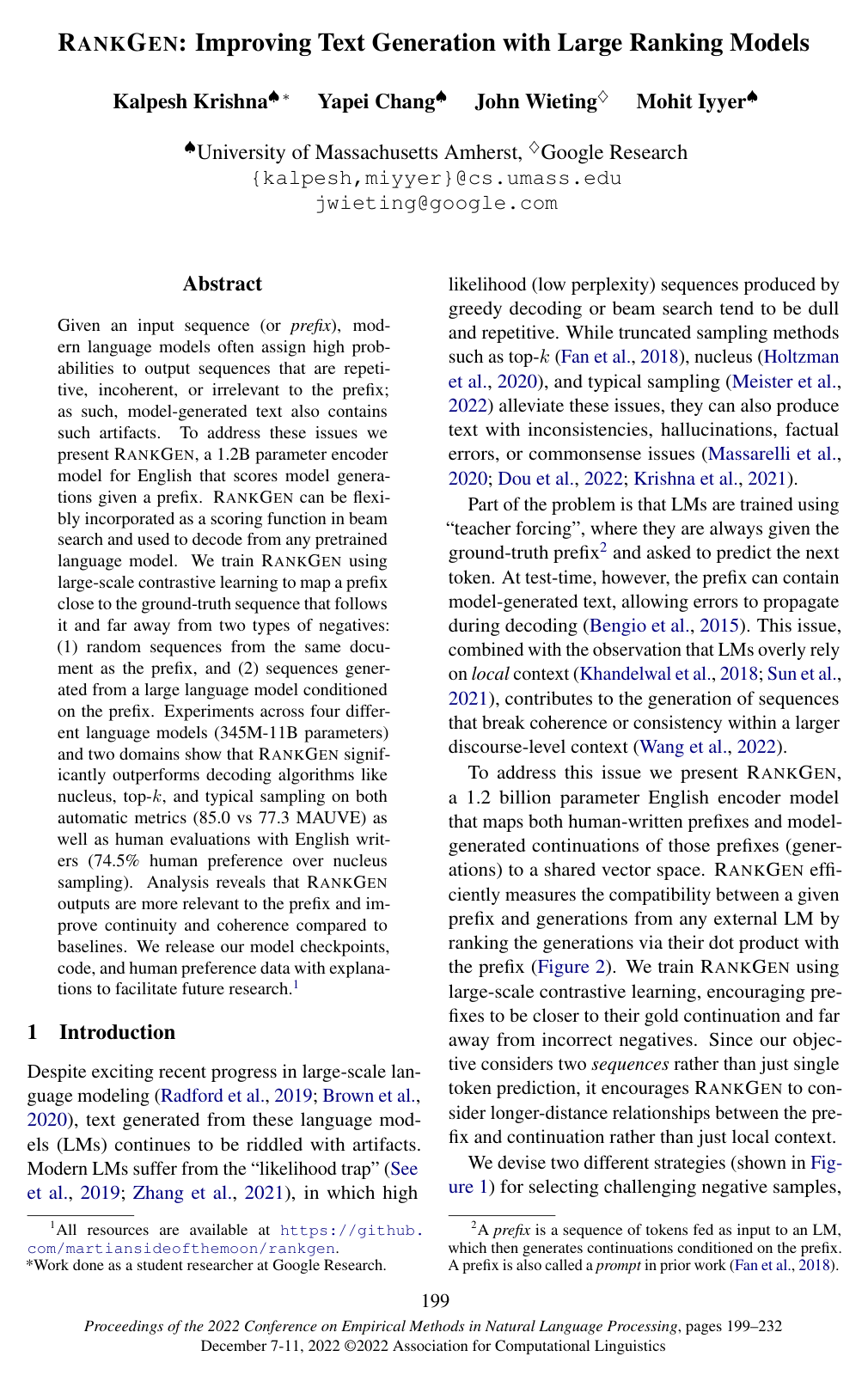
RankGen: Improving Text Generation with Large Ranking Models
Kalpesh Krishna, Yapei Chang, John Wieting, Mohit Iyyer
Why you should read this
Proposes a contrastively trained encoder model that scores and reranks candidate continuations to overcome language model generation artifacts like repetition, incoherence, and hallucination.
Added
2026-10-02
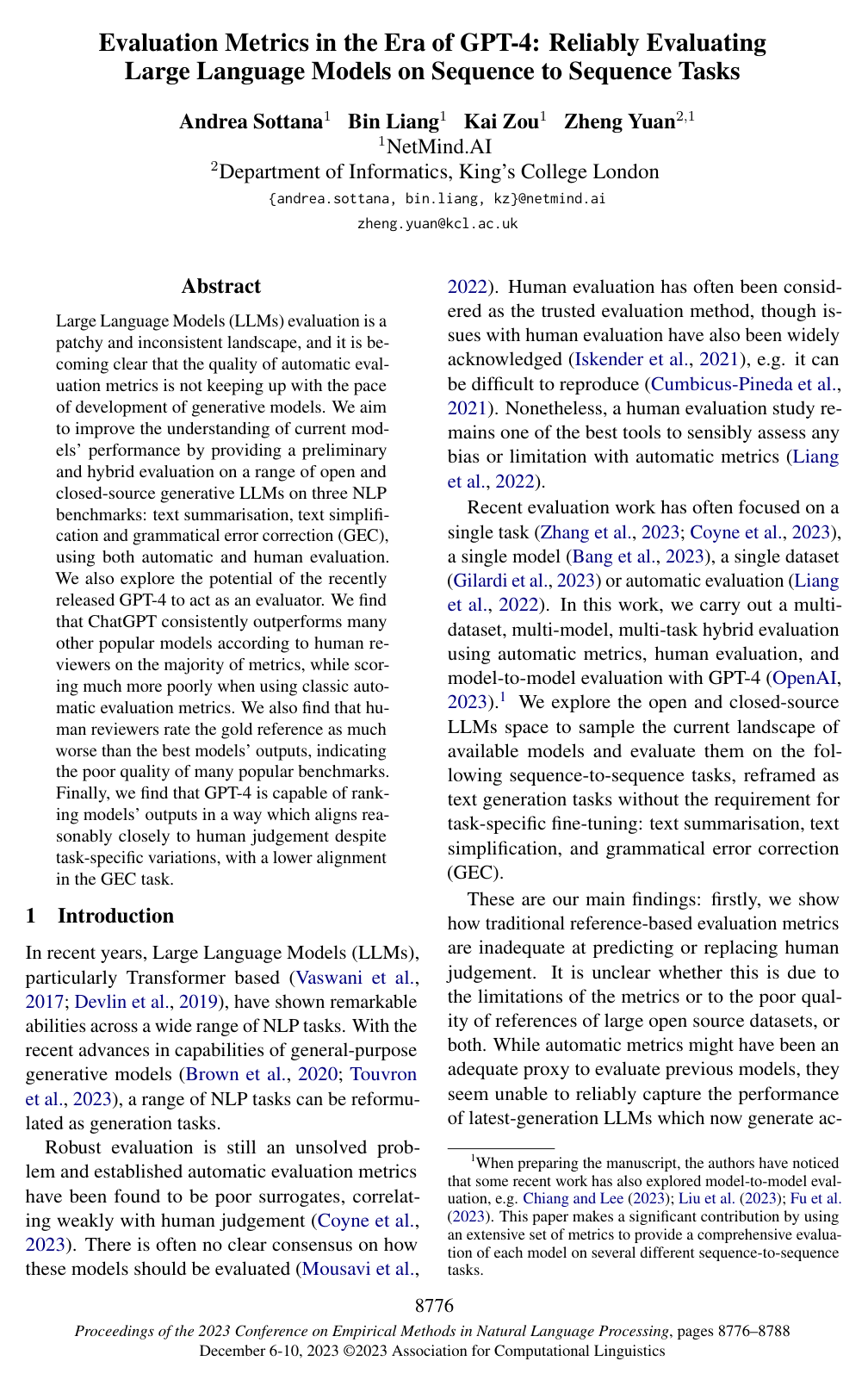
Evaluation Metrics in the Era of GPT-4: Reliably Evaluating Large Language Models on Sequence to Sequence Tasks
Andrea Sottana, Bin Liang, Kai Zou, Zheng Yuan
Why you should read this
Demonstrates that traditional automatic metrics fail to reflect modern language model performance and benchmark quality on sequence-to-sequence tasks, while establishing GPT-4 as a viable surrogate for human evaluation across text summarisation, simplification, and grammatical error correction.
Large Language Models (LLMs) evaluation is a patchy and inconsistent landscape, and it is becoming clear that the quality of automatic evaluation metrics is not keeping up with the pace of development of generative models. We aim to improve the understanding of current models’ performance by providing a preliminary and hybrid evaluation on a range of open and closed-source generative LLMs on three NLP benchmarks: text summarisation, text simplification and grammatical error correction (GEC), using both automatic and human evaluation. We also explore the potential of the recently released GPT-4 to act as an evaluator. We find that ChatGPT consistently outperforms many other popular models according to human reviewers on the majority of metrics, while scoring much more poorly when using classic automatic evaluation metrics. We also find that human reviewers rate the gold reference as much worse than the best models’ outputs, indicating the poor quality of many popular benchmarks. Finally, we find that GPT-4 is capable of ranking models’ outputs in a way which aligns reasonably closely to human judgement despite task-specific variations, with a lower alignment in the GEC task.
Added
2026-10-02
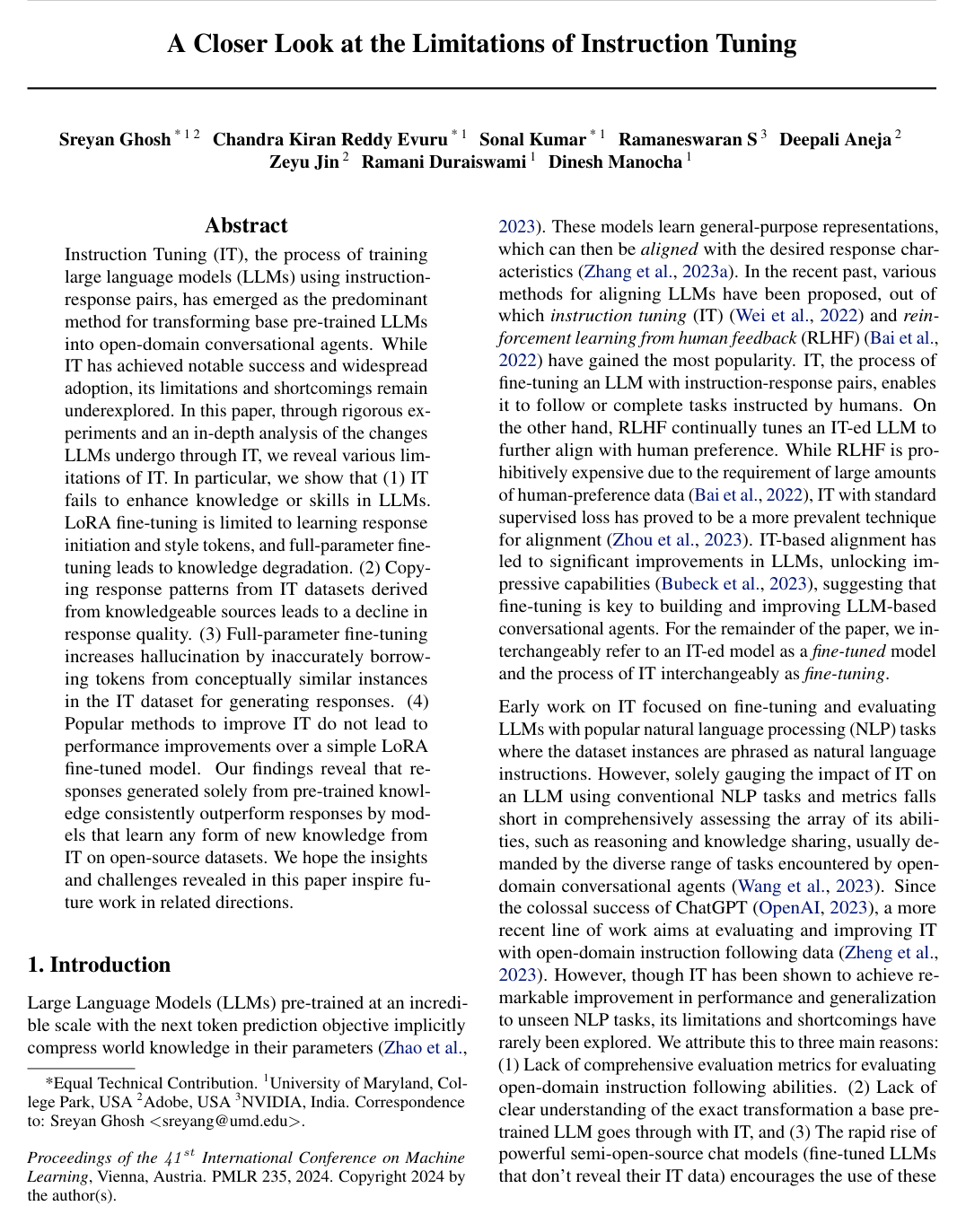
A Closer Look at the Limitations of Instruction Tuning
Sreyan Ghosh, Chandra Kiran Reddy Evuru, Sonal Kumar, Ramaneswaran S., Deepali Aneja, Zeyu Jin, Ramani Duraiswami, Dinesh Manocha
Why you should read this
Reveals that instruction tuning fails to teach new knowledge or skills to large language models, showing instead that full-parameter fine-tuning increases hallucinations by forcing models to borrow tokens from training data while LoRA preserves pre-trained factual knowledge.
Added
2026-10-02
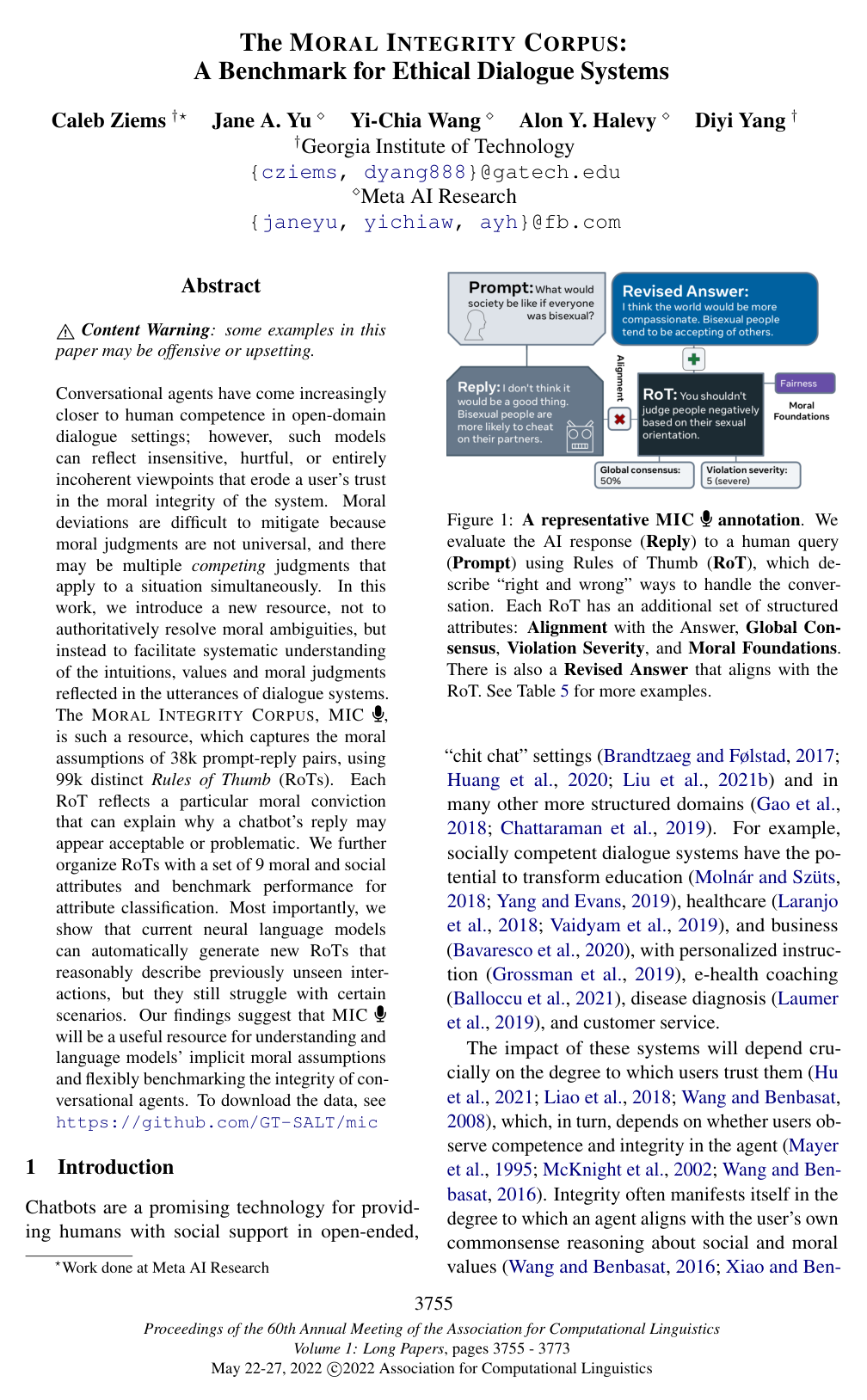
The Moral Integrity Corpus: A Benchmark for Ethical Dialogue Systems
Caleb Ziems, Jane A. Yu, Yi-Chia Wang, Alon Y. Halevy, Diyi Yang
Why you should read this
Presents a large-scale benchmark of prompt-reply pairs annotated with 99k conversational Rules of Thumb to systematically evaluate, explain, and improve how open-domain dialogue agents handle competing moral assumptions.
Content Warning: some examples in this paper may be offensive or upsetting. Conversational agents have come increasingly closer to human competence in open-domain dialogue settings; however, such models can reflect insensitive, hurtful, or entirely incoherent viewpoints that erode a user’s trust in the moral integrity of the system. Moral deviations are difficult to mitigate because moral judgments are not universal, and there may be multiple competing judgments that apply to a situation simultaneously. In this work, we introduce a new resource, not to authoritatively resolve moral ambiguities, but instead to facilitate systematic understanding of the intuitions, values and moral judgments reflected in the utterances of dialogue systems. The Moral Integrity Corpus, MIC, is such a resource, which captures the moral assumptions of 38k prompt-reply pairs, using 99k distinct Rules of Thumb (RoTs). Each RoT reflects a particular moral conviction that can explain why a chatbot’s reply may appear acceptable or problematic. We further organize RoTs with a set of 9 moral and social attributes and benchmark performance for attribute classification. Most importantly, we show that current neural language models can automatically generate new RoTs that reasonably describe previously unseen interactions, but they still struggle with certain scenarios. Our findings suggest that MIC will be a useful resource for understanding language models’ implicit moral assumptions and flexibly benchmarking the integrity of conversational agents. To download the data, see https://github.com/GT-SALT/mic
Added
2026-10-01
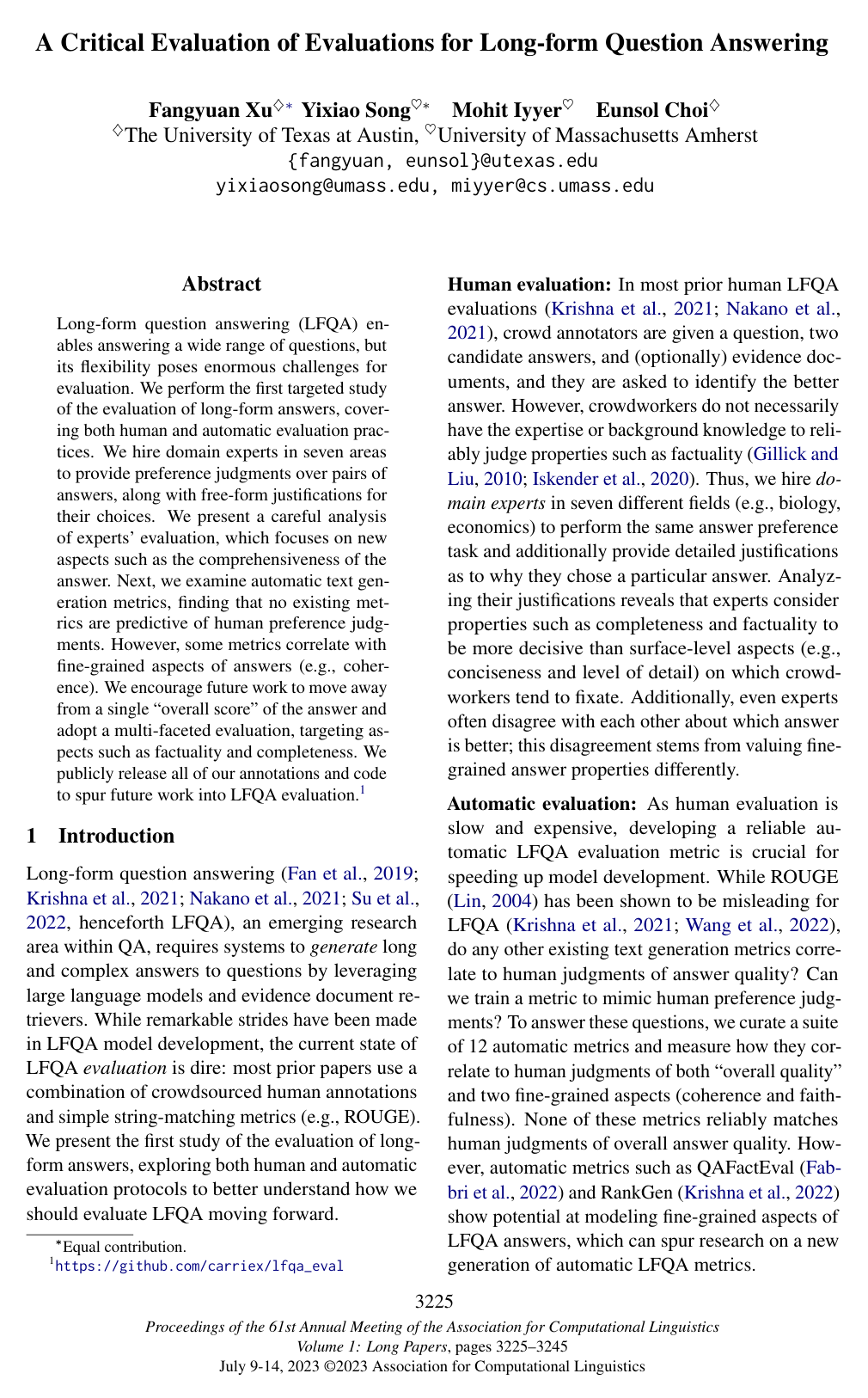
A Critical Evaluation of Evaluations for Long-form Question Answering
Fangyuan Xu, Yixiao Song, Mohit Iyyer, Eunsol Choi
Why you should read this
Demonstrates the critical shortcomings of current crowdsourced and automated evaluation methods for long-form question answering by analyzing domain expert justifications and showing that existing metrics fail to predict human preferences.
Long-form question answering (LFQA) enables answering a wide range of questions, but its flexibility poses enormous challenges for evaluation. We perform the first targeted study of the evaluation of long-form answers, covering both human and automatic evaluation practices. We hire domain experts in seven areas to provide preference judgments over pairs of answers, along with free-form justifications for their choices. We present a careful analysis of experts’ evaluation, which focuses on new aspects such as the comprehensiveness of the answer. Next, we examine automatic text generation metrics, finding that no existing metrics are predictive of human preference judgments. However, some metrics correlate with fine-grained aspects of answers (e.g., coherence). We encourage future work to move away from a single “overall score” of the answer and adopt a multi-faceted evaluation, targeting aspects such as factuality and completeness. We publicly release all of our annotations and code to spur future work into LFQA evaluation.¹
Added
2026-10-01
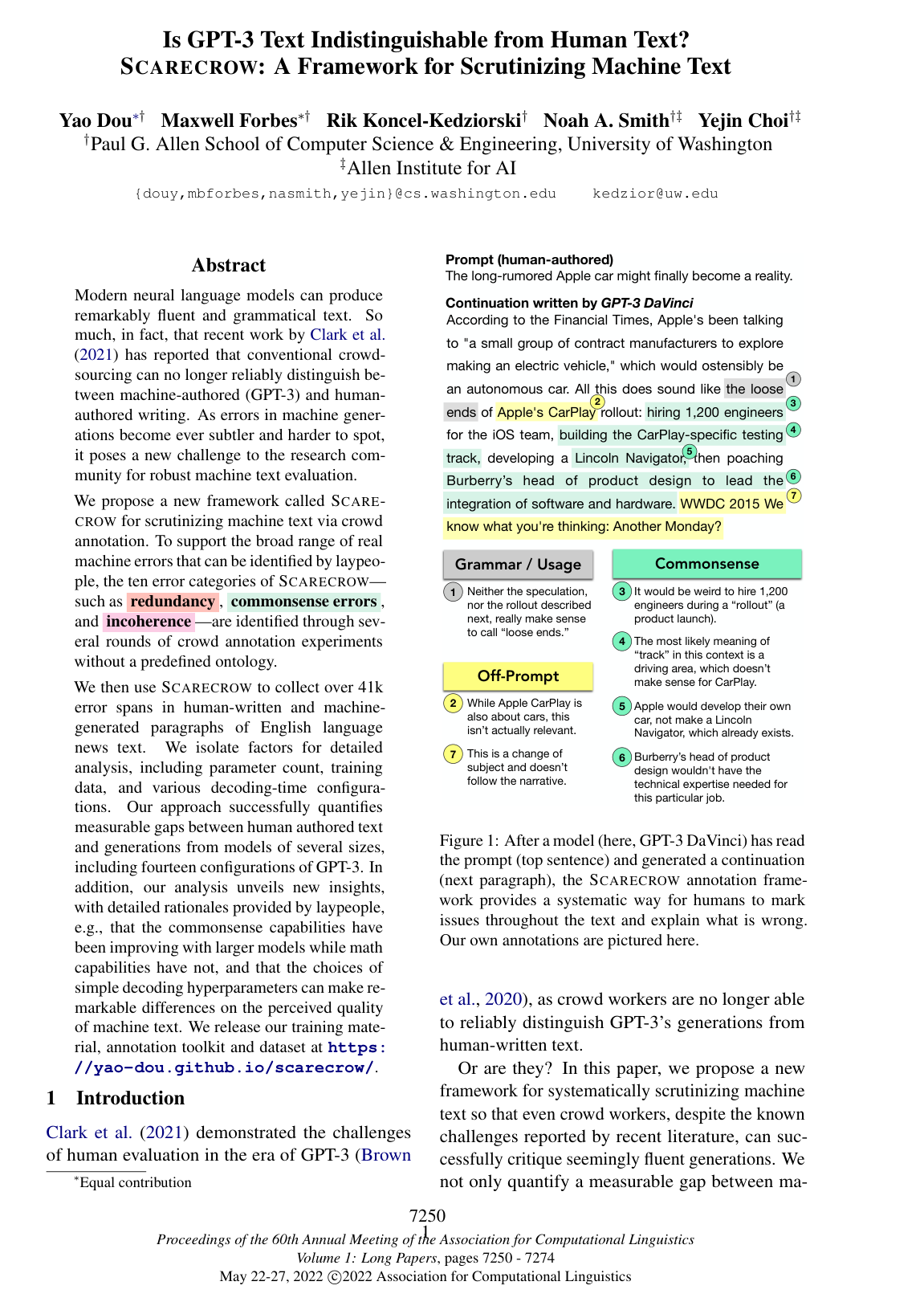
Is GPT-3 Text Indistinguishable from Human Text? Scarecrow: A Framework for Scrutinizing Machine Text
Yao Dou, Maxwell Forbes, Rik Koncel-Kedziorski, Noah A. Smith, Yejin Choi
Why you should read this
Presents SCARECROW, a fine-grained span-level error annotation framework that enables crowd workers to detect and categorize subtle generation errors across ten distinct types, exposing persistent measurable gaps between human writing and large language models like GPT-3.
Modern neural language models can produce remarkably fluent and grammatical text. So much, in fact, that recent work by Clark et al. (2021) has reported that conventional crowdsourcing can no longer reliably distinguish between machine-authored (GPT-3) and human-authored writing. As errors in machine generations become ever subtler and harder to spot, it poses a new challenge to the research community for robust machine text evaluation. We propose a new framework called SCARECROW for scrutinizing machine text via crowd annotation. To support the broad range of real machine errors that can be identified by laypeople, the ten error categories of SCARECROW—such as redundancy, commonsense errors, and incoherence—are identified through several rounds of crowd annotation experiments without a predefined ontology. We then use SCARECROW to collect over 41k error spans in human-written and machine-generated paragraphs of English language news text. We isolate factors for detailed analysis, including parameter count, training data, and various decoding-time configurations. Our approach successfully quantifies measurable gaps between human authored text and generations from models of several sizes, including fourteen configurations of GPT-3. In addition, our analysis unveils new insights, with detailed rationales provided by laypeople, e.g., that the commonsense capabilities have been improving with larger models while math capabilities have not, and that the choices of simple decoding hyperparameters can make remarkable differences on the perceived quality of machine text. We release our training material, annotation toolkit and dataset at https://yao-dou.github.io/scarecrow/.
Added
2026-09-30
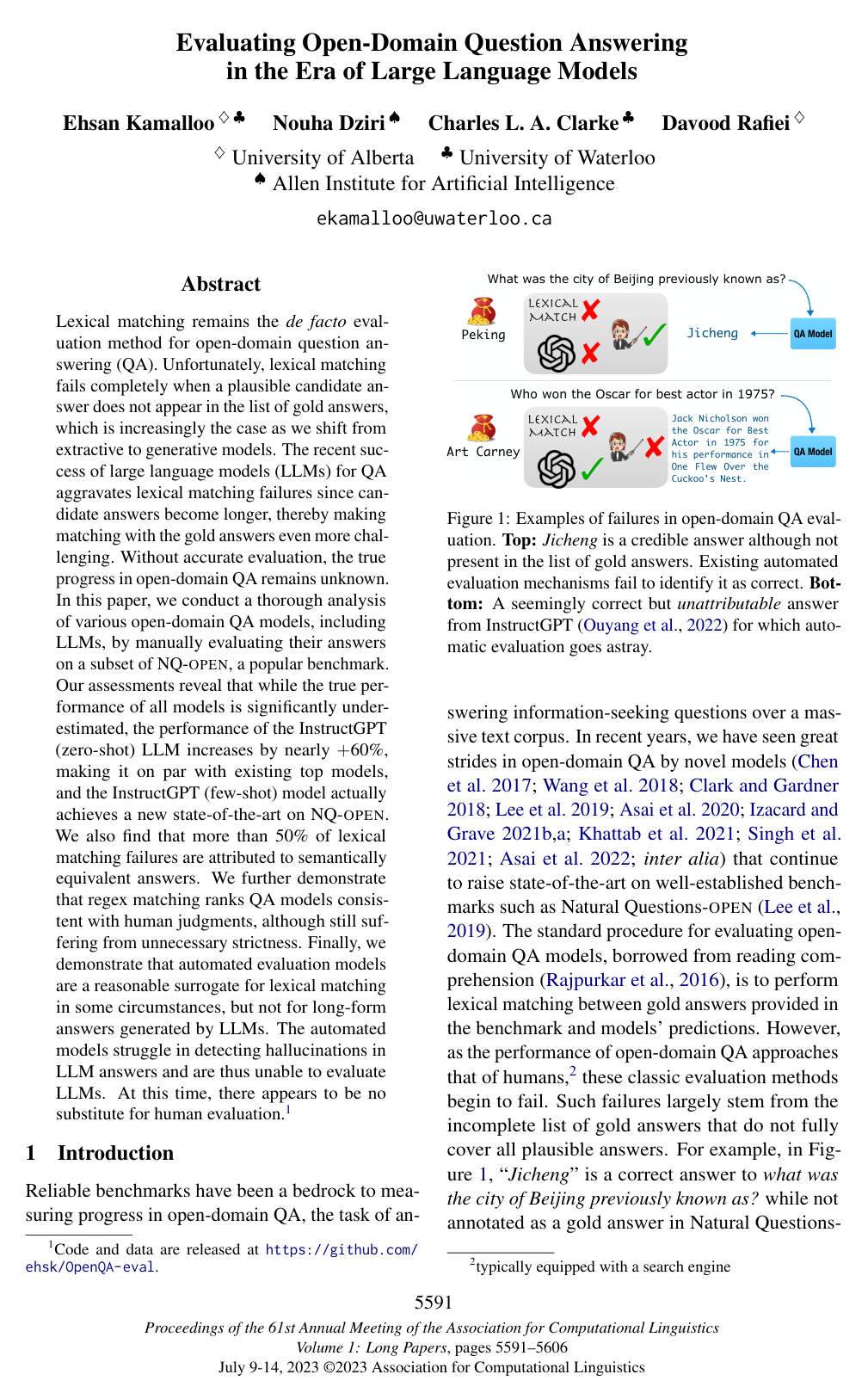
Evaluating Open-Domain Question Answering in the Era of Large Language Models
Ehsan Kamalloo, Nouha Dziri, Charles L. A. Clarke, Davood Rafiei
Why you should read this
Reveals that standard lexical metrics drastically underestimate generative LLM performance on open-domain question answering benchmarks by missing semantically equivalent answers and failing to handle hallucinations, demonstrating why human evaluation remains indispensable.
Lexical matching remains the de facto evaluation method for open-domain question answering (QA). Unfortunately, lexical matching fails completely when a plausible candidate answer does not appear in the list of gold answers, which is increasingly the case as we shift from extractive to generative models. The recent success of large language models (LLMs) for QA aggravates lexical matching failures since candidate answers become longer, thereby making matching with the gold answers even more challenging. Without accurate evaluation, the true progress in open-domain QA remains unknown. In this paper, we conduct a thorough analysis of various open-domain QA models, including LLMs, by manually evaluating their answers on a subset of NQ-OPEN, a popular benchmark. Our assessments reveal that while the true performance of all models is significantly underestimated, the performance of the InstructGPT (zero-shot) LLM increases by nearly +60%, making it on par with existing top models, and the InstructGPT (few-shot) model actually achieves a new state-of-the-art on NQ-OPEN. We also find that more than 50% of lexical matching failures are attributed to semantically equivalent answers. We further demonstrate that regex matching ranks QA models consistent with human judgments, although still suffering from unnecessary strictness. Finally, we demonstrate that automated evaluation models are a reasonable surrogate for lexical matching in some circumstances, but not for long-form answers generated by LLMs. The automated models struggle in detecting hallucinations in LLM answers and are thus unable to evaluate LLMs. At this time, there appears to be no substitute for human evaluation.
Added
2026-09-30
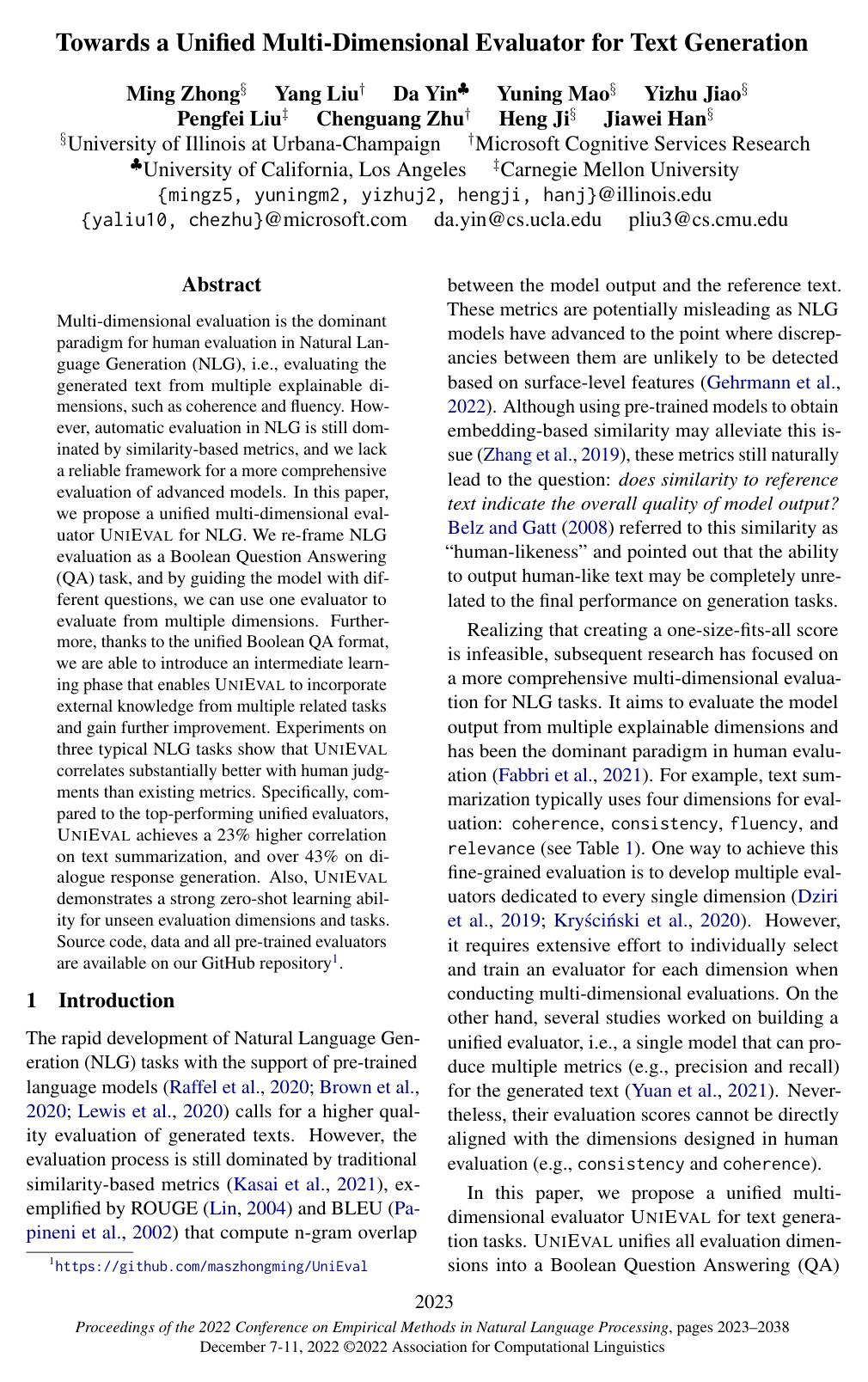
Towards a Unified Multi-Dimensional Evaluator for Text Generation
Ming Zhong, Yang Liu, Da Yin, Yuning Mao, Yizhu Jiao, Pengfei Liu, Chenguang Zhu, Heng Ji, Jiawei Han
Why you should read this
Proposes UniEval, a unified text generation evaluator that reframes multi-dimensional assessment as Boolean question answering, markedly improving correlation with human judgments across summarization and dialogue while enabling zero-shot generalization to unseen criteria.
Multi-dimensional evaluation is the dominant paradigm for human evaluation in Natural Language Generation (NLG), i.e., evaluating the generated text from multiple explainable dimensions, such as coherence and fluency. However, automatic evaluation in NLG is still dominated by similarity-based metrics, and we lack a reliable framework for a more comprehensive evaluation of advanced models. In this paper, we propose a unified multi-dimensional evaluator UniEval for NLG. We re-frame NLG evaluation as a Boolean Question Answering (QA) task, and by guiding the model with different questions, we can use one evaluator to evaluate from multiple dimensions. Furthermore, thanks to the unified Boolean QA format, we are able to introduce an intermediate learning phase that enables UniEval to incorporate external knowledge from multiple related tasks and gain further improvement. Experiments on three typical NLG tasks show that UniEval correlates substantially better with human judgments than existing metrics. Specifically, compared to the top-performing unified evaluators, UniEval achieves a 23% higher correlation on text summarization, and over 43% on dialogue response generation. Also, UniEval demonstrates a strong zero-shot learning ability for unseen evaluation dimensions and tasks. Source code, data and all pre-trained evaluators are available on our GitHub repository (this https URL).
Added
2026-09-29
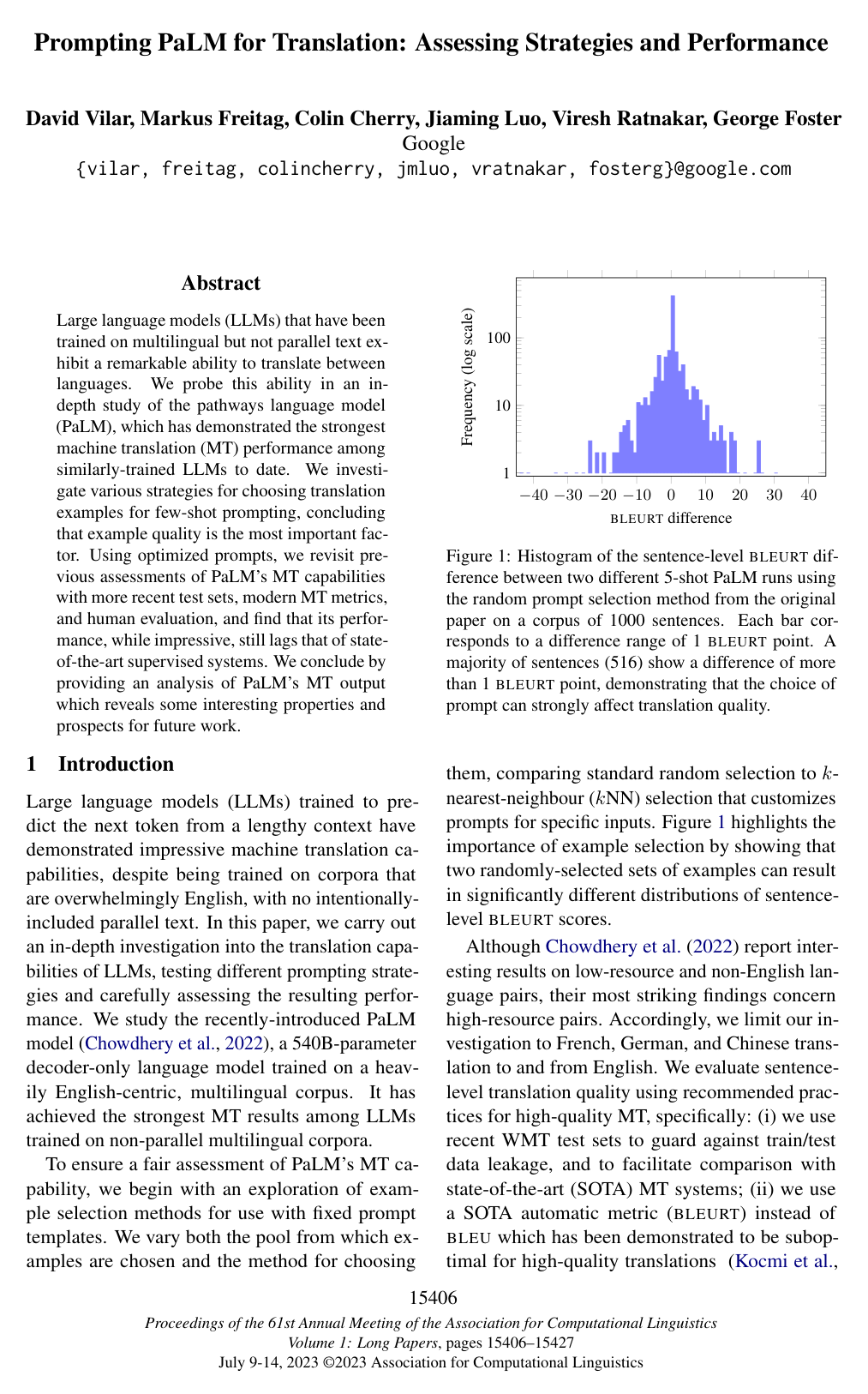
Prompting PaLM for Translation: Assessing Strategies and Performance
David Vilar, Markus Freitag, Colin Cherry, Jiaming Luo, Viresh Ratnakar, George F. Foster
Why you should read this
Demonstrates that example quality outweighs domain match and semantic proximity in few-shot prompt selection for translation with PaLM, while establishing that even optimized large language models still lag behind dedicated supervised translation systems across modern benchmarks and human evaluation.
Large language models (LLMs) that have been trained on multilingual but not parallel text exhibit a remarkable ability to translate between languages. We probe this ability in an in-depth study of the pathways language model (PaLM), which has demonstrated the strongest machine translation (MT) performance among similarly-trained LLMs to date. We investigate various strategies for choosing translation examples for few-shot prompting, concluding that example quality is the most important factor. Using optimized prompts, we revisit previous assessments of PaLM’s MT capabilities with more recent test sets, modern MT metrics, and human evaluation, and find that its performance, while impressive, still lags that of state-of-the-art supervised systems. We conclude by providing an analysis of PaLM’s MT output which reveals some interesting properties and prospects for future work.
Added
2026-09-29
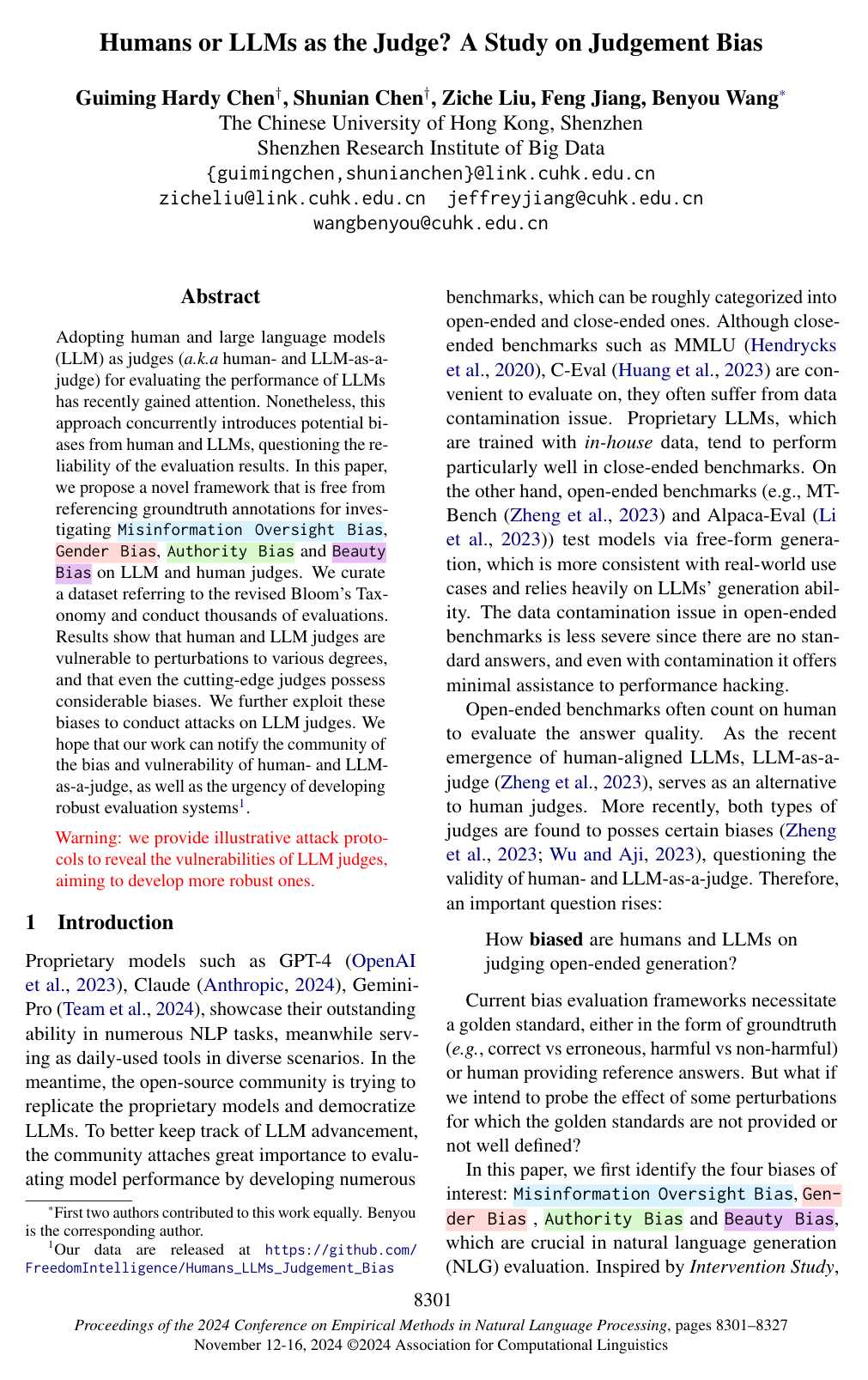
Humans or LLMs as the Judge? A Study on Judgement Bias
Guiming Chen, Shunian Chen, Ziche Liu, Feng Jiang, Benyou Wang
Why you should read this
Reveals critical vulnerabilities in human and automated evaluation pipelines by introducing a reference-free framework to measure authority, gender, and misinformation biases, demonstrating that even advanced language model judges can be systematically manipulated through bias-exploiting attacks.
Adopting human and large language models (LLM) as judges (a.k.a human- and LLM-as-a-judge) for evaluating the performance of LLMs has recently gained attention. Nonetheless, this approach concurrently introduces potential biases from human and LLMs, questioning the reliability of the evaluation results. In this paper, we propose a novel framework that is free from referencing groundtruth annotations for investigating Misinformation Oversight Bias, Gender Bias, Authority Bias and Beauty Bias on LLM and human judges. We curate a dataset referring to the revised Bloom's Taxonomy and conduct thousands of evaluations. Results show that human and LLM judges are vulnerable to perturbations to various degrees, and that even the cutting-edge judges possess considerable biases. We further exploit these biases to conduct attacks on LLM judges. We hope that our work can notify the community of the bias and vulnerability of human- and LLM-as-a-judge, as well as the urgency of developing robust evaluation systems.
Added
2026-09-28
Is DPO Superior to PPO for LLM Alignment? A Comprehensive Study
Shusheng Xu, Wei Fu, Jiaxuan Gao, Wenjie Ye, Weilin Liu, Zhiyu Mei, Guangju Wang, Chao Yu, Yi Wu
Why you should read this
Demonstrates that properly configured Proximal Policy Optimization consistently surpasses Direct Preference Optimization across diverse alignment benchmarks, identifying fundamental limitations in reward-free methods and isolating the critical training factors needed to achieve superior performance in complex tasks like code generation.
Reinforcement Learning from Human Feedback (RLHF) is currently the most widely used method to align large language models (LLMs) with human preferences. Existing RLHF methods can be roughly categorized as either reward-based or reward-free. Novel applications such as ChatGPT and Claude leverage reward-based methods that first learn a reward model and apply actor-critic algorithms, such as Proximal Policy Optimization (PPO). However, in academic benchmarks, state-of-the-art results are often achieved via reward-free methods, such as Direct Preference Optimization (DPO). Is DPO truly superior to PPO? Why does PPO perform poorly on these benchmarks? In this paper, we first conduct both theoretical and empirical studies on the algorithmic properties of DPO and show that DPO may have fundamental limitations. Moreover, we also comprehensively examine PPO and reveal the key factors for the best performances of PPO in fine-tuning LLMs. Finally, we benchmark DPO and PPO across a collection of RLHF testbeds, ranging from dialogue to code generation. Experiment results demonstrate that PPO is able to surpass other alignment methods in all cases and achieve state-of-the-art results in challenging code competitions. Our code is publicly available at this https URL.
Added
2026-09-28
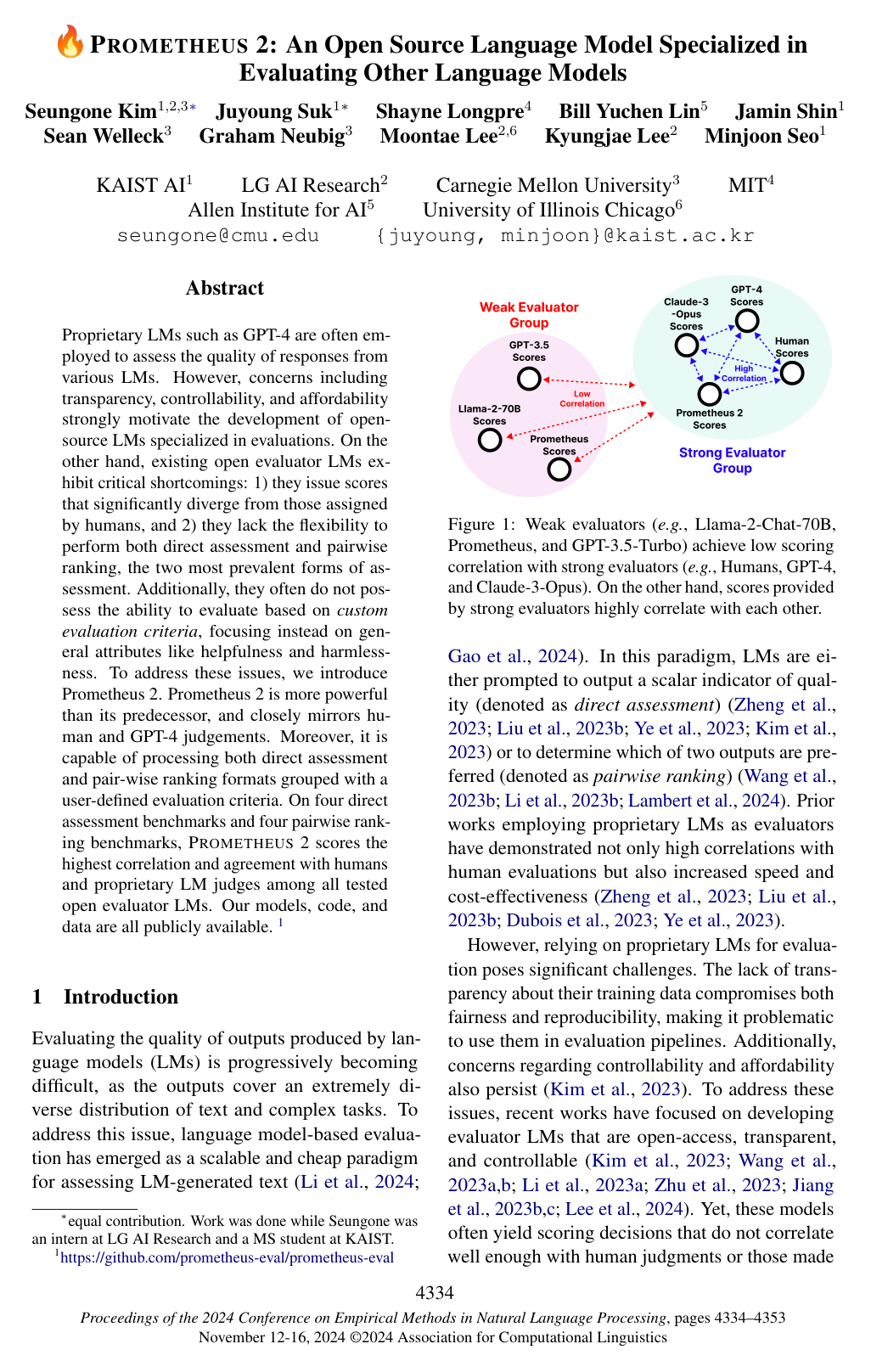
Prometheus 2: An Open Source Language Model Specialized in Evaluating Other Language Models
Seungone Kim, Juyoung Suk, Shayne Longpre, Bill Yuchen Lin, Jamin Shin, Sean Welleck, Graham Neubig, Moontae Lee, Kyungjae Lee, Minjoon Seo
Why you should read this
Presents Prometheus 2, an open-source evaluator language model that handles both direct assessment and pairwise ranking with custom criteria by merging models trained on separate evaluation formats, closely mirroring human and GPT-4 judgments.
Proprietary LMs such as GPT-4 are often employed to assess the quality of responses from various LMs. However, concerns including transparency, controllability, and affordability strongly motivate the development of open-source LMs specialized in evaluations. On the other hand, existing open evaluator LMs exhibit critical shortcomings: 1) they issue scores that significantly diverge from those assigned by humans, and 2) they lack the flexibility to perform both direct assessment and pairwise ranking, the two most prevalent forms of assessment. Additionally, they often do not possess the ability to evaluate based on *custom evaluation criteria*, focusing instead on general attributes like helpfulness and harmlessness. To address these issues, we introduce Prometheus 2. Prometheus 2 is more powerful than its predecessor, and closely mirrors human and GPT-4 judgements. Moreover, it is capable of processing both direct assessment and pair-wise ranking formats grouped with a user-defined evaluation criteria. On four direct assessment benchmarks and four pairwise ranking benchmarks, PROMETHEUS 2 scores the highest correlation and agreement with humans and proprietary LM judges among all tested open evaluator LMs. Our models, code, and data are all publicly available. 1
Added
2026-09-28
Seeing is not always believing: Benchmarking Human and Model Perception of AI-Generated Images
Zeyu Lu, Di Huang, Lei Bai, Jingjing Qu, Chengyue Wu, Xihui Liu, Wanli Ouyang
Why you should read this
Presents a two-million-image dataset alongside comprehensive human and algorithmic benchmarks, revealing that people fail to identify state-of-the-art AI-generated images nearly 39% of the time while specialized detection models reduce this error rate to 13%.
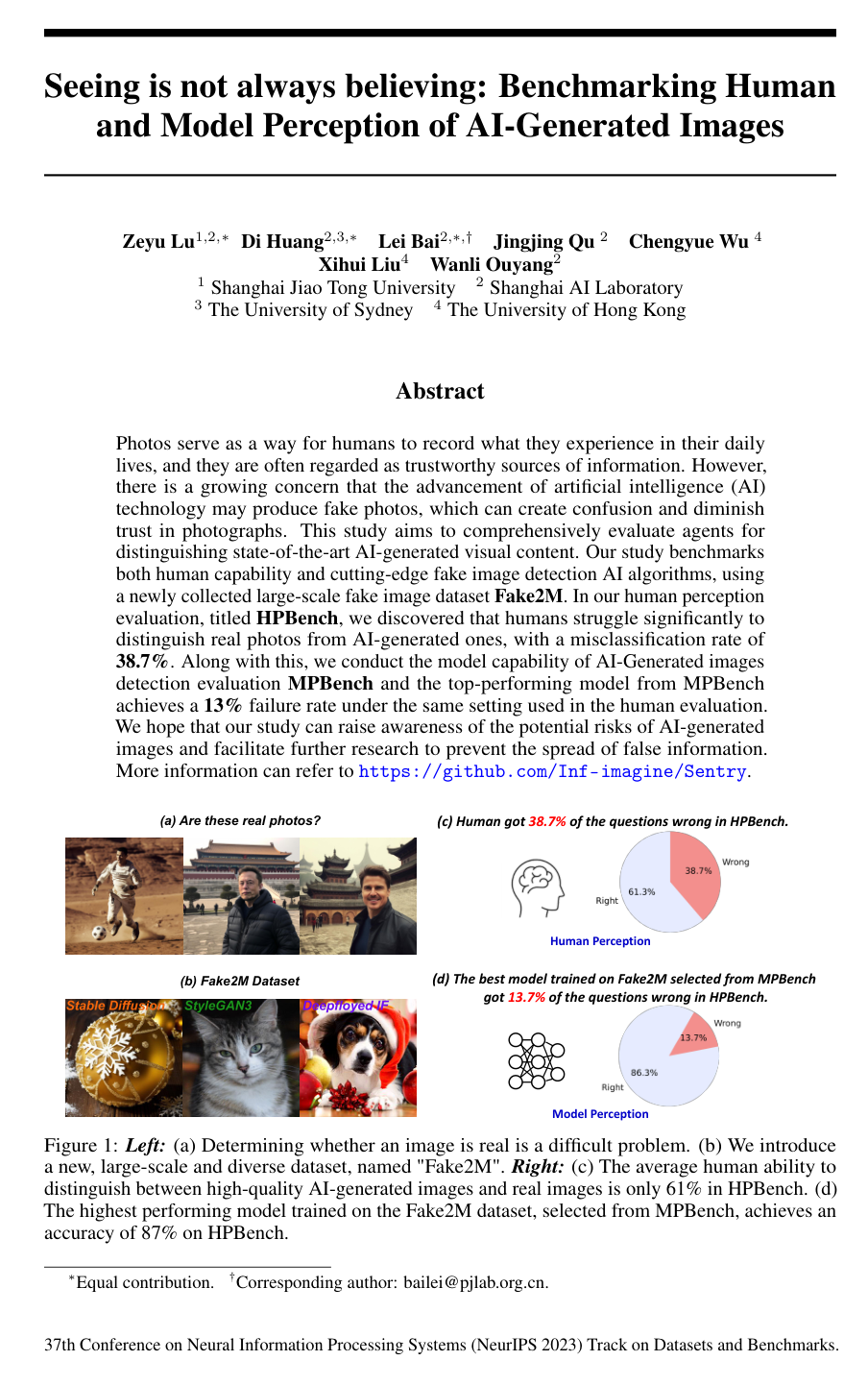
Photos serve as a way for humans to record what they experience in their daily lives, and they are often regarded as trustworthy sources of information. However, there is a growing concern that the advancement of artificial intelligence (AI) technology may produce fake photos, which can create confusion and diminish trust in photographs. This study aims to comprehensively evaluate agents for distinguishing state-of-the-art AI-generated visual content. Our study benchmarks both human capability and cutting-edge fake image detection AI algorithms, using a newly collected large-scale fake image dataset Fake2M. In our human perception evaluation, titled HPBench, we discovered that humans struggle significantly to distinguish real photos from AI-generated ones, with a misclassification rate of 38.7%. Along with this, we conduct the model capability of AI-Generated images detection evaluation MPBench and the top-performing model from MPBench achieves a 13% failure rate under the same setting used in the human evaluation. We hope that our study can raise awareness of the potential risks of AI-generated images and facilitate further research to prevent the spread of false information. More information can refer to https://github.com/Inf-imagine/Sentry.
Added
2026-09-26
Can We Automate Scientific Reviewing?
Weizhe Yuan, Pengfei Liu, Graham Neubig
Why you should read this
Evaluates the feasibility of automated peer review by benchmarking state-of-the-art language models on review generation, revealing critical limitations in factuality and bias while outlining practical directions for machine-assisted reviewing.
The rapid development of science and technology has been accompanied by an exponential growth in peer-reviewed scientific publications. At the same time, the review of each paper is a laborious process that must be carried out by subject matter experts. Thus, providing high-quality reviews of this growing number of papers is a significant challenge. In this work, we ask the question “can we automate scientific reviewing?”, discussing the possibility of using natural language processing (NLP) models to generate peer reviews for scientific papers. Because it is non-trivial to define what a “good” review is in the first place, we first discuss possible evaluation metrics that could be used to judge success in this task. We then focus on the machine learning domain and collect a dataset of papers in the domain, annotate them with different aspects of content covered in each review, and train targeted summarization models that take in papers as input and generate reviews as output. Comprehensive experimental results on the test set show that while system-generated reviews are comprehensive, touching upon more aspects of the paper than human-written reviews, the generated texts are less constructive and less factual than human-written reviews for all aspects except the explanation of the core ideas of the papers, which are largely factually correct. Given these results, we pose eight challenges in the pursuit of a good review generation system together with potential solutions, which, hopefully, will inspire more future research in this direction. We make relevant resource publicly available for use by future research: https://github.com/neulab/ReviewAdvisor. In addition, while our conclusion is that the technology is not yet ready for use in high-stakes review settings we provide a system demo, ReviewAdvisor (http://review.nlpedia.ai/), showing the current capabilities and failings of state-of-the-art NLP models at this task (see demo screenshot in A.2). A review of this paper written by the system proposed in this paper can be found in A.1.
Added
2026-09-26
The BiGGen Bench: A Principled Benchmark for Fine-grained Evaluation of Language Models with Language Models
Seungone Kim, Juyoung Suk, Ji Yong Cho, Shayne Longpre, Chaeeun Kim, Dongkeun Yoon, Guijin Son, Yejin Choi, Sheikh Shafayat, Jinheon Baek, Sue Hyun Park, Hyeonbin Hwang, Jinkyung Jo, Hyowon Cho, Haebin Shin, Seongyun Lee, Hanseok Oh, Noah Lee, Namgyu Ho, Se June Joo, Miyoung Ko, Yoonjoo Lee, Hyungjoo Chae, Jamin Shin, Joel Jang, Seonghyeon Ye, Bill Yuchen Lin, Sean Welleck, Graham Neubig, Moontae Lee, Kyungjae Lee, Minjoon Seo
Why you should read this
Presents a generation benchmark that evaluates 103 language models across nine core capabilities and 77 tasks by replacing generic metrics with instance-specific grading rubrics for automated model-based assessment.
As language models (LMs) become capable of handling a wide range of tasks, their evaluation is becoming as challenging as their development. Most generation benchmarks currently assess LMs using abstract evaluation criteria—like helpfulness and harmlessness—which often lack the flexibility and granularity of human assessment. Additionally, these benchmarks tend to focus disproportionately on specific capabilities such as instruction following, leading to coverage bias. To overcome these limitations, we introduce the BIGGEN BENCH, a principled generation benchmark designed to thoroughly evaluate nine distinct capabilities of LMs across 77 diverse tasks. A key feature of the BIGGEN BENCH is its use of instance-specific evaluation criteria, closely mirroring the nuanced discernment of human evaluation. We apply this benchmark to assess 103 frontier LMs using five evaluator LMs. Our code, data, and evaluation results are all publicly available.
Added
2026-09-26
The Curious Case of Neural Text Degeneration
Ari Holtzman, Jan Buys, Li Du, Maxwell Forbes, Yejin Choi
Why you should read this
Introduces Nucleus Sampling, a simple yet highly effective decoding strategy that dramatically improves the quality of neural text generation by producing diverse, coherent, and human-like output, thereby solving the perplexing problem of "neural text degeneration."
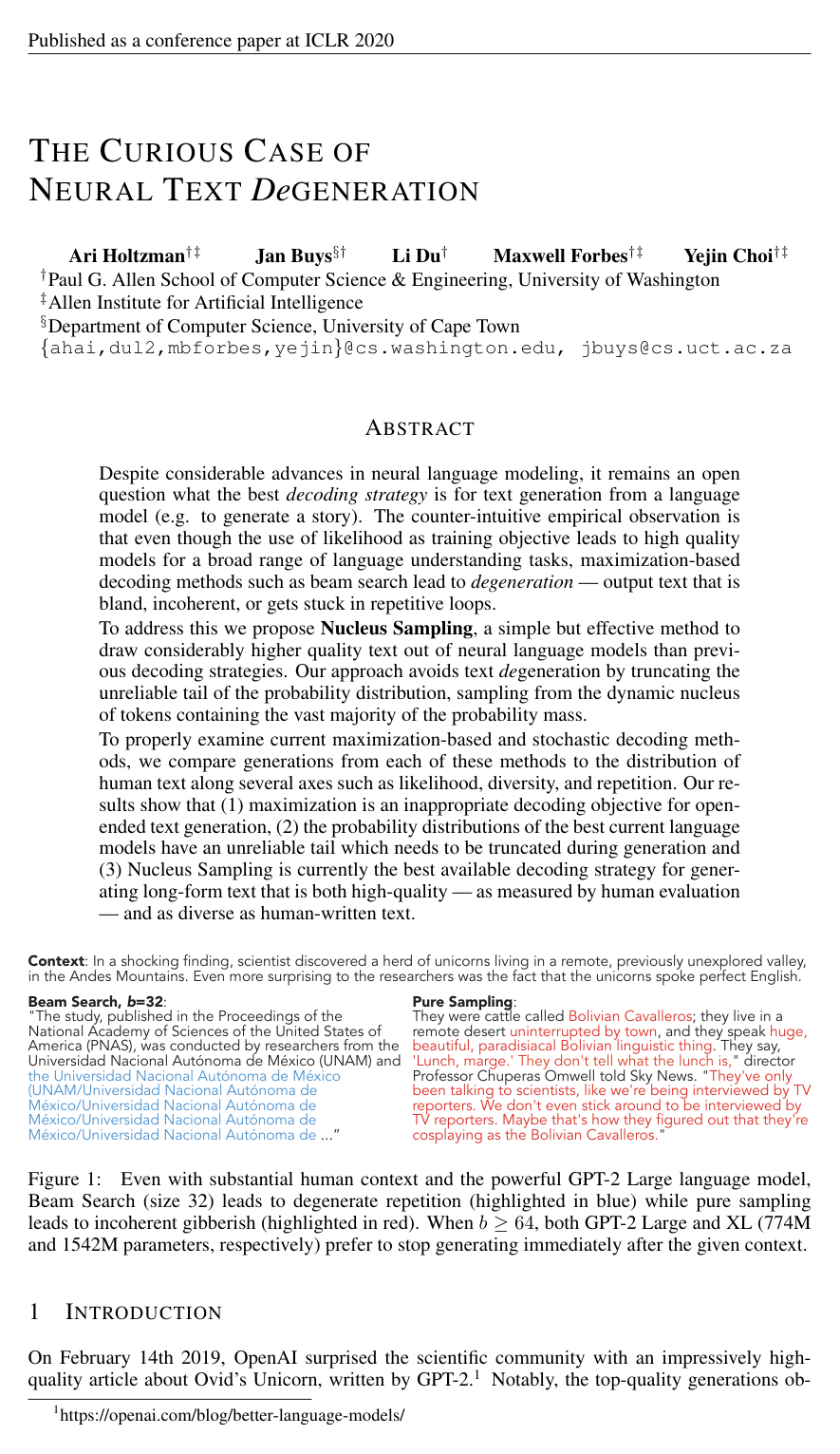
Despite considerable advancements with deep neural language models, the enigma of neural text degeneration persists when these models are tested as text generators. The counter-intuitive empirical observation is that even though the use of likelihood as training objective leads to high quality models for a broad range of language understanding tasks, using likelihood as a decoding objective leads to text that is bland and strangely repetitive. In this paper, we reveal surprising distributional differences between human text and machine text. In addition, we find that decoding strategies alone can dramatically effect the quality of machine text, even when generated from exactly the same neural language model. Our findings motivate Nucleus Sampling, a simple but effective method to draw the best out of neural generation. By sampling text from the dynamic nucleus of the probability distribution, which allows for diversity while effectively truncating the less reliable tail of the distribution, the resulting text better demonstrates the quality of human text, yielding enhanced diversity without sacrificing fluency and coherence.
Added
2026-03-10
