Built independently by an author, for readers. Read the story and support ChapterPal

keyword

histopathological image classification

Histopathological image classification is an automated computational process in digital pathology where machine learning algorithms analyze digitized microscopic images of biological tissue specimens to assign them into predefined diagnostic categories. Typically applied to whole-slide images or localized tissue patches, these computer vision techniques evaluate cellular morphology, structural tissue patterns, and staining variations to distinguish between healthy and diseased tissue, identify specific cancer subtypes, or determine disease grades. By standardizing the visual interpretation of complex histological features, this task supports pathologists in clinical decision-making, accelerates diagnostic workflows, and assists in large-scale biomedical research.

1 item

Benchmarking Self-Supervised Learning on Diverse Pathology Datasets

Benchmarking Self-Supervised Learning on Diverse Pathology Datasets

Mingu Kang, Heon Song, Seonwook Park, Donggeun Yoo, Sérgio Pereira

OrganizationsLunit Inc.

Why you should read this

Presents a large-scale benchmark of self-supervised learning methods on 19 million pathology image patches, demonstrating that domain-aligned pre-training with tailored augmentations consistently outperforms standard ImageNet pre-training across diverse classification and nuclei segmentation tasks, especially in label-scarce settings.

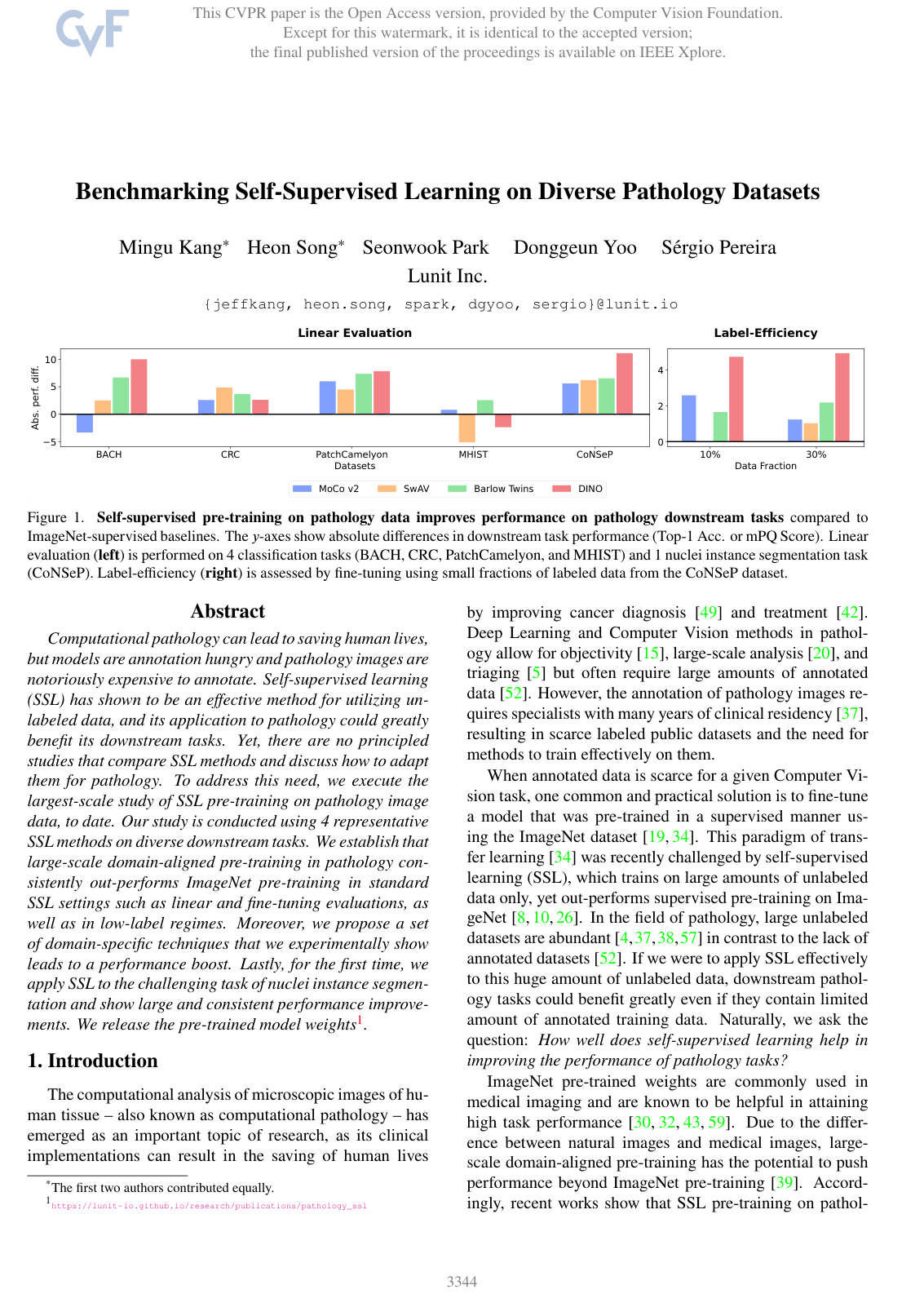
Computational pathology can lead to saving human lives, but models are annotation hungry and pathology images are notoriously expensive to annotate. Self-supervised learning (SSL) has shown to be an effective method for utilizing unlabeled data, and its application to pathology could greatly benefit its downstream tasks. Yet, there are no principled studies that compare SSL methods and discuss how to adapt them for pathology. To address this need, we execute the largest-scale study of SSL pre-training on pathology image data, to date. Our study is conducted using 4 representative SSL methods on diverse downstream tasks. We establish that large-scale domain-aligned pre-training in pathology consistently out-performs ImageNet pre-training in standard SSL settings such as linear and fine-tuning evaluations, as well as in low-label regimes. Moreover, we propose a set of domain-specific techniques that we experimentally show leads to a performance boost. Lastly, for the first time, we apply SSL to the challenging task of nuclei instance segmentation and show large and consistent performance improvements. We release the pre-trained model weights1.

Added

2026-09-26