
keyword
high-resolution image synthesis
High-resolution image synthesis is the computational generation of detailed, high-fidelity visual images with large pixel dimensions using generative machine learning models. The process creates novel imagery unconditionally from random noise or conditionally from inputs such as text descriptions, semantic segmentation maps, or class labels, while preserving both global structural coherence and fine textural details. Because directly modeling the vast number of pixels in high-resolution outputs creates severe computational and memory bottlenecks, standard approaches often operate within compressed latent representations, use multi-scale hierarchical architectures, or combine tokenized visual vocabularies with generative frameworks such as diffusion models, transformers, and generative adversarial networks.
10 items
Masked Generative Nested Transformers with Decode Time Scaling
Sahil Goyal, Debapriya Tula, Gagan Jain, Pradeep Shenoy, Prateek Jain, Sujoy Paul
Why you should read this
Presents a decode-time scaling framework for masked generative transformers that shares parameters across nested sub-models and reuses cached computations, reducing visual generation inference compute nearly threefold without sacrificing quality.
Recent advances in visual generation have made significant strides in producing content of exceptional quality. However, most methods suffer from a fundamental problem - a bottleneck of inference computational efficiency. Most of these algorithms involve multiple passes over a transformer model to generate tokens or denoise inputs. However, the model size is kept consistent throughout all iterations, which makes it computationally expensive. In this work, we aim to address this issue primarily through two key ideas - (a) not all parts of the generation process need equal compute, and we design a decode time model scaling schedule to utilize compute effectively, and (b) we can cache and reuse some of the computation. Combining these two ideas leads to using smaller models to process more tokens while large models process fewer tokens. These different-sized models do not increase the parameter size, as they share parameters. We rigorously experiment with ImageNet256256 , UCF101, and Kinetics600 to showcase the efficacy of the proposed method for image/video generation and frame prediction. Our experiments show that with almost less compute than baseline, our model obtains competitive performance.
Added
2026-10-01
Composer: Creative and Controllable Image Synthesis with Composable Conditions
Lianghua Huang, Di Chen, Yu Liu, Yujun Shen, Deli Zhao, Jingren Zhou
Why you should read this
Develops Composer, a controllable diffusion framework that conditions image synthesis on decomposed representations like text descriptions, spatial layouts, and color histograms to enable flexible visual creation and multi-task image editing without retraining.
Recent large-scale generative models learned on big data are capable of synthesizing incredible images yet suffer from limited controllability. This work offers a new generation paradigm that allows flexible control of the output image, such as spatial layout and palette, while maintaining the synthesis quality and model creativity. With compositionality as the core idea, we first decompose an image into representative factors, and then train a diffusion model with all these factors as the conditions to recompose the input. At the inference stage, the rich intermediate representations work as composable elements, leading to a huge design space (i.e., exponentially proportional to the number of decomposed factors) for customizable content creation. It is noteworthy that our approach, which we call Composer, supports various levels of conditions, such as text description as the global information, depth map and sketch as the local guidance, color histogram for low-level details, etc. Besides improving controllability, we confirm that Composer serves as a general framework and facilitates a wide range of classical generative tasks without retraining. Code and models will be made available.
Added
2026-09-28
Regularized Vector Quantization for Tokenized Image Synthesis
Jiahui Zhang, Fangneng Zhan, Christian Theobalt, Shijian Lu
Why you should read this
Proposes a dual-regularized vector quantization framework with a probabilistic contrastive loss that prevents codebook collapse and aligns training with stochastic sampling for superior image synthesis in autoregressive and diffusion models.
Quantizing images into discrete representations has been a fundamental problem in unified generative modeling. Predominant approaches learn the discrete representation either in a deterministic manner by selecting the best-matching token or in a stochastic manner by sampling from a predicted distribution. However, deterministic quantization suffers from severe codebook collapse and misalignment with inference stage while stochastic quantization suffers from low codebook utilization and perturbed reconstruction objective. This paper presents a regularized vector quantization framework that allows to mitigate above issues effectively by applying regularization from two perspectives. The first is a prior distribution regularization which measures the discrepancy between a prior token distribution and the predicted token distribution to avoid codebook collapse and low codebook utilization. The second is a stochastic mask regularization that introduces stochasticity during quantization to strike a good balance between inference stage misalignment and unperturbed reconstruction objective. In addition, we design a probabilistic contrastive loss which serves as a calibrated metric to further mitigate the perturbed reconstruction objective. Extensive experiments show that the proposed quantization framework outperforms prevailing vector quantization methods consistently across different generative models including auto-regressive models and diffusion models.
Added
2026-09-26
Accelerating Diffusion Sampling with Optimized Time Steps
Shuchen Xue, Zhaoqiang Liu, Fei Chen, Shifeng Zhang, Tianyang Hu, Enze Xie, Zhenguo Li
Why you should read this
Proposes a training-free optimization framework that computes non-uniform sampling schedules in under 15 seconds to minimize numerical solver approximation errors, substantially improving diffusion generation quality at very low step counts.
Diffusion probabilistic models (DPMs) have shown remarkable performance in high-resolution image synthesis, but their sampling efficiency is still to be desired due to the typically large number of sampling steps. Recent advancements in high-order numerical ODE solvers for DPMs have enabled the generation of high-quality images with much fewer sampling steps. While this is a significant development, most sampling methods still employ uniform time steps, which is not optimal when using a small number of steps. To address this issue, we propose a general framework for designing an optimization problem that seeks more appropriate time steps for a specific numerical ODE solver for DPMs. This optimization problem aims to minimize the distance between the ground-truth solution to the ODE and an approximate solution corresponding to the numerical solver. It can be efficiently solved using the constrained trust region method, taking less than 15 seconds. Our extensive experiments on both unconditional and conditional sampling using pixel- and latent-space DPMs demonstrate that, when combined with the state-of-the-art sampling method UniPC, our optimized time steps significantly improve image generation performance in terms of FID scores for datasets such as CIFAR-10 and ImageNet, compared to using uniform time steps.^1
Added
2026-09-26
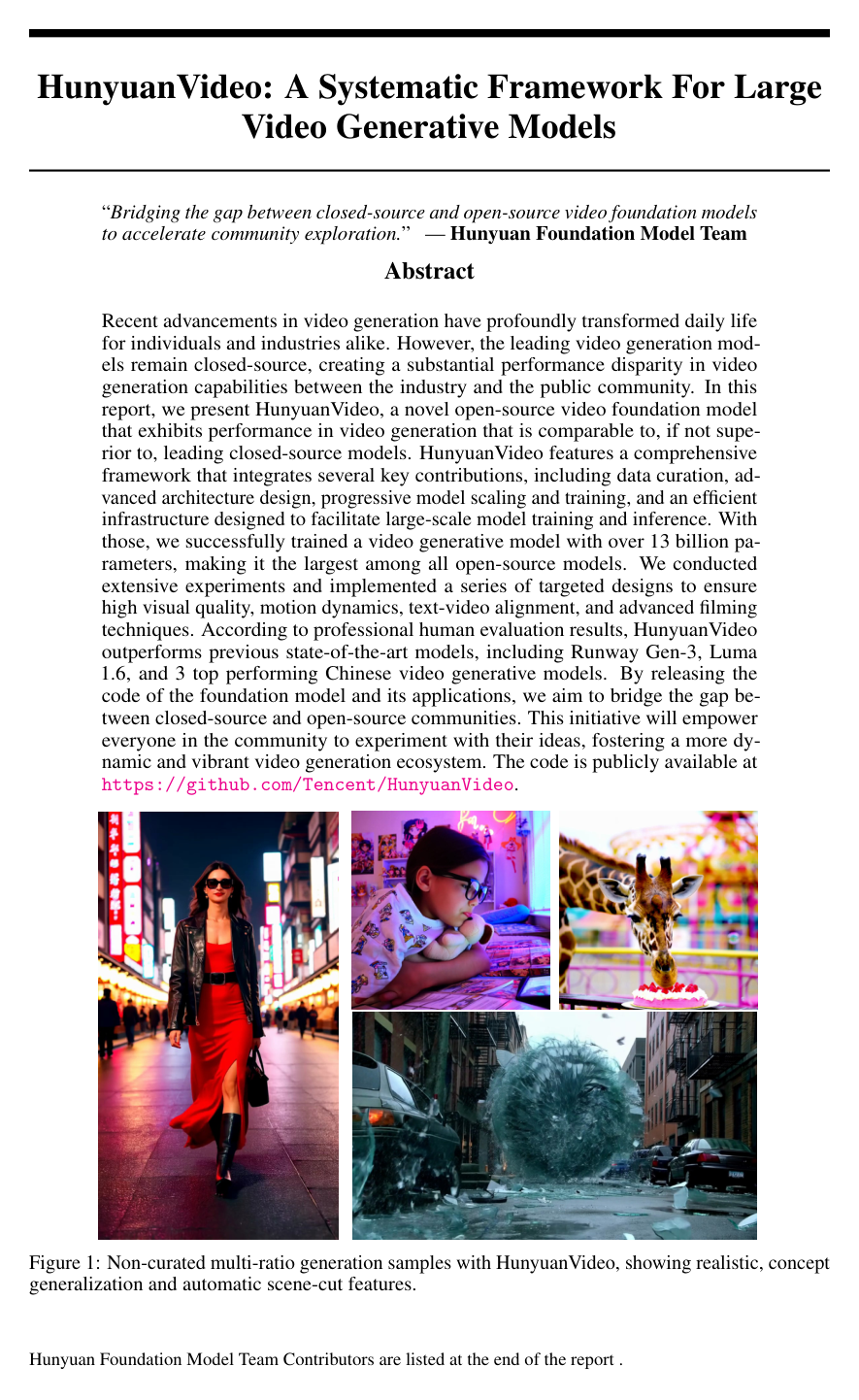
HunyuanVideo: A Systematic Framework For Large Video Generative Models
Weijie Kong, Qi Tian, Zijian Zhang, Rox Min, Zuozhuo Dai, Jin Zhou, Jia-Liang Xiong, Xin Li, Bo Wu, Jianwei Zhang, Kathrina Wu, Qin Lin, Junkun Yuan, Yanxin Long, Aladdin Wang, Andong Wang, Changlin Li, Duojun Huang, Fang Yang, Hao Tan, Hongmei Wang, Jacob Song, Jiawang Bai, Jianbing Wu, Jinbao Xue, Joey Wang, Kai Wang, Meng-Yang Liu, Peng-Yuan Li, Shuai Li, Wei-Yan Wang, Wenqing Yu, Xin-Chi Deng, Yang Li, Yi Chen, Yutao Cui, Yuanbo Peng, Zhen Yu, Zhiyu He, Zhiyong Xu, Zi-Xiang Zhou, Zunnan Xu, Yang-Dan Tao, Qinglin Lu, Songtao Liu, Daquan Zhou, Hongfa Wang, Yong Yang, Di Wang, Yuhong Liu, Jie Jiang, Caesar Zhong
Why you should read this
Presents HunyuanVideo, an open-source, 13-billion-parameter video foundation model with a systematic training and inference framework that rivals leading closed-source systems in visual quality, motion dynamics, and text alignment.
Recent advancements in video generation have significantly impacted daily life for both individuals and industries. However, the leading video generation models remain closed-source, resulting in a notable performance gap between industry capabilities and those available to the public. In this report, we introduce HunyuanVideo, an innovative open-source video foundation model that demonstrates performance in video generation comparable to, or even surpassing, that of leading closed-source models. HunyuanVideo encompasses a comprehensive framework that integrates several key elements, including data curation, advanced architectural design, progressive model scaling and training, and an efficient infrastructure tailored for large-scale model training and inference. As a result, we successfully trained a video generative model with over 13 billion parameters, making it the largest among all open-source models. We conducted extensive experiments and implemented a series of targeted designs to ensure high visual quality, motion dynamics, text-video alignment, and advanced filming techniques. According to evaluations by professionals, HunyuanVideo outperforms previous state-of-the-art models, including Runway Gen-3, Luma 1.6, and three top-performing Chinese video generative models. By releasing the code for the foundation model and its applications, we aim to bridge the gap between closed-source and open-source communities. This initiative will empower individuals within the community to experiment with their ideas, fostering a more dynamic and vibrant video generation ecosystem. The code is publicly available at this https URL.
Added
2026-09-24
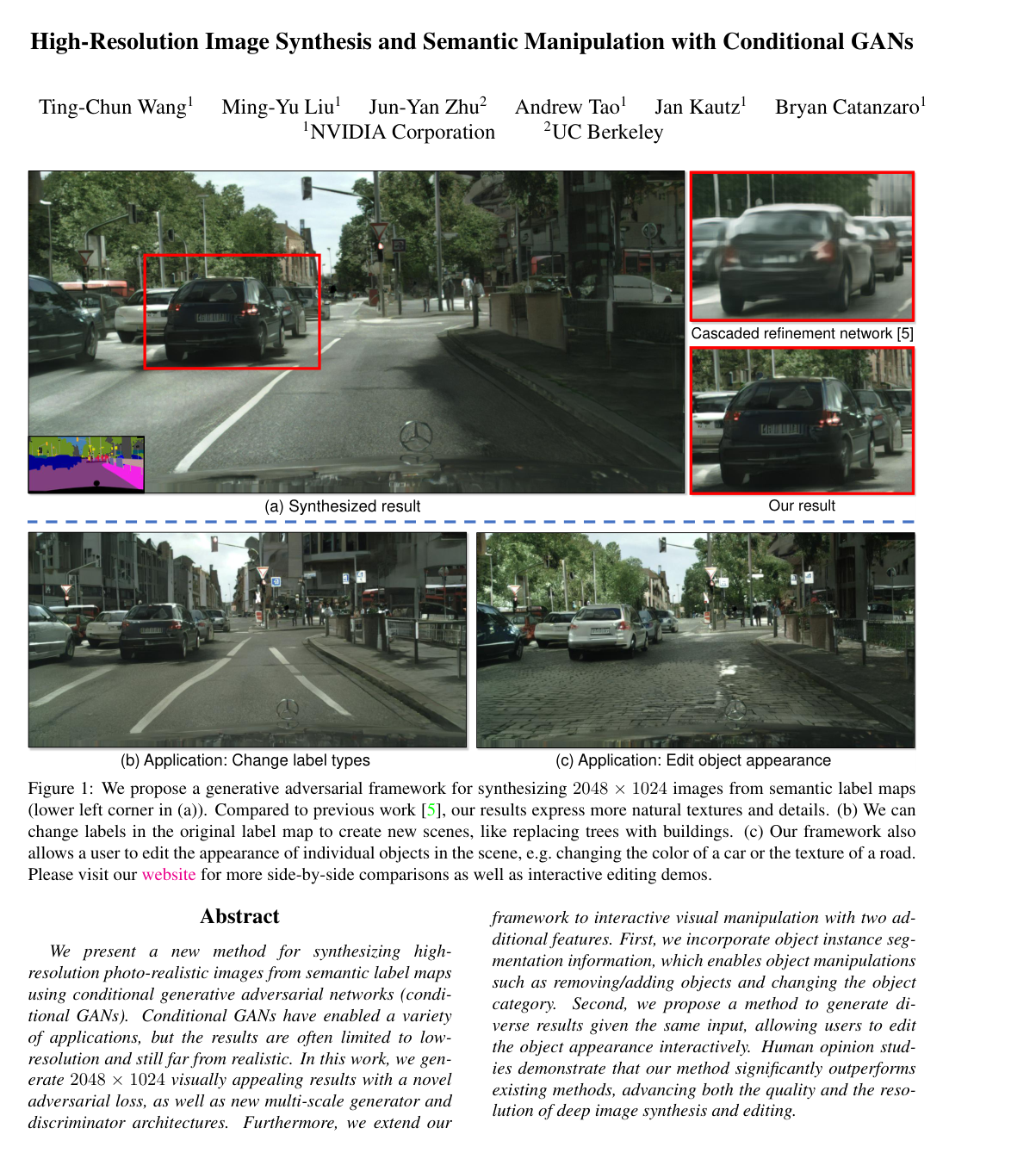
High-Resolution Image Synthesis and Semantic Manipulation with Conditional GANs
Ting-Chun Wang, Ming-Yu Liu, Jun-Yan Zhu, Andrew Tao, Jan Kautz, Bryan Catanzaro
Why you should read this
Presents a multi-scale conditional generative adversarial framework that achieves photorealistic 2048x1024 image synthesis from semantic label maps while supporting interactive, instance-level visual manipulation.
We present a new method for synthesizing high-resolution photo-realistic images from semantic label maps using conditional generative adversarial networks (conditional GANs). Conditional GANs have enabled a variety of applications, but the results are often limited to low-resolution and still far from realistic. In this work, we generate 2048x1024 visually appealing results with a novel adversarial loss, as well as new multi-scale generator and discriminator architectures. Furthermore, we extend our framework to interactive visual manipulation with two additional features. First, we incorporate object instance segmentation information, which enables object manipulations such as removing/adding objects and changing the object category. Second, we propose a method to generate diverse results given the same input, allowing users to edit the object appearance interactively. Human opinion studies demonstrate that our method significantly outperforms existing methods, advancing both the quality and the resolution of deep image synthesis and editing.
Added
2026-09-10
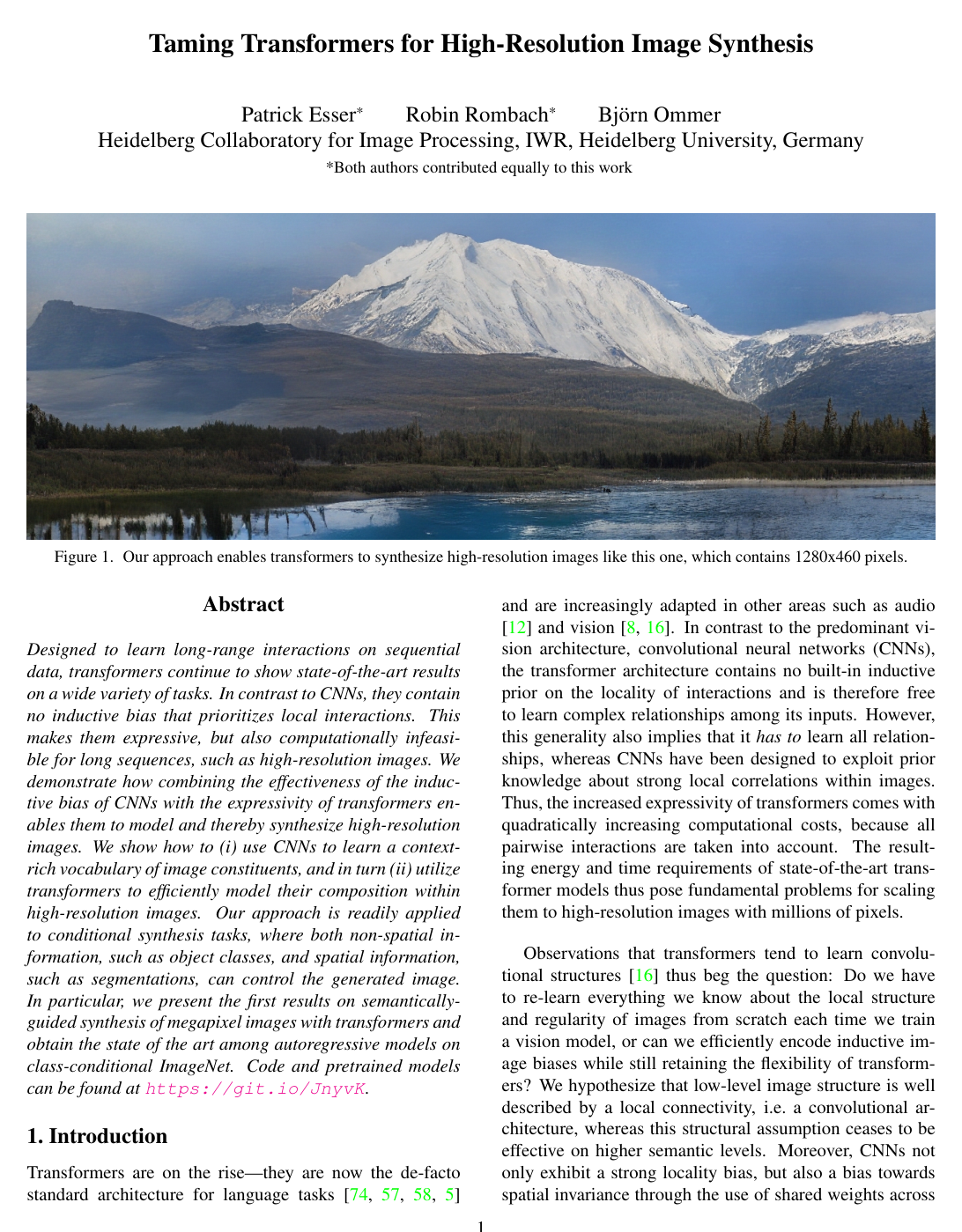
Taming Transformers for High-Resolution Image Synthesis
Patrick Esser, Robin Rombach, Björn Ommer
Why you should read this
Introduces a framework that pairs convolutional codebooks with autoregressive transformers to enable efficient, high-resolution, and semantically guided megapixel image synthesis.
Designed to learn long-range interactions on sequential data, transformers continue to show state-of-the-art results on a wide variety of tasks. In contrast to CNNs, they contain no inductive bias that prioritizes local interactions. This makes them expressive, but also computationally infeasible for long sequences, such as high-resolution images. We demonstrate how combining the effectiveness of the inductive bias of CNNs with the expressivity of transformers enables them to model and thereby synthesize high-resolution images. We show how to (i) use CNNs to learn a context-rich vocabulary of image constituents, and in turn (ii) utilize transformers to efficiently model their composition within high-resolution images. Our approach is readily applied to conditional synthesis tasks, where both non-spatial information, such as object classes, and spatial information, such as segmentations, can control the generated image. In particular, we present the first results on semantically-guided synthesis of megapixel images with transformers and obtain the state of the art among autoregressive models on class-conditional ImageNet. Code and pretrained models can be found at this https URL .
Added
2026-09-10
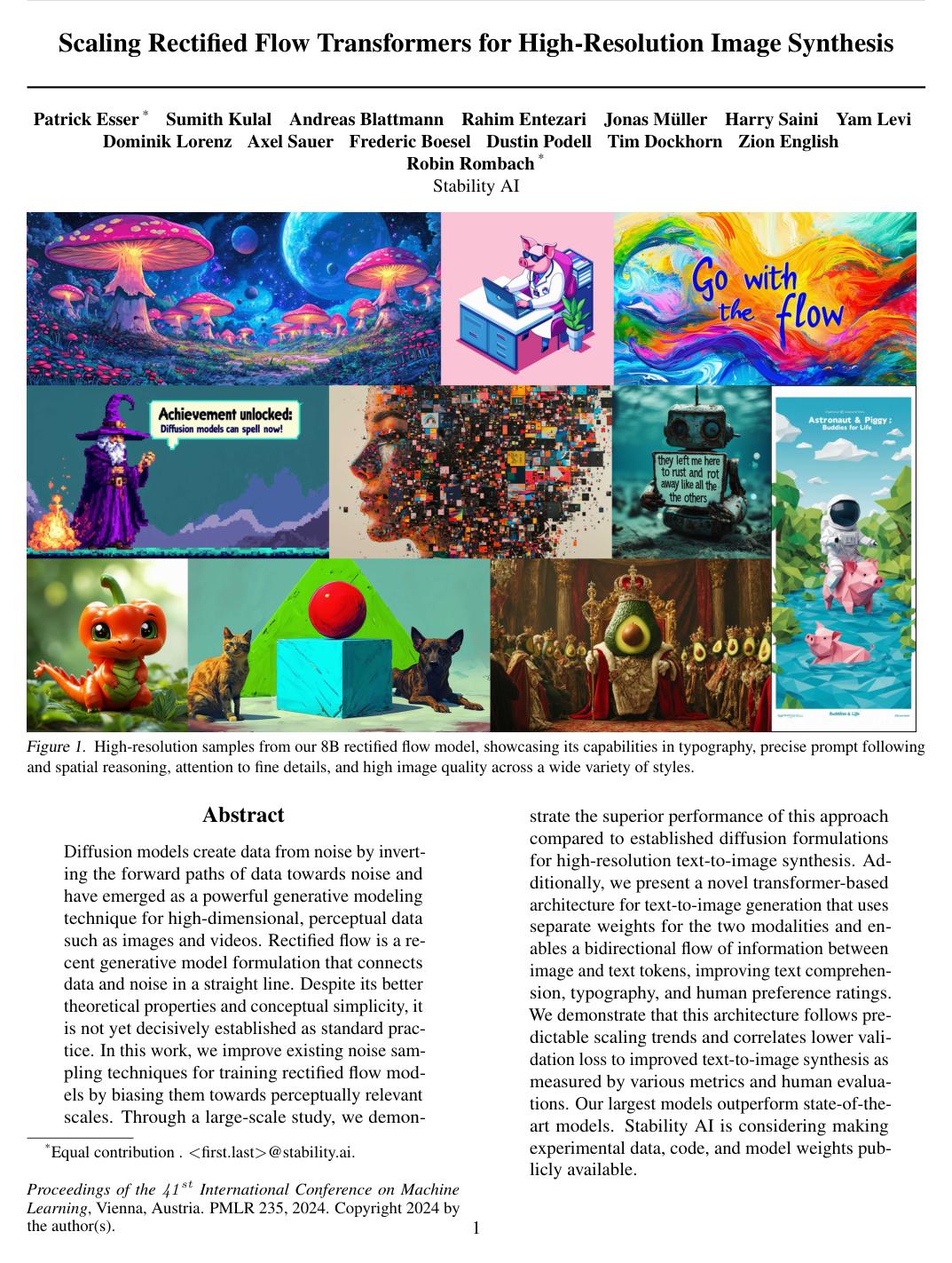
Scaling Rectified Flow Transformers for High-Resolution Image Synthesis
Patrick Esser, Sumith Kulal, Andreas Blattmann, Rahim Entezari, Jonas Müller, Harry Saini, Yam Levi, Dominik Lorenz, Axel Sauer, Frederic Boesel, Dustin Podell, Tim Dockhorn, Zion English, Robin Rombach
Why you should read this
Proposes a multimodal transformer architecture and tailored noise sampling strategy that enables rectified flow models to scale efficiently, outperforming existing state-of-the-art systems in high-resolution image synthesis and typographic accuracy.
Diffusion models create data from noise by inverting the forward paths of data towards noise and have emerged as a powerful generative modeling technique for high-dimensional, perceptual data such as images and videos. Rectified flow is a recent generative model formulation that connects data and noise in a straight line. Despite its better theoretical properties and conceptual simplicity, it is not yet decisively established as standard practice. In this work, we improve existing noise sampling techniques for training rectified flow models by biasing them towards perceptually relevant scales. Through a large-scale study, we demonstrate the superior performance of this approach compared to established diffusion formulations for high-resolution text-to-image synthesis. Additionally, we present a novel transformer-based architecture for text-to-image generation that uses separate weights for the two modalities and enables a bidirectional flow of information between image and text tokens, improving text comprehension, typography, and human preference ratings. We demonstrate that this architecture follows predictable scaling trends and correlates lower validation loss to improved text-to-image synthesis as measured by various metrics and human evaluations. Our largest models outperform state-of-the-art models, and we will make our experimental data, code, and model weights publicly available.
Added
2026-05-13
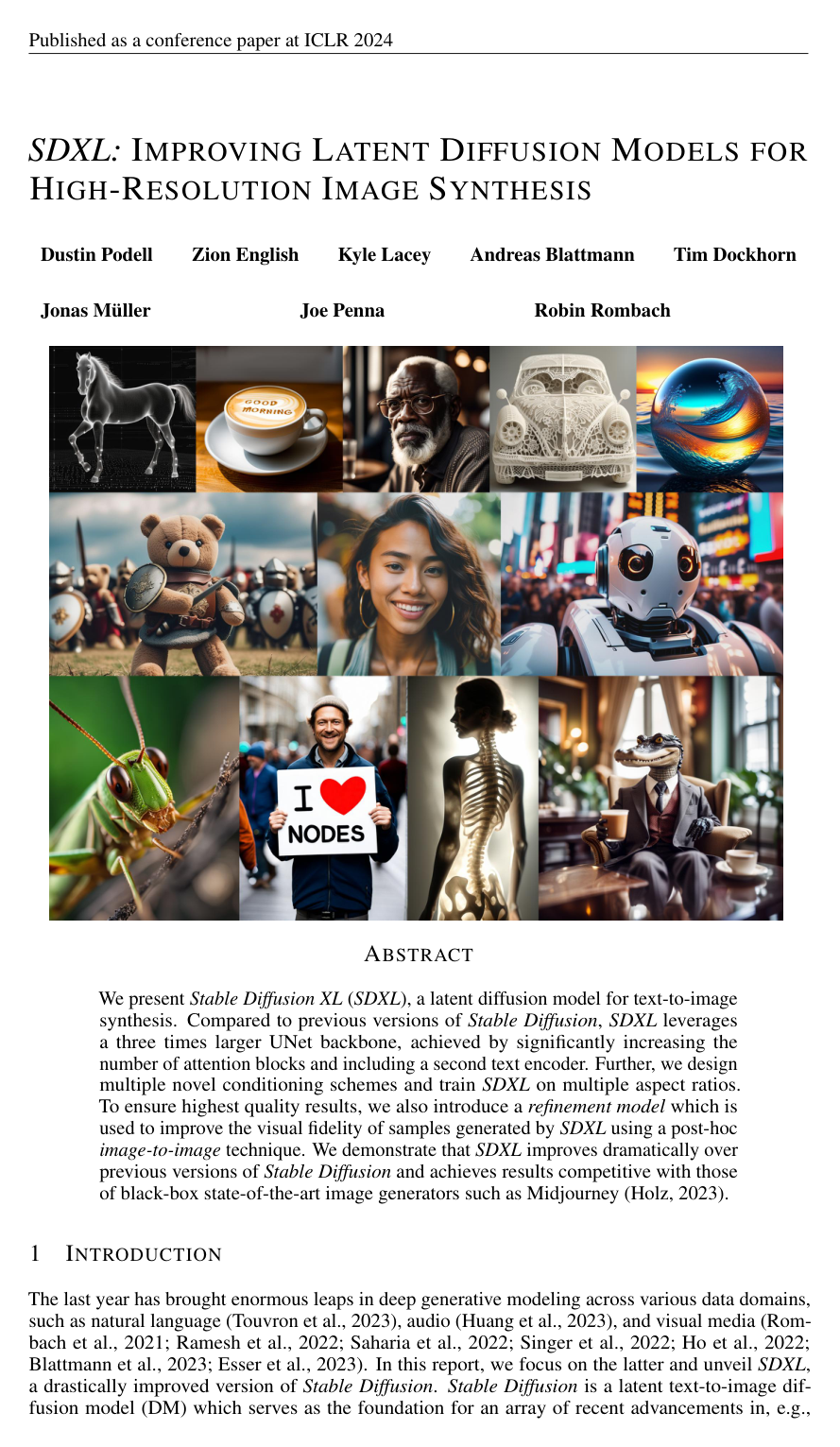
SDXL: Improving Latent Diffusion Models for High-Resolution Image Synthesis
Dustin Podell, Zion English, Kyle Lacey, Andreas Blattmann, Tim Dockhorn, Jonas Müller, Joe Penna, Robin Rombach
Why you should read this
Introduces the architectural enhancements and micro-conditioning strategies that enable SDXL to produce high-resolution, photorealistic images competitive with leading proprietary models through a scaled-up UNet backbone and a specialized two-stage refinement process.
We present SDXL, a latent diffusion model for text-to-image synthesis. Compared to previous versions of Stable Diffusion, SDXL leverages a three times larger UNet backbone: The increase of model parameters is mainly due to more attention blocks and a larger cross-attention context as SDXL uses a second text encoder. We design multiple novel conditioning schemes and train SDXL on multiple aspect ratios. We also introduce a refinement model which is used to improve the visual fidelity of samples generated by SDXL using a post-hoc image-to-image technique. We demonstrate that SDXL shows drastically improved performance compared the previous versions of Stable Diffusion and achieves results competitive with those of black-box state-of-the-art image generators. In the spirit of promoting open research and fostering transparency in large model training and evaluation, we provide access to code and model weights at https://github.com/Stability-AI/generative-models
Added
2026-05-12
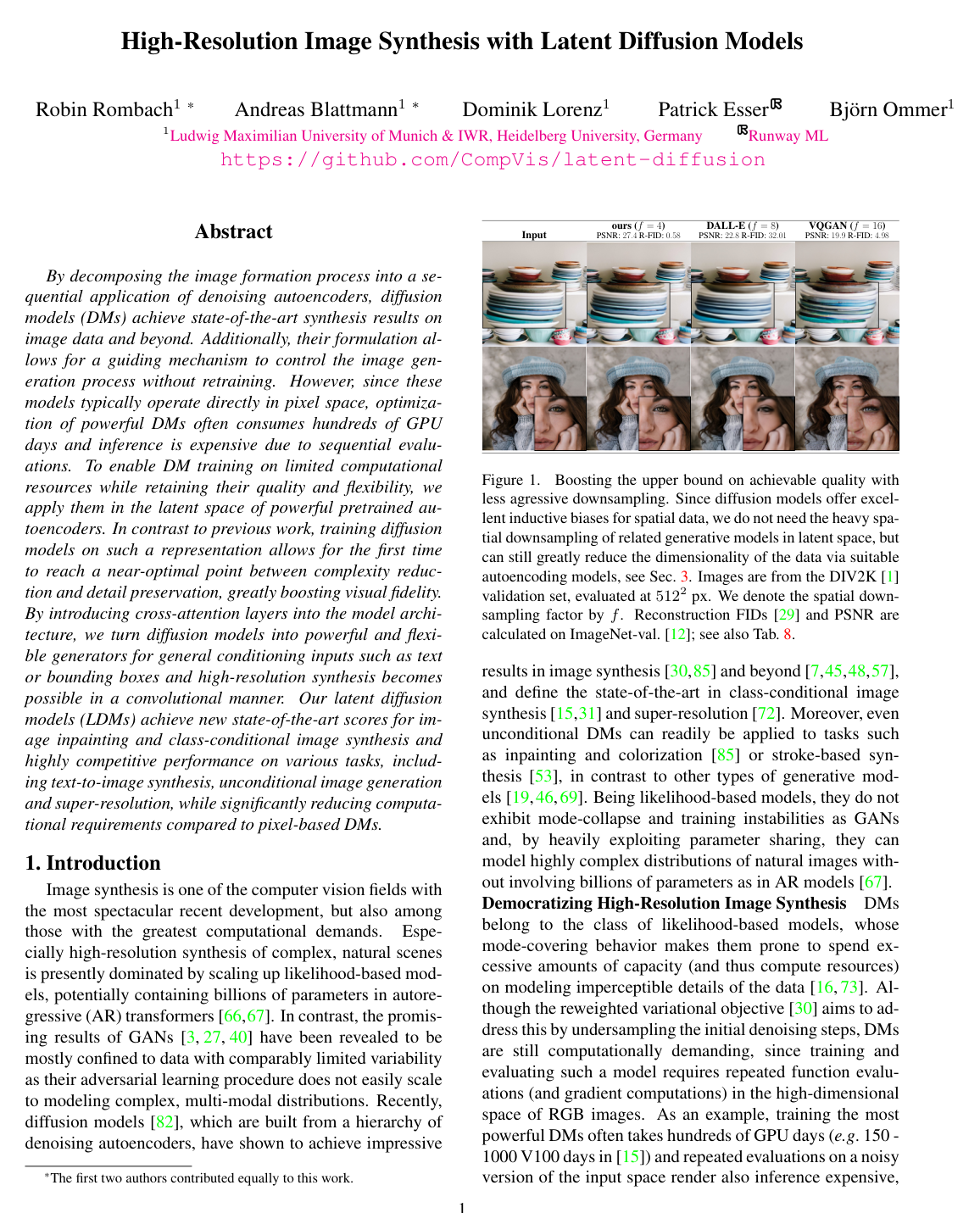
High-Resolution Image Synthesis with Latent Diffusion Models
Robin Rombach, Andreas Blattmann, Dominik Lorenz, Patrick Esser, Björn Ommer
Why you should read this
Applies diffusion processes within a compressed latent space to enable high-quality, computationally efficient image generation (Stable Diffusion).
By decomposing the image formation process into a sequential application of denoising autoencoders, diffusion models (DMs) achieve state-of-the-art synthesis results on image data and beyond. Additionally, their formulation allows for a guiding mechanism to control the image generation process without retraining. However, since these models typically operate directly in pixel space, optimization of powerful DMs often consumes hundreds of GPU days and inference is expensive due to sequential evaluations. To enable DM training on limited computational resources while retaining their quality and flexibility, we apply them in the latent space of powerful pretrained autoencoders. In contrast to previous work, training diffusion models on such a representation allows for the first time to reach a near-optimal point between complexity reduction and detail preservation, greatly boosting visual fidelity. By introducing cross-attention layers into the model architecture, we turn diffusion models into powerful and flexible generators for general conditioning inputs such as text or bounding boxes and high-resolution synthesis becomes possible in a convolutional manner. Our latent diffusion models (LDMs) achieve new state of the art scores for image inpainting and class-conditional image synthesis and highly competitive performance on various tasks, including unconditional image generation, text-to-image synthesis, and super-resolution, while significantly reducing computational requirements compared to pixel-based DMs.
Added
2026-01-28