keyword
High-probability correctness
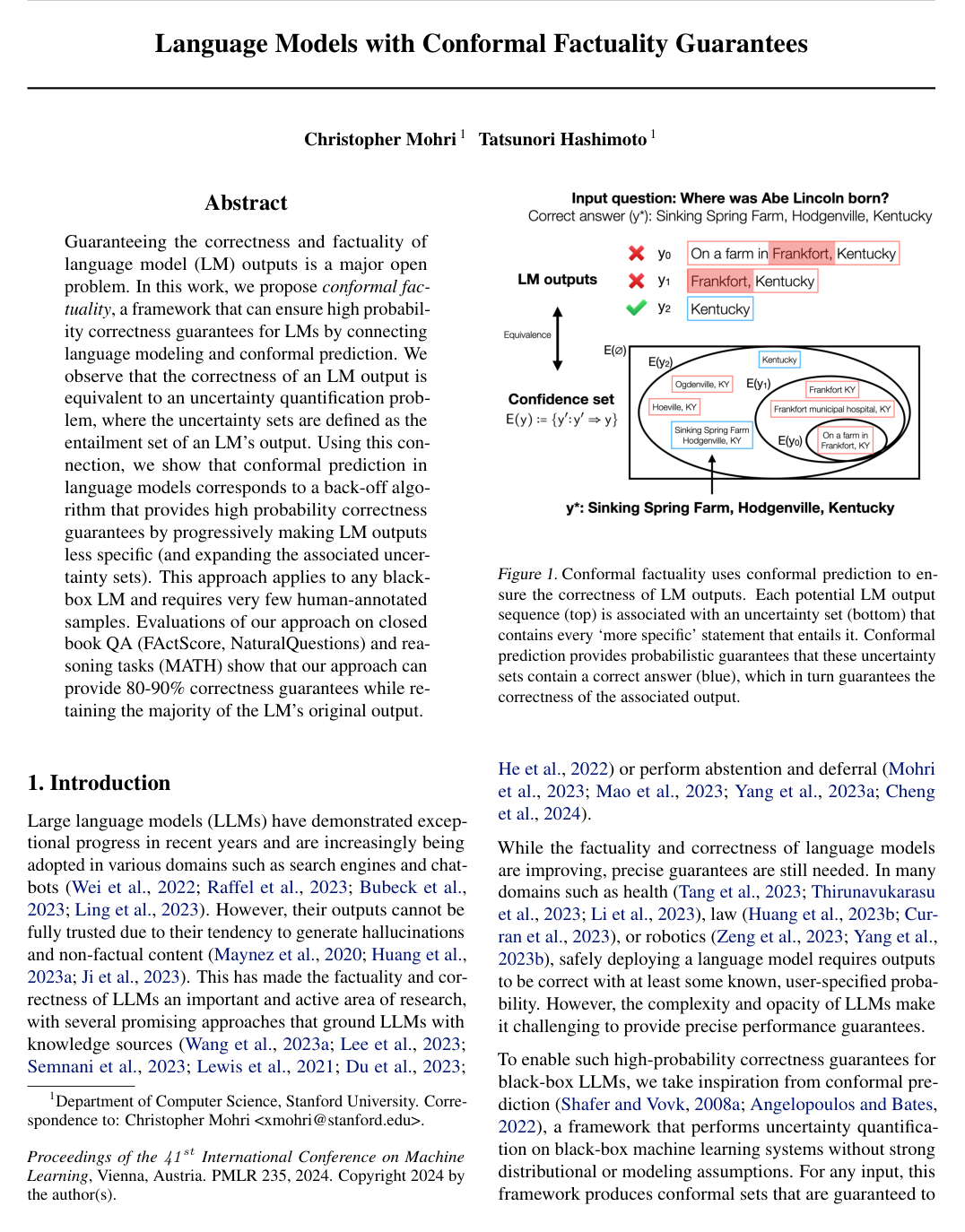
High-probability correctness is a statistical guarantee that an automated system or machine learning model produces outputs—such as predictions, factual assertions, or decision sets—that are accurate and valid with a predefined minimum level of confidence. Rather than relying on heuristic confidence scores or average-case performance metrics, this property establishes formal mathematical bounds ensuring that the probability of error does not exceed a chosen tolerance across the underlying data distribution. Often achieved through distribution-free uncertainty quantification techniques such as conformal prediction, high-probability correctness enables practitioners to calibrate risk thresholds, filter unreliable outputs, and enforce rigorous safety and factuality constraints in high-stakes algorithmic decision-making.
1 item