
keyword
hallucination detection
Hallucination detection is the process of identifying factually inaccurate, unfaithful, or ungrounded statements generated by artificial intelligence models, such as large language models and machine translation systems. This task involves determining whether a generated response contradicts established world knowledge, deviates from provided reference contexts, or introduces fabricated claims despite appearing fluent and plausible. Detection methodologies typically encompass analyzing the internal states, layer activations, and confidence signals of the generating model, evaluating consistency against retrieved or source documents, and employing automated classifiers or self-evaluation techniques to flag errors. Reliably detecting these inaccuracies is a critical step in assessing model trustworthiness, preventing the propagation of misinformation, and enabling effective mitigation strategies in AI-driven applications.
9 items
LLMs Know More Than They Show: On the Intrinsic Representation of LLM Hallucinations
Hadas Orgad, Michael Toker, Zorik Gekhman, Roi Reichart, Idan Szpektor, Hadas Kotek, Yonatan Belinkov
Why you should read this
Demonstrates that large language models often internally represent the correct answer while generating hallucinations, and identifies token-level truthfulness signals that predict specific error types despite failing to transfer across datasets.
Large language models (LLMs) often produce errors, including factual inaccuracies, biases, and reasoning failures, collectively referred to as "hallucinations". Recent studies have demonstrated that LLMs' internal states encode information regarding the truthfulness of their outputs, and that this information can be utilized to detect errors. In this work, we show that the internal representations of LLMs encode much more information about truthfulness than previously recognized. We first discover that the truthfulness information is concentrated in specific tokens, and leveraging this property significantly enhances error detection performance. Yet, we show that such error detectors fail to generalize across datasets, implying that -- contrary to prior claims -- truthfulness encoding is not universal but rather multifaceted. Next, we show that internal representations can also be used for predicting the types of errors the model is likely to make, facilitating the development of tailored mitigation strategies. Lastly, we reveal a discrepancy between LLMs' internal encoding and external behavior: they may encode the correct answer, yet consistently generate an incorrect one. Taken together, these insights deepen our understanding of LLM errors from the model's internal perspective, which can guide future research on enhancing error analysis and mitigation.
Added
2026-10-05
Why language models hallucinate
Adam Tauman Kalai, Ofir Nachum, Santosh S. Vempala, Edwin Zhang
Why you should read this
Explains how standard training objectives and benchmark scoring inherently reward language models for guessing rather than expressing uncertainty, framing hallucinations as predictable statistical classification errors that require reformed evaluation metrics to fix.
Like students facing hard exam questions, large language models sometimes guess when uncertain, producing plausible yet incorrect statements instead of admitting uncertainty. Such "hallucinations" persist even in state-of-the-art systems and undermine trust. We argue that language models hallucinate because the training and evaluation procedures reward guessing over acknowledging uncertainty, and we analyze the statistical causes of hallucinations in the modern training pipeline. Hallucinations need not be mysterious -- they originate simply as errors in binary classification. If incorrect statements cannot be distinguished from facts, then hallucinations in pretrained language models will arise through natural statistical pressures. We then argue that hallucinations persist due to the way most evaluations are graded -- language models are optimized to be good test-takers, and guessing when uncertain improves test performance. This "epidemic" of penalizing uncertain responses can only be addressed through a socio-technical mitigation: modifying the scoring of existing benchmarks that are misaligned but dominate leaderboards, rather than introducing additional hallucination evaluations. This change may steer the field toward more trustworthy AI systems.
Added
2026-10-05
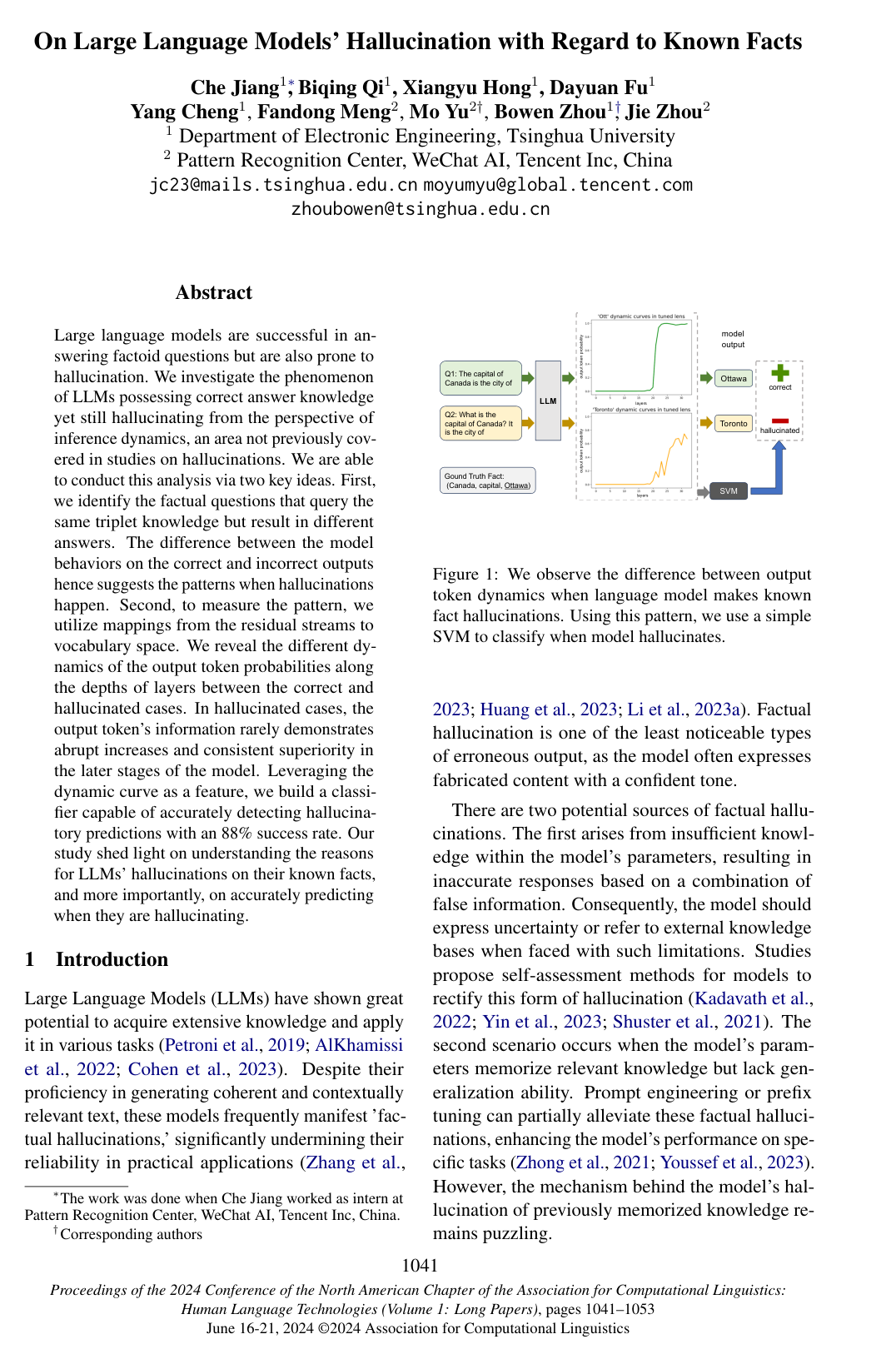
On Large Language Models' Hallucination with Regard to Known Facts
Che Jiang, Biqing Qi, Xiangyu Hong, Dayuan Fu, Yang Cheng, Fandong Meng, Mo Yu, Bowen Zhou, Jie Zhou
Why you should read this
Reveals distinct token probability trajectories across model layers during failed knowledge recall, enabling an 88% accurate classifier for detecting when large language models hallucinate facts they actually know.
Large language models are successful in answering factoid questions but are also prone to hallucination. We investigate the phenomenon of LLMs possessing correct answer knowledge yet still hallucinating from the perspective of inference dynamics, an area not previously covered in studies on hallucinations. We are able to conduct this analysis via two key ideas. First, we identify the factual questions that query the same triplet knowledge but result in different answers. The difference between the model behaviors on the correct and incorrect outputs hence suggests the patterns when hallucinations happen. Second, to measure the pattern, we utilize mappings from the residual streams to vocabulary space. We reveal the different dynamics of the output token probabilities along the depths of layers between the correct and hallucinated cases. In hallucinated cases, the output token’s information rarely demonstrates abrupt increases and consistent superiority in the later stages of the model. Leveraging the dynamic curve as a feature, we build a classifier capable of accurately detecting hallucinatory predictions with an 88% success rate. Our study shed light on understanding the reasons for LLMs’ hallucinations on their known facts, and more importantly, on accurately predicting when they are hallucinating.
Added
2026-10-03
Detecting and Mitigating Hallucinations in Machine Translation: Model Internal Workings Alone Do Well, Sentence Similarity Even Better
David Dale, Elena Voita, Loïc Barrault, Marta R. Costa-jussà
Why you should read this
Demonstrates that measuring source token contribution from a translation model's internal mechanics doubles the detection accuracy of severe hallucinations without external tools, while cross-lingual sentence similarity models achieve an 80% precision gain across all hallucination types.
While the problem of hallucinations in neural machine translation has long been recognized, so far the progress on its alleviation is very little. Indeed, recently it turned out that without artificially encouraging models to hallucinate, previously existing methods fall short and even the standard sequence log-probability is more informative. It means that internal characteristics of the model can give much more information than we expect, and before using external models and measures, we first need to ask: how far can we go if we use nothing but the translation model itself ? We propose to use a method that evaluates the percentage of the source contribution to a generated translation. Intuitively, hallucinations are translations “detached” from the source, hence they can be identified by low source contribution. This method improves detection accuracy for the most severe hallucinations by a factor of 2 and is able to alleviate hallucinations at test time on par with the previous best approach that relies on external models. Next, if we move away from internal model characteristics and allow external tools, we show that using sentence similarity from cross-lingual embeddings further improves these results. We release the code of our experiments.
Added
2026-10-02
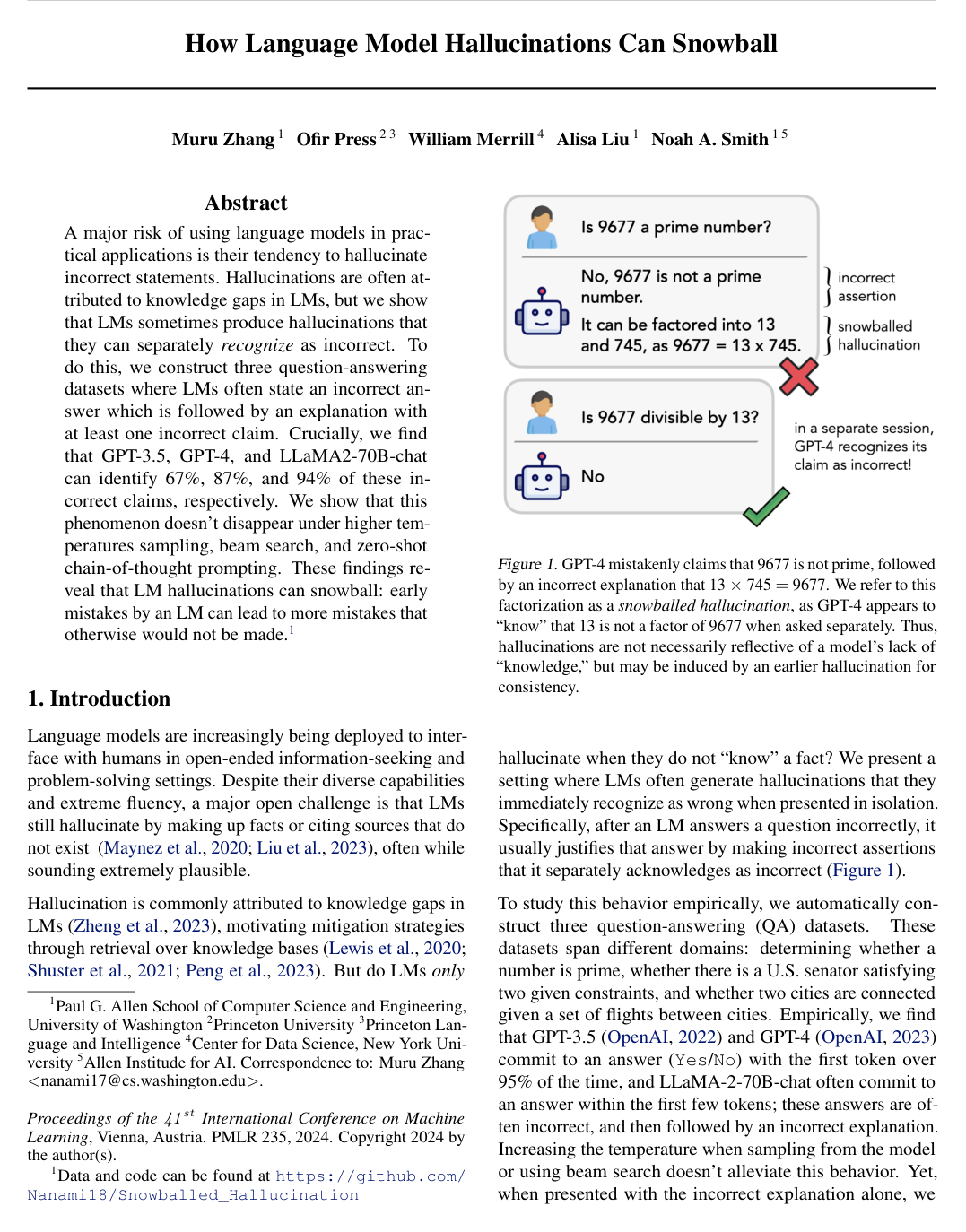
How Language Model Hallucinations Can Snowball
Muru Zhang, Ofir Press, William Merrill, Alisa Liu, Noah A. Smith
Why you should read this
Reveals that large language models frequently invent false justifications to maintain consistency with their own earlier mistakes, generating secondary errors that they are otherwise capable of correctly identifying as false in isolation.
A major risk of using language models in practical applications is their tendency to hallucinate incorrect statements. Hallucinations are often attributed to knowledge gaps in LMs, but we show that LMs sometimes produce hallucinations that they can separately recognize as incorrect. To do this, we construct three question-answering datasets where LMs often state an incorrect answer which is followed by an explanation with at least one incorrect claim. Crucially, we find that GPT-3.5, GPT-4, and LLaMA2-70B-chat can identify 67%, 87%, and 94% of these incorrect claims, respectively. We show that this phenomenon doesn’t disappear under higher temperatures sampling, beam search, and zero-shot chain-of-thought prompting. These findings reveal that LM hallucinations can snowball: early mistakes by an LM can lead to more mistakes that otherwise would not be made.
Added
2026-09-28
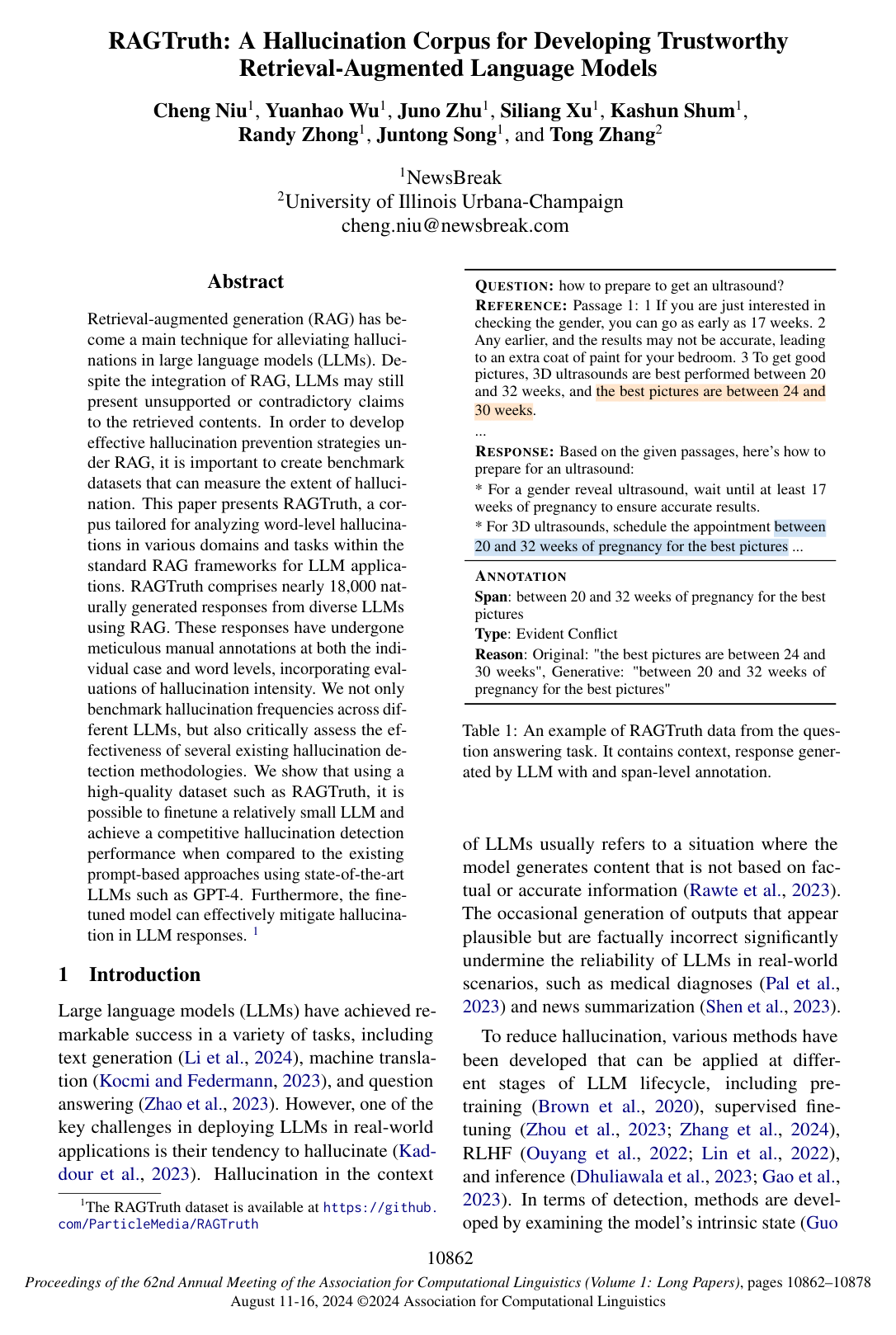
RAGTruth: A Hallucination Corpus for Developing Trustworthy Retrieval-Augmented Language Models
Cheng Niu, Yuanhao Wu, Juno Zhu, Siliang Xu, Kashun Shum, Randy Zhong, Juntong Song, Tong Zhang
Why you should read this
Presents RAGTruth, a large-scale word-level hallucination benchmark of nearly 18,000 manually annotated retrieval-augmented generations that enables smaller language models to match GPT-4 in detecting and mitigating factual errors.
Retrieval-augmented generation (RAG) has become a main technique for alleviating hallucinations in large language models (LLMs). Despite the integration of RAG, LLMs may still present unsupported or contradictory claims to the retrieved contents. In order to develop effective hallucination prevention strategies under RAG, it is important to create benchmark datasets that can measure the extent of hallucination. This paper presents RAGTruth, a corpus tailored for analyzing word-level hallucinations in various domains and tasks within the standard RAG frameworks for LLM applications. RAGTruth comprises nearly 18,000 naturally generated responses from diverse LLMs using RAG. These responses have undergone meticulous manual annotations at both the individual case and word levels, incorporating evaluations of hallucination intensity. We not only benchmark hallucination frequencies across different LLMs, but also critically assess the effectiveness of several existing hallucination detection methodologies. We show that using a high-quality dataset such as RAGTruth, it is possible to finetune a relatively small LLM and achieve a competitive hallucination detection performance when compared to the existing prompt-based approaches using state-of-the-art LLMs such as GPT-4. Furthermore, the finetuned model can effectively mitigate hallucination in LLM responses.
Added
2026-09-26
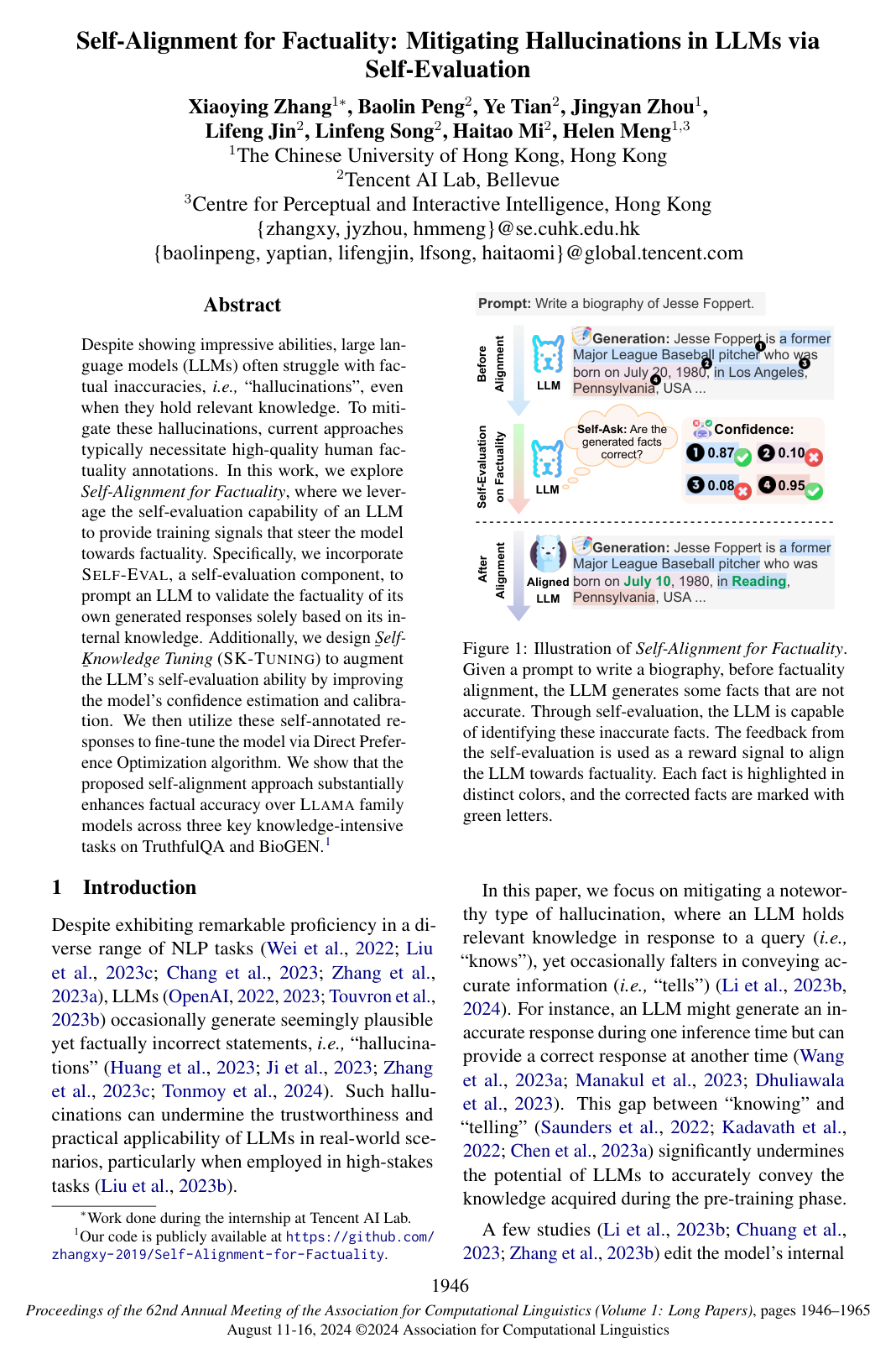
Self-Alignment for Factuality: Mitigating Hallucinations in LLMs via Self-Evaluation
Xiaoying Zhang, Baolin Peng, Ye Tian, Jingyan Zhou, Lifeng Jin, Linfeng Song, Haitao Mi, Helen Meng
Why you should read this
Proposes a self-alignment framework that mitigates hallucinations by training large language models to self-evaluate their own factual accuracy and using those internal confidence scores to guide preference optimization without human annotations.
Despite showing impressive abilities, large language models (LLMs) often struggle with factual inaccuracies, i.e., “hallucinations”, even when they hold relevant knowledge. To mitigate these hallucinations, current approaches typically necessitate high-quality human factuality annotations. In this work, we explore Self-Alignment for Factuality, where we leverage the self-evaluation capability of an LLM to provide training signals that steer the model towards factuality. Specifically, we incorporate Self-Eval, a self-evaluation component, to prompt an LLM to validate the factuality of its own generated responses solely based on its internal knowledge. Additionally, we design Self-Knowledge Tuning (SK-Tuning) to augment the LLM’s self-evaluation ability by improving the model’s confidence estimation and calibration. We then utilize these self-annotated responses to fine-tune the model via Direct Preference Optimization algorithm. We show that the proposed self-alignment approach substantially enhances factual accuracy over LLAMA family models across three key knowledge-intensive tasks on TruthfulQA and BioGEN.¹
Added
2026-09-26
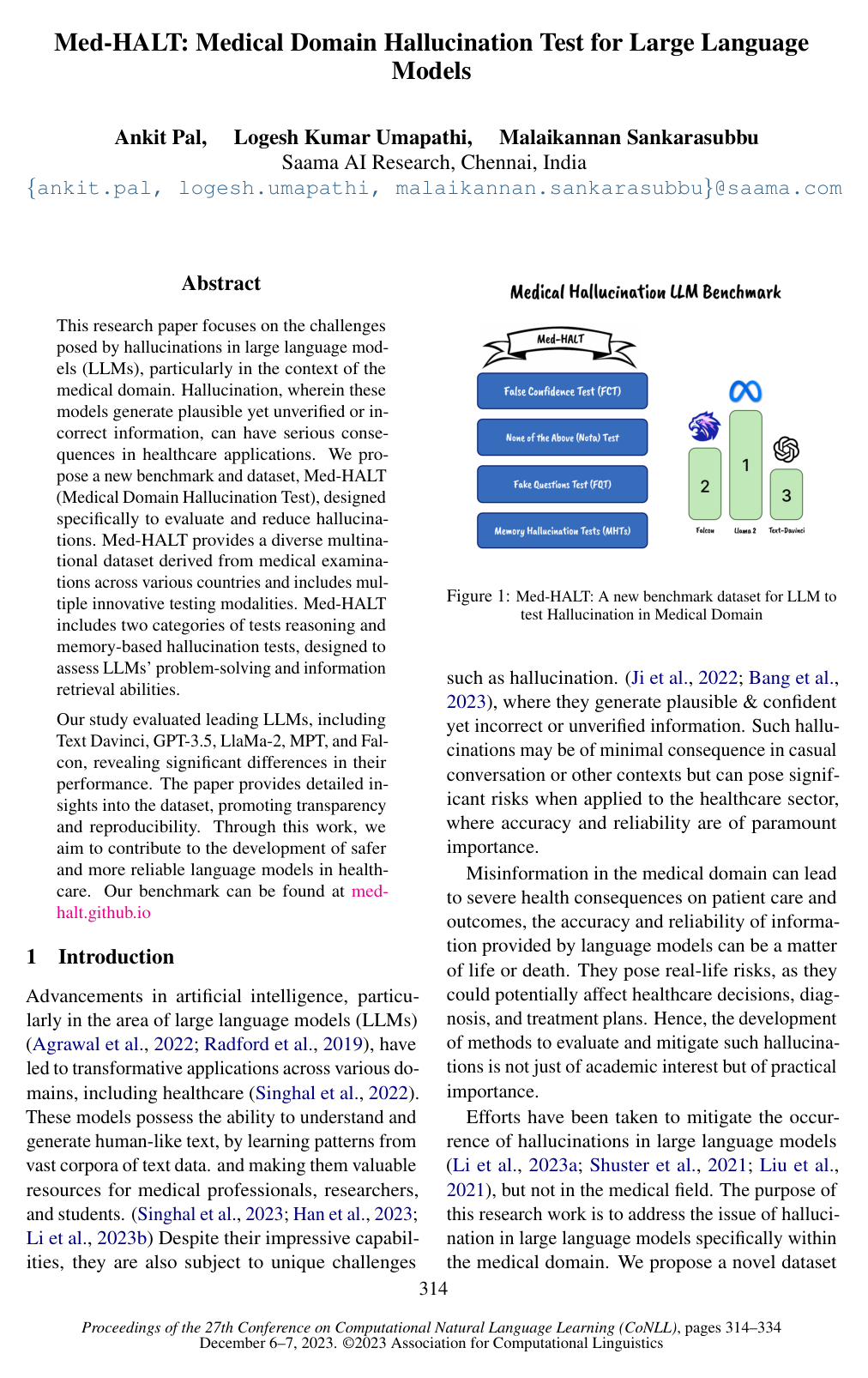
Med-HALT: Medical Domain Hallucination Test for Large Language Models
Ankit Pal, Logesh Kumar Umapathi, Malaikannan Sankarasubbu
Why you should read this
Introduces Med-HALT, a multinational benchmark featuring reasoning and memory-based tests to evaluate and mitigate factual errors and hallucinations in large language models applied to healthcare.
This research paper focuses on the challenges posed by hallucinations in large language models (LLMs), particularly in the context of the medical domain. Hallucination, wherein these models generate plausible yet unverified or incorrect information, can have serious consequences in healthcare applications. We propose a new benchmark and dataset, Med-HALT (Medical Domain Hallucination Test), designed specifically to evaluate and reduce hallucinations. Med-HALT provides a diverse multinational dataset derived from medical examinations across various countries and includes multiple innovative testing modalities. Med-HALT includes two categories of tests reasoning and memory-based hallucination tests, designed to assess LLMs’ problem-solving and information retrieval abilities. Our study evaluated leading LLMs, including Text Davinci, GPT-3.5, LlaMa-2, MPT, and Falcon, revealing significant differences in their performance. The paper provides detailed insights into the dataset, promoting transparency and reproducibility. Through this work, we aim to contribute to the development of safer and more reliable language models in healthcare. Our benchmark can be found at med-halt.github.io
Added
2026-09-26
Why Language Models Hallucinate
Adam Tauman Kalai, Ofir Nachum, Santosh S. Vempala, Edwin Zhang
Why you should read this
Demonstrates that language model hallucinations arise from statistical pressures and misaligned evaluation metrics that reward guessing, proposing a socio-technical solution to foster more trustworthy AI.
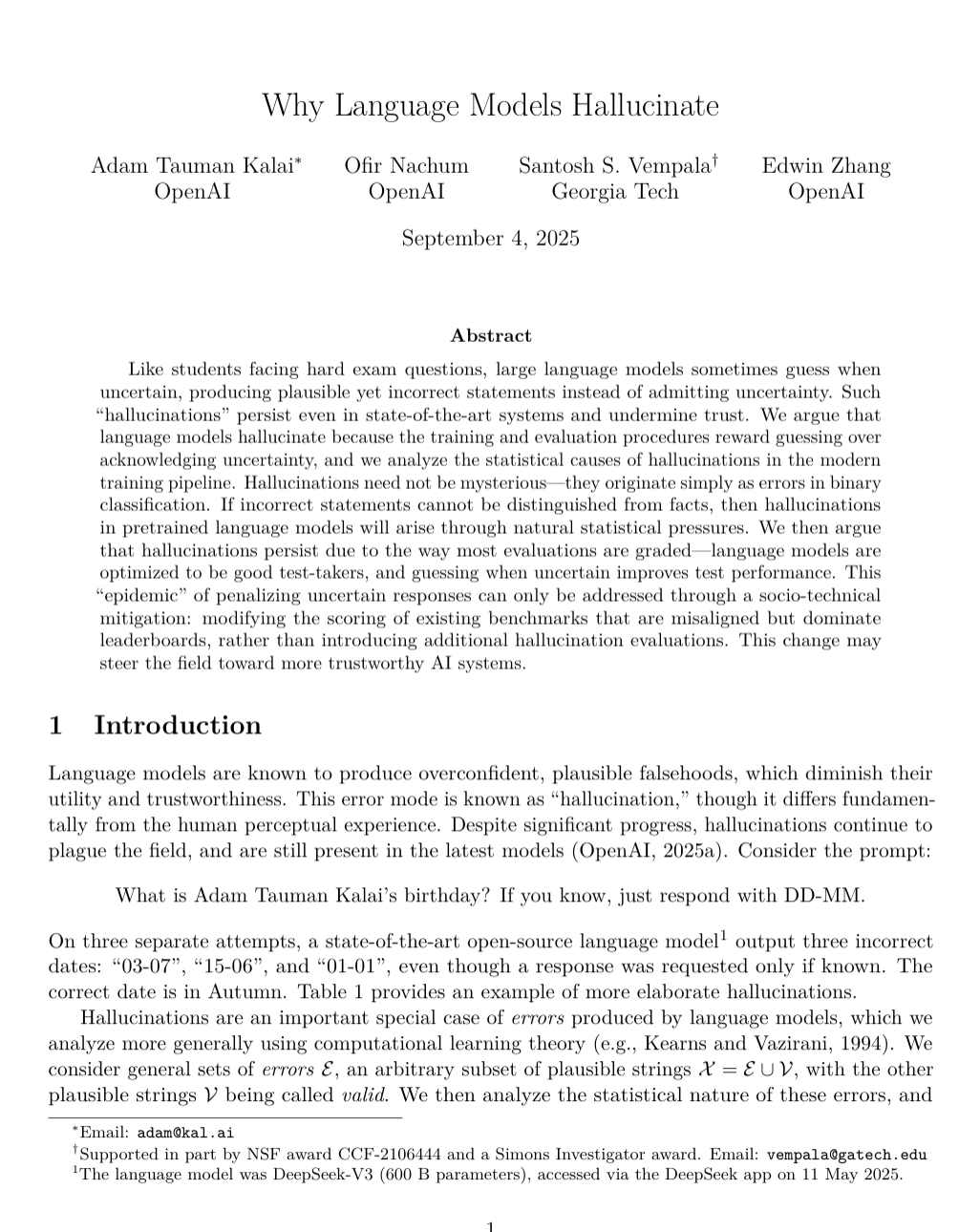
Like students facing hard exam questions, large language models sometimes guess when uncertain, producing plausible yet incorrect statements instead of admitting uncertainty. Such "hallucinations" persist even in state-of-the-art systems and undermine trust. We argue that language models hallucinate because the training and evaluation procedures reward guessing over acknowledging uncertainty, and we analyze the statistical causes of hallucinations in the modern training pipeline. Hallucinations need not be mysterious -- they originate simply as errors in binary classification. If incorrect statements cannot be distinguished from facts, then hallucinations in pretrained language models will arise through natural statistical pressures. We then argue that hallucinations persist due to the way most evaluations are graded -- language models are optimized to be good test-takers, and guessing when uncertain improves test performance. This "epidemic" of penalizing uncertain responses can only be addressed through a socio-technical mitigation: modifying the scoring of existing benchmarks that are misaligned but dominate leaderboards, rather than introducing additional hallucination evaluations. This change may steer the field toward more trustworthy AI systems.
Added
2025-10-14
