
keyword
graph kernels
A graph kernel is a mathematical function that quantifies the similarity between pairs of graphs, allowing standard kernel-based machine learning algorithms such as support vector machines to operate directly on structured, non-vectorial data. Instead of requiring graphs to be explicitly mapped to fixed-dimensional Euclidean vectors, graph kernels evaluate the overlap between structural components, implicitly computing an inner product in a high-dimensional feature space. Typical graph kernels measure similarity by counting common substructures such as random walks, shortest paths, graphlets, cyclic patterns, or subtree neighborhoods generated through iterative refinement algorithms like the Weisfeiler-Lehman isomorphism test. By capturing both topological connectivity and categorical or continuous node and edge attributes, graph kernels provide a foundational framework for whole-graph comparison, classification, regression, and evaluation in fields such as chemoinformatics, bioinformatics, and social network analysis.
14 items
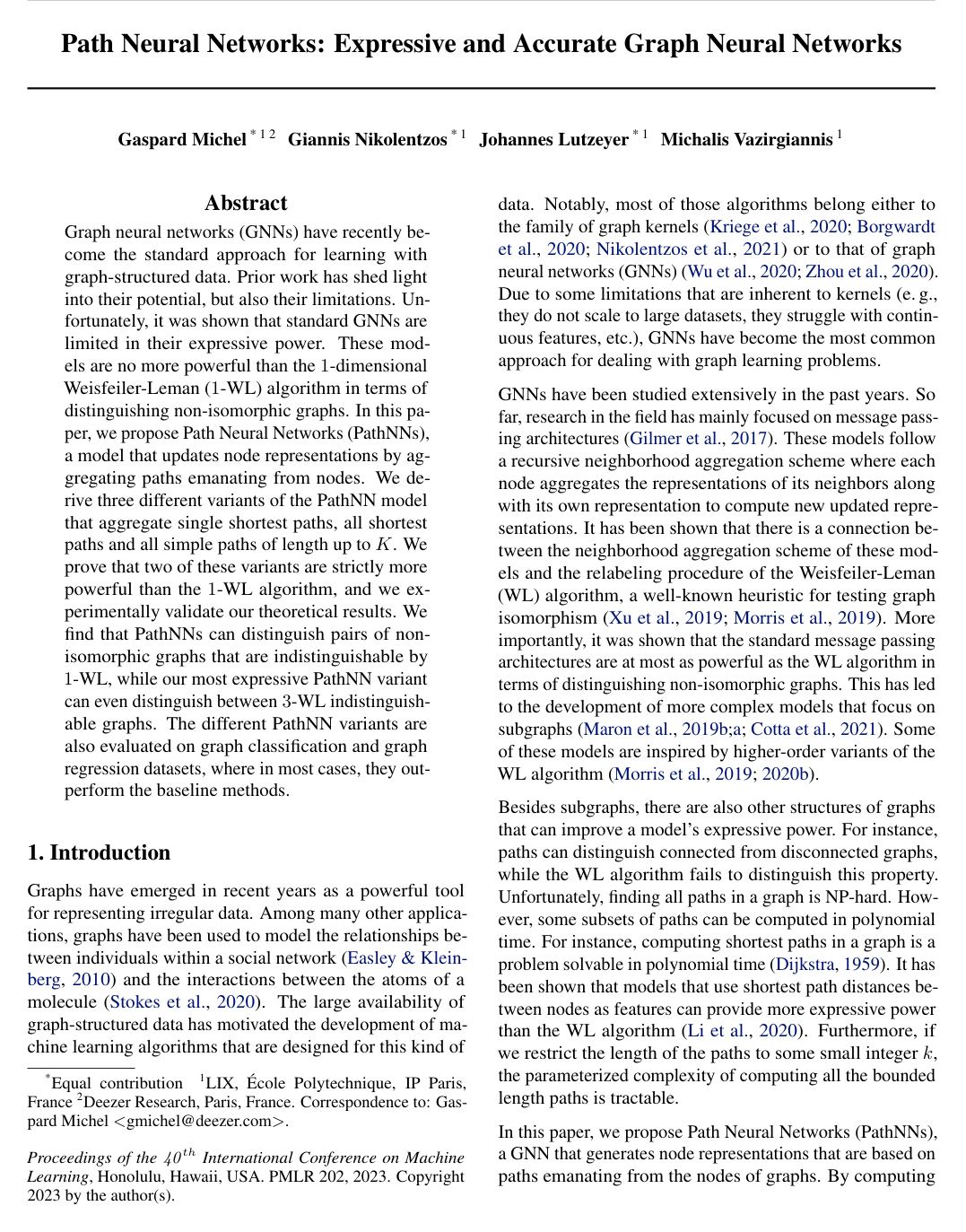
Path Neural Networks: Expressive and Accurate Graph Neural Networks
Gaspard Michel, Giannis Nikolentzos, Johannes F. Lutzeyer, Michalis Vazirgiannis
Why you should read this
Proposes Path Neural Networks, a graph learning framework that updates node representations by aggregating path information of bounded length to surpass the expressive limitations of the standard 1-WL graph isomorphism test.
Graph neural networks (GNNs) have recently become the standard approach for learning with graph-structured data. Prior work has shed light into their potential, but also their limitations. Unfortunately, it was shown that standard GNNs are limited in their expressive power. These models are no more powerful than the 1-dimensional Weisfeiler-Leman (1-WL) algorithm in terms of distinguishing non-isomorphic graphs. In this paper, we propose Path Neural Networks (PathNNs), a model that updates node representations by aggregating paths emanating from nodes. We derive three different variants of the PathNN model that aggregate single shortest paths, all shortest paths and all simple paths of length up to K. We prove that two of these variants are strictly more powerful than the 1-WL algorithm, and we experimentally validate our theoretical results. We find that PathNNs can distinguish pairs of non-isomorphic graphs that are indistinguishable by 1-WL, while our most expressive PathNN variant can even distinguish between 3-WL indistinguishable graphs. The different PathNN variants are also evaluated on graph classification and graph regression datasets, where in most cases, they outperform the baseline methods.
Added
2026-10-04

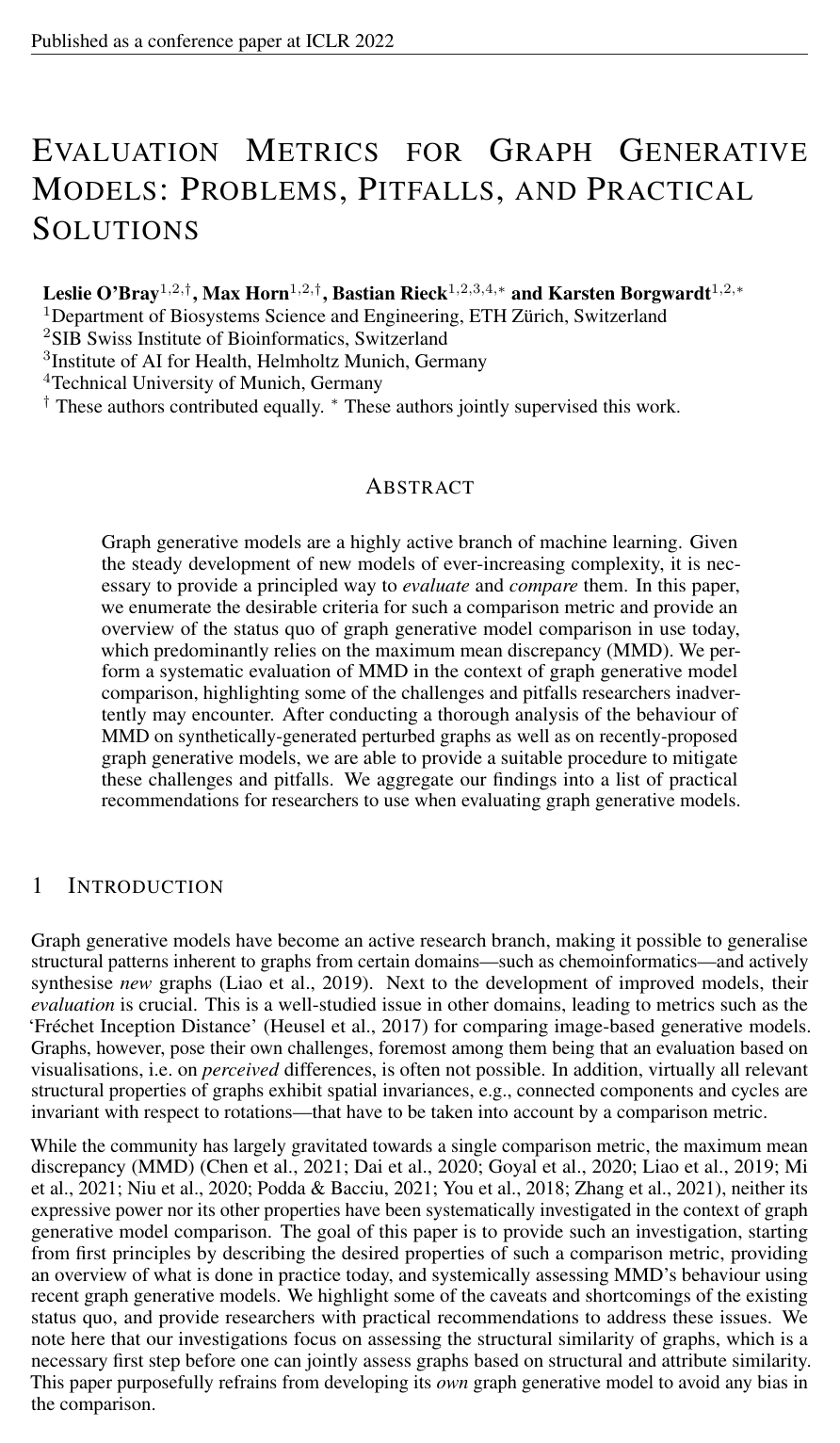
Evaluation Metrics for Graph Generative Models: Problems, Pitfalls, and Practical Solutions
Leslie O'Bray, Max Horn, Bastian Rieck, Karsten M. Borgwardt
Why you should read this
Demonstrates critical flaws in evaluating graph generative models with Maximum Mean Discrepancy and establishes practical guidelines to ensure reliable and standardized model benchmarking.
Graph generative models are a highly active branch of machine learning. Given the steady development of new models of ever-increasing complexity, it is necessary to provide a principled way to evaluate and compare them. In this paper, we enumerate the desirable criteria for such a comparison metric and provide an overview of the status quo of graph generative model comparison in use today, which predominantly relies on the maximum mean discrepancy (MMD). We perform a systematic evaluation of MMD in the context of graph generative model comparison, highlighting some of the challenges and pitfalls researchers inadvertently may encounter. After conducting a thorough analysis of the behaviour of MMD on synthetically-generated perturbed graphs as well as on recently-proposed graph generative models, we are able to provide a suitable procedure to mitigate these challenges and pitfalls. We aggregate our findings into a list of practical recommendations for researchers to use when evaluating graph generative models.
Added
2026-09-26
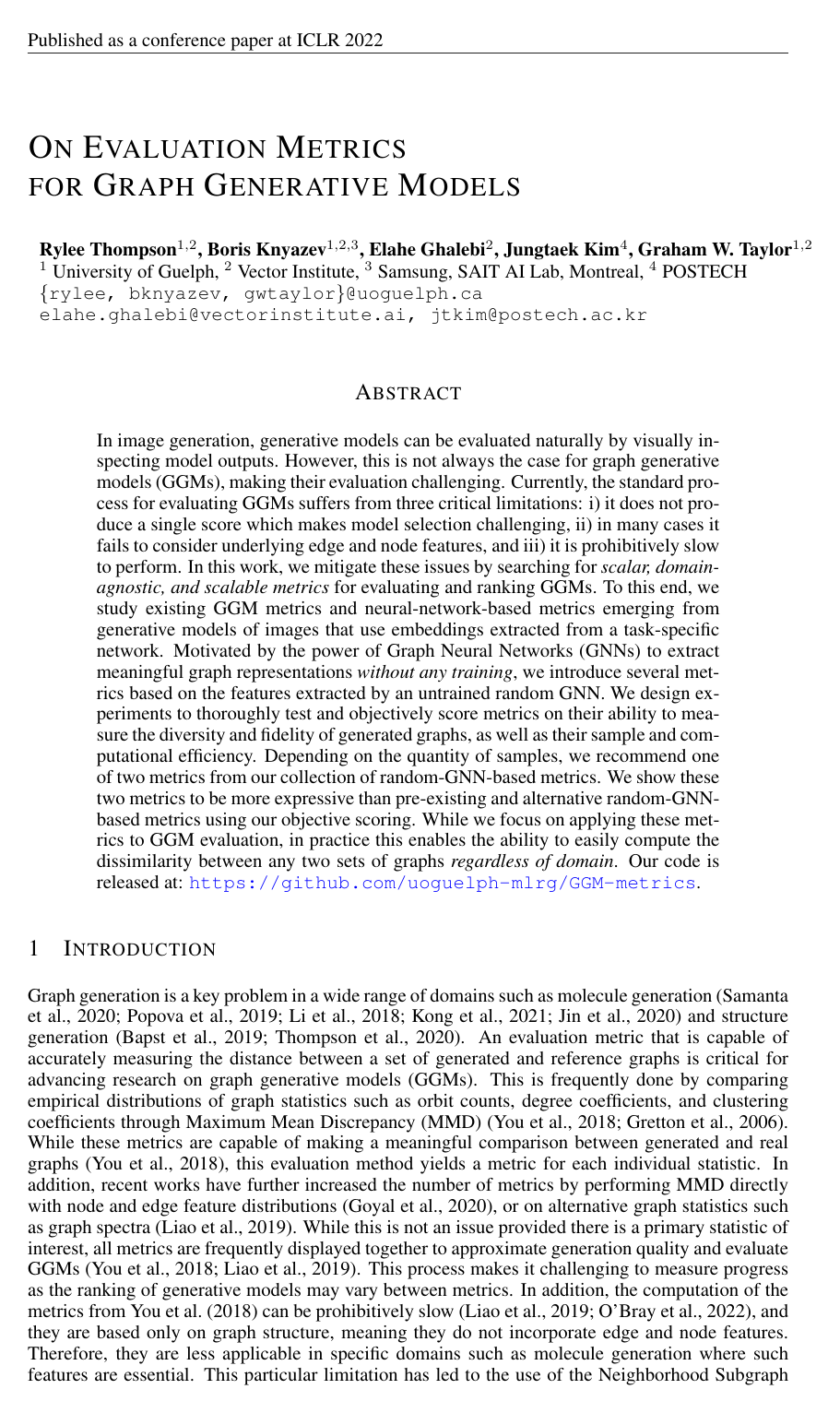
On Evaluation Metrics for Graph Generative Models
Rylee Thompson, Boris Knyazev, Elahe Ghalebi, Jungtaek Kim, Graham W. Taylor
Why you should read this
Proposes scalable, single-score evaluation metrics for graph generative models based on untrained random graph neural networks, enabling fast and feature-aware measurement of generated graph fidelity and diversity.
In image generation, generative models can be evaluated naturally by visually inspecting model outputs. However, this is not always the case for graph generative models (GGMs), making their evaluation challenging. Currently, the standard process for evaluating GGMs suffers from three critical limitations: i) it does not produce a single score which makes model selection challenging, ii) in many cases it fails to consider underlying edge and node features, and iii) it is prohibitively slow to perform. In this work, we mitigate these issues by searching for scalar, domain-agnostic, and scalable metrics for evaluating and ranking GGMs. To this end, we study existing GGM metrics and neural-network-based metrics emerging from generative models of images that use embeddings extracted from a task-specific network. Motivated by the power of certain Graph Neural Networks (GNNs) to extract meaningful graph representations without any training, we introduce several metrics based on the features extracted by an untrained random GNN. We design experiments to thoroughly test metrics on their ability to measure the diversity and fidelity of generated graphs, as well as their sample and computational efficiency. Depending on the quantity of samples, we recommend one of two random-GNN-based metrics that we show to be more expressive than pre-existing metrics. While we focus on applying these metrics to GGM evaluation, in practice this enables the ability to easily compute the dissimilarity between any two sets of graphs regardless of domain. Our code is released at: this https URL.
Added
2026-09-26
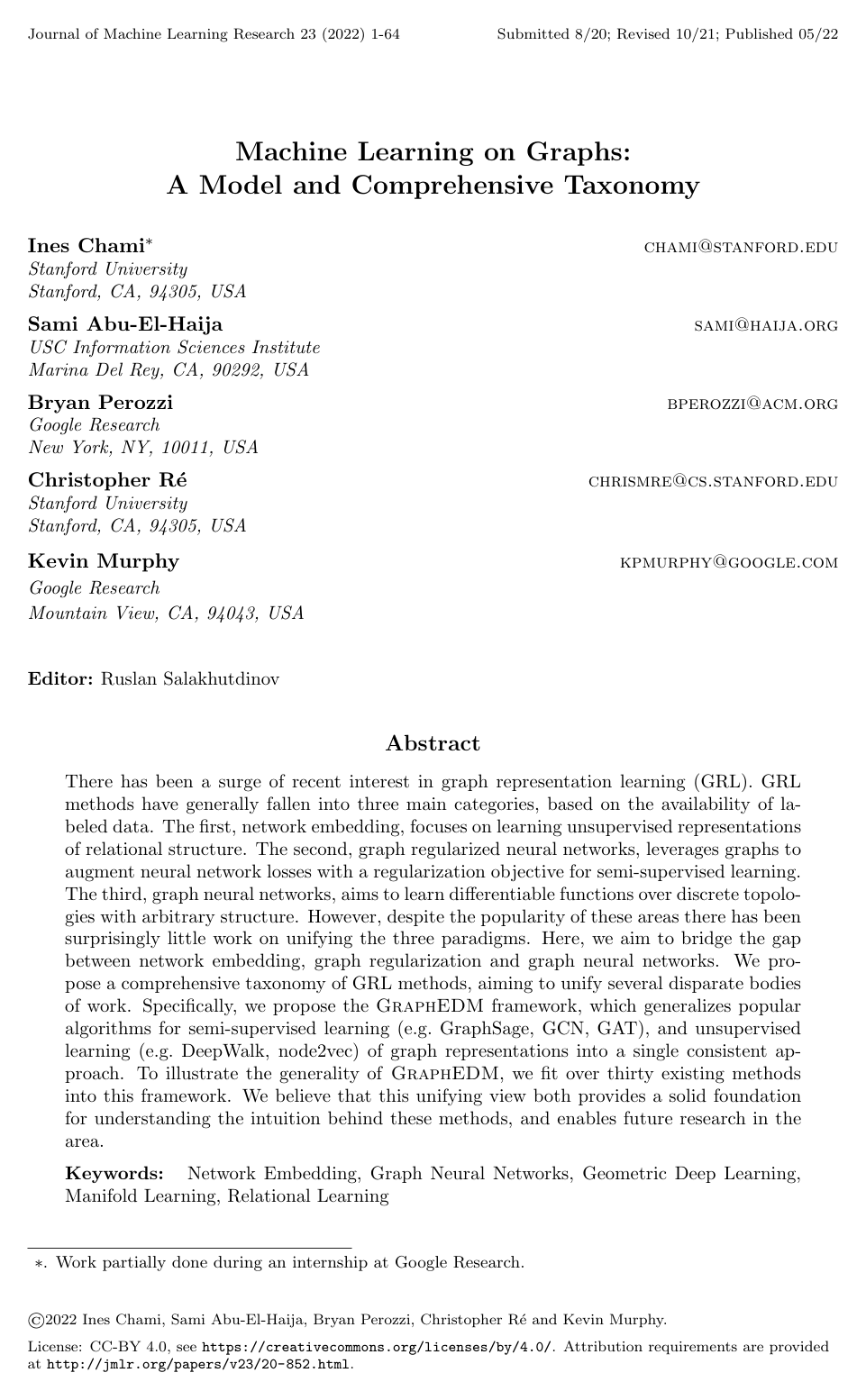
Machine Learning on Graphs: A Model and Comprehensive Taxonomy
Ines Chami, Sami Abu-El-Haija, Bryan Perozzi, Christopher Ré, Kevin Murphy
Why you should read this
Presents a unified Graph Encoder Decoder Model (GraphEDM) and comprehensive taxonomy that integrates over thirty supervised and unsupervised graph representation learning methods into a single consistent mathematical formulation.
There has been a surge of recent interest in graph representation learning (GRL). GRL methods have generally fallen into three main categories, based on the availability of labeled data. The first, network embedding, focuses on learning unsupervised representations of relational structure. The second, graph regularized neural networks, leverages graphs to augment neural network losses with a regularization objective for semi-supervised learning. The third, graph neural networks, aims to learn differentiable functions over discrete topologies with arbitrary structure. However, despite the popularity of these areas there has been surprisingly little work on unifying the three paradigms. Here, we aim to bridge the gap between network embedding, graph regularization and graph neural networks. We propose a comprehensive taxonomy of GRL methods, aiming to unify several disparate bodies of work. Specifically, we propose the GRAPHEDM framework, which generalizes popular algorithms for semi-supervised learning (e.g. GraphSage, GCN, GAT), and unsupervised learning (e.g. DeepWalk, node2vec) of graph representations into a single consistent approach. To illustrate the generality of GRAPHEDM, we fit over thirty existing methods into this framework. We believe that this unifying view both provides a solid foundation for understanding the intuition behind these methods, and enables future research in the area.
Added
2026-09-26
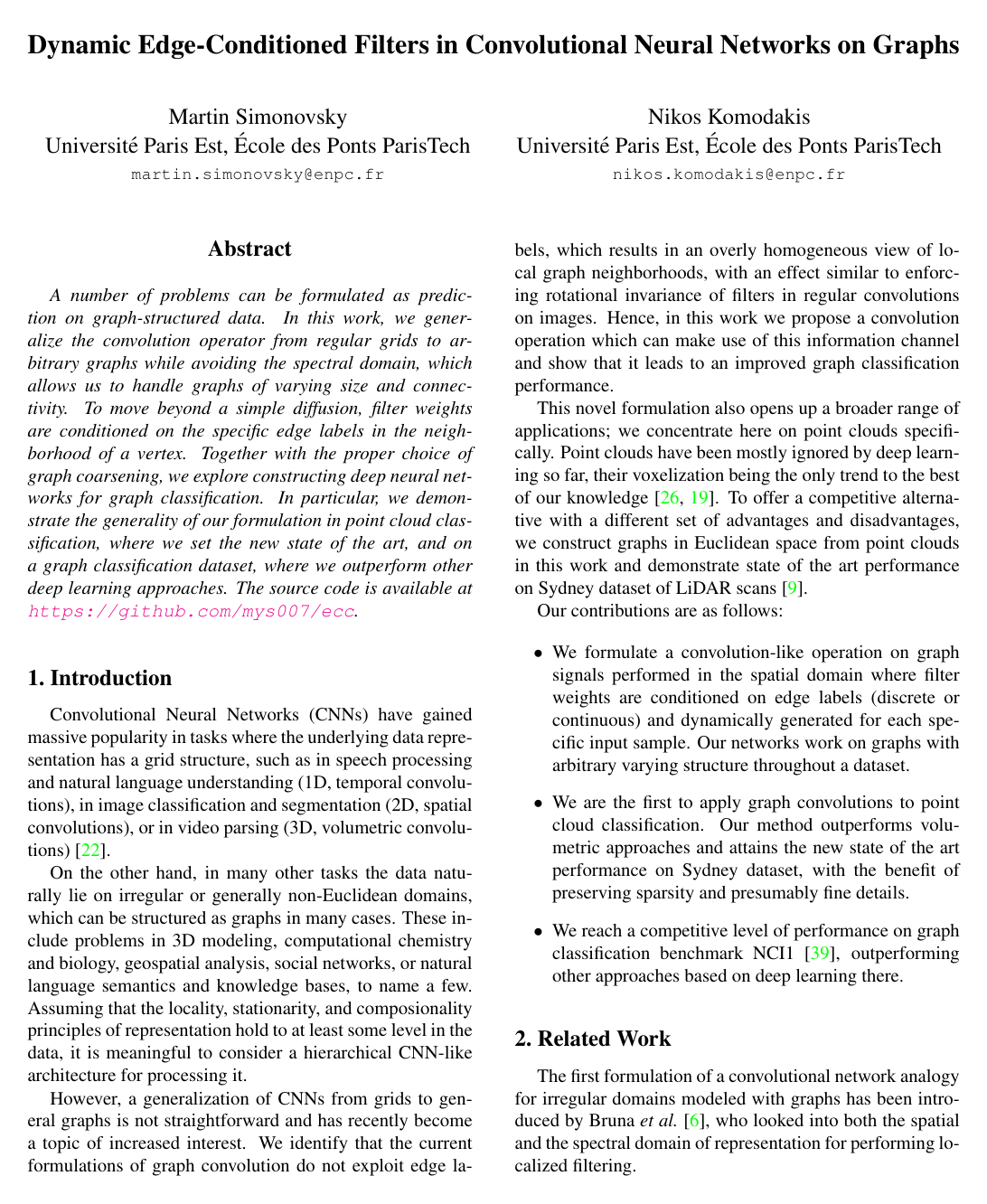
Dynamic Edge-Conditioned Filters in Convolutional Neural Networks on Graphs
Martin Simonovsky, Nikos Komodakis
Why you should read this
Introduces edge-conditioned convolutions that dynamically generate filter weights from edge attributes, allowing neural networks to generalize across arbitrary graph structures and excel at 3D point cloud classification.
A number of problems can be formulated as prediction on graph-structured data. In this work, we generalize the convolution operator from regular grids to arbitrary graphs while avoiding the spectral domain, which allows us to handle graphs of varying size and connectivity. To move beyond a simple diffusion, filter weights are conditioned on the specific edge labels in the neighborhood of a vertex. Together with the proper choice of graph coarsening, we explore constructing deep neural networks for graph classification. In particular, we demonstrate the generality of our formulation in point cloud classification, where we set the new state of the art, and on a graph classification dataset, where we outperform other deep learning approaches. The source code is available at this https URL
Added
2026-09-25
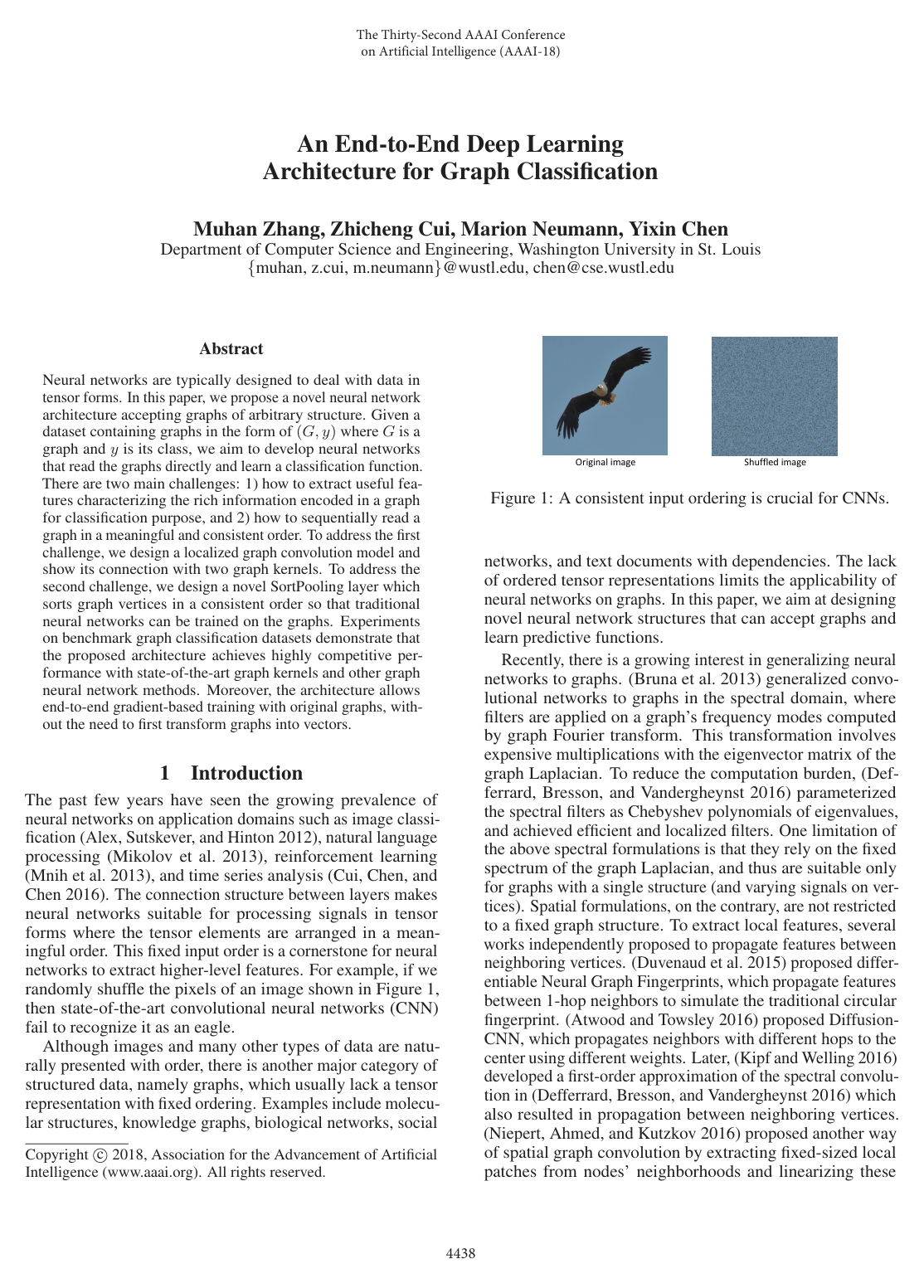
An End-to-End Deep Learning Architecture for Graph Classification
Muhan Zhang, Zhicheng Cui, Marion Neumann, Yixin Chen
Why you should read this
Proposes Deep Graph Convolutional Neural Networks and a novel SortPooling layer to consistently order and extract multi-scale vertex features from arbitrary graphs, enabling end-to-end classification directly using standard neural network layers without graph-to-vector preprocessing.
Neural networks are typically designed to deal with data in tensor forms. In this paper, we propose a novel neural network architecture accepting graphs of arbitrary structure. Given a dataset containing graphs in the form of (G, y) where G is a graph and y is its class, we aim to develop neural networks that read the graphs directly and learn a classification function. There are two main challenges: 1) how to extract useful features characterizing the rich information encoded in a graph for classification purpose, and 2) how to sequentially read a graph in a meaningful and consistent order. To address the first challenge, we design a localized graph convolution model and show its connection with two graph kernels. To address the second challenge, we design a novel SortPooling layer which sorts graph vertices in a consistent order so that traditional neural networks can be trained on the graphs. Experiments on benchmark graph classification datasets demonstrate that the proposed architecture achieves highly competitive performance with state-of-the-art graph kernels and other graph neural network methods. Moreover, the architecture allows end-to-end gradient-based training with original graphs, without the need to first transform graphs into vectors.
Added
2026-09-24
A Comprehensive Survey of Graph Embedding: Problems, Techniques, and Applications
Hongyun Cai, Vincent W. Zheng, Kevin Chen-Chuan Chang
Why you should read this
Presents dual taxonomies that systematically categorize graph embedding problem settings and algorithmic solutions, clarifying how low-dimensional representations preserve network structure for downstream applications like node classification and link prediction.
Graph is an important data representation which appears in a wide diversity of real-world scenarios. Effective graph analytics provides users a deeper understanding of what is behind the data, and thus can benefit a lot of useful applications such as node classification, node recommendation, link prediction, etc. However, most graph analytics methods suffer the high computation and space cost. Graph embedding is an effective yet efficient way to solve the graph analytics problem. It converts the graph data into a low dimensional space in which the graph structural information and graph properties are maximally preserved. In this survey, we conduct a comprehensive review of the literature in graph embedding. We first introduce the formal definition of graph embedding as well as the related concepts. After that, we propose two taxonomies of graph embedding which correspond to what challenges exist in different graph embedding problem settings and how the existing work address these challenges in their solutions. Finally, we summarize the applications that graph embedding enables and suggest four promising future research directions in terms of computation efficiency, problem settings, techniques and application scenarios.
Added
2026-09-18
Representation Learning on Graphs: Methods and Applications
William L. Hamilton, Rex Ying, Jure Leskovec
Why you should read this
Develops a unified conceptual framework for graph representation learning that systematically categorizes node and whole-graph embedding techniques across matrix factorization, random walks, and graph neural networks for machine learning applications.
Machine learning on graphs is an important and ubiquitous task with applications ranging from drug design to friendship recommendation in social networks. The primary challenge in this domain is finding a way to represent, or encode, graph structure so that it can be easily exploited by machine learning models. Traditionally, machine learning approaches relied on user-defined heuristics to extract features encoding structural information about a graph (e.g., degree statistics or kernel functions). However, recent years have seen a surge in approaches that automatically learn to encode graph structure into low-dimensional embeddings, using techniques based on deep learning and nonlinear dimensionality reduction. Here we provide a conceptual review of key advancements in this area of representation learning on graphs, including matrix factorization-based methods, random-walk based algorithms, and graph neural networks. We review methods to embed individual nodes as well as approaches to embed entire (sub)graphs. In doing so, we develop a unified framework to describe these recent approaches, and we highlight a number of important applications and directions for future work.
Added
2026-09-16
Link Prediction Based on Graph Neural Networks
Muhan Zhang, Yixin Chen
Why you should read this
Establishes a unifying theory proving that local subgraphs capture link existence patterns and introduces a graph neural network approach that automatically learns graph-specific heuristics superior to standard handcrafted metrics.
Link prediction is a key problem for network-structured data. Link prediction heuristics use some score functions, such as common neighbors and Katz index, to measure the likelihood of links. They have obtained wide practical uses due to their simplicity, interpretability, and for some of them, scalability. However, every heuristic has a strong assumption on when two nodes are likely to link, which limits their effectiveness on networks where these assumptions fail. In this regard, a more reasonable way should be learning a suitable heuristic from a given network instead of using predefined ones. By extracting a local subgraph around each target link, we aim to learn a function mapping the subgraph patterns to link existence, thus automatically learning a `heuristic' that suits the current network. In this paper, we study this heuristic learning paradigm for link prediction. First, we develop a novel -decaying heuristic theory. The theory unifies a wide range of heuristics in a single framework, and proves that all these heuristics can be well approximated from local subgraphs. Our results show that local subgraphs reserve rich information related to link existence. Second, based on the -decaying theory, we propose a new algorithm to learn heuristics from local subgraphs using a graph neural network (GNN). Its experimental results show unprecedented performance, working consistently well on a wide range of problems.
Added
2026-09-14
Gated Graph Sequence Neural Networks
Yujia Li, Daniel Tarlow, Marc Brockschmidt, Richard Zemel
Why you should read this
Introduces Gated Graph Sequence Neural Networks, modernizing graph neural architectures with gated recurrent units to learn representations and generate sequential outputs across graph-structured tasks such as program verification.
Graph-structured data appears frequently in domains including chemistry, natural language semantics, social networks, and knowledge bases. In this work, we study feature learning techniques for graph-structured inputs. Our starting point is previous work on Graph Neural Networks (Scarselli et al., 2009), which we modify to use gated recurrent units and modern optimization techniques and then extend to output sequences. The result is a flexible and broadly useful class of neural network models that has favorable inductive biases relative to purely sequence-based models (e.g., LSTMs) when the problem is graph-structured. We demonstrate the capabilities on some simple AI (bAbI) and graph algorithm learning tasks. We then show it achieves state-of-the-art performance on a problem from program verification, in which subgraphs need to be matched to abstract data structures.
Added
2026-09-11
Open Graph Benchmark: Datasets for Machine Learning on Graphs
Weihua Hu, Matthias Fey, Marinka Zitnik, Yuxiao Dong, Hongyu Ren, Bowen Liu, Michele Catasta, Jure Leskovec
Why you should read this
Introduces the Open Graph Benchmark (OGB), a standardized suite of large-scale, realistic datasets and unified evaluation protocols designed to address scalability and out-of-distribution generalization challenges across graph machine learning.
We present the Open Graph Benchmark (OGB), a diverse set of challenging and realistic benchmark datasets to facilitate scalable, robust, and reproducible graph machine learning (ML) research. OGB datasets are large-scale, encompass multiple important graph ML tasks, and cover a diverse range of domains, ranging from social and information networks to biological networks, molecular graphs, source code ASTs, and knowledge graphs. For each dataset, we provide a unified evaluation protocol using meaningful application-specific data splits and evaluation metrics. In addition to building the datasets, we also perform extensive benchmark experiments for each dataset. Our experiments suggest that OGB datasets present significant challenges of scalability to large-scale graphs and out-of-distribution generalization under realistic data splits, indicating fruitful opportunities for future research. Finally, OGB provides an automated end-to-end graph ML pipeline that simplifies and standardizes the process of graph data loading, experimental setup, and model evaluation. OGB will be regularly updated and welcomes inputs from the community. OGB datasets as well as data loaders, evaluation scripts, baseline code, and leaderboards are publicly available at this https URL .
Added
2026-09-11
How Powerful are Graph Neural Networks?
Keyulu Xu, Weihua Hu, Jure Leskovec, Stefanie Jegelka
Why you should read this
Proves that standard GNNs are at most as expressive as the Weisfeiler-Leman isomorphism test and introduces the Graph Isomorphism Network (GIN) to reach this limit.
Graph Neural Networks (GNNs) are an effective framework for representation learning of graphs. GNNs follow a neighborhood aggregation scheme, where the representation vector of a node is computed by recursively aggregating and transforming representation vectors of its neighboring nodes. Many GNN variants have been proposed and have achieved state-of-the-art results on both node and graph classification tasks. However, despite GNNs revolutionizing graph representation learning, there is limited understanding of their representational properties and limitations. Here, we present a theoretical framework for analyzing the expressive power of GNNs to capture different graph structures. Our results characterize the discriminative power of popular GNN variants, such as Graph Convolutional Networks and GraphSAGE, and show that they cannot learn to distinguish certain simple graph structures. We then develop a simple architecture that is provably the most expressive among the class of GNNs and is as powerful as the Weisfeiler-Lehman graph isomorphism test. We empirically validate our theoretical findings on a number of graph classification benchmarks, and demonstrate that our model achieves state-of-the-art performance.
Added
2026-02-19
Hierarchical graph representation learning with differentiable pooling
Rex Ying, Jiaxuan You, Christopher Morris, Xiang Ren, William L. Hamilton, Jure Leskovec
Why you should read this
Introduces DiffPool, a differentiable clustering module that learns to hierarchically coarsen a graph for efficient graph-level classification.
Recently, graph neural networks (GNNs) have revolutionized the field of graph representation learning through effectively learned node embeddings, and achieved state-of-the-art results in tasks such as node classification and link prediction. However, current GNN methods are inherently flat and do not learn hierarchical representations of graphs---a limitation that is especially problematic for the task of graph classification, where the goal is to predict the label associated with an entire graph. Here we propose DiffPool, a differentiable graph pooling module that can generate hierarchical representations of graphs and can be combined with various graph neural network architectures in an end-to-end fashion. DiffPool learns a differentiable soft cluster assignment for nodes at each layer of a deep GNN, mapping nodes to a set of clusters, which then form the coarsened input for the next GNN layer. Our experimental results show that combining existing GNN methods with DiffPool yields an average improvement of 5-10% accuracy on graph classification benchmarks, compared to all existing pooling approaches, achieving a new state-of-the-art on four out of five benchmark datasets.
Added
2026-02-19
Weisfeiler and Leman Go Neural: Higher-Order Graph Neural Networks
Christopher Morris, Martin Ritzert, Matthias Fey, William L. Hamilton, Jan Eric Lenssen, Gaurav Rattan, Martin Grohe
Why you should read this
Develops k-dimensional GNNs that effectively mimic higher-order Weisfeiler-Leman tests to distinguish graph structures that standard MPNNs cannot.
In recent years, graph neural networks (GNNs) have emerged as a powerful neural architecture to learn vector representations of nodes and graphs in a supervised, end-to-end fashion. Up to now, GNNs have only been evaluated empirically—showing promising results. The following work investigates GNNs from a theoretical point of view and relates them to the 1-dimensional Weisfeiler-Leman graph isomorphism heuristic (1-WL). We show that GNNs have the same expressiveness as the 1-WL in terms of distinguishing non-isomorphic (sub-)graphs. Hence, both algorithms also have the same shortcomings. Based on this, we propose a generalization of GNNs, so-called k-dimensional GNNs (k-GNNs), which can take higher-order graph structures at multiple scales into account. These higher-order structures play an essential role in the characterization of social networks and molecule graphs. Our experimental evaluation confirms our theoretical findings as well as confirms that higher-order information is useful in the task of graph classification and regression.
Added
2026-02-19