
keyword
graph convolutions
A graph convolution is an operation in machine learning and signal processing that generalizes the classical convolution operation from regular grid structures to irregular, graph-structured data. It generates updated representations for graph elements by aggregating and transforming feature information from a node and its local neighborhood according to the underlying graph connectivity. Graph convolutions are broadly implemented through either spatial or spectral formulations: spatial approaches perform localized message passing and feature aggregation directly across neighboring nodes, while spectral approaches apply mathematical filters in the graph Fourier domain using the eigendecomposition or polynomial approximations of the graph Laplacian matrix. By capturing both localized node attributes and structural topological relationships, graph convolutions serve as foundational building blocks in graph neural networks for tasks such as node classification, link prediction, and graph-level representation learning.
9 items
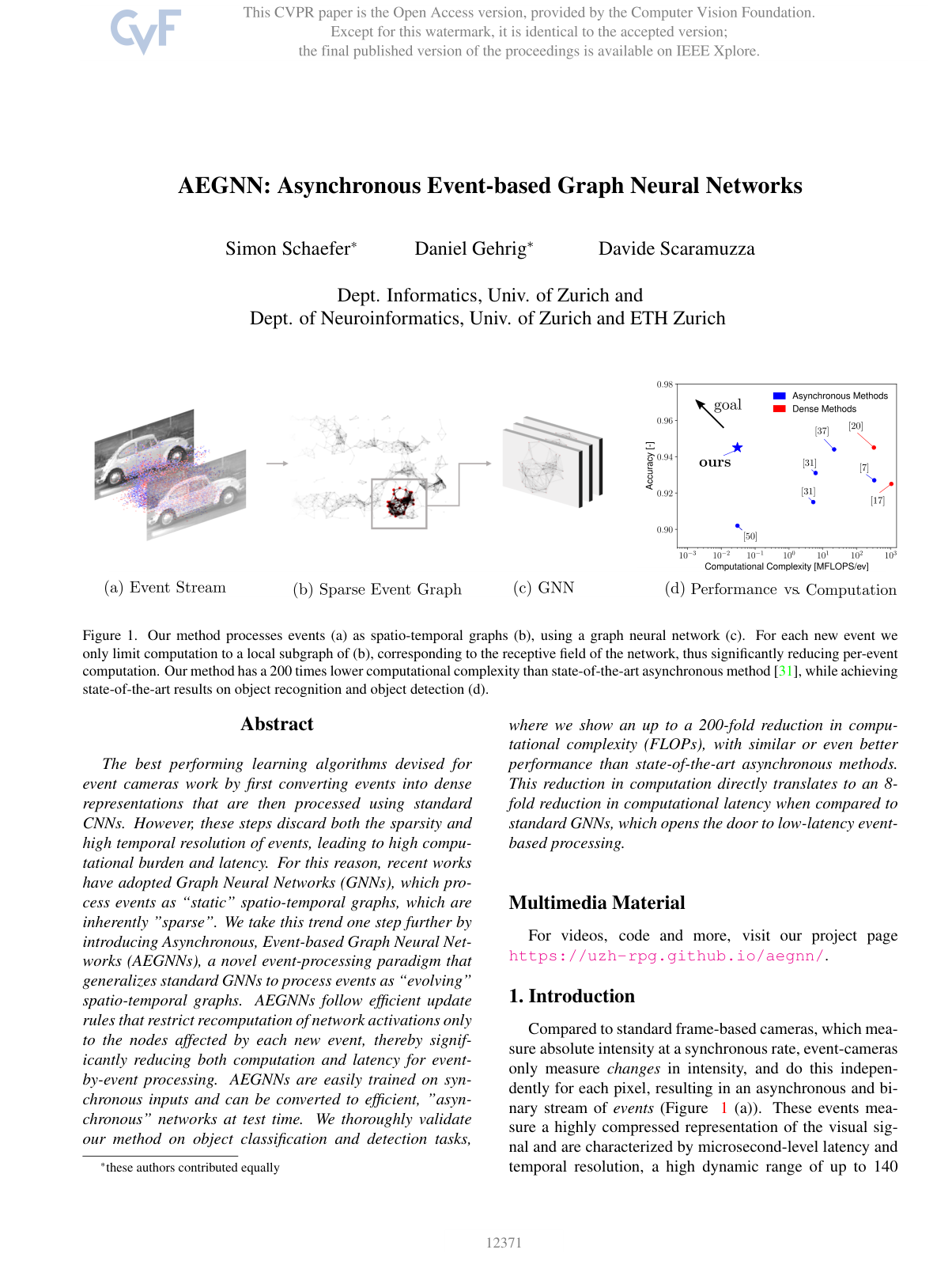
AEGNN: Asynchronous Event-based Graph Neural Networks
Simon Schaefer, Daniel Gehrig, Davide Scaramuzza
Why you should read this
Presents an asynchronous graph neural network framework that processes event camera streams as dynamically evolving spatio-temporal graphs, updating only affected local activations per event to achieve up to a 200-fold reduction in computational complexity and an 8-fold drop in latency compared to standard graph-based methods.
The best performing learning algorithms devised for event cameras work by first converting events into dense representations that are then processed using standard CNNs. However, these steps discard both the sparsity and high temporal resolution of events, leading to high computational burden and latency. For this reason, recent works have adopted Graph Neural Networks (GNNs), which process events as “static” spatio-temporal graphs, which are inherently “sparse”. We take this trend one step further by introducing Asynchronous, Event-based Graph Neural Networks (AEGNNs), a novel event-processing paradigm that generalizes standard GNNs to process events as “evolving” spatio-temporal graphs. AEGNNs follow efficient update rules that restrict recomputation of network activations only to the nodes affected by each new event, thereby significantly reducing both computation and latency for event-by-event processing. AEGNNs are easily trained on synchronous inputs and can be converted to efficient, “asynchronous” networks at test time. We thoroughly validate our method on object classification and detection tasks, where we show an up to a 200-fold reduction in computational complexity (FLOPs), with similar or even better performance than state-of-the-art asynchronous methods. This reduction in computation directly translates to an 8-fold reduction in computational latency when compared to standard GNNs, which opens the door to low-latency event-based processing.
Added
2026-10-05
p-Laplacian Based Graph Neural Networks
Guoji Fu, Peilin Zhao, Yatao Bian
Why you should read this
Develops a discrete regularization framework based on the -Laplacian to create graph neural networks that act as adaptive low-high-pass spectral filters, effectively handling heterophilic graphs and noisy topology where standard architectures fail.
Graph neural networks (GNNs) have demonstrated superior performance for semi-supervised node classification on graphs, as a result of their ability to exploit node features and topological information. However, most GNNs implicitly assume that the labels of nodes and their neighbors in a graph are the same or consistent, which does not hold in heterophilic graphs, where the labels of linked nodes are likely to differ. Moreover, when the topology is non-informative for label prediction, ordinary GNNs may work significantly worse than simply applying multi-layer perceptrons (MLPs) on each node. To tackle the above problem, we propose a new p-Laplacian based GNN model, termed as pGNN, whose message passing mechanism is derived from a discrete regularization framework and can be theoretically explained as an approximation of a polynomial graph filter defined on the spectral domain of p-Laplacians. The spectral analysis shows that the new message passing mechanism works as low-high-pass filters, thus rendering pGNNs effective on both homophilic and heterophilic graphs. Empirical studies on real-world and synthetic datasets validate our findings and demonstrate that pGNNs significantly outperform several state-of-the-art GNN architectures on heterophilic benchmarks while achieving competitive performance on homophilic benchmarks. Moreover, pGNNs can adaptively learn aggregation weights and are robust to noisy edges.
Added
2026-10-03
Specformer: Spectral Graph Neural Networks Meet Transformers
Deyu Bo, Chuan Shi, Lele Wang, Renjie Liao
Why you should read this
Proposes Specformer, a spectral graph neural network that applies Transformer self-attention across the entire eigenvalue spectrum to learn flexible, set-to-set spectral filters for both node- and graph-level representation learning.
Spectral graph neural networks (GNNs) learn graph representations via spectral-domain graph convolutions. However, most existing spectral graph filters are scalar-to-scalar functions, i.e., mapping a single eigenvalue to a single filtered value, thus ignoring the global pattern of the spectrum. Furthermore, these filters are often constructed based on some fixed-order polynomials, which have limited expressiveness and flexibility. To tackle these issues, we introduce Specformer, which effectively encodes the set of all eigenvalues and performs self-attention in the spectral domain, leading to a learnable set-to-set spectral filter. We also design a decoder with learnable bases to enable non-local graph convolution. Importantly, Specformer is equivariant to permutation. By stacking multiple Specformer layers, one can build a powerful spectral GNN. On synthetic datasets, we show that our Specformer can better recover ground-truth spectral filters than other spectral GNNs. Extensive experiments of both node-level and graph-level tasks on real-world graph datasets show that our Specformer outperforms state-of-the-art GNNs and learns meaningful spectrum patterns. Code and data are available at this https URL.
Added
2026-09-26
Large-Scale Point Cloud Semantic Segmentation with Superpoint Graphs
Loic Landrieu, Martin Simonovsky
Why you should read this
Introduces superpoint graphs to partition massive 3D point clouds into geometrically homogeneous components, enabling graph convolutional networks to capture contextual relationships and significantly advance large-scale semantic segmentation.
We propose a novel deep learning-based framework to tackle the challenge of semantic segmentation of large-scale point clouds of millions of points. We argue that the organization of 3D point clouds can be efficiently captured by a structure called superpoint graph (SPG), derived from a partition of the scanned scene into geometrically homogeneous elements. SPGs offer a compact yet rich representation of contextual relationships between object parts, which is then exploited by a graph convolutional network. Our framework sets a new state of the art for segmenting outdoor LiDAR scans (+11.9 and +8.8 mIoU points for both Semantic3D test sets), as well as indoor scans (+12.4 mIoU points for the S3DIS dataset).
Added
2026-09-25
Deep Learning on Graphs: A Survey
Ziwei Zhang, Peng Cui, Wenwu Zhu
Why you should read this
Categorizes graph deep learning into five foundational model architectures and training strategies to provide researchers with a systematic framework for understanding and comparing graph neural networks across diverse applications.
Deep learning has been shown to be successful in a number of domains, ranging from acoustics, images, to natural language processing. However, applying deep learning to the ubiquitous graph data is non-trivial because of the unique characteristics of graphs. Recently, substantial research efforts have been devoted to applying deep learning methods to graphs, resulting in beneficial advances in graph analysis techniques. In this survey, we comprehensively review the different types of deep learning methods on graphs. We divide the existing methods into five categories based on their model architectures and training strategies: graph recurrent neural networks, graph convolutional networks, graph autoencoders, graph reinforcement learning, and graph adversarial methods. We then provide a comprehensive overview of these methods in a systematic manner mainly by following their development history. We also analyze the differences and compositions of different methods. Finally, we briefly outline the applications in which they have been used and discuss potential future research directions.
Added
2026-09-24
Deep Convolutional Networks on Graph-Structured Data
Mikael Henaff, Joan Bruna, Yann LeCun
Why you should read this
Develops an extension of spectral convolutional networks that estimates underlying graph structures directly from unstructured data, drastically reducing parameter complexity while matching or exceeding the classification performance of standard deep architectures.
Deep Learning's recent successes have mostly relied on Convolutional Networks, which exploit fundamental statistical properties of images, sounds and video data: the local stationarity and multi-scale compositional structure, that allows expressing long range interactions in terms of shorter, localized interactions. However, there exist other important examples, such as text documents or bioinformatic data, that may lack some or all of these strong statistical regularities. In this paper we consider the general question of how to construct deep architectures with small learning complexity on general non-Euclidean domains, which are typically unknown and need to be estimated from the data. In particular, we develop an extension of Spectral Networks which incorporates a Graph Estimation procedure, that we test on large-scale classification problems, matching or improving over Dropout Networks with far less parameters to estimate.
Added
2026-09-24
A Comprehensive Survey on Graph Neural Networks
Zonghan Wu, Shirui Pan, Fengwen Chen, Guodong Long, Chengqi Zhang, Philip S. Yu
Why you should read this
Systematizes graph neural network research by establishing a four-part taxonomy of recurrent, convolutional, autoencoder, and spatial-temporal architectures alongside practical guides to standard benchmarks, applications, and open challenges.
Deep learning has revolutionized many machine learning tasks in recent years, ranging from image classification and video processing to speech recognition and natural language understanding. The data in these tasks are typically represented in the Euclidean space. However, there is an increasing number of applications where data are generated from non-Euclidean domains and are represented as graphs with complex relationships and interdependency between objects. The complexity of graph data has imposed significant challenges on existing machine learning algorithms. Recently, many studies on extending deep learning approaches for graph data have emerged. In this survey, we provide a comprehensive overview of graph neural networks (GNNs) in data mining and machine learning fields. We propose a new taxonomy to divide the state-of-the-art graph neural networks into four categories, namely recurrent graph neural networks, convolutional graph neural networks, graph autoencoders, and spatial-temporal graph neural networks. We further discuss the applications of graph neural networks across various domains and summarize the open source codes, benchmark data sets, and model evaluation of graph neural networks. Finally, we propose potential research directions in this rapidly growing field.
Added
2026-09-11
Representation Learning on Graphs with Jumping Knowledge Networks
Keyulu Xu, Chengtao Li, Yonglong Tian, Tomohiro Sonobe, Ken-ichi Kawarabayashi, Stefanie Jegelka
Why you should read this
Introduces Jumping Knowledge (JK) Networks, a novel architecture that adaptively learns the effective neighborhood range for representation learning on graphs, consistently improving performance over existing state-of-the-art models.
Recent deep learning approaches for representation learning on graphs follow a neighborhood aggregation procedure. We analyze some important properties of these models, and propose a strategy to overcome those. In particular, the range of “neighboring” nodes that a node’s representation draws from strongly depends on the graph structure, analogous to the spread of a random walk. To adapt to local neighborhood properties and tasks, we explore an architecture – jumping knowledge (JK) networks – that flexibly leverages, for each node, different neighborhood ranges to enable better structure-aware representation. In a number of experiments on social, bioinformatics and citation networks, we demonstrate that our model achieves state-of-the-art performance. Furthermore, combining the JK framework with models like Graph Convolutional Networks, GraphSAGE and Graph Attention Networks consistently improves those models’ performance.
Added
2026-02-23

Hierarchical graph representation learning with differentiable pooling
Rex Ying, Jiaxuan You, Christopher Morris, Xiang Ren, William L. Hamilton, Jure Leskovec
Why you should read this
Introduces DiffPool, a differentiable clustering module that learns to hierarchically coarsen a graph for efficient graph-level classification.
Recently, graph neural networks (GNNs) have revolutionized the field of graph representation learning through effectively learned node embeddings, and achieved state-of-the-art results in tasks such as node classification and link prediction. However, current GNN methods are inherently flat and do not learn hierarchical representations of graphs---a limitation that is especially problematic for the task of graph classification, where the goal is to predict the label associated with an entire graph. Here we propose DiffPool, a differentiable graph pooling module that can generate hierarchical representations of graphs and can be combined with various graph neural network architectures in an end-to-end fashion. DiffPool learns a differentiable soft cluster assignment for nodes at each layer of a deep GNN, mapping nodes to a set of clusters, which then form the coarsened input for the next GNN layer. Our experimental results show that combining existing GNN methods with DiffPool yields an average improvement of 5-10% accuracy on graph classification benchmarks, compared to all existing pooling approaches, achieving a new state-of-the-art on four out of five benchmark datasets.
Added
2026-02-19